The Short Answer
Alpina is a Swiss watchmaker founded in 1883, now owned by Citizen Watch Co. through the Frédérique Constant Group, building four collections: Startimer (pilot watches), Alpiner (sport and integrated-bracelet watches), Seastrong (dive watches), and Heritage. Prices run from roughly $600 for an entry Startimer to $3,695 for a limited-edition Alpiner, and the lineup splits cleanly between ETA or Sellita-based models and genuinely in-house calibers built at Alpina's own Manufacture in Biel.
The honest read: real Swiss engineering and a legitimate history at a fair price, with one real trade-off. Several Alpina designs read as derivative of bigger names, and one reviewer put it bluntly: the Startimer Pilot Manufacture looks like an IWC.
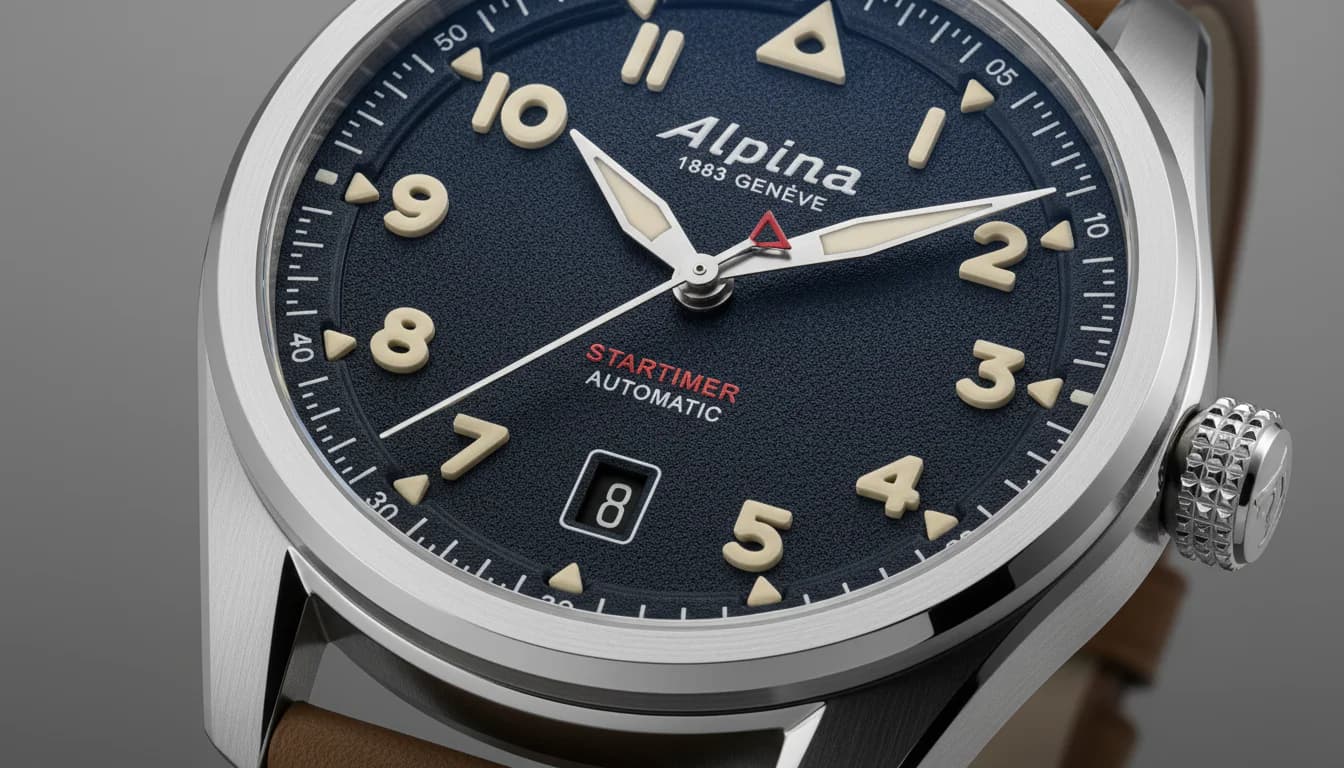
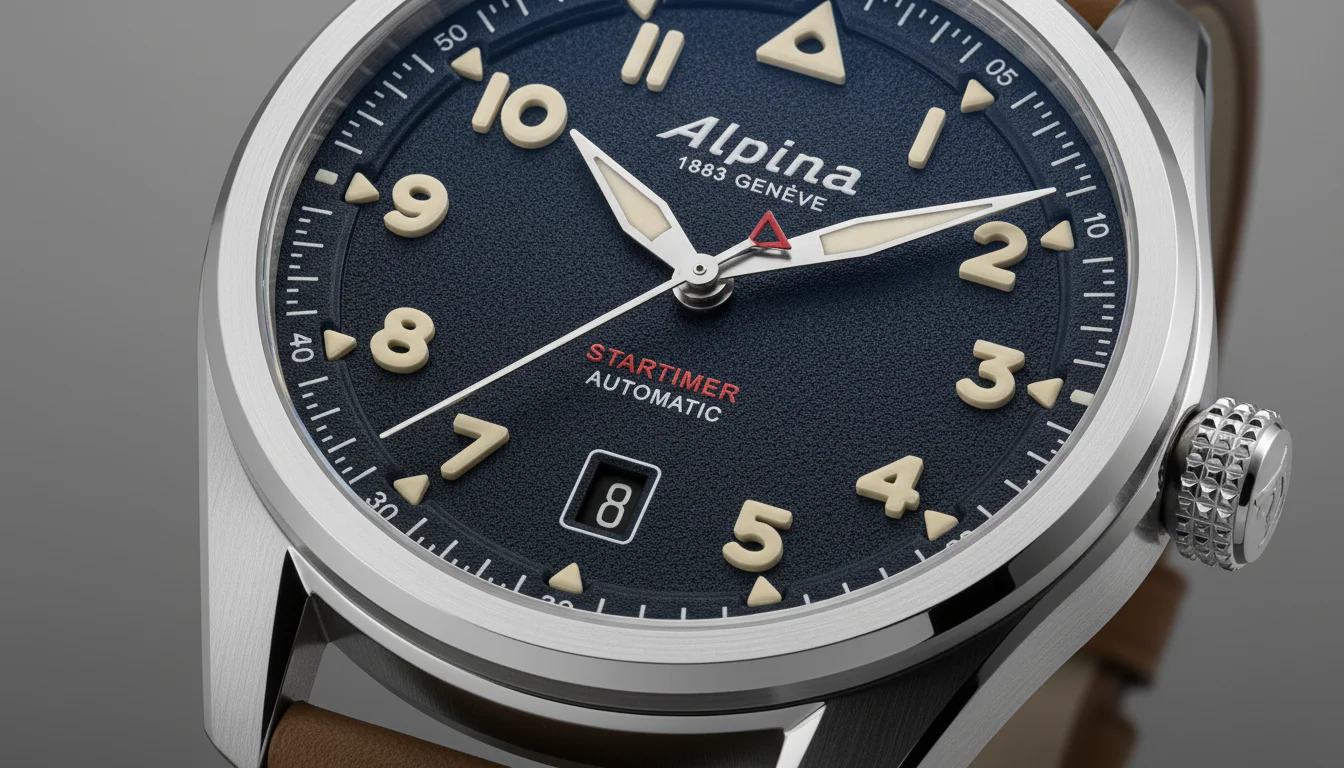 The 2026 Startimer Pilot Automatic refresh trims the case down to 40mm, a size that suits far more wrists than the brand's older 44mm pilot watches.
The watch photos in this article were generated with AI image tools, conditioned on real reference photography of Alpina watches so the case shapes, dial layouts, and construction details are accurate to the real watches.
Where Alpina Actually Comes From
Alpina started in 1883 as a cooperative, not a single company. Gottlieb Hauser, a watchmaker from Winterthur, organized independent Swiss watchmakers under the name Schweizerische Uhrmacher-Genossenschaft, later called the Union Horlogère. The cooperative moved its headquarters to Biel in 1890, into a movement manufactory owned by member Jacob Straub, and registered the Alpina trademark for calibers in 1901. The brand did not put that name on finished watches, alongside its red triangle emblem, until 1908.
That standard became real in 1938 with the Alpina 4, a sports watch that required every alliance member to build cases meeting four criteria at once: anti-magnetic, shock-resistant, water-resistant, and stainless steel. No single spec was new by 1938, but requiring all four together, across an entire alliance of brands, was. A decade later, in 1948, the Biel cantonal watchmaking school chose Alpina's caliber 592 as its teaching movement, which says something about how seriously the trade took Alpina's engineering at the time.
Who Owns Alpina Now
Alpina today is not independent. Peter and Aletta Stas, the founders of Frédérique Constant, acquired Alpina in 2002 and folded it into their group alongside Ateliers deMonaco. Citizen Watch Co. of Japan bought the entire Frédérique Constant Group, Alpina included, on May 26, 2016, and kept the Stas founders in executive roles rather than replacing them. That makes Alpina a Swiss brand with Japanese corporate ownership, which is a common enough structure in the industry but worth knowing before assuming this is a scrappy independent.
The Current Lineup: Startimer
Startimer is Alpina's pilot watch line, and it splits into two clear tiers. The Startimer Pilot Automatic got a 2026 refresh at Watches and Wonders, slimming the case to 40mm by 10.14mm with 20mm lugs, 100 meters of water resistance, and a choice of steel or black PVD. It runs Caliber AL-525, built on a La Joux-Perret base movement according to Monochrome's reporting on the refresh. Pricing lands at EUR 1,295 in steel and EUR 1,395 in PVD.
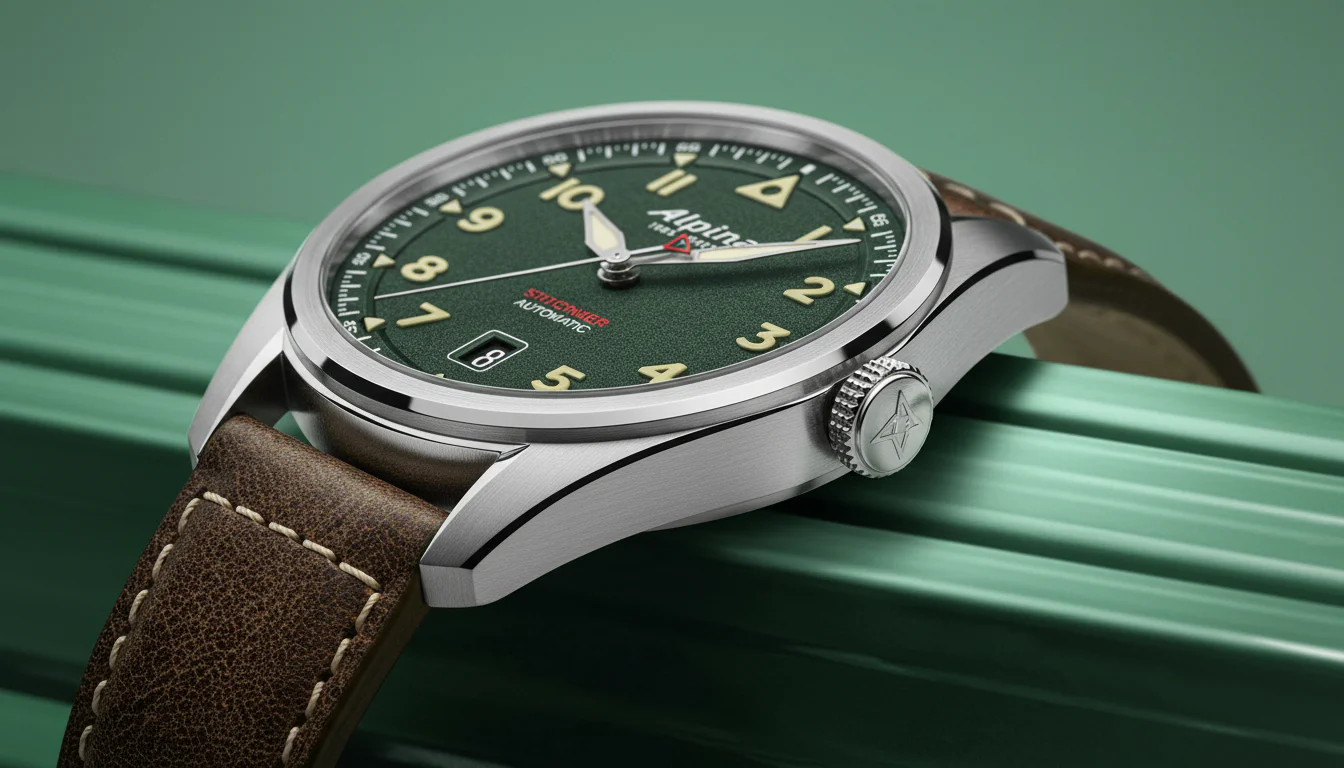 The 2026 refresh keeps the same pilot-watch DNA in a noticeably slimmer case.
One step up sits the Startimer Pilot Manufacture, a larger 44mm case (53mm lug-to-lug, 13.5mm thick) built around the in-house Caliber AL-710, a 26-jewel movement Alpina actually makes rather than sources. That watch runs $2,550.
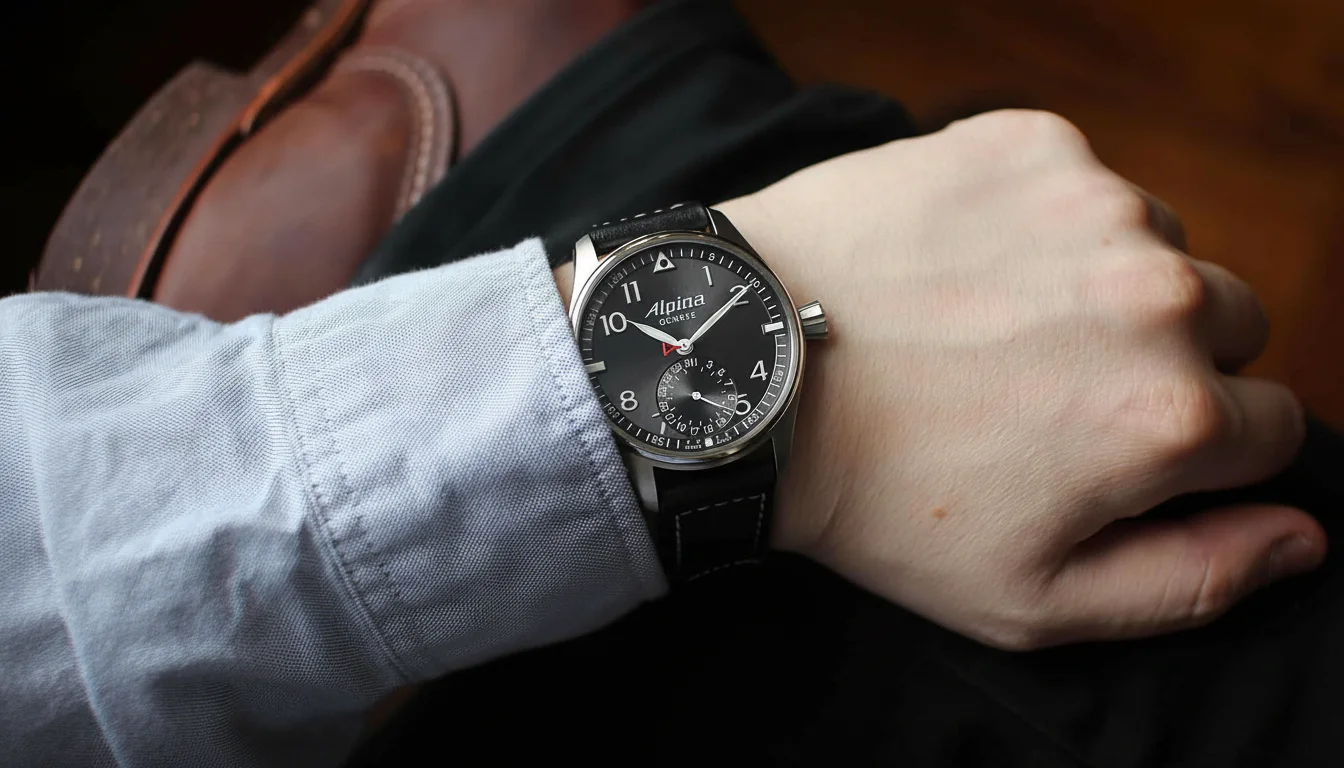 The pointer-date subdial is a genuine complication, not a styling flourish, and it is one of the nicer details in the Manufacture line.
Inside the Manufacture Movement
Flip the Startimer Pilot Manufacture over and the caseback tells the real story: a display back engraved with the model name, water resistance, and case reference, showing off a movement Alpina actually builds rather than buys from ETA or Sellita. That distinction matters to a certain kind of buyer, and it is the strongest argument for paying the premium over the base Automatic line.
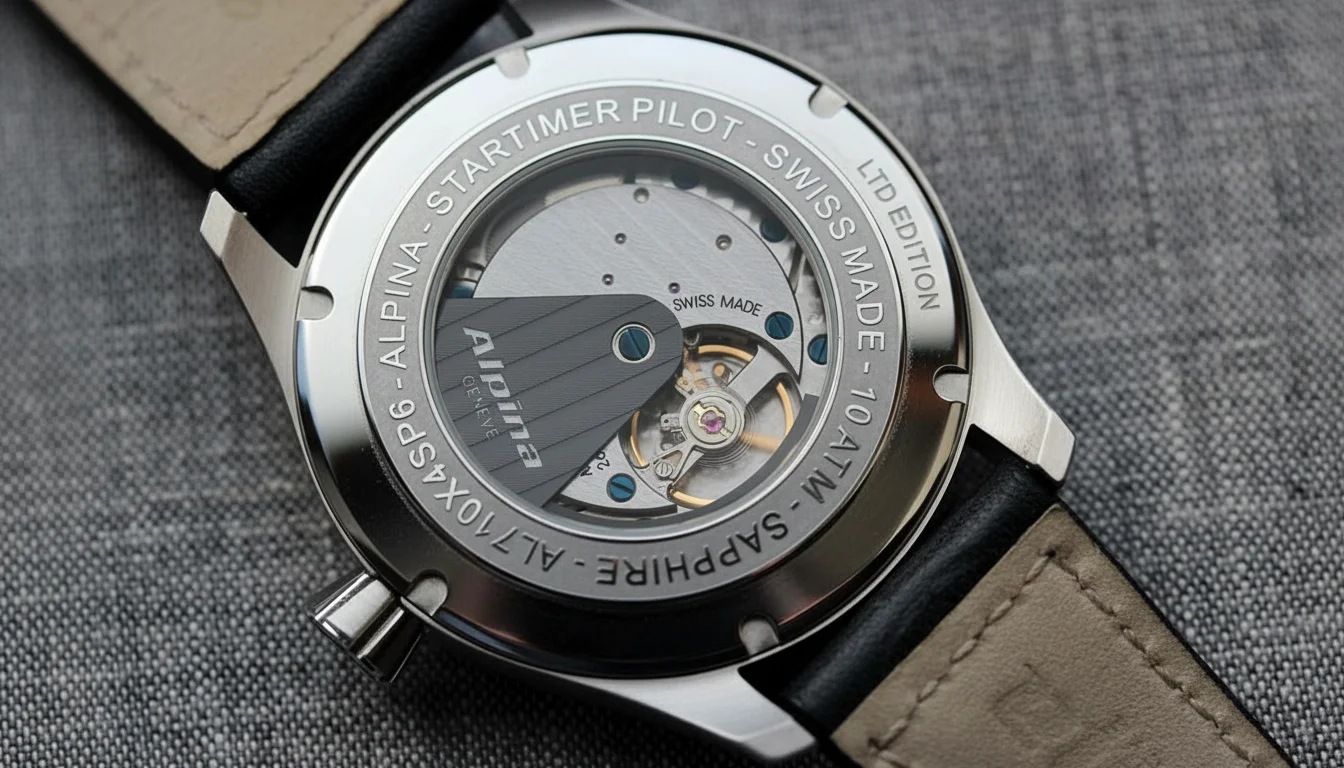 An in-house movement worth showing off, engraved rotor included.
The Alpiner Line: Sport and Integrated Bracelets
Where Startimer chases classic pilot-watch styling, Alpiner goes after the integrated-bracelet sport watch look that has dominated the category since Genta's original designs. The Alpiner Extreme Automatic runs $2,295, with an Extreme Regulator Automatic limited edition at $2,495, both featuring the octagonal bezel and cushion case that reads instantly as belonging to this specific design language.
In February 2026, Alpina released the Alpiner x Label Noir Manufacture Date, a 41.5mm by 13mm limited edition of 130 pieces at EUR 3,695. It runs the in-house Caliber AL-706, which holds a 72-hour power reserve, the longest in Alpina's current lineup.
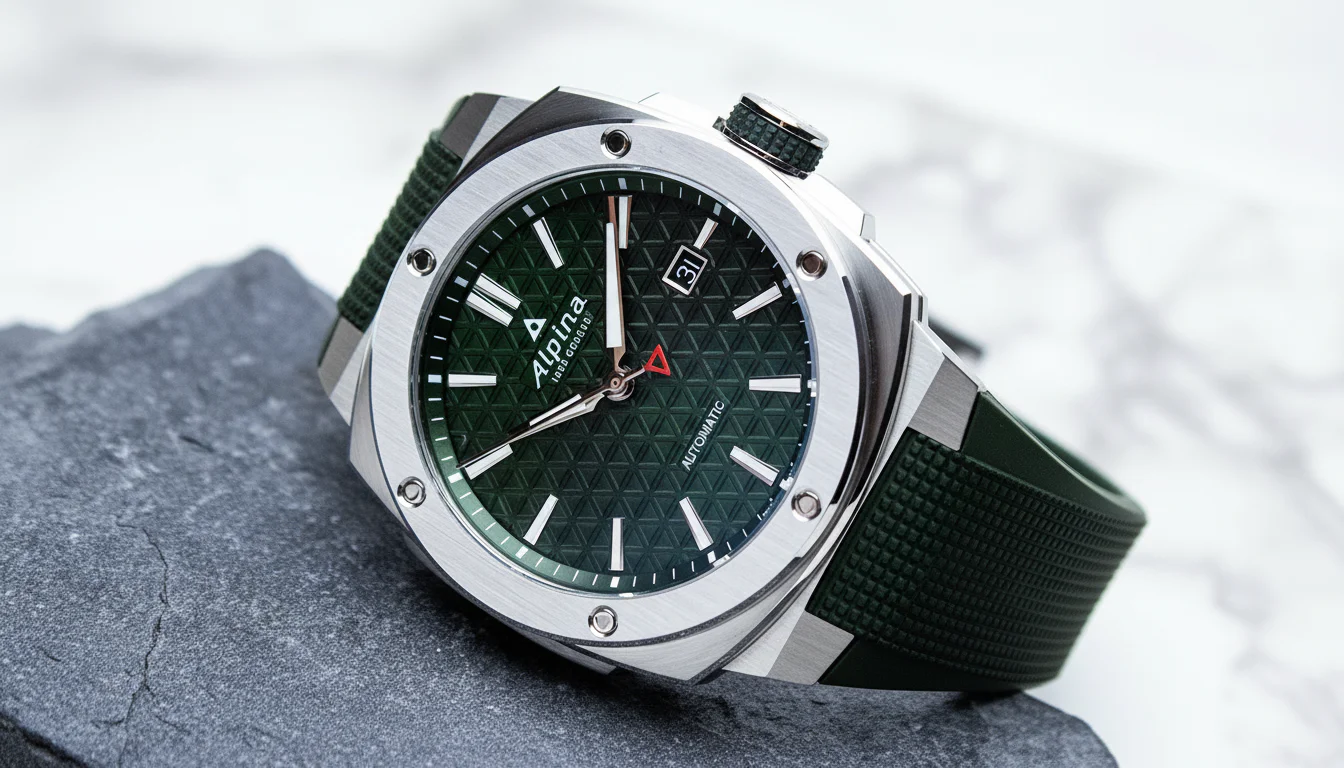 The Alpiner Extreme trades pilot-watch heritage for the integrated-bracelet sport look, and it wears the part convincingly.
Across the broader Alpiner and Startimer ranges, expect roughly $800 to $2,000 for Alpiner references and $600 to $1,500 for Startimer references, with case sizes typically running 42 to 44mm outside the newly slimmed 2026 Pilot Automatic.
Where the Lineup Falls Short
An honest guide has to cover what a buyer gives up, and Alpina has a few real issues worth knowing before ordering one.
The biggest one is design originality. Worn & Wound's review of the Startimer Pilot Manufacture put it plainly: at a glance, it looks like an IWC. Alpina is not alone in building pilot watches that echo the Big Pilot silhouette, but the resemblance is close enough that it shapes how the watch reads on the wrist, for better or worse depending on what a buyer wants.
That same review flagged a second issue: the $2,550 in-house Manufacture model shares its case and dial design with Sellita-equipped models costing roughly $1,200 less. If the movement is the only meaningful difference between two watches that look nearly identical, that is a genuine self-cannibalization problem for Alpina's own lineup, not just a marketing quirk.
Smaller complaints show up consistently across owner reports: dim or spotty lume on the applied numerals, occasional user reports of crown cross-threading on models with internally threaded crowns, and case sizing that sits at 42 to 44mm across much of the range, less than ideal for smaller wrists even as the 2026 Startimer refresh moves in the right direction.
Should You Buy One
Alpina makes sense for a buyer who wants genuine Swiss engineering, including a real in-house movement option, at a price well under what IWC or a comparable haute horlogerie brand would charge, and who is not bothered by design language that echoes bigger names. It makes less sense for a buyer who wants a design identity entirely its own, or who needs a smaller case than most of the current lineup offers.
FAQ
Who owns Alpina watches?
Citizen Watch Co. of Japan owns Alpina through its ownership of the Frédérique Constant Group, which acquired Alpina in 2002 under founders Peter and Aletta Stas. Citizen bought the full group, Alpina included, in May 2016.
What is Alpina's history?
Alpina started in 1883 as a cooperative of independent Swiss watchmakers called the Union Horlogère, based in Winterthur before moving to Biel in 1890. It registered the Alpina name in 1901 and put it on finished watches starting in 1908.
Does Alpina make its own movements?
Some models. The Startimer Pilot Manufacture uses the in-house Caliber AL-710, and the Alpiner x Label Noir Manufacture Date uses the in-house Caliber AL-706. Other models, like the base Startimer Pilot Automatic, use outsourced base movements.
How much do Alpina watches cost?
Roughly $600 to $1,500 for Startimer references and $800 to $2,000 for Alpiner references, with limited editions like the Alpiner x Label Noir Manufacture Date reaching EUR 3,695.
Is the Alpina Startimer Pilot Manufacture worth the price over the Automatic?
Only if an in-house movement matters to you specifically. Reviewers have noted the Manufacture model shares its case and dial design with cheaper Sellita-equipped models, so the price difference buys movement pedigree rather than a meaningfully different watch.