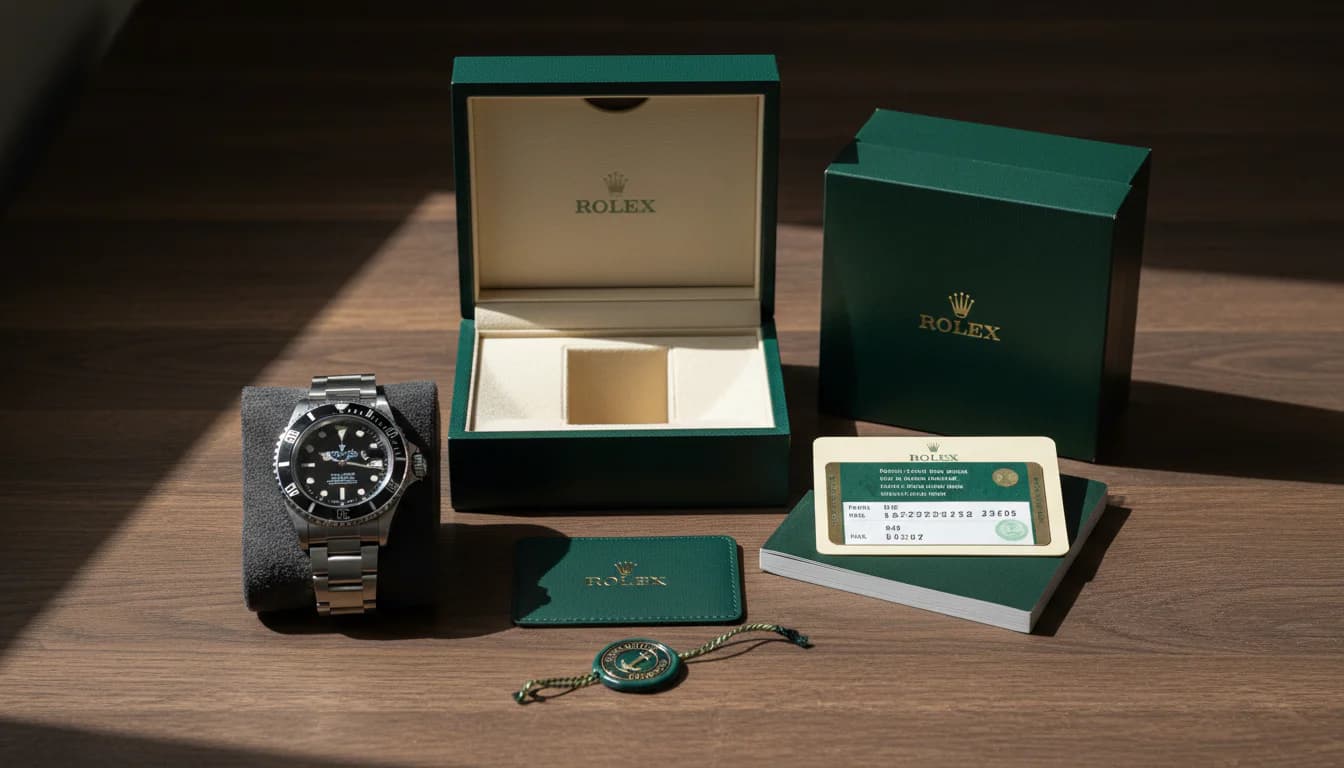
"Box and papers" is the most-asked question in pre-owned watch listings and one of the most misunderstood factors in pre-owned pricing. Buyers know the phrase adds value. Most do not know the actual premium, what the documents are doing for the watch, or when paying for them is rational versus when it is not.
Here is the working dealer's breakdown.
All images in this post are AI-generated and may not perfectly represent the actual watch references discussed. They are intended for illustration only.
The short answer
A pre-owned luxury watch with its original box and papers typically trades 10 to 25% above the same watch sold "naked" (watch only). The premium is highest on hyped sport references, lowest on dress watches and high-volume models. It also reflects faster sale turnover: full-set watches sell roughly 13% faster than naked equivalents per Chrono24 data.
For most buyers, paying the premium for box and papers is rational on serious sport references and overrated on entry-level dress watches.
What "box and papers" actually means
The phrase is shorthand for the watch's complete original presentation package as it left the authorized dealer. The full term collectors use is "full set." A genuine full set typically includes:
- Warranty card or chronometer certificate (the most important item by a meaningful margin)
- Outer cardboard sleeve (the protective sleeve over the inner box)
- Inner presentation box (the leather-covered green box for Rolex; varies by brand)
- Hangtags and anchor card (the small swing-tag with reference and serial)
- Owner's booklet or instruction manual (brand-specific operating guide)
- Original receipt (when present, often the most provenance-rich document)
- Service records (papers from any service work performed)
The warranty card and the original receipt do the most pricing work. The box, while visible in listings and visually compelling, weighs less in dealer assessment than buyers typically assume.
The pricing premium by category
Here is what the box-and-papers premium looks like across watch categories in May 2026.
| Category | Typical premium |
|---|---|
| Hyped steel sport (Submariner, GMT, Daytona) | 15 to 25% |
| Standard sport (Explorer, Datejust 41 sport variants) | 10 to 18% |
| Dress watches (Datejust 36, Cellini, Cartier Tank) | 5 to 12% |
| Limited editions and rare references | 20 to 40% |
| Vintage references (50+ years old) | 25 to 100%+ |
Per Diamond Banc's analysis of Rolex full-set premiums, the premium is consistently 10 to 20% on average across the Rolex catalog and significantly higher on collectible vintage references.
Specific examples that illustrate the range:
- A pre-ceramic Rolex Submariner reference 16610 typically costs 17.8% more with full set than naked
- A pre-ceramic GMT-Master II 16710 Pepsi typically costs 23.3% more with full set
- A Cartier Santos 100XL 2656 typically costs 20.8% more with full set
- An Explorer 36 reference 124270 trades around $6,000 to $7,500 watch only vs $7,000 to $8,500 with papers (roughly 14 to 16%)
The pattern is consistent: the more collectible the reference, the larger the box-and-papers premium.
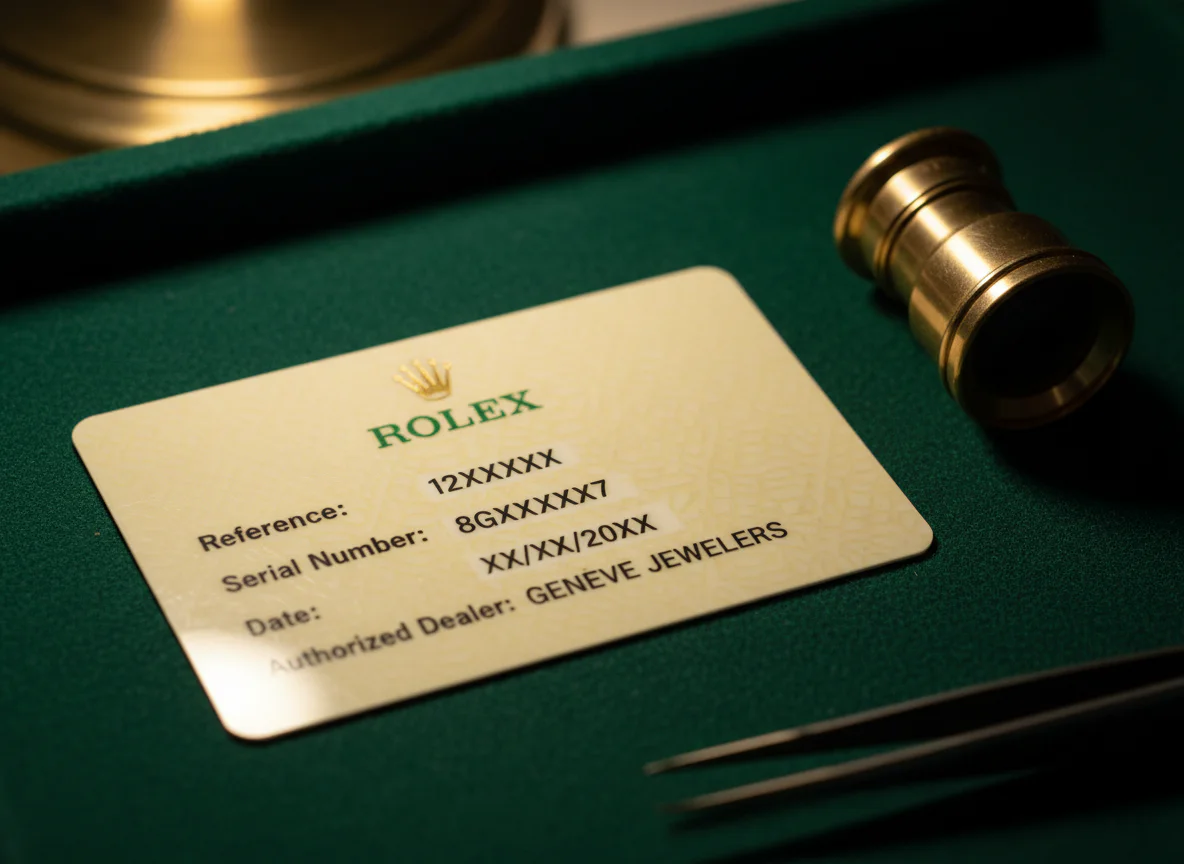 The warranty card. The single most important piece of documentation in a full set, and the item dealers verify most carefully.
Why the premium exists
Three things justify the box-and-papers premium, in descending order of importance.
Authentication confidence
The warranty card with matching reference and serial numbers is the strongest single piece of authentication evidence available outside of dealer service records. It establishes that the watch was sold as a genuine reference by an authorized dealer on a specific date. Combined with a watch whose case and movement match those numbers, the documentation closes most of the authentication question before a loupe ever comes out.
This matters more in 2026 than it did 10 years ago. Counterfeit watches have improved meaningfully, with high-quality "superclones" passing visual inspection on watches that fooled experienced buyers a decade ago. Documentation provides what a visual inspection cannot.
Provenance and ownership history
The original receipt (when present) tells you where and when the watch was first sold, often by which dealer, and sometimes to whom. For collectible references, this provenance can add meaningful price and historical interest. Service records add a parallel layer: every authorized service is documented, which functions as both a maintenance history and an ongoing authenticity verification.
Liquidity and resale
A watch with full set is easier to sell. Per the Chrono24 magazine analysis, full-set watches sell roughly 13% faster than naked ones on the platform. Faster turnover at higher prices is, structurally, a better asset. Buyers with full sets can typically command better trade-in values when stepping into the next watch.
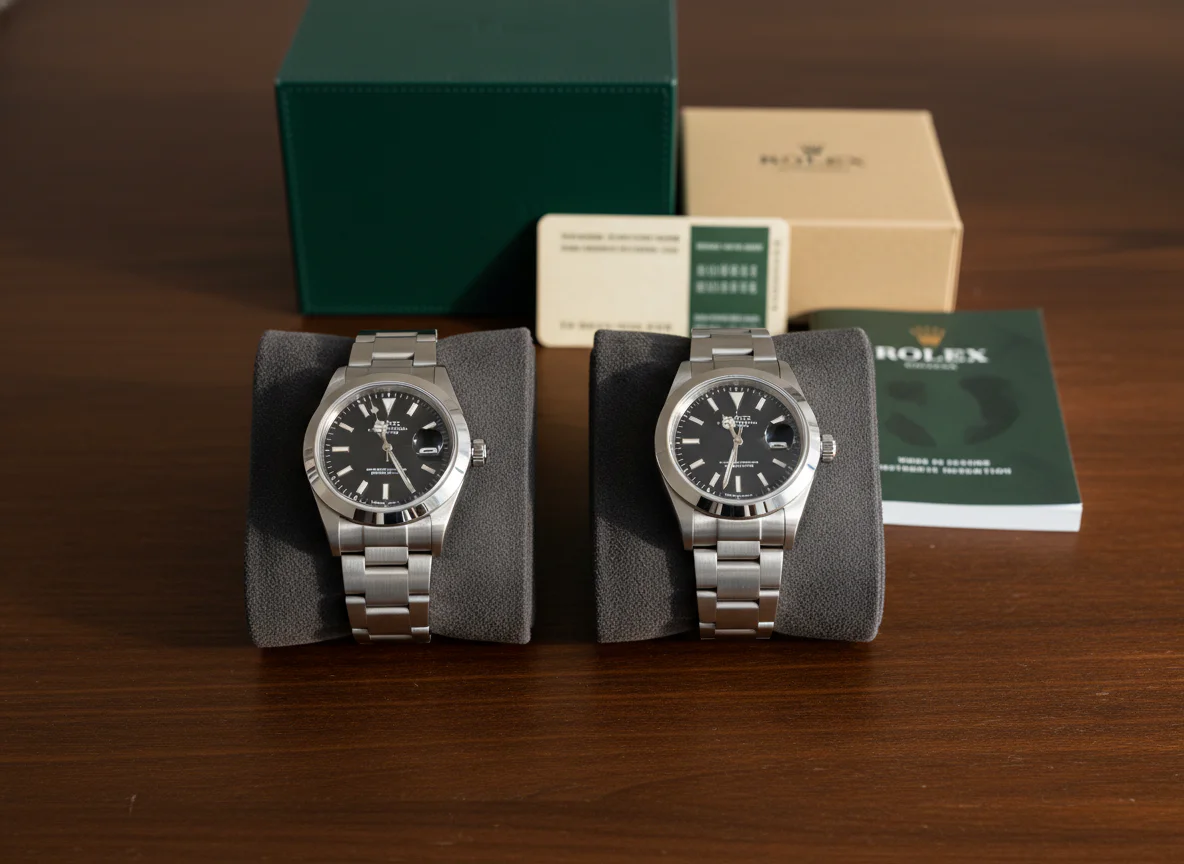 Two identical watches, one with full set, one naked. Same reference, same condition, different price brackets.
What the premium is NOT doing
A few honest clarifications.
The box is not authenticating the watch on its own. Boxes can be sourced separately. Empty Rolex boxes trade on the secondary market for $200 to $600 depending on era. A box without papers is not a full set, and a watch with a box but no warranty card is closer to "naked" than to "full set" in dealer assessment.
The papers are not a guarantee that nothing has been replaced. Documentation establishes the watch's identity and original sale, not the originality of every component. A watch with full set papers can still have a service-replaced dial, hands, or bezel insert. See our authentication primer for what physical inspection adds.
Old papers on an old watch are worth less than recent papers on a recent watch. A 1985 warranty card establishes provenance to that era, which is valuable. A 2023 warranty card on a 2023-purchased watch is worth meaningfully more in pricing because the premium for newness compounds with the premium for documentation.
The premium is not constant across markets. A dealer in a tight US market may price a full set at a 20% premium. A private seller on a forum may price the same configuration at a 10% premium. The box-and-papers price gap is wider through professional channels because professional buyers trade more on documentation.
When the date on the card matters
The single most underdiscussed aspect of warranty cards is the date stamp.
For new and recent references (less than five years old), the warranty card's date establishes how much factory warranty time remains. Most modern luxury watch warranties are five years from the original sale date. A 2025-card watch retains four years of warranty coverage. A 2018-card watch on the same reference has zero warranty time left.
This time-on-the-card calculation moves the premium meaningfully. A current-production reference with full set and 4+ years of remaining warranty trades at the high end of the range. A current-production reference with full set but expired warranty trades closer to the middle of the range.
For vintage references (15+ years old), the card's date is purely provenance. Warranty coverage is irrelevant; the card simply establishes when and where the watch was first sold.
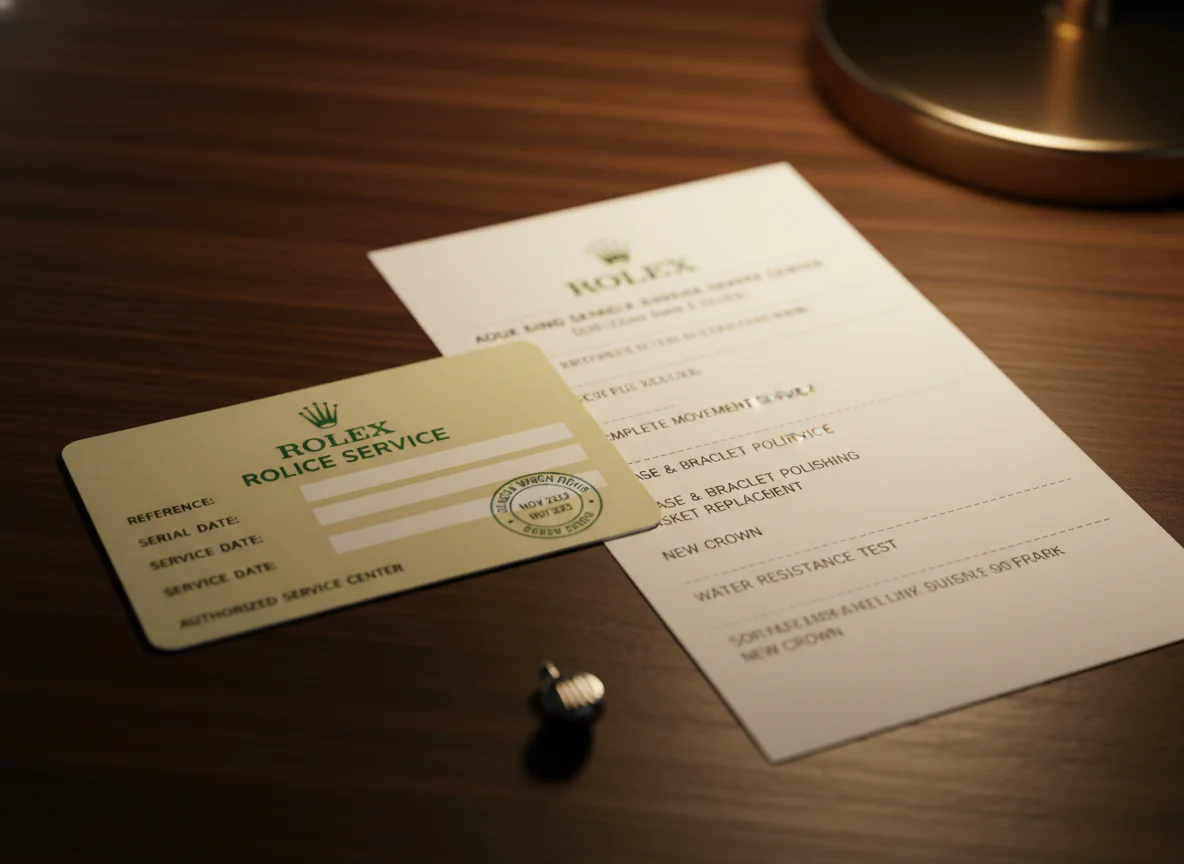 ,
Service cards and service receipts function as secondary documentation. Authorized service work is recorded, which adds verification value if original papers are missing.
,
Service cards and service receipts function as secondary documentation. Authorized service work is recorded, which adds verification value if original papers are missing.
When papers are missing: the service card workaround
Original papers get lost. Watches change hands across decades, get inherited, get repacked into different boxes, get sold at estate sales without their documentation. A meaningful portion of the pre-owned market consists of genuine watches with no original papers.
For these watches, a recent authorized service card functions as the new documentation. Brand authorized service centers will not service a counterfeit or heavily modified watch. The existence of a recent service receipt from a Rolex Service Center, an Omega service center, or a Patek Philippe service center is, in dealer terms, the new proof of authenticity.
A naked watch with a recent authorized service card trades meaningfully closer to a full-set price than a naked watch with no documentation at all. Not all the way there, but closer.
When to skip paying the premium
Three scenarios where naked is the smarter buy.
When the watch is for wearing, not trading
If you are buying a watch you intend to wear for a decade and not flip, the resale liquidity benefit of a full set matters less. A naked Datejust at $5,500 is a $5,500 watch on the wrist for the next 10 years. The same watch with full set at $6,500 is functionally identical on the wrist. The $1,000 saved is real money for a buyer who is not optimizing for resale.
When the dealer's authentication is solid
A reputable pre-owned dealer with a strong authentication process and warranty effectively replaces some of the function that original papers provide. Their authentication and guarantee is the verification. Buying naked from a dealer with a 2-year authentication warranty is meaningfully different from buying naked from a private seller on a forum.
When the savings outweigh the trade-in math
Calculate the premium against your expected ownership horizon. A 15% box-and-papers premium on a $10,000 watch is $1,500. If you plan to own the watch for 8 years and the premium will translate to roughly the same percentage on resale, the math is essentially neutral, with a slight edge to having papers due to faster sale time. If you plan to own forever, the premium is pure overhead.
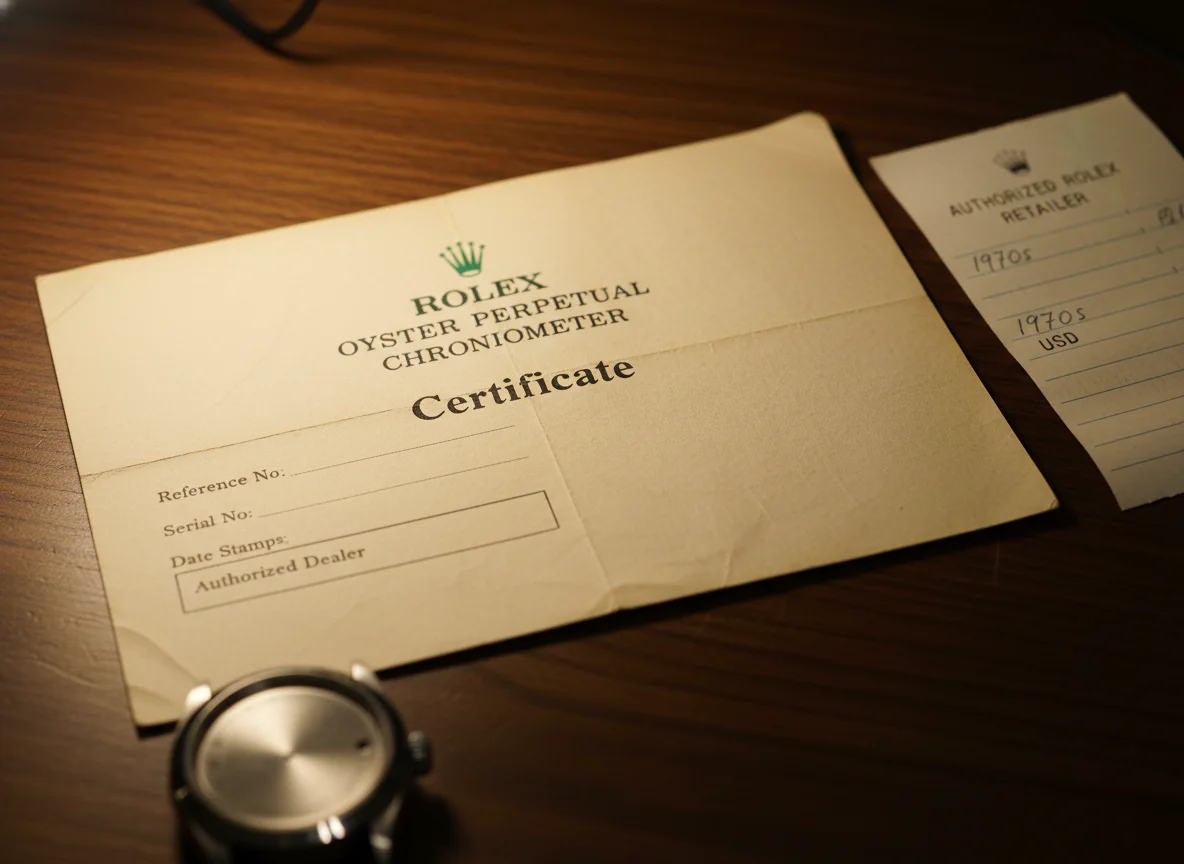 Vintage paper documentation. For watches 30+ years old, the original chronometer certificate provides provenance that money cannot easily replace.
What dealer authentication actually adds
At 5D Watches, every pre-owned watch is examined under loupe magnification, photographed in detail, and assessed against verified period reference imagery before listing. We disclose what is original and what has been service-replaced. We document what comes in the package and what does not.
A dealer warranty does not replace the historical and provenance value of original papers. It does meaningfully reduce the authentication risk of buying a naked watch. For buyers without a strong personal authentication background, working with a dealer who guarantees the watch is closer to having papers than buying naked from a private seller would be.
The 30-second pre-purchase checklist for box and papers
Before you pay the box-and-papers premium:
- Verify the warranty card's reference and serial match the watch. Numbers should match exactly. If they do not, the card is for a different watch.
- Check the dealer stamp on the card. Authorized dealer stamps should be legible. If the stamp is illegible or missing, ask why.
- Note the date on the card. Recent papers add more value than old papers on a recent watch. Confirm the warranty time remaining if applicable.
- Compare the documentation set to the brand's typical full-set contents for that reference and era. Anything missing should be disclosed by the seller.
- Examine the box for authenticity wear. A box that looks like new on a watch that does not is a flag. Boxes age.
- Ask whether service papers are included. If the watch has been serviced by an authorized service center, those records add documentation and authentication value.
If the seller hesitates on any of these checks, the premium is not justified.
Bottom line
Box and papers add 10 to 25% on most modern pre-owned luxury watches and meaningfully more on vintage and collectible references. The premium is real, and it is not arbitrary. It reflects authentication confidence, provenance, and liquidity advantages that all flow through to actual resale dynamics.
Whether to pay the premium depends on your ownership horizon, your authentication risk tolerance, and the specific reference. For collectible sport references, full set is almost always worth it. For wear-it-and-keep-it dress watches, naked from a reputable dealer is often the smarter play.
For broader pre-owned context, see our Frankenwatch authentication primer and our first luxury watch buyer's roadmap.
Browse authenticated pre-owned Rolex, pre-owned Omega, pre-owned Tudor, and other authenticated luxury watches at 5dwatches.com.