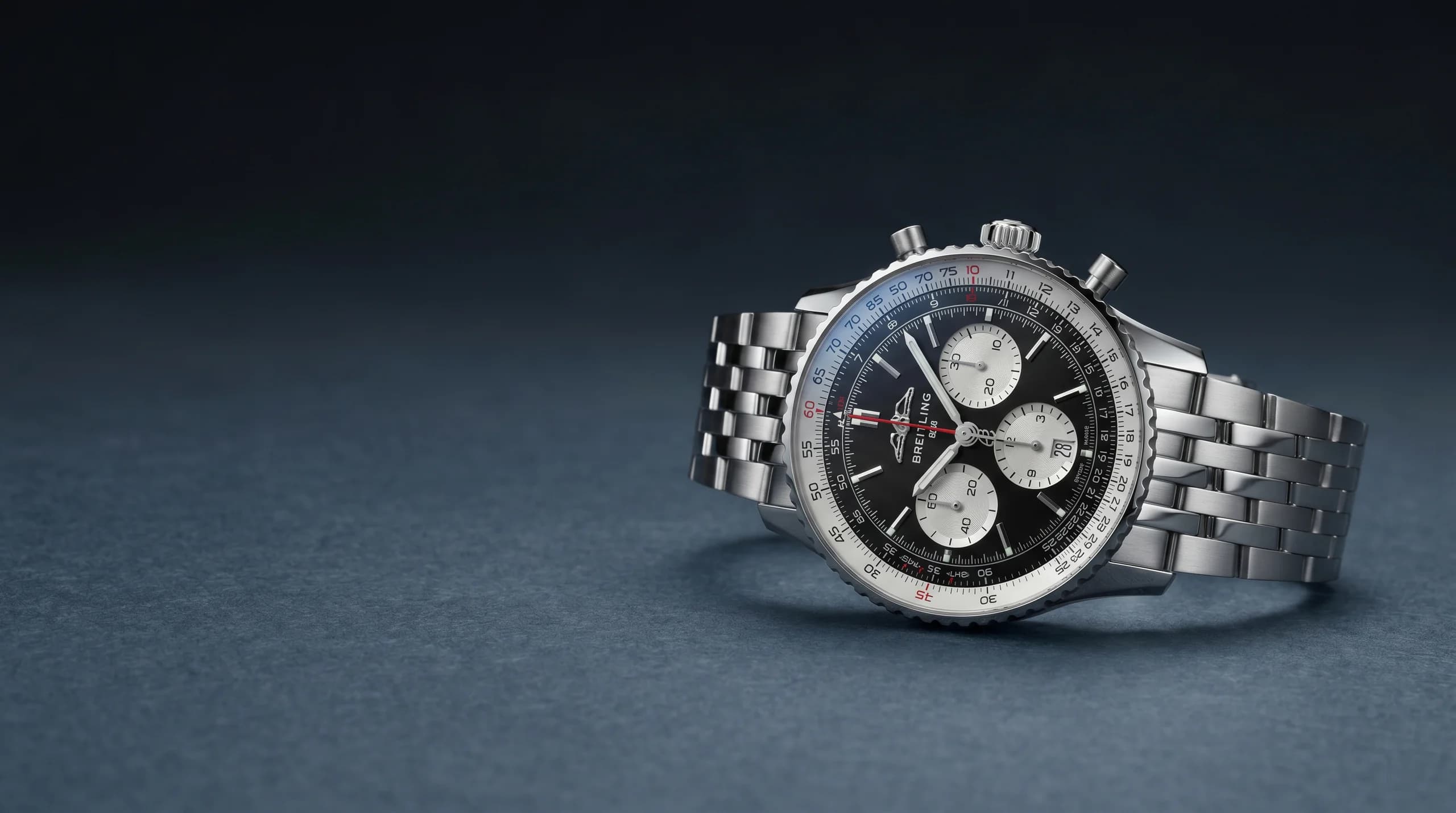
The Breitling Navitimer is the watch that taught a wristwatch to do math. Introduced in 1952 as the first wrist-worn aviation computer, adopted by airline pilots and astronauts, and the first Swiss watch worn in space when Scott Carpenter took the Cosmonaute aboard Aurora 7 in 1962. The modern Navitimer catalog spans from a $4,950 three-hand Automatic 35 up to the new $11,900 Cosmonaute Artemis II with a galaxy-blue meteorite dial that just returned from a lunar flyby on the wrists of NASA's Artemis II crew.
This guide covers every modern Navitimer worth knowing, the current 2026 releases, what the pre-owned market actually charges, and which configuration suits which buyer.
All images in this post are AI-generated and may not perfectly represent the actual watch references discussed. They are intended for illustration only.
The Short Answer
The Navitimer is a wide family with a clear hierarchy. The defensible decisions:
- For the iconic Navitimer experience: The B01 Chronograph 43 AB0138 at ~$9,100 retail / ~$6,500 pre-owned. The volume reference, full slide rule bezel, in-house calibre 01.
- For the smaller proportion: The B01 Chronograph 41 AB0139 at ~$8,800 retail / ~$5,500 pre-owned. Same movement, more wearable case.
- For the long-haul collector piece: The B02 Chronograph 41 Cosmonaute Artemis II at $11,900 retail, 450 pieces, galaxy-blue meteorite dial, the 2026 limited edition with the strongest news hook in the family.
- For the non-chronograph entry: The Navitimer Automatic 41 A17326 at ~$4,950 retail / ~$3,500-3,800 pre-owned. Three-hand, no slide rule bezel calculations, the modern alternative to a dressier Breitling.
The Navitimer is one of the only sub-$10,000 in-house chronographs with both legitimate aviation heritage and a genuine space-flight pedigree. The Speedmaster gets most of the space credit. The Cosmonaute got there earlier, and it just went back.
The Navitimer in 90 Seconds
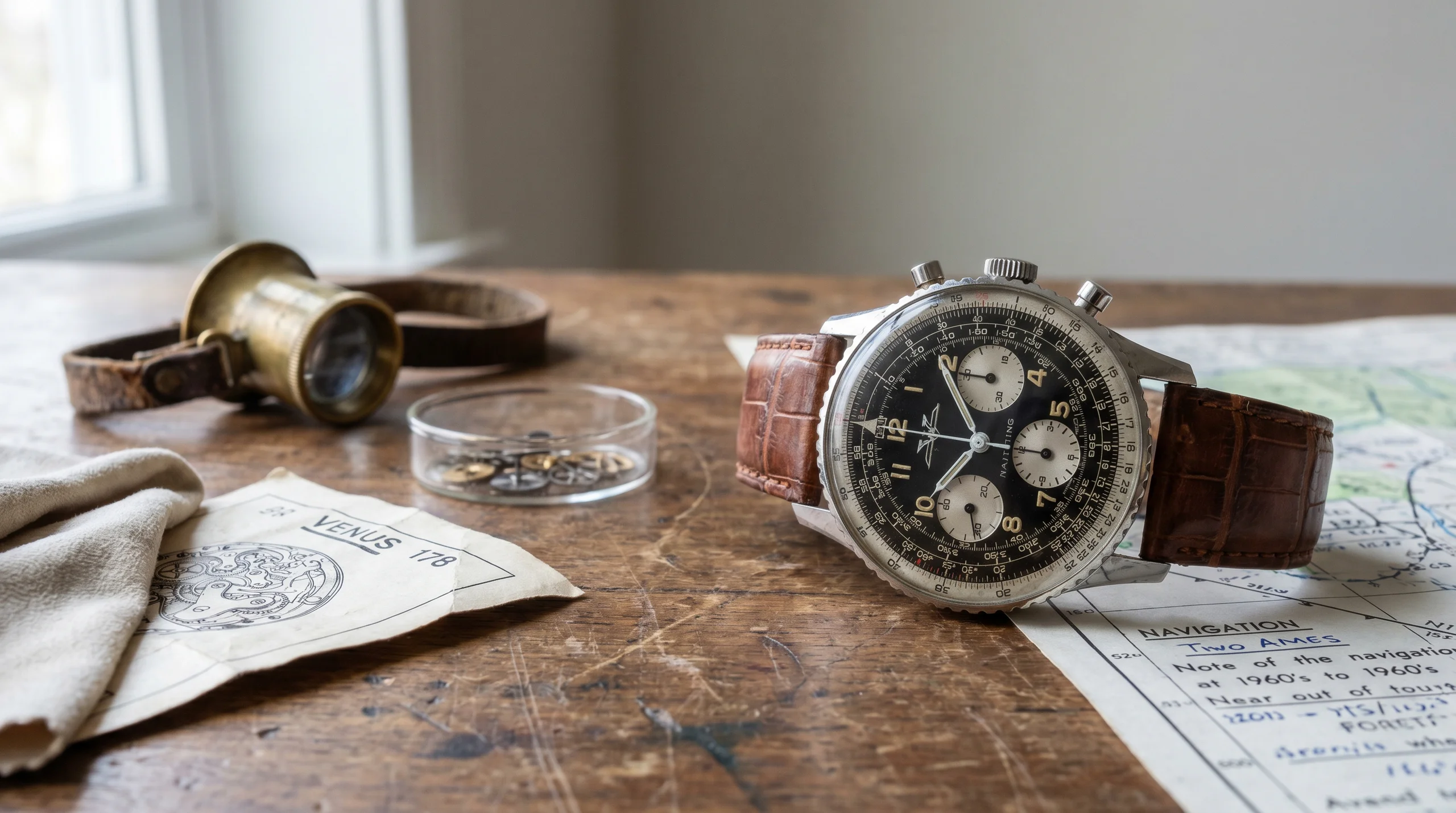 The original 1962 Navitimer reference 806 with the twin-planes dial logo and the Venus 178 manual-wind chronograph movement. Reference 806 ran from 1953 to 1969 and is the foundation reference every modern Navitimer descends from.
The Navitimer launched in 1952 at the request of the Aircraft Owners and Pilots Association (AOPA). The brief was specific: pilots needed a wristwatch that could calculate flight time, fuel burn, ground speed, distance, unit conversions, and short multiplications without taking their hands off the controls or pulling out a separate flight computer.
Breitling's solution was a rotating bezel printed with a logarithmic circular slide rule, paired with a chronograph for stopwatch functions. The watch could perform the same calculations as the standard E6B "whiz wheel" flight computer that every pilot of the era already carried, integrated into a wristwatch.
The Navitimer was adopted by airline pilots, military aviators, and eventually astronauts. In 1962, astronaut Scott Carpenter took a specially modified Navitimer aboard Aurora 7 during the Mercury-Atlas 7 mission. Carpenter's version had a 24-hour scale instead of the standard 12-hour layout, because in orbit there is no day-night cycle to anchor time perception. That watch became known as the Cosmonaute and was the first Swiss wristwatch worn in space.
Through the 1960s, John Glenn (first American to orbit Earth) and James McDivitt (Gemini 4 and Apollo 9 commander) also wore Navitimers. The Navitimer is the only chronograph other than the Speedmaster with a documented Apollo-era spaceflight history.
In 2026, the connection came full circle. All four crew members of NASA's Artemis II lunar flyby mission were spotted wearing the new Cosmonaute Artemis II reference during the mission. Hypebeast's coverage called it "a major organic marketing win" for Breitling.
The Modern Navitimer Lineup at a Glance
| Reference family | Size | Movement | Retail (USD) |
|---|---|---|---|
| A17326 Navitimer Automatic 41 | 41mm x 12.0mm | Breitling 17 (auto, 38h) | ~$4,950 |
| AB0139 Navitimer B01 Chronograph 41 | 41mm x 13.6mm | Breitling 01 (auto, 70h) | ~$8,800 |
| AB0138 Navitimer B01 Chronograph 43 | 43mm x 13.6mm | Breitling 01 (auto, 70h) | ~$9,100 |
| AB0127 Navitimer B01 Chronograph 46 | 46mm x 14.7mm | Breitling 01 (auto, 70h) | ~$9,300 |
| UB0127 Navitimer B01 Chronograph 46 two-tone | 46mm x 14.7mm | Breitling 01 (auto, 70h) | ~$13,500 |
| RB0137 Navitimer B01 Chronograph 46 rose gold | 46mm x 14.7mm | Breitling 01 (auto, 70h) | ~$22,400 |
| AB02307A1C1P1 Cosmonaute Artemis II | 41mm x 13.0mm | Breitling B02 (manual, 70h) | $11,900 (450 pieces) |
The Breitling reference numbering follows a convention: AB is steel, UB is two-tone steel and gold, RB is rose gold, PB is platinum (rare). The first numerals indicate the case style and movement family.
Navitimer B01 Chronograph 43 AB0138: The Volume Reference
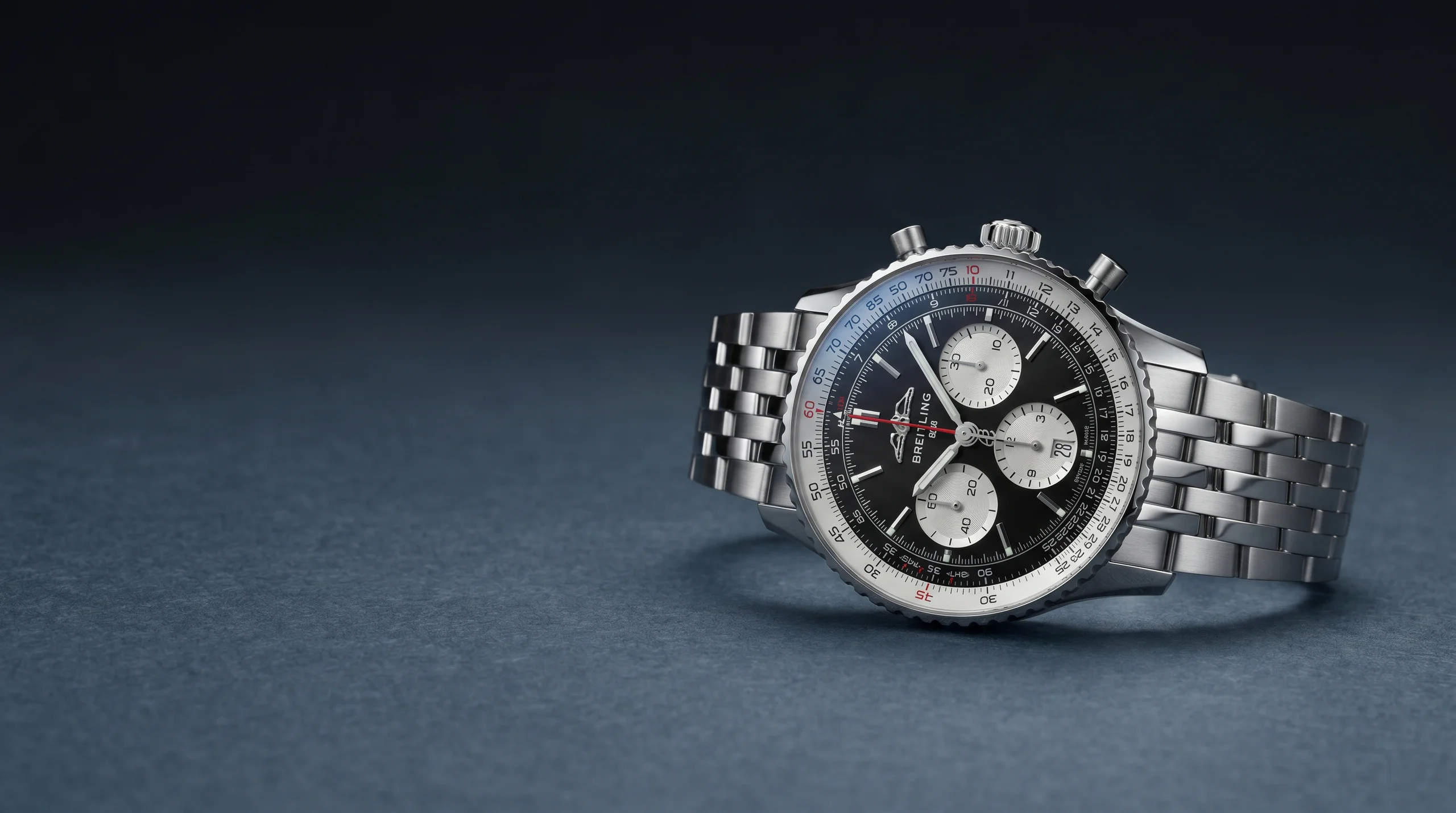 The Navitimer B01 Chronograph 43 AB0138 in steel with black dial. 43mm case, in-house Breitling 01 movement, the seven-row beads-of-rice bracelet, and the iconic circular slide rule bezel that has defined the Navitimer since 1952.
The AB0138 is the core Navitimer in the modern catalog. The reference launched in 2022 as part of Breitling's broader Navitimer refresh under CEO Georges Kern, which standardized the line around the 41mm, 43mm, and 46mm case options and brought the in-house Breitling 01 movement to the entire B01 chronograph family.
What it delivers
The case is 43mm by 13.6mm thick, which sounds large but wears more moderately than the numbers suggest because of the relatively short lug-to-lug distance and the slide rule bezel that adds visual presence without adding case diameter.
The dial is the classical Navitimer tricompax layout: silvered sub-dials with concentric guilloche, the 30-minute counter at 3, the 12-hour counter at 6, and small running seconds at 9. The date window sits at 4:30 to preserve the symmetry of the sub-dials. Applied steel baton hour markers and Arabic numerals carry luminescent fill.
The bracelet is the seven-row beads-of-rice design, which is one of the most distinctive bracelets in production. The intricate bead-link construction is a deliberate callback to the 1950s and 1960s era when this style was widely used. It is one of the few bracelets in modern luxury watchmaking that you can identify from across a room.
Specs and pricing
| Spec | Value |
|---|---|
| Reference | AB0138 (steel) |
| Case | 43mm x 13.6mm, polished and brushed steel |
| Bezel | Bidirectional rotating slide rule (logarithmic circular flight computer) |
| Dial | Black, blue, mint green, copper, or ice blue variants |
| Movement | Breitling 01, in-house automatic, 70h reserve, COSC chronometer |
| Functions | Hours, minutes, seconds, chronograph, date |
| Bracelet | Seven-row beads-of-rice steel, butterfly clasp |
| Retail | ~$9,100 (leather) / ~$9,400 (bracelet) |
| Pre-owned | ~$6,500-$7,500 |
Pre-owned market reality
WatchCharts data tracks the AB0138 in the top 1% of Breitling watches by trading volume, with 118 recorded sales in January 2026 alone. The reference moved up 8.8% over the past year, outperforming the broader Breitling Navitimer index by 7.2 percentage points.
A 2022-2024 AB0138 in box and papers condition with full service history runs $6,500-$7,500 through specialist dealers. The black dial and blue dial variants are the most liquid. The mint green and copper variants run a small premium because production runs were tighter.
This is one of the better value propositions in current sub-$10,000 chronograph territory. You get a genuine in-house movement, 70-hour power reserve, COSC chronometer certification, and aviation heritage that traces directly to 1952. The Speedmaster Hesalite at a similar pre-owned price point gives you a hand-wound movement and Moon heritage, but no in-house automatic and no integrated date.
Our Omega Speedmaster Professional vs Rolex Daytona breakdown covers the broader chronograph decision matrix at this price tier.
Navitimer B01 Chronograph 41 AB0139: The Smaller Sibling
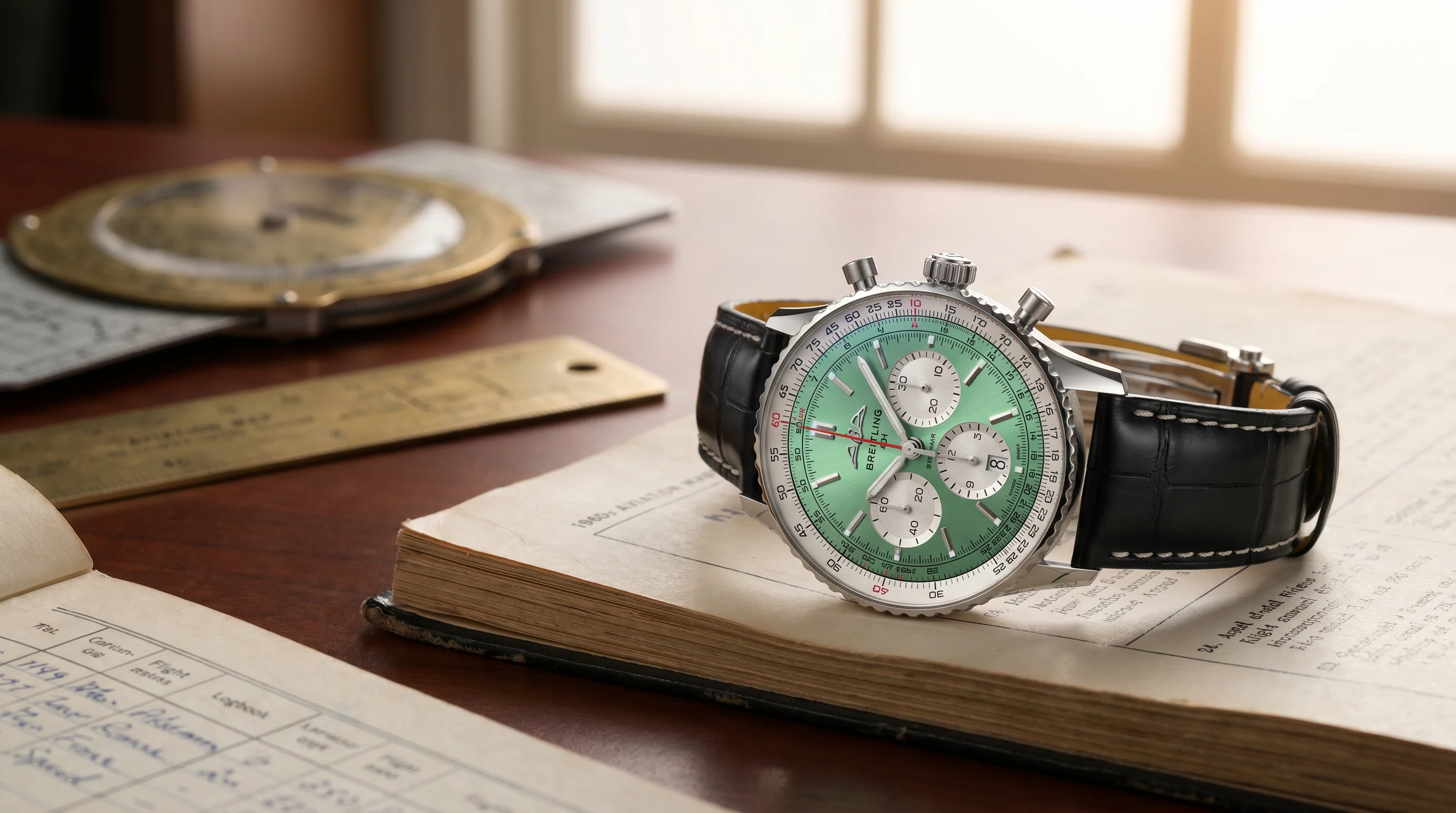 The Navitimer B01 Chronograph 41 AB0139 in mint green. Same movement and slide rule architecture as the 43mm version, in a more wearable 41mm case. The mint green and copper dial variants have been the most successful new colorways in the post-2022 catalog refresh.
The AB0139 is the 41mm version of the B01 Chronograph. The case dimensions are the only meaningful difference from the AB0138. Same Breitling 01 movement, same slide rule bezel, same dial architecture, same sub-dial layout.
The case is 41mm by 13.6mm. Lug-to-lug is approximately 50mm, which fits a 6.5-inch to 7.5-inch wrist comfortably. For buyers who find the 43mm AB0138 too large, this is the answer that does not require giving up any movement or design content.
Why the 41 outperforms the 43 secondary market
Two reasons. The 41mm dimensions match the proportions of the most desirable vintage Navitimer references (the 806 and 7806 ran at approximately 41mm). The smaller case reads more correctly within the Navitimer's design heritage.
Second is wrist fit. The 41mm fits a wider range of wrists than the 43mm. Buyers who would have hesitated on the 43mm move forward on the 41mm.
WatchCharts puts the AB0139 secondary market value up 5.5% over the past year. Pre-owned in box and papers condition with mint green or copper dial runs $5,500-$6,200 at specialist dealers.
The 2026 boutique exclusive variant (AB0139A71G1A1, released earlier this year) carries a small premium and is positioned as the limited-distribution dial option for Breitling boutique buyers. Pre-owned availability is tight through summer 2026.
Navitimer B01 Chronograph 46 AB0127: The Original Big Pilot
The 46mm B01 Chronograph is the closest direct successor to the late-1960s and 1970s Navitimer references that defined the brand's "Big Pilot" era. The case is 46mm by 14.7mm, which is meaningfully larger than the 43mm core reference and reads as the heritage statement Breitling made when oversized aviation watches dominated the 2000s and early 2010s.
The 46mm is not for everyone. Lug-to-lug measures approximately 54mm, which is the wrist-fit edge for most buyers. Owners who fit it tend to love it. Owners who do not fit it move to the 43mm or 41mm.
In the secondary market, the 46mm AB0127 runs $5,200-$6,500 in steel with box and papers. The two-tone steel and rose gold UB0127 variant runs $8,500-$11,000 depending on dial color and age. The full 18k rose gold RB0137 with silver dial runs $15,000-$18,500 pre-owned, against approximately $22,400 retail.
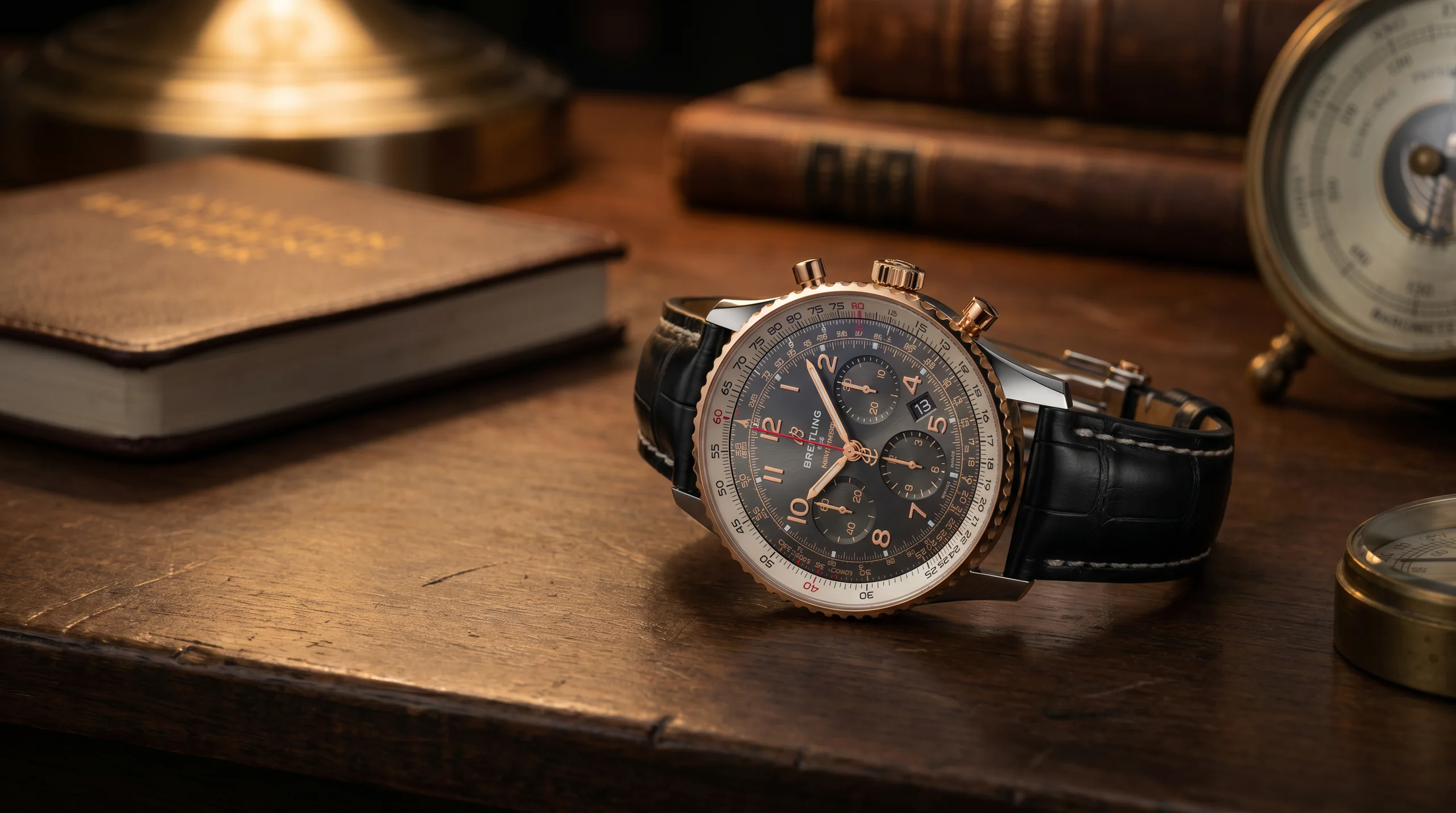 The Navitimer B01 Chronograph 46 UB0127 in two-tone steel and 18k rose gold with anthracite grey dial. The precious metal expression of the largest modern Navitimer.
The two-tone configuration is the move for buyers who want a precious metal accent without the full gold weight or the full gold price. The rose gold bezel and crown create the visual warmth most associated with classical Navitimer presentations, while the steel case keeps total weight closer to 200g rather than the 280g+ of a full gold case.
Navitimer B02 Cosmonaute Artemis II: The 2026 Limited Edition News Hook
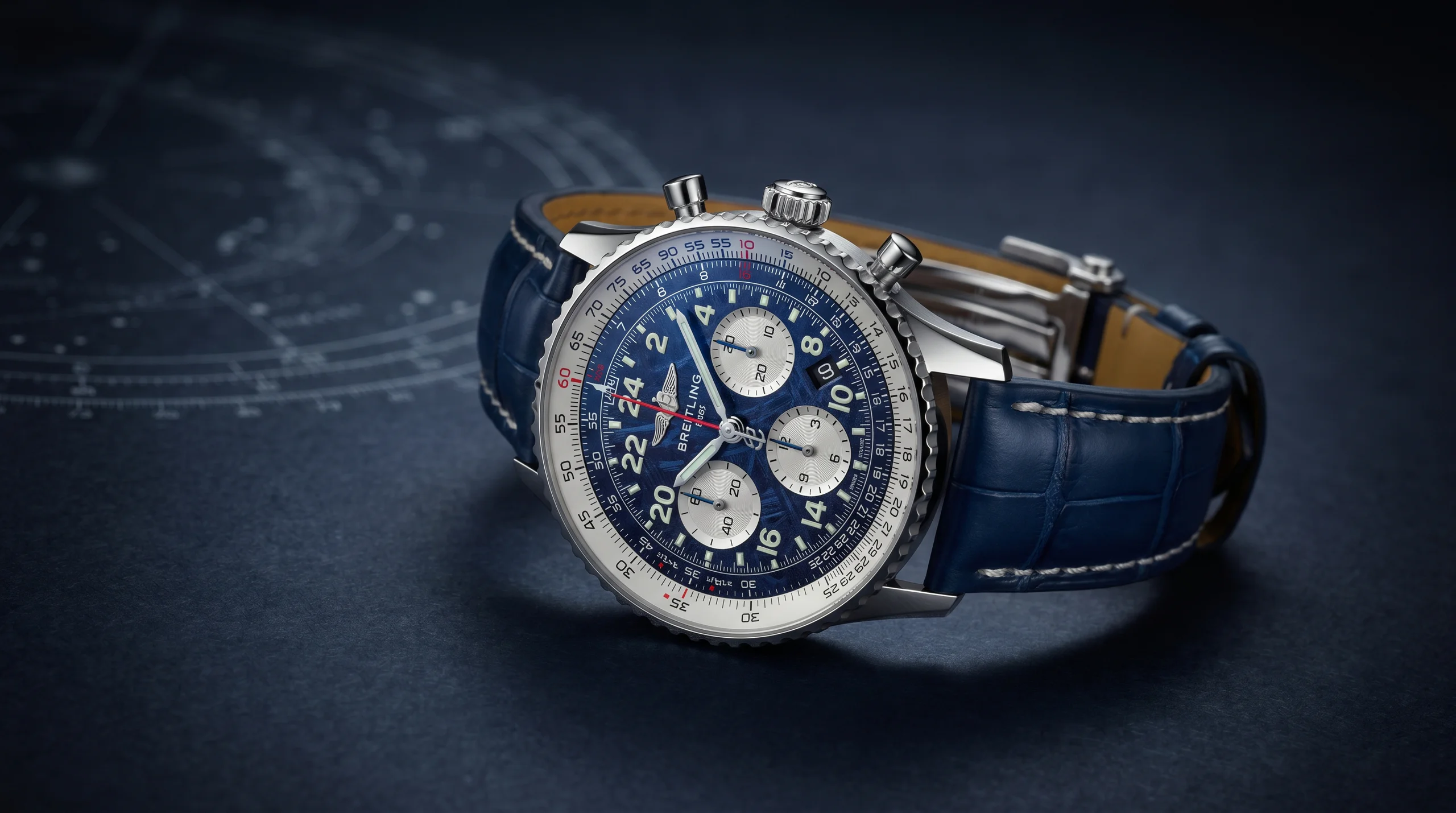 The Navitimer B02 Chronograph 41 Cosmonaute Artemis II. Galaxy-blue meteorite dial, 24-hour scale, $11,900, 450 pieces. The watch the Artemis II crew wore during NASA's first crewed lunar flyby mission in over 50 years.
Breitling released the Navitimer B02 Chronograph 41 Cosmonaute Artemis II (Ref. AB02307A1C1P1) in April 2026 to commemorate NASA's Artemis II lunar flyby mission. The reference is the most newsworthy Breitling release of the year and the strongest recent news hook in the Cosmonaute family.
What makes it different
The dial is genuine meteorite stone, dyed a deep cosmic blue, with the natural Widmanstätten crystalline pattern visible across the surface. No two meteorite dials are identical, which means every one of the 450 watches produced has a unique dial.
The 24-hour scale layout (hours marked 0 through 24 instead of 1 through 12) is the original Cosmonaute signature dating to Scott Carpenter's 1962 Aurora 7 mission. The hour hand makes one full rotation per day rather than two, which is the convention that makes time legible in orbit where there is no day-night cycle.
The movement is the manual-wind Breitling B02, an in-house chronograph calibre with a 70-hour power reserve and a 24-hour module on top of the base calibre. The caseback is engraved with the official Artemis II mission logo.
Hypebeast confirms all four Artemis II crew members were spotted wearing the watch during the mission alongside their NASA-issued Speedmaster Moonwatches. Teddy Baldassarre's review notes that the steel case keeps the retail at $11,900, significantly below the precious metal Cosmonaute editions that have run $20,000-$30,000+ in recent years.
The Cosmonaute lineage
The 2026 Artemis II is the latest in a series of modern Cosmonaute limited editions:
- 2022 Cosmonaute 362-piece platinum bezel (60th anniversary of Aurora 7). All-black dial, $20,500 retail.
- 2024 Cosmonaute red gold limited 250 pieces (Breitling 140th anniversary). Black dial with green accents, B12 automatic upgrade (first automatic Cosmonaute).
- 2025 Cosmonaute platinum 50-piece (centennial of Scott Carpenter's birth). Blue dial.
- 2026 Cosmonaute Artemis II 450 pieces. Galaxy-blue meteorite dial, B02 manual, $11,900.
The Artemis II is the most accessible Cosmonaute reference in this group, and the only one in steel. The combination of meteorite dial, manual-wind movement, and verified astronaut-worn provenance makes it the strongest Cosmonaute purchase available in current production.
Pre-owned outlook
At launch, the AB02307A1C1P1 is selling above retail through grey market dealers. Realistic secondary market pricing through summer 2026 will be $13,500-$16,000 depending on dial pattern desirability. By 2027, expect the watch to settle closer to or slightly above retail as the initial allocation completes.
For collectors who specifically value astronaut-worn watches with documented mission provenance, this is one of the few current production references that genuinely qualifies. The OMEGA Speedmaster Moonwatch is the obvious parallel.
Navitimer Automatic 41 A17326: The Non-Chronograph Entry
The A17326 is the entry to Navitimer ownership for buyers who do not need or want a chronograph. The case is 41mm with the signature slide rule bezel, but the dial is three-handed (hours, minutes, seconds) with a date window, and the movement is the Breitling 17 base automatic.
This reference is overlooked by enthusiasts and significantly more accessible than the chronograph references. Retail is approximately $4,950. Pre-owned in box and papers condition runs $3,200-$3,800, which is genuinely strong value for a Swiss automatic with full Navitimer design DNA and a working slide rule.
The slide rule bezel still functions on the A17326. You can perform the same flight calculations as the chronograph references. The only thing you give up is the chronograph movement itself.
For first-time Navitimer ownership at a budget under $4,000 pre-owned, this is the answer. For buyers who specifically want the chronograph, the AB0139 41mm at $5,500-$6,200 pre-owned is the move up.
Vintage Navitimer Territory
The vintage Navitimer market is one of the deepest in luxury watchmaking, with references that trace directly to the 1950s and 1960s. Worth knowing:
- Reference 806 (1953-1969). The original Navitimer. Venus 178 manual-wind chronograph, 41mm steel case, AOPA dial (early) or twin-planes dial (later 1960s). Pre-owned runs $5,000-$15,000 depending on dial era, condition, and provenance. The early AOPA-dial 806 commands the strongest premium.
- Reference 7806 (1969-1970s). The first automatic Navitimer, powered by the Calibre 11 (Chronomatic). Larger 48mm case. Pre-owned runs $4,500-$8,500 in good condition.
- Reference 81600 (1980s). The 1980s Navitimer using the Lemania-based Calibre 12. Smaller cases, transitional era references. Pre-owned runs $3,500-$6,000.
- Reference A41322 50th Anniversary (2002). Limited edition 41mm with Valjoux 7750. Pre-owned runs $3,500-$5,500.
- Reference AB0127 / AB0121 (2010s pre-2022 refresh). The previous generation of B01 Chronograph 46 references. Pre-owned runs $4,000-$6,000, which is a meaningful discount versus the current generation while delivering the same in-house movement.
If you want vintage Navitimer character at the most accessible entry point, the A41322 50th Anniversary at $4,000 is the move. If you want a serious vintage piece with strong provenance, an AOPA-dial 806 in original condition is the answer.
Pre-Owned Market Reality
WatchCharts tracks the Navitimer with strong secondary market liquidity. The overall average price across modern Navitimer references is approximately $6,500. The range runs from about $2,500 (vintage Navitimer Automatic references in average condition) to $22,000+ (rose gold B01 46 references and limited Cosmonaute editions).
In-production Navitimer references in steel typically trade 15-25% below retail on the secondary market, which is meaningfully tighter than most luxury chronograph families. This reflects three things: Breitling's broader allocation policy is less constrained than Rolex or AP, the in-house Breitling 01 movement is widely respected, and the buyer profile tends to use the watches rather than hold them speculatively.
The Cosmonaute Artemis II is the outlier currently trading above retail. Limited editions in the Navitimer family tend to settle near retail within 12-18 months as initial allocation completes.
For buyers who want a Navitimer without retail premiums, the pre-owned market is genuinely deep. A 2022-2024 AB0138 in box and papers runs $6,500-$7,500 versus $9,100 retail. A 2022-2024 AB0139 in similar condition runs $5,500-$6,200 versus $8,800 retail.
Which Navitimer Should You Buy?
First-time luxury buyer with a budget under $5,000
A pre-owned Navitimer Automatic 41 A17326 at $3,200-$3,800 is the move. You get the full Navitimer design DNA, the working slide rule bezel, the iconic dial layout, and a Swiss automatic movement. The only meaningful trade-off versus the chronograph references is the absence of the chronograph itself.
A vintage A41322 50th Anniversary at $4,000-$5,500 is the alternative if you want chronograph functionality at this budget and accept the Valjoux 7750 base movement rather than the in-house Breitling 01.
Growing collector adding their definitive chronograph
The AB0138 B01 Chronograph 43 at $6,500-$7,500 pre-owned is the move. In-house Breitling 01, 70-hour reserve, COSC certified, the seven-row beads-of-rice bracelet, and aviation heritage that traces to 1952. For buyers who find 43mm too large, the AB0139 B01 Chronograph 41 at $5,500-$6,200 pre-owned delivers the same content in a smaller case.
This pairs especially well alongside an Omega Speedmaster or a Rolex Submariner as the aviation-leaning entry to a multi-watch collection. Worth reading our Speedmaster Reduced cult classic breakdown for the parallel under-$5,000 chronograph option.
Growing collector wanting precious metal expression
The UB0127 two-tone B01 Chronograph 46 at $8,500-$11,000 pre-owned is the move. The rose gold bezel and accents create the warm classical Navitimer aesthetic without the full gold weight or full gold price. The 46mm case fits aviation watch enthusiasts who specifically want presence.
Experienced collector chasing the current limited edition
The B02 Cosmonaute Artemis II AB02307A1C1P1 at $11,900 retail is the answer. Galaxy-blue meteorite dial, 24-hour scale, manual-wind B02 movement, 450-piece limited, documented Artemis II crew provenance. The combination of mission-worn legitimacy, unique meteorite dials (no two identical), and the most accessible price tier the precious-metal Cosmonaute family has seen in recent years makes this the strongest current Cosmonaute purchase.
For the broader context on aviation and aerospace chronograph releases this year, see our Omega Seamaster 007 First Light breakdown for another major story-driven release from the same week.
The collector building a true vintage focus
An AOPA-dial reference 806 from the 1950s in original condition with documented provenance is one of the most rewarding vintage chronograph purchases in luxury watchmaking. Expect $10,000+ for collector-grade examples with original AOPA-stamped dials. The 806 is also significantly more economically accessible than parallel-era Speedmaster references with similar provenance.
FAQs
What is the slide rule bezel on a Navitimer for?
The slide rule bezel is a fully functional circular logarithmic slide rule designed for pilot calculations. It can calculate flight time, fuel burn, ground speed, distance, unit conversions (miles to kilometers, gallons to liters), and short multiplications and divisions. It is the same mechanism as the E6B flight computer used by pilots, integrated into a wristwatch.
How much does a new Breitling Navitimer cost?
Retail prices range from approximately $4,950 for the Navitimer Automatic 41 three-hand reference up to $22,400 for the rose gold B01 Chronograph 46. Most popular chronograph references (B01 41 and B01 43) sit between $8,800 and $9,400 retail in steel. The 2026 Cosmonaute Artemis II is $11,900 in steel limited to 450 pieces.
What movement is in the modern Navitimer?
The modern catalog uses several in-house Breitling movements depending on the reference. The Breitling 01 powers the entire B01 Chronograph family (41, 43, 46), with 70-hour reserve and COSC certification. The Breitling B02 is the manual-wind Cosmonaute movement. The Breitling 17 is the entry-tier automatic in the Navitimer Automatic references.
Is the Cosmonaute Artemis II a good purchase at $11,900?
For collectors who value documented astronaut-worn provenance and unique meteorite dials, yes. The Artemis II is the most accessible Cosmonaute reference in the current series (the prior precious-metal Cosmonaute editions ran $20,500-$30,000+), it carries genuine 2026 mission provenance, and the 450-piece production is tight enough to maintain collector interest while broad enough to allow secondary market liquidity.
What is the difference between the Navitimer and the Breitling Premier?
The Navitimer is the aviation chronograph with the slide rule bezel. The Premier is Breitling's dressier 1940s-inspired chronograph line with a fixed bezel and a more elegant case profile. The Navitimer is for buyers who want the iconic tool watch aesthetic. The Premier is for buyers who want a Breitling that wears dressier.
Can I buy a Navitimer pre-owned with confidence?
Yes. Navitimer references are well documented, widely serviced, and have strong reference number traceability through Breitling's service archive. Look for box and papers, recent service history (Navitimers should be serviced every 5-7 years), original slide rule bezel (some aftermarket replacements exist), and a dealer who provides authentication. Browse authenticated pre-owned Breitling at 5dwatches.com.
Will a Navitimer hold its value?
Modern Navitimer references trade approximately 15-25% below retail in the secondary market on average, which is tighter than most luxury chronograph families. We do not make investment-return claims at 5D Watches. The Navitimer is positioned to be used rather than held. Buy the watch because you want to wear it.
What is the most collectible Navitimer right now?
By production tightness and current news momentum, the B02 Cosmonaute Artemis II in steel with meteorite dial is the current collector statement. By long-term value retention, the AOPA-dial Reference 806 in collector-grade vintage condition is the answer.
The Navitimer is the watch that proved a wristwatch could be a computer 65 years before the Apple Watch existed. The fact that the design has barely changed since 1952 and the slide rule bezel still works exactly as it did when AOPA pilots first wore it tells you everything about how right Breitling got the original brief. Browse authenticated pre-owned Breitling at 5dwatches.com.