Christie's just set a new record. Its two-day Rare Watches live auction at the Four Seasons Hotel des Bergues in Geneva on May 11 and 12 brought in $42,309,684 (CHF 33,054,441), the highest total ever for a multi-owner watch auction at the house, JCK reported in its post-sale coverage.
The headline lot belonged to the late Quincy Jones. The producer, composer, and 28-time Grammy winner died in 2024, and his estate brought a 1981 Patek Philippe Nautilus to Geneva that had been on his wrist during the Thriller production era. It was joined by a 1990 Cartier London Crash that set a world auction record for the model, a platinum Patek perpetual calendar chronograph, an F.P. Journe Tourbillon Souverain, and a 1930 Audemars Piguet chronograph appearing at auction for the first time.
This is the working dealer's read on what sold, what set records, and what the $42.3M total tells us about where the auction market is heading in 2026.
All images in this post are AI-generated and may not perfectly represent the actual watch references discussed. They are intended for illustration only.
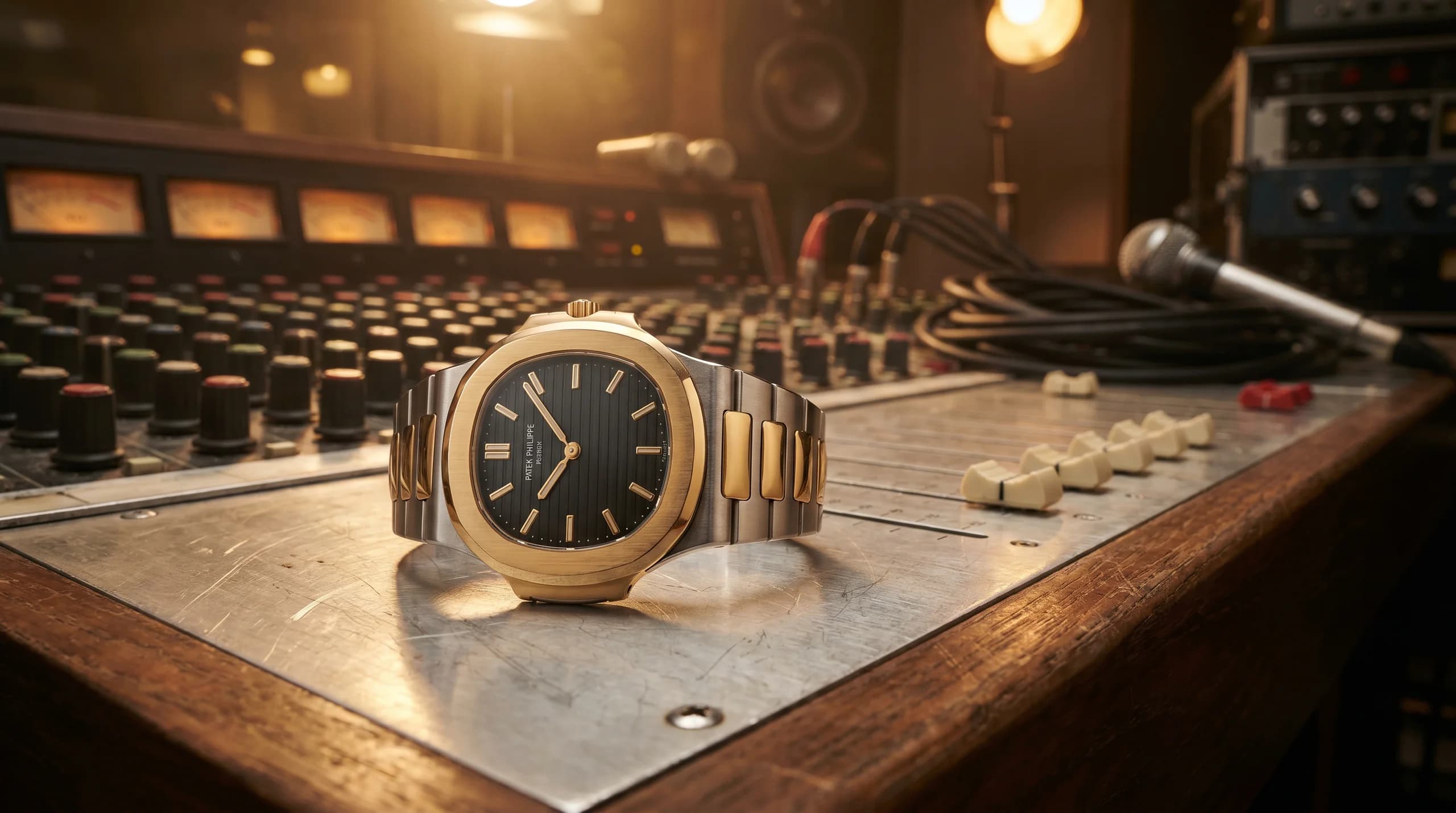
The vintage Patek Philippe Nautilus Reference 3700/1JA Jumbo from 1981 that Quincy Jones owned for 43 years until his death in 2024. The two-tone steel and 18k yellow gold Jumbo carried Christie's estimate of CHF 100,000 to 200,000.
The Headlines
If you are scanning, the sale compressed to these numbers and stories.
- $42.3 million total, a record for any multi-owner watch auction at Christie's.
- $2,028,800 for a 1990 Cartier London Crash, a world auction record for the model and triple the low estimate.
- Quincy Jones's 1981 Patek Nautilus Ref. 3700/1JA, the headline provenance lot, with three pieces from his estate offered.
- Six other Patek Philippe references above CHF 400,000 estimate, including a 3970 platinum perpetual calendar chronograph and a white gold 3700/1G Royal Khanjar from 1978.
- Independent watchmaking continues to climb, with an F.P. Journe Tourbillon Souverain Ref. T from circa 2000 carrying a CHF 500,000 to 1 million estimate.
The Christie's $42.3M result lands the same week the Phillips Geneva XXIII auction set the all-time watch auction record at $96.3M. Two house records in seven days.
The Quincy Jones Story
Quincy Jones bought his Patek Philippe Nautilus Reference 3700/1JA in 1981 and owned it for the next 43 years. The watch was on his wrist during one of the most productive years of his career. In 1981 he received a Grammy nomination for Producer of the Year, won Best Instrumental Arrangement, and was beginning work on Michael Jackson's Thriller (1982). The album would become one of the best-selling records ever made.
The 3700/1JA is the original Gérald Genta Jumbo Nautilus in two-tone configuration. The reference launched in 1976 as the first commercially produced Nautilus, with the 42mm monobloc case, integrated bracelet, and horizontally grooved tapisserie dial that became the template for every Nautilus that followed. The "1JA" suffix denotes two-tone construction in stainless steel and 18k yellow gold. The caliber 28-255C automatic movement, Antiques and the Arts Weekly catalogs, was the ultra-thin Jaeger-LeCoultre caliber 920 family that became the engine for both the Nautilus and the Audemars Piguet Royal Oak in this era.
Christie's estimate sat at CHF 100,000 to 200,000 (USD $130,000 to $250,000). That number reflects the open-market value of a clean two-tone 3700/1JA from 1981 before the provenance multiplier. The Jones provenance, as JCK noted in its pre-sale coverage, was widely expected to push the result significantly higher.
The Other Two Jones Lots
The Jones property included two additional pieces that traced the personal relationships defining his career.
A Girard-Perregaux World Time Control Shadow Reference 49820 from circa 2011 carried a CHF 100,000 to 200,000 estimate. The watch was a gift from Andrea Bocelli in recognition of Jones's lifetime charitable work, according to The Music Universe. Girard-Perregaux's World Time complication makes the reference horologically interesting on its own, but the provenance turns it into something rarer.
A 22k gold and colored diamond pendant from U2 frontman Bono, engraved "B4Q80" for Jones's 80th birthday in 2013, carried a CHF 10,000 to 15,000 estimate. The pendant is the kind of object that exists outside conventional auction categorization. It is jewelry, it is celebrity gift, it is documentary artifact. Christie's offered it as part of the watches sale because the buyer pool for "objects Quincy Jones wore" overlaps more with watch collectors than fine jewelry buyers.
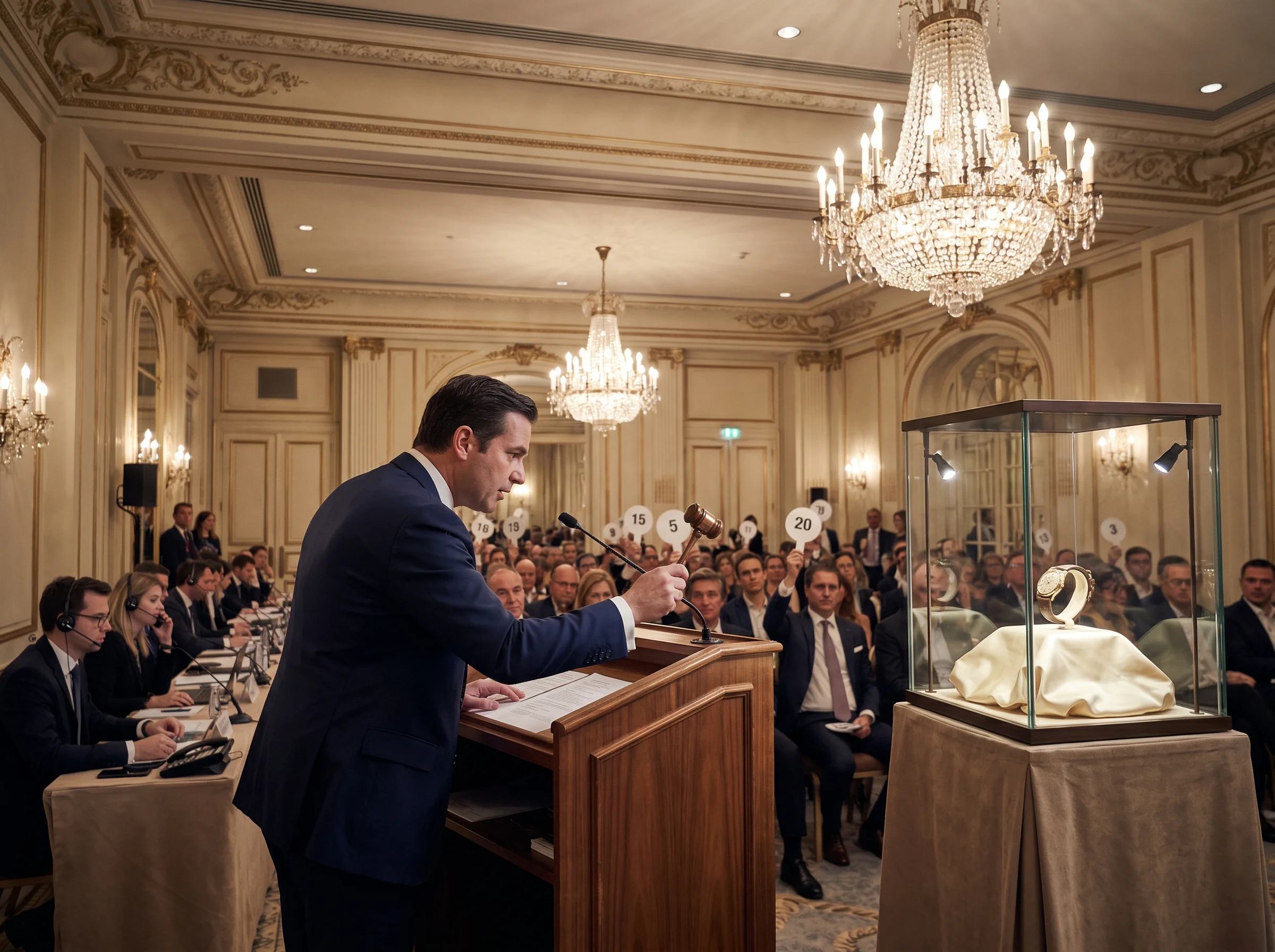 Christie's two-day Rare Watches live auction was held May 11 and 12, 2026 at the Four Seasons Hotel des Bergues in Geneva. The combined total of $42.3M set a record for multi-owner watch auctions at the house.
The Cartier London Crash Record
The standout result of the sale, ahead of the Jones provenance angle, was the 1990 Cartier "London Crash" that hammered at $2,028,800 (CHF 1,585,000). The result set a world record for the model and tripled its low estimate.
The Crash is one of the most distinctive Cartier designs ever produced. Jean-Jacques Cartier and Rupert Emmerson designed the original at Cartier London in 1967 as a deliberate break from the orthogonal proportions of the Tank line. The case appears warped, almost melted, as if a Tank had been left on a hot dashboard. The design is widely understood to be inspired by a Cartier dress watch that had been damaged in a fire, though the company has never confirmed the origin story.
Only about 20 of the original 1967 examples were produced. The 1990 London Crash that sold at Christie's is a different beast. It was a small limited edition reissue produced at Cartier London in 18k yellow gold, signed "Cartier London" on the dial, with the same asymmetric melted-tonneau case proportions as the 1967 original. The 1990 production run is itself extremely scarce, and the Christie's example carried full provenance documentation.
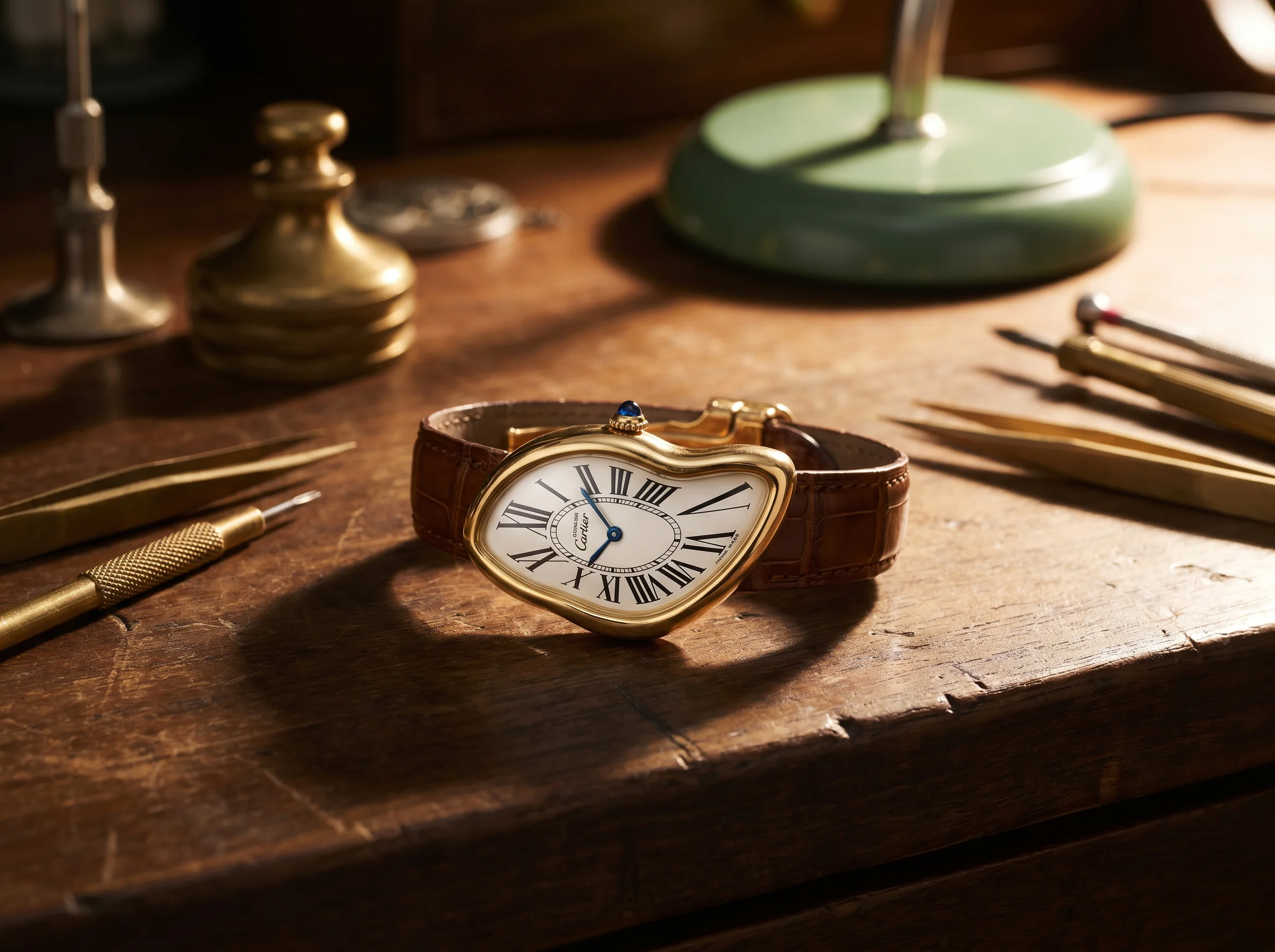 The 1990 Cartier London Crash in 18k yellow gold that hammered at $2,028,800 (CHF 1,585,000), setting a world auction record for the model.
The $2.03M result is the kind of number that reshapes how the market values asymmetric vintage Cartier. Cartier London production from the 1960s through 1990 was always small, and surviving examples in unpolished condition are rare. Modern Cartier collectors have been bidding up Tonneau, Asymétrique, and Maxi Oval references for the past three years. The Crash record extends that demand pattern into a higher price tier.
The Top Patek Lots
Christie's assembled six Patek Philippe references with estimates above CHF 400,000. Two stood out.
Patek 3970 Platinum Perpetual Calendar Chronograph
The Patek Philippe Reference 3970 Platinum Perpetual Calendar Chronograph carried an estimate of CHF 500,000 to 1,000,000. The 3970 is one of Patek's most important complicated wristwatches of the modern era, produced from 1986 to 2004 across four series (the second series being the most common, the platinum the rarest).
The reference combines the perpetual calendar with the chronograph, the moonphase, and the leap year indicator on a 36mm case. The platinum examples were produced in very small numbers, almost always for the private market. A platinum 3970 in this configuration sets the upper benchmark for "investment-grade" Patek perpetual calendar chronographs at auction.
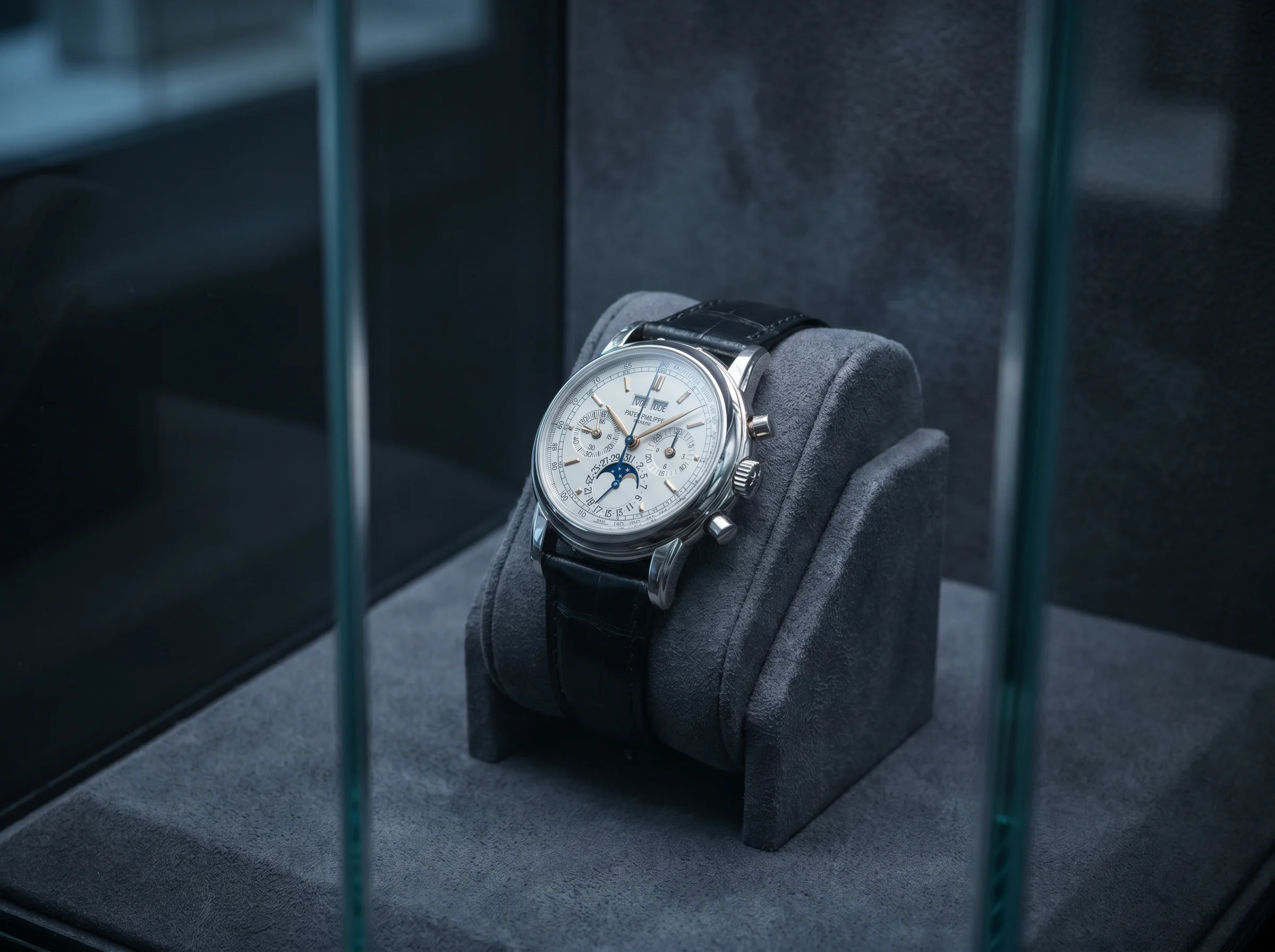 The Patek Philippe Reference 3970 platinum perpetual calendar chronograph carried an estimate of CHF 500,000 to 1 million in the Christie's Geneva sale.
Patek 3700/1G Royal Khanjar
The Patek Philippe Reference 3700/1G Royal Khanjar from 1978 carried a CHF 400,000 to 750,000 estimate. The 3700/1G is the rare 18k white gold version of the Jumbo Nautilus, and "Royal Khanjar" refers to the Omani khanjar dagger emblem applied to the dial at the request of the Royal Office of Oman during Sultan Qaboos bin Said's reign.
Royal Khanjar watches are some of the most documented royal-commissioned wristwatches in horology. The Sultan ordered limited runs from Patek, Rolex, and other top makers throughout his reign, and the watches were given as official gifts of state. They occupy a specific niche in collecting where horological pedigree and political history converge.
The Independent and Vintage Standouts
F.P. Journe Tourbillon Souverain Ref. T
The F.P. Journe Tourbillon Souverain Reference T from circa 2000 carried an estimate of CHF 500,000 to 1,000,000. The Tourbillon Souverain was Francois-Paul Journe's first serially produced wristwatch, launched in 1999 with a limited production run that established the FPJ market position.
The watch is the engineering equivalent of a thesis statement. Asymmetric off-center dial, visible tourbillon cage, classically engraved "F. P. Journe Invenit et Fecit" text. Every element signals "this is what an independent watchmaker working at the highest level looks like." The Tourbillon Souverain Ref. T market has appreciated significantly over the past three years as the broader independent watchmaking category has scaled.
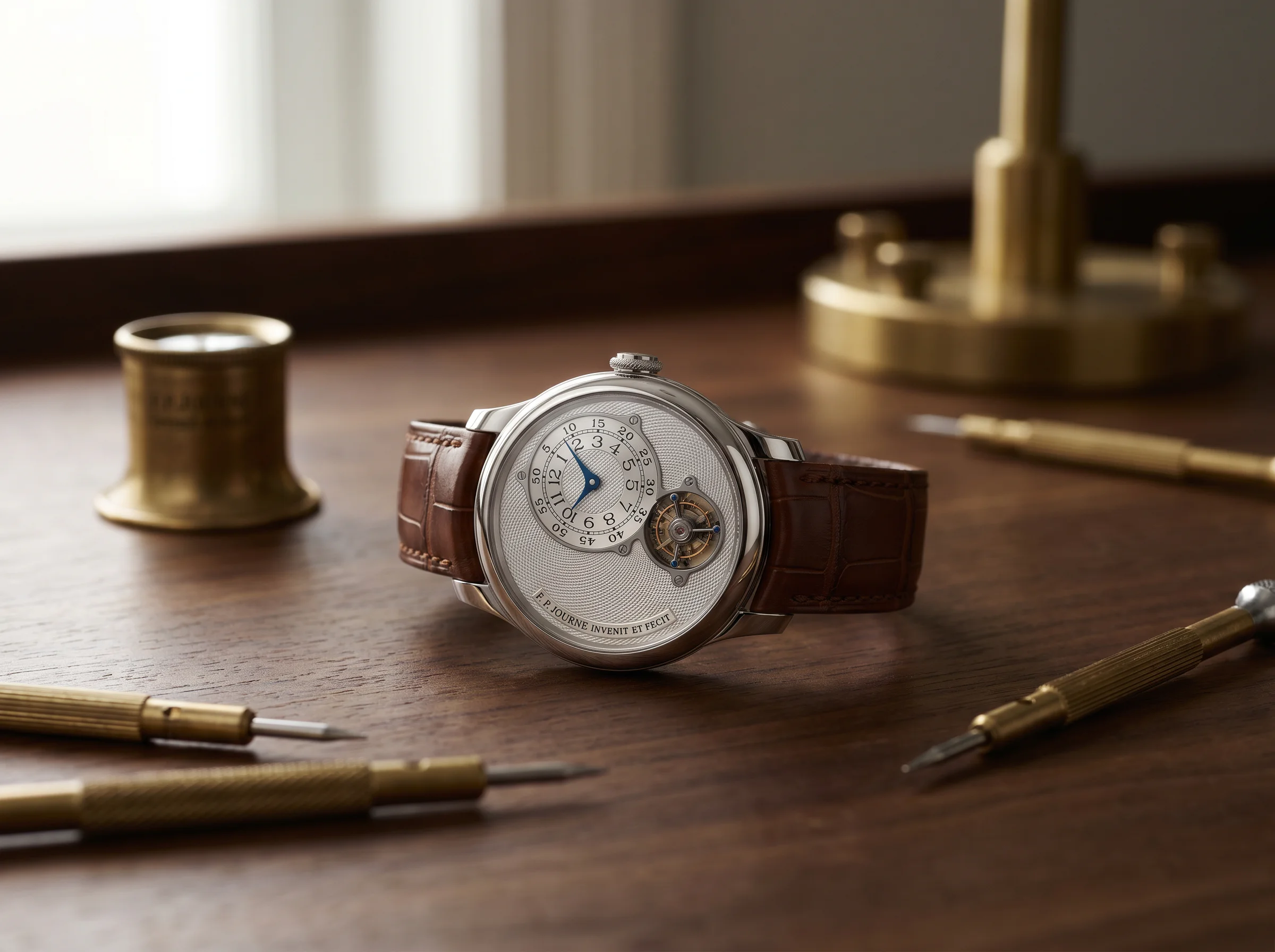 The F.P. Journe Tourbillon Souverain Reference T from circa 2000 carried an estimate of CHF 500,000 to 1 million.
AP Coussin Tortue Chronograph (1930)
The Audemars Piguet Coussin Tortue platinum chronograph wristwatch from circa 1930 appeared at auction for the first time ever with an estimate of CHF 200,000 to 400,000. The watch is a unique, historically significant piece that AP sold to the American market in the 1930s, featuring the rare "Coussin Tortue" (cushion-tortoise) cushion-shaped case with a single-button chronograph mechanism.
Pre-war Audemars Piguet wristwatches at auction are rare events. AP's pre-war production was small (it survived the Depression by trimming production aggressively), and the surviving examples in collectible condition are exceptional. The first-time-at-auction status adds meaningful provenance weight.
Rolex King Midas Ref. 9630
The sale also included a Rolex King Midas Reference 9630 from circa 1970, an extremely rare 18k white gold asymmetric left-handed winding wristwatch designed by Gérald Genta. The King Midas was Rolex's heaviest watch at launch, produced in very limited numbers and considered one of Genta's lesser-known but technically distinctive designs.
The Market Read
Two Christie's records in two days, against the backdrop of Phillips Geneva XXIII setting the all-time watch auction record at $96.3M the same week, makes this the strongest seven-day window for top-tier watch auctions in history.
Three signals matter for buyers and sellers:
The provenance premium continues to scale. The Quincy Jones lots arrived with full provenance documentation and a cultural narrative that extends far beyond watch collectors. Auction houses increasingly bring named-collection sales because the buyer pool for "objects from cultural figures" overlaps with luxury collectors of every category. The result is upward pressure on otherwise normally-traded references.
Independent watchmaking is now an investment category. F.P. Journe estimates have shifted into the high six-figure and seven-figure range over the past five years. Rexhepi and Akrivia routinely set independent records at Phillips. The 2026 market treats the top independents the way the 2010 market treated vintage Patek chronographs: as the rare-end-of-supply that the next wave of new buyers will pay any number to access.
Cartier London is the alternative-investment story. The 1990 Crash result extends a pattern that began with Tank Asymétrique and Tortue Monopoussoir records over the past three years. Cartier London production from the 1960s through 1990 is finite. The buyer pool for "designer-pedigree Cartier" is growing faster than the supply of clean unpolished examples in the market.
The dealer takeaway: provenance, independents, and asymmetric Cartier are the three categories where the 2026 auction floor has clearly moved upward. The mainstream Rolex sport, Patek Nautilus 5711, and AP Royal Oak 15202 markets remain liquid but no longer set the records.
A Working Dealer's Read
The $42.3M total is a Christie's house record, not a market-wide record. Phillips Geneva XXIII set the all-time watch auction record at $96.3M the same week. Different sales, different positioning, both pointing to the same conclusion. The top-tier auction market is operating at a higher floor than at any point in history.
For pre-owned market buyers, the auction results matter for one specific reason. They set the comparable price ceiling that all other transactions reference. When a Patek 3970 platinum trades at CHF 800,000 at Christie's Geneva, every other 3970 platinum offered privately or through pre-owned dealers in the next 12 months prices off that result. The auction floor is the visible top of the market that the rest of the market trades against.
Browse authenticated pre-owned Patek Philippe at 5dwatches.com. Modern Patek Nautilus, Aquanaut, Calatrava, and Complications inventory trades through 5D Watches regularly. The references in the Christie's Geneva sale anchor the upper tier of pre-owned Patek pricing, and the inventory at 5dwatches.com sits in the practical buying tier where most collectors actually transact.
Frequently Asked Questions
How much did Christie's Geneva Rare Watches make in May 2026?
The two-day live auction on May 11 and 12, 2026 at the Four Seasons Hotel des Bergues in Geneva totaled $42,309,684 (CHF 33,054,441), the highest amount ever for a multi-owner watch auction at Christie's.
What is the Quincy Jones Patek Philippe Nautilus reference?
The watch is a Patek Philippe Nautilus Reference 3700/1JA from 1981, the original Gérald Genta Jumbo Nautilus in two-tone stainless steel and 18k yellow gold. Jones purchased it in 1981 and owned it for 43 years until his death in 2024. It was on his wrist during the production era of Michael Jackson's Thriller. Christie's estimated it at CHF 100,000 to 200,000 (USD $130,000 to $250,000).
What did the Cartier London Crash sell for?
The 1990 Cartier London Crash in 18k yellow gold hammered at $2,028,800 (CHF 1,585,000), a world auction record for the model and triple its low estimate of CHF 500,000.
What is the difference between the 1967 and 1990 Cartier Crash?
The original Cartier Crash was designed by Jean-Jacques Cartier and Rupert Emmerson at Cartier London in 1967. Approximately 20 examples were produced. The 1990 London Crash was a small limited edition reissue produced at Cartier London in 18k yellow gold, signed "Cartier London" on the dial, with the same asymmetric melted-tonneau case proportions as the 1967 original. Both are extremely rare.
How does this compare to Phillips Geneva XXIII?
Phillips Geneva XXIII totaled $96.3M the same week, setting the all-time watch auction record. Christie's $42.3M is the multi-owner record for the house specifically. Different sales, different structure, both indicating the strongest seven-day window in top-tier auction history.
Are auction results a good guide to pre-owned market prices?
Auction results set the visible price ceiling that the rest of the pre-owned market trades against. Top auction results are a useful upper benchmark, though most actual buying happens at the practical pre-owned tier below auction. For typical Patek Nautilus, Submariner, or Daytona purchases, the pre-owned dealer market is the working price reference.