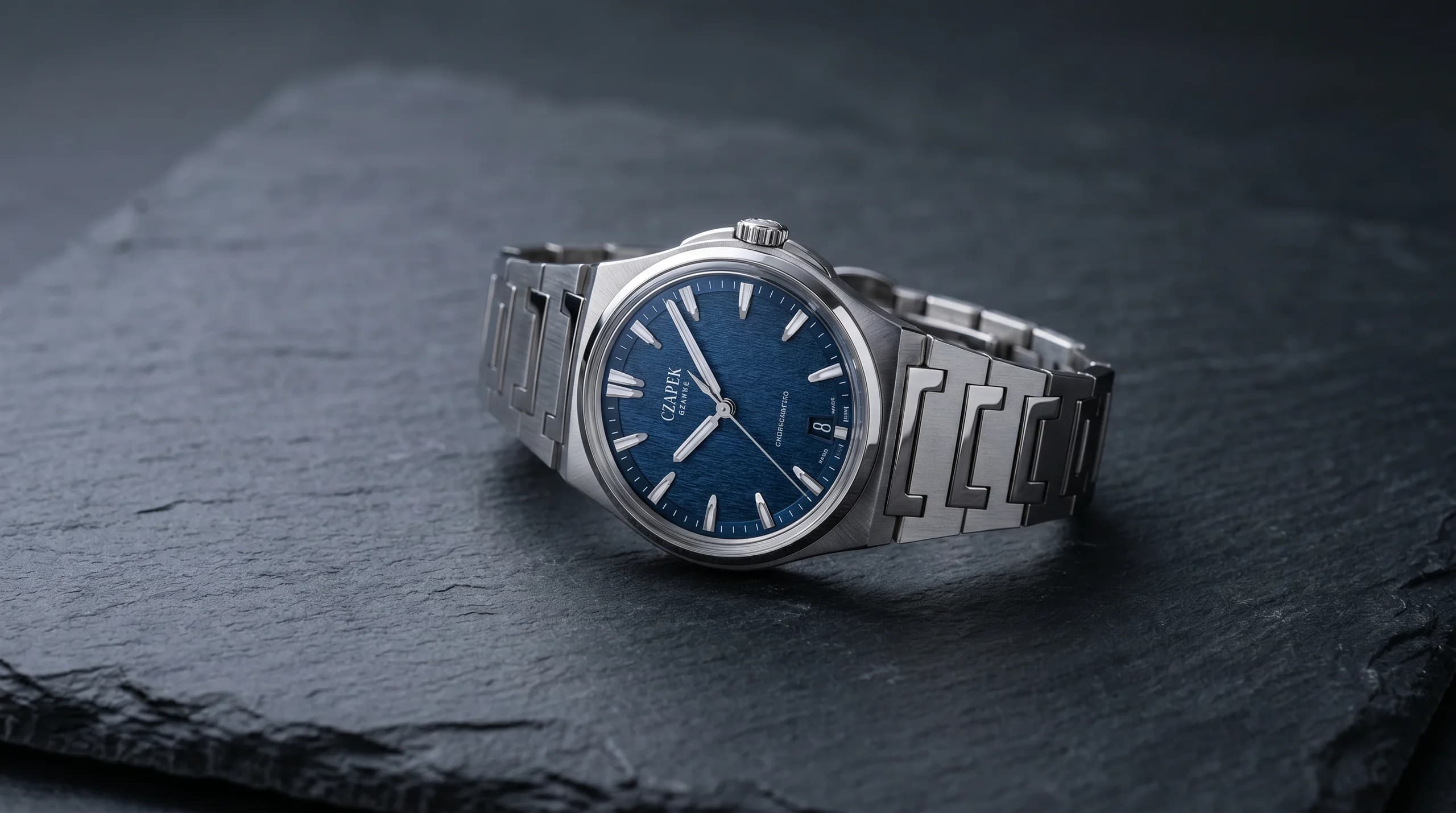
Here is a piece of watch trivia that turns into a real brand. Before Antoine Norbert de Patek partnered with Adrien Philippe to create Patek Philippe, he had a different partner: a Bohemian watchmaker named François Czapek. Their firm, Patek, Czapek & Cie, opened in 1839. When the partnership dissolved, one name went on to become the most revered in watchmaking, and the other vanished for over 150 years.
In 2015, a group of enthusiasts brought the Czapek name back, and they did it in a way no luxury brand had tried: by crowdfunding it. Today Czapek & Cie is one of the more talked-about young independents, largely on the strength of one watch.
This is a working dealer's read on what Czapek is, the Antarctique that made it, and what it costs. To be clear: 5D Watches does not stock Czapek. This is an education piece for the collector who keeps seeing the name.
The short answer: Czapek revives the name of Patek's original 1839 partner, relaunched in 2015 through equity crowdfunding so its collectors are literally shareholders. Its hit is the Antarctique, an integrated-bracelet luxury sports watch with an in-house micro-rotor movement and artisanal textured dials. Prices run from about $20,000 for a steel Antarctique to CHF 67,000 for the titanium tourbillon. Demand outstrips supply, so getting one is the hard part.
The images in this article were generated with AI for illustration, conditioned on real reference photography of Czapek watches. They depict recognizable models but are not photographs of specific watches for sale.
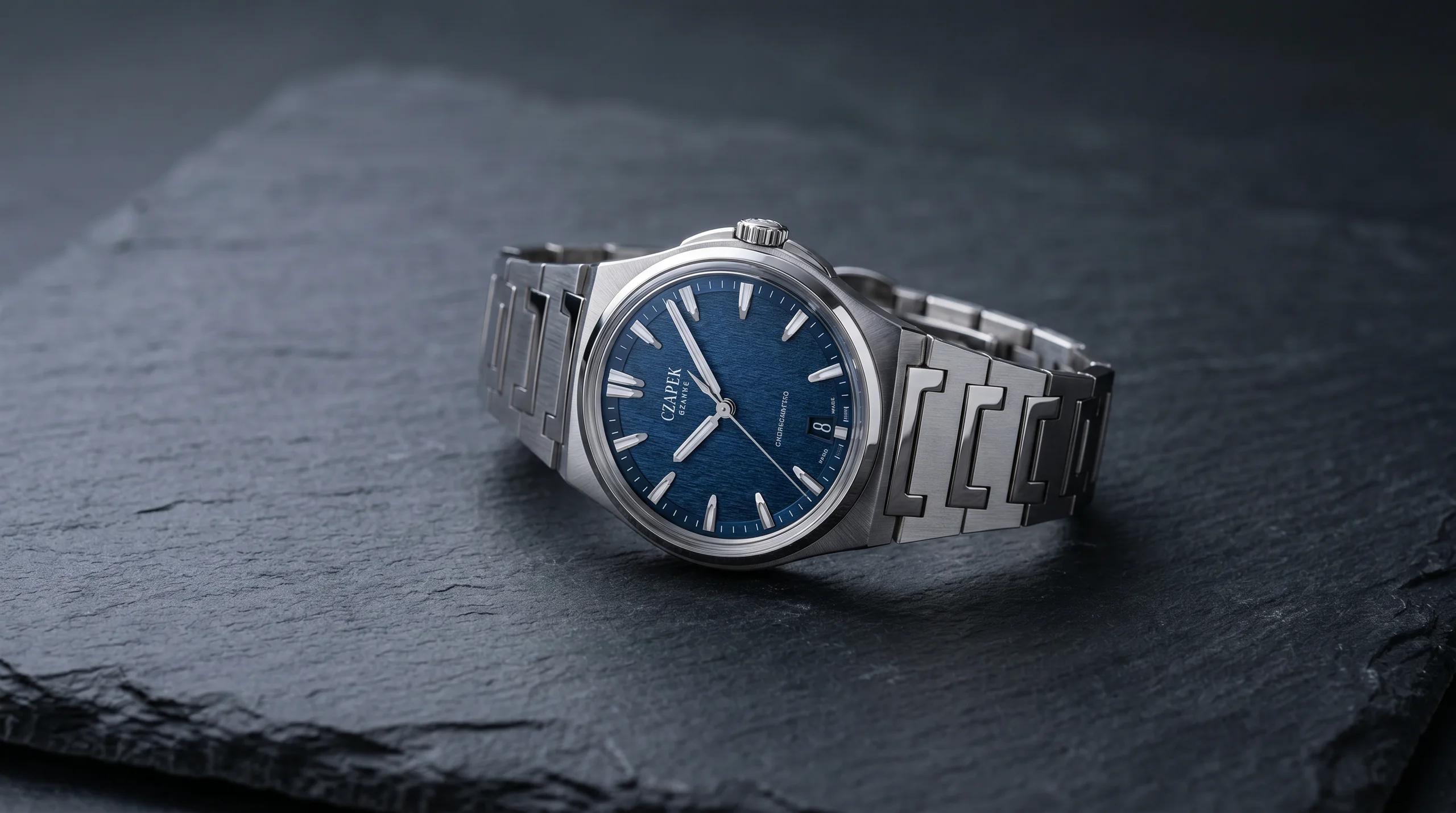 The Czapek Antarctique, the watch that put the revived brand on the map. A luxury sports watch with an artisanal dial.
What Czapek & Cie Is
The name is historic, but the company is a modern startup with an unusual structure.
When Czapek relaunched in 2015, it raised money through an equity crowdfunding campaign, which means many of its collectors are also shareholders who advise and support the brand. That community ownership is not a marketing line, it is how the company actually runs, and it shapes everything from the model names to the release strategy.
On the making side, Czapek began as what it calls a horizontal manufacture, designing watches and working with elite partners like the dial maker Metalem and the movement house Chronode. Then it did the hard thing a small brand rarely manages: it built its own movement.
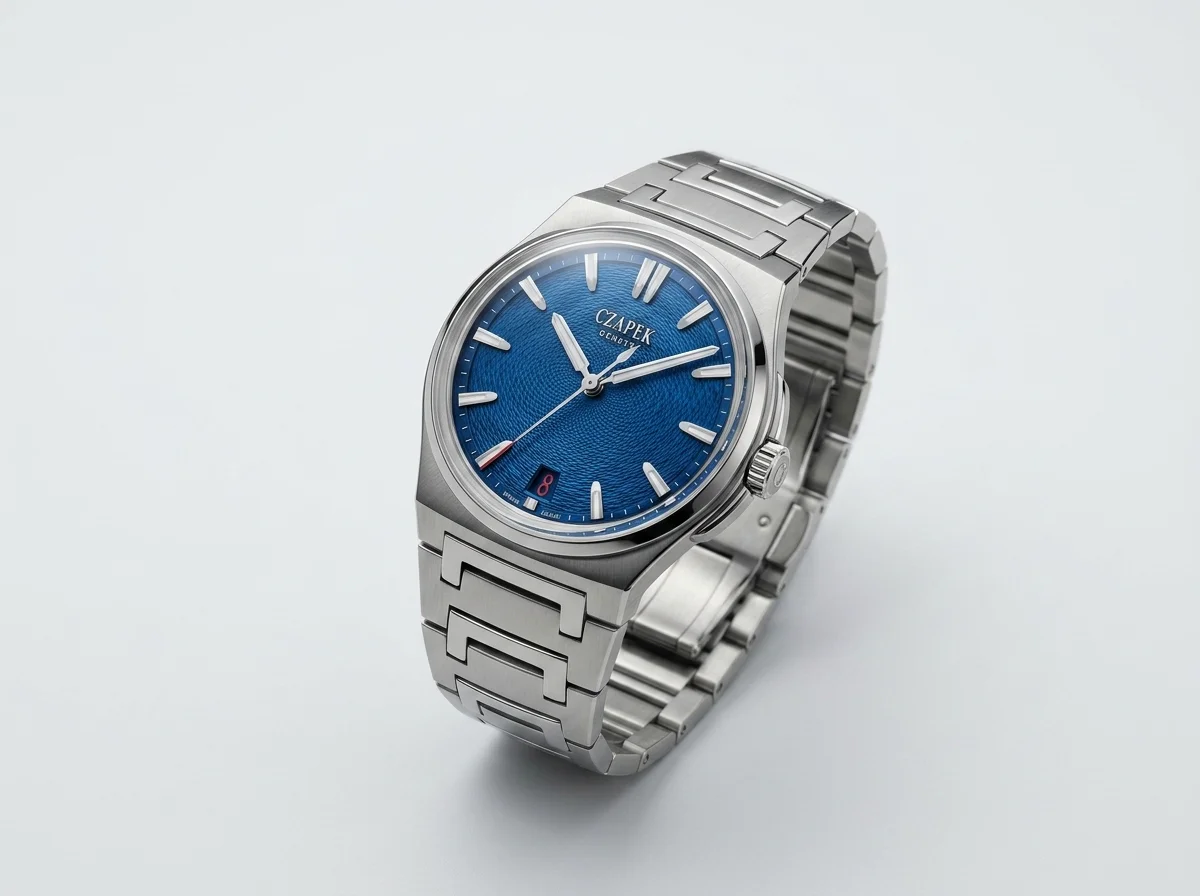 The Antarctique's case avoids the angular bezel cliche. The bracelet links form a stylized C for Czapek.
The Antarctique, the Watch That Made the Brand
Czapek makes dressier pieces, the Quai des Bergues and Place Vendôme lines, but the watch that made its name is the Antarctique.
Launched in 2020, the Antarctique is Czapek's take on the integrated-bracelet luxury sports watch, and it deliberately sidesteps the angular Royal Oak template. The case is barrel-shaped with a round, sloped, polished bezel, the finish radiates from the dial center, and the bracelet links form a stylized C. It is a genuine alternative in a category full of copies.
The In-House SXH5 Movement
Inside is the calibre SXH5, Czapek's first fully in-house movement and the thing that earns it serious respect. It is an automatic with an off-center micro-rotor in platinum, a 60-hour power reserve, and an architecture of seven bridges, five of them openworked so you can see the mechanism work.
For a brand this young and this small to design and build its own micro-rotor movement is the difference between a fashion project and a real watchmaker. The SXH5 is why collectors take Czapek seriously.
Czapek updated that same movement architecture into the Caliber SXH5.1 for the new Promenade L'Ecume des Jours, a smaller dress piece built around a 1947 French novel rather than the sports-watch case language of the Antarctique. See our full read on the Promenade L'Ecume des Jours for the story and the specs.
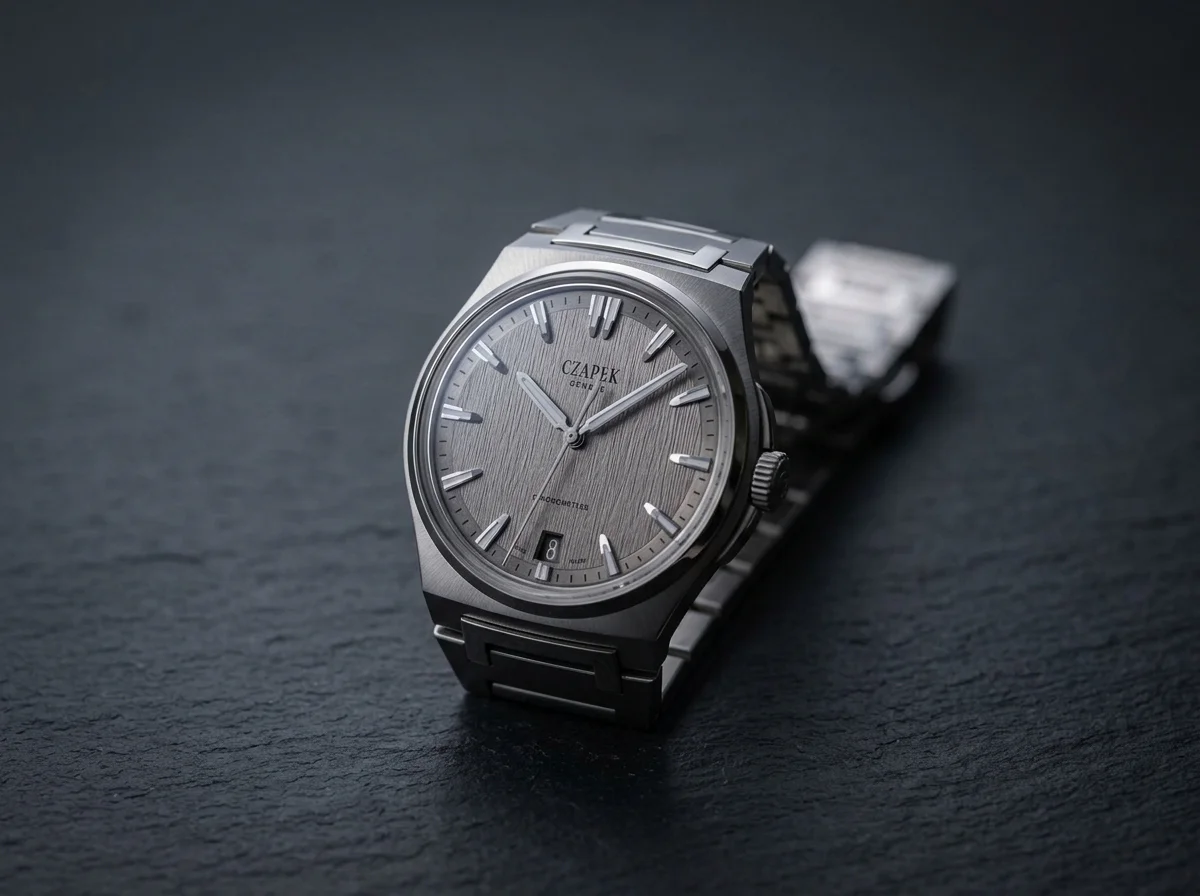 Czapek's dials are made by Metalem using hand-crafted texturing. The depth and shift of light is the whole appeal.
The Dials Are the Signature
If the movement earns respect, the dials earn the love. Czapek's Antarctique dials are made by Metalem using artisanal texturing techniques, and they are what collectors chase.
The inaugural Terre Adélie used a Lamé pattern, a series of fine combed lines that create depth and reflection. Later came the flinqué guilloché of the Passage de Drake, and a run of distinctive colors and materials, from the Emerald Iceberg to stone dials and meteorite. In a segment where most watches wear a plain sunburst, Czapek's hand-worked dials stand out.
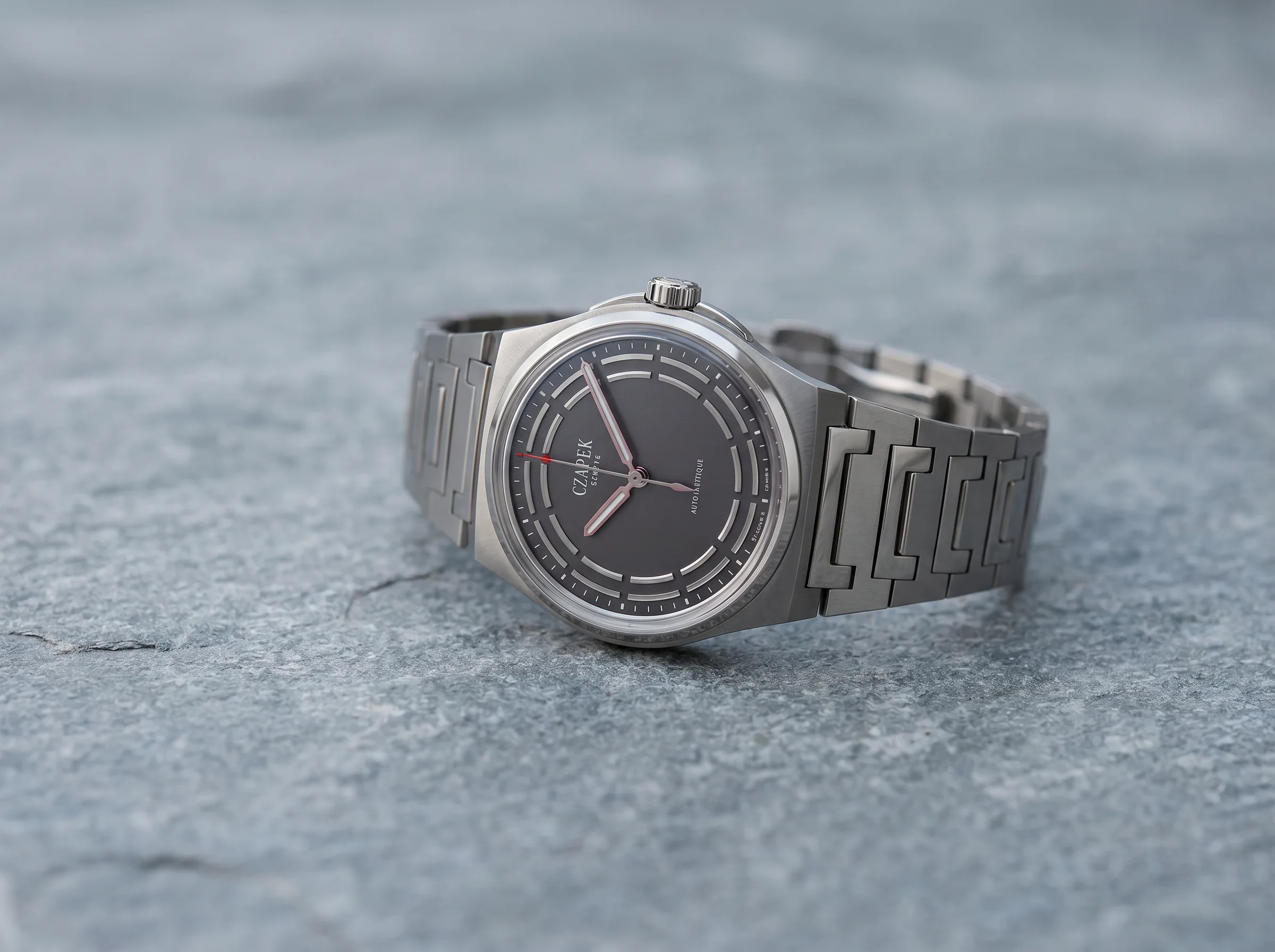 The Antarctique in grade 5 titanium. Lighter, greyer, and a more contemporary look than the steel originals.
What It Costs, and Whether You Can Get One
Czapek sits in the sweet spot between accessible and serious: pricier than a mainstream brand, cheaper than the mega-independents.
A steel Antarctique starts around $20,000 to $22,000. The titanium models climb, with the Antarctique Titanium Dark Sector at CHF 32,000, the skeletonized Révélation at CHF 42,000, and the Antarctique Tourbillon in titanium at CHF 67,000. Compared with F.P. Journe or Richard Mille, this is an attainable way into a real independent.
The catch is availability. The Antarctique has been an unexpected hit for a brand this size, editions are produced in small yearly runs, and the order book opens in windows rather than sitting on a shelf. Wanted references trade at or above retail on the secondary market, and simply getting one is the main challenge.
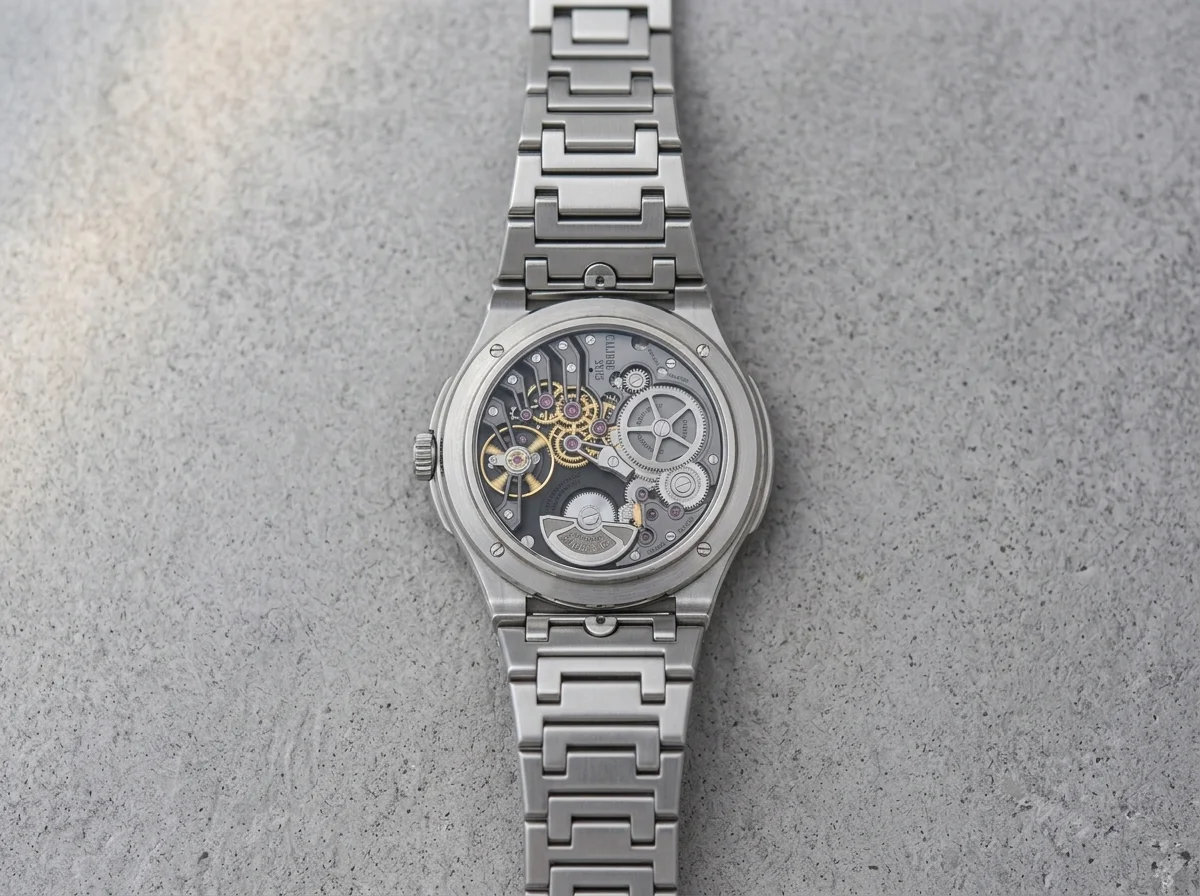 The in-house SXH5: an off-center platinum micro-rotor and five openworked bridges. The reason Czapek is taken seriously.
How to Buy One
New allocation comes in waves, often around Watches and Wonders, and the wanted dials go fast, so many buyers turn to the secondary market.
The rules are the familiar ones for a low-volume independent. Buy with the full set and papers, from a dealer who authenticates, and pay attention to which dial and edition you are getting, since that drives both desirability and price. Czapek is not heavily counterfeited, so the real risks are condition, completeness, and overpaying for a hyped color.
The Bottom Line
Czapek & Cie turned a footnote in Patek's history into one of the more credible young independents in watchmaking. The community ownership is genuinely different, the Antarctique is a real alternative in a crowded category, and the in-house SXH5 gives the whole thing substance. For a collector who wants an integrated sports watch with a story and serious watchmaking, Czapek is well worth knowing.
Czapek turned a footnote in Patek's history into a watch worth owning, and its buyers are shareholders as much as customers. If a small brand with a big story is more your speed than the safe pick, you already understand the appeal, and the Nautilus versus Royal Oak rivalry it quietly descends from is a good place to keep reading.
Frequently Asked Questions
What is Czapek & Cie?
Czapek & Cie revives the name of François Czapek, the watchmaker who partnered with Antoine Norbert de Patek in 1839 as Patek, Czapek & Cie, before Patek went on to form Patek Philippe. The modern brand relaunched in 2015 through equity crowdfunding, so many of its collectors are also shareholders. It is an independent based in Geneva.
What is the Czapek Antarctique?
The Antarctique, launched in 2020, is Czapek's integrated-bracelet luxury sports watch. It has a barrel-shaped case that avoids the usual angular bezel, an integrated bracelet with C-shaped links, artisanal textured dials, and the in-house SXH5 micro-rotor movement. It is the watch that made the brand's reputation.
How much is a Czapek watch?
A steel Antarctique starts around $20,000 to $22,000. Titanium models run higher: the Antarctique Titanium Dark Sector is CHF 32,000, the skeletonized Révélation is CHF 42,000, and the Antarctique Tourbillon in titanium is CHF 67,000. Czapek is the attainable end of serious independent watchmaking.
Is the Czapek Antarctique hard to get?
Yes. The Antarctique has been a bigger success than expected for a brand this size, editions are made in small yearly runs, and the order book opens in windows rather than being always available. Wanted references trade at or above retail on the secondary market, so getting one is often the hardest part.
What makes Czapek dials special?
They are made by the specialist dial maker Metalem using artisanal texturing, such as the combed Lamé pattern of the first Terre Adélie and the flinqué guilloché of the Passage de Drake. Czapek also uses distinctive colors and materials, from the Emerald Iceberg to stone and meteorite dials, which is a big part of the brand's appeal.