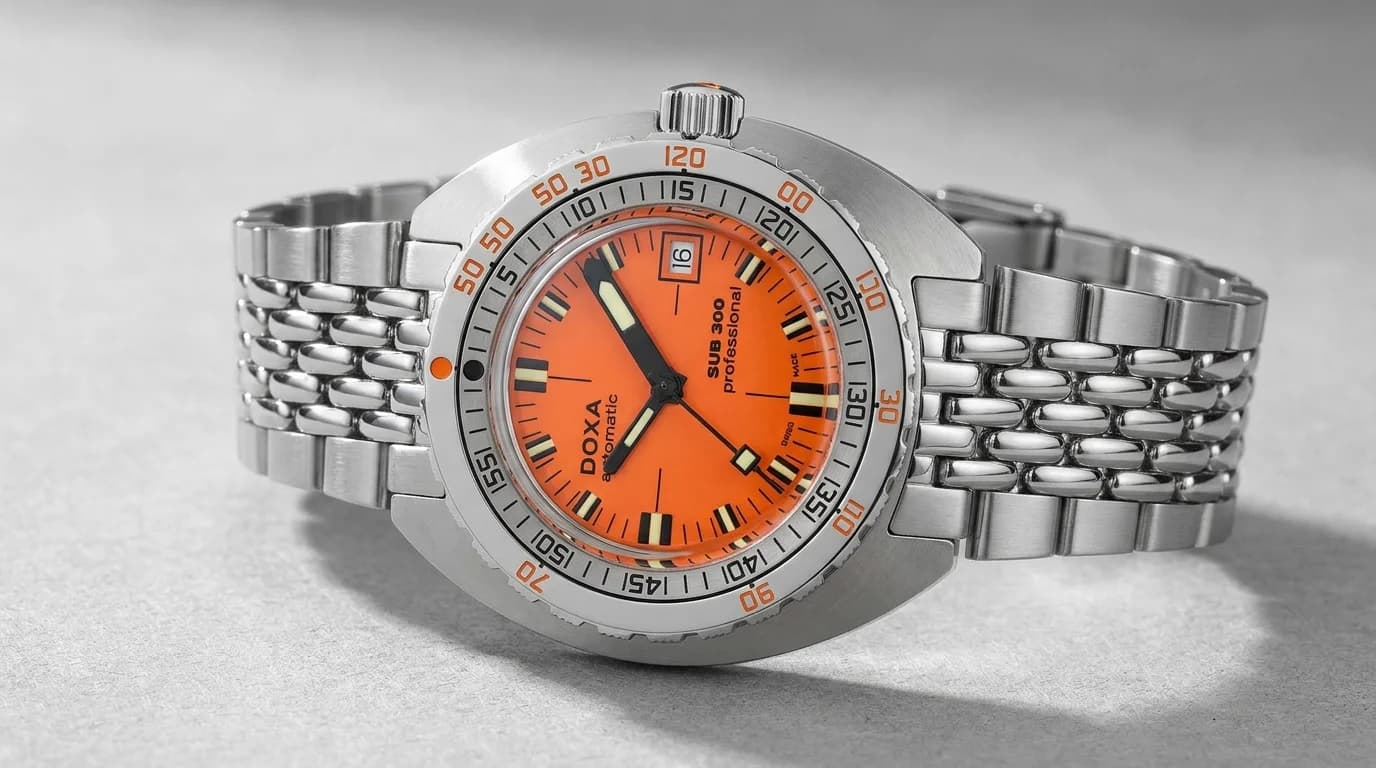
Ask a room full of watch people to name the brand that invented the orange dive dial and you will get blank stares from half the room. Doxa has been making that orange dial since 1967, and it is older than Rolex, yet most collectors have never handled one. That gap between reputation and quality is exactly why Doxa is worth understanding before you buy.
The images in this article were generated with AI for illustration. They show recognizable Doxa models based on real reference photography, but are not photographs of a specific watch for sale.
The Short Answer
- Doxa was founded in 1889 in Le Locle, decades before most of the brands it now gets compared to.
- The SUB 300, launched in 1967, introduced the orange dial (chosen for depth visibility) and the no-decompression bezel, a rotating bezel marked with actual dive-table limits.
- The current SUB 300 Professional runs 42.5mm, COSC-certified, 300m water resistant, at $2,890 on the steel bracelet.
- The smaller SUB 200 II drops to 200m water resistance and a non-COSC movement, starting around $1,690 to $1,750.
- Doxa built the first commercially available helium escape valve in 1969, two years before Rolex added one to the Sea-Dweller.
Who Doxa Actually Is
Doxa spent its first seven decades as an ordinary Swiss watchmaker. Founded by Georges Ducommun in 1889, the brand made pocket watches, dress watches, and even alarm complications before anyone connected the name to diving.
The SUB 300 changed everything
Doxa unveiled the SUB 300 at Basel in 1967. It was not the first dive watch, but it solved a real problem nobody else had addressed. Orange, it turned out, stays visible longest as water filters out color with depth. So Doxa put the whole dial in orange rather than a small accent.
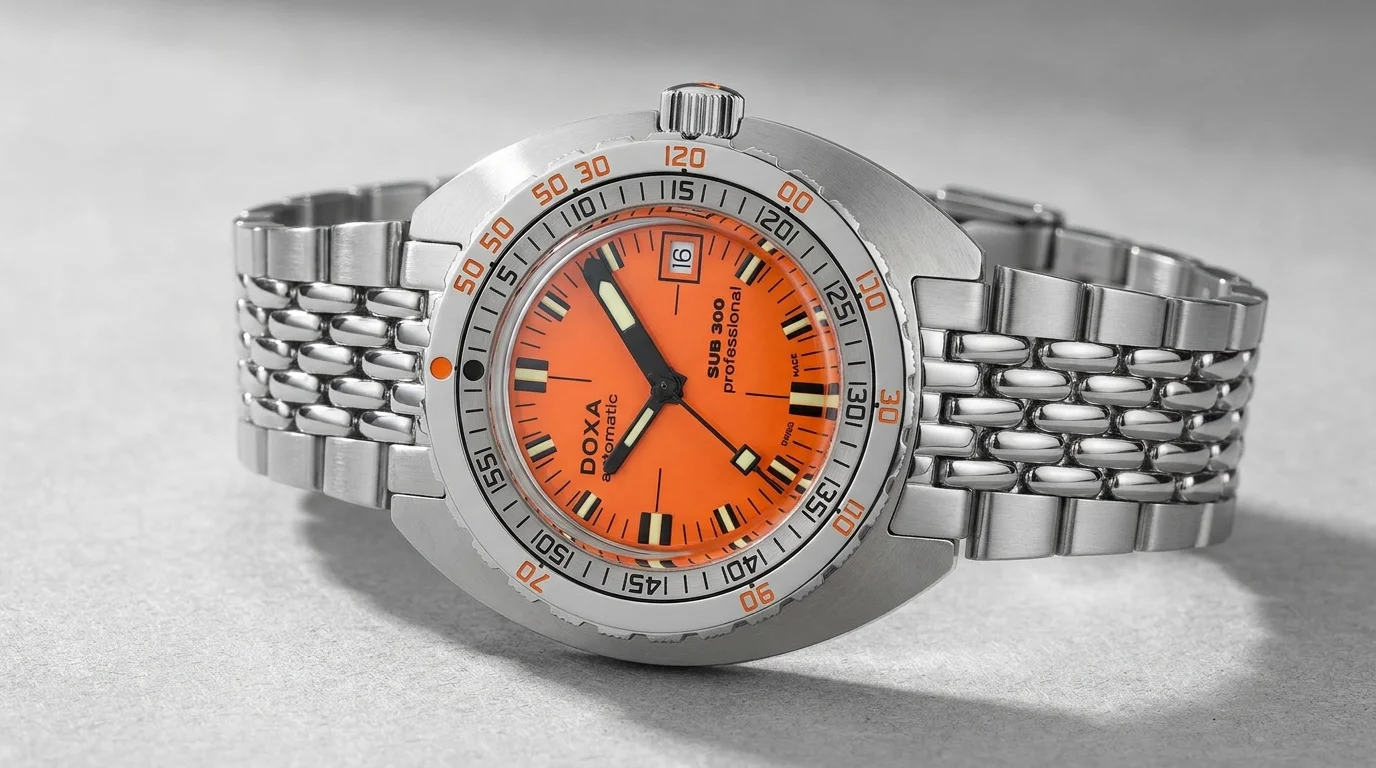 The orange dial was never a style choice. It is the color that stays legible longest as depth cuts out the rest of the spectrum.
The bezel that put dive tables on your wrist
The SUB 300's rotating bezel carried the U.S. Navy's no-decompression limits printed directly on the steel. A diver could check remaining bottom time without a separate table or a dive computer, which did not exist yet.
Doxa developed the no-decompression bezel with U.S. Divers, the company Jacques Cousteau chaired from 1957 until his death in 1996. Cousteau's own teams wore the SUB 300.
That Cousteau connection is not marketing color. It is the reason Doxa earned real credibility in the water instead of in an advertisement.
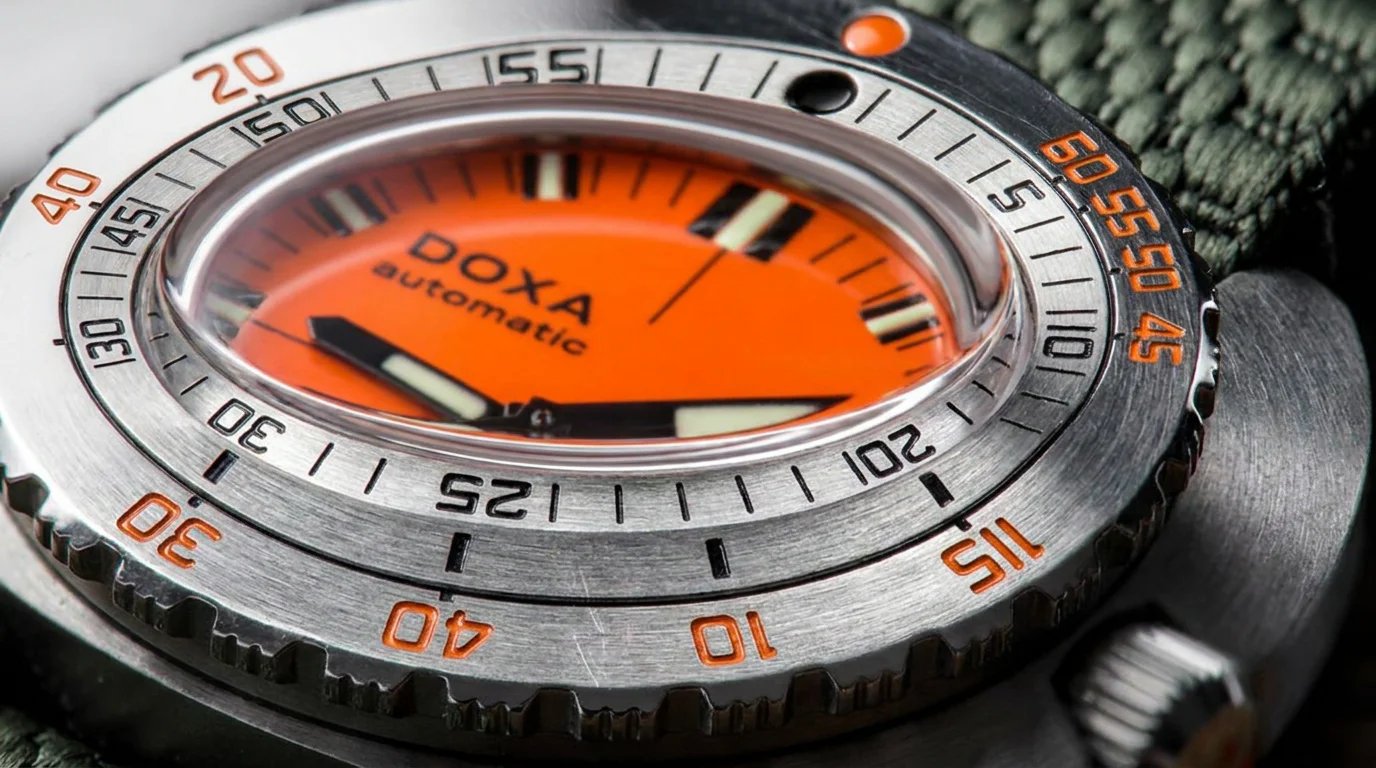 Depth and time, printed directly on the bezel. This is the mechanism that made the SUB 300 more than a pretty orange watch.
The helium valve nobody credits Doxa for
In 1969 Doxa built the SUB 300T, the first commercially available dive watch with a helium escape valve. The valve releases helium that seeps into the case during saturation diving, preventing the crystal from popping off during decompression. Rolex added the same idea to the Sea-Dweller two years later, and Rolex gets most of the credit today. Our Helium Escape Valve Explained piece covers how the mechanism works and why Doxa rarely gets mentioned in that story.
The SUB 300: The Serious Diver
The SUB 300 Professional is Doxa's flagship, and it is a genuine tool watch, not a heritage costume.
What you actually get
| Spec | SUB 300 Professional |
|---|---|
| Case | 42.5mm steel, 13.4mm thick |
| Movement | Swiss automatic, COSC chronometer certified |
| Power reserve | 38 hours |
| Water resistance | 300m |
| Bezel | Unidirectional, no-decompression and depth scale |
| Dial options | Professional orange, Sharkhunter, Caribbean, Searambler, Divingstar, Aquamarine, Whitepearl, Sea Emerald |
| Strap | Beads-of-rice bracelet or FKM rubber |
| Price | $2,890 (bracelet) / $2,850 (rubber) |
Eight dial colors sounds like a lot, but each one traces back to a specific decade or dive team in Doxa's own history rather than a marketing color chart. The Sharkhunter's black dial and the Divingstar's silver both have their own 1960s and 1970s namesakes.
The Divingstar variant
The SUB 300 Divingstar shares every spec with the Professional but ships with a distinct dial treatment aimed at collectors who want the flagship spec sheet without the signature orange. Same 42.5mm case, same COSC movement, same $2,890 to $2,850 pricing depending on strap.
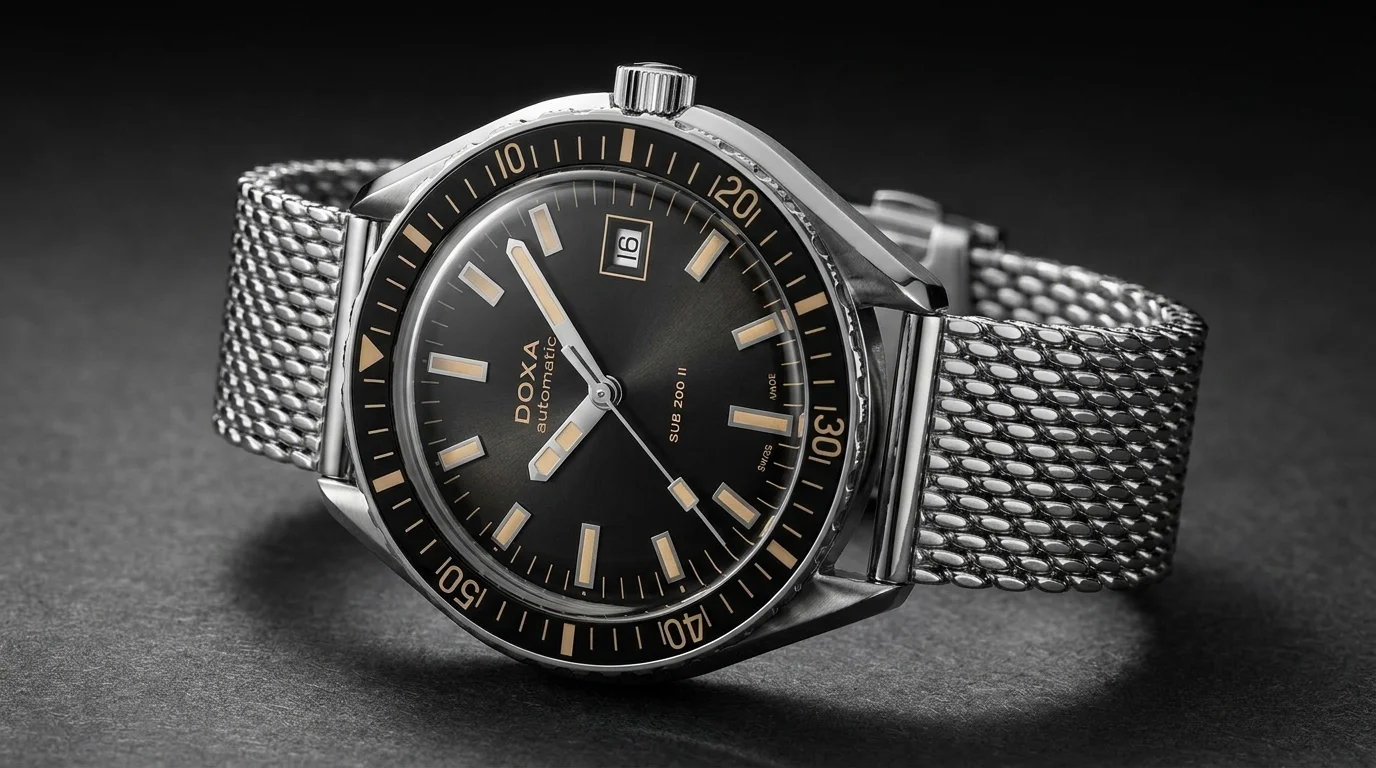 The SUB 200 II Sharkhunter trades the orange dial and COSC certification for a lower price and a genuinely different look.
The SUB 200: The Accessible Entry
Doxa's SUB 200 line exists for buyers who want the design language without the SUB 300's price or COSC premium.
What changes at this tier
The SUB 200 II Sharkhunter runs a larger 44mm case but a thinner 12.8mm profile, water resistance drops to 200m, and the movement is a standard Swiss automatic rather than COSC-certified. It comes on a mesh bracelet rather than beads-of-rice, priced at $1,750 on steel or $1,690 on rubber.
Where this line actually fits
This is not a lesser SUB 300. It is a different watch for a different buyer: someone who wants Doxa's cushion case and dial language for daily wear rather than actual technical diving. If you are weighing this against other brands at a similar price, our Best Dive Watches 2026 roundup places the SUB 200 alongside its closest competitors.
What Doxa Just Released
If the SUB 200 II and SUB 300 Professional cover the core lineup, the 2026 news cycle added a genuine deep cut. Doxa revived its 1969 dive chronograph as the SUB 200 T.GRAPH II, a smaller 42mm cushion case on a Sellita SW510 automatic chronograph, priced at $4,250. That piece sits above this buying guide's core lineup as a specialist reissue rather than an everyday reference, and it is worth reading on its own for how carefully Doxa handled the resize.
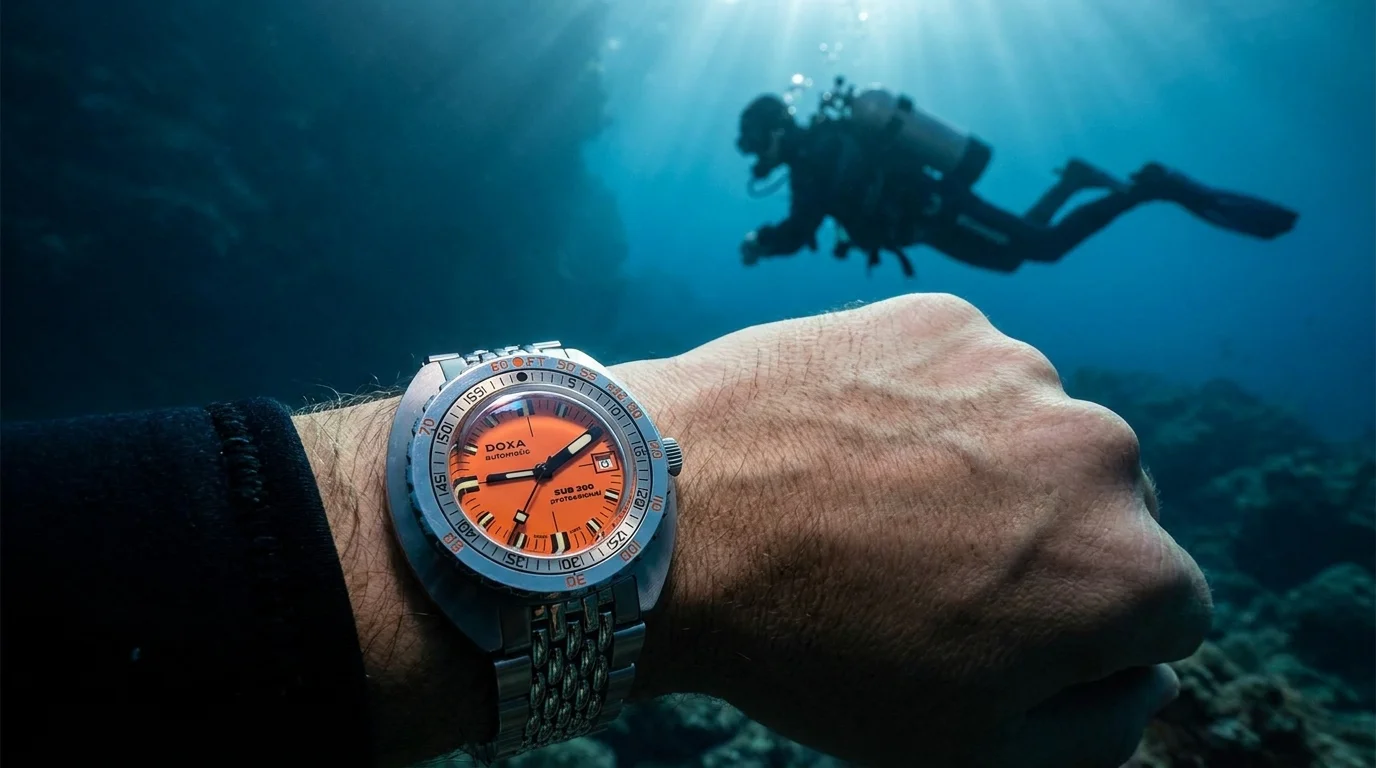 Orange was never about looking good in a photo. It is the color a diver can still read at depth.
Buying Pre-Owned
Doxa depreciates more than Rolex or Omega simply because fewer people know the name, and that works entirely in a buyer's favor.
What to check
Inspect the bezel action first. A gritty or loose-feeling bezel usually means sand or salt intrusion, not a defect, but it should still be serviced before you dive with it. Check the beads-of-rice bracelet for stretch at the pin links, the most common wear point on this style of bracelet. Confirm the lume still charges evenly across all hour markers, since uneven aging suggests a dial that has been refinished.
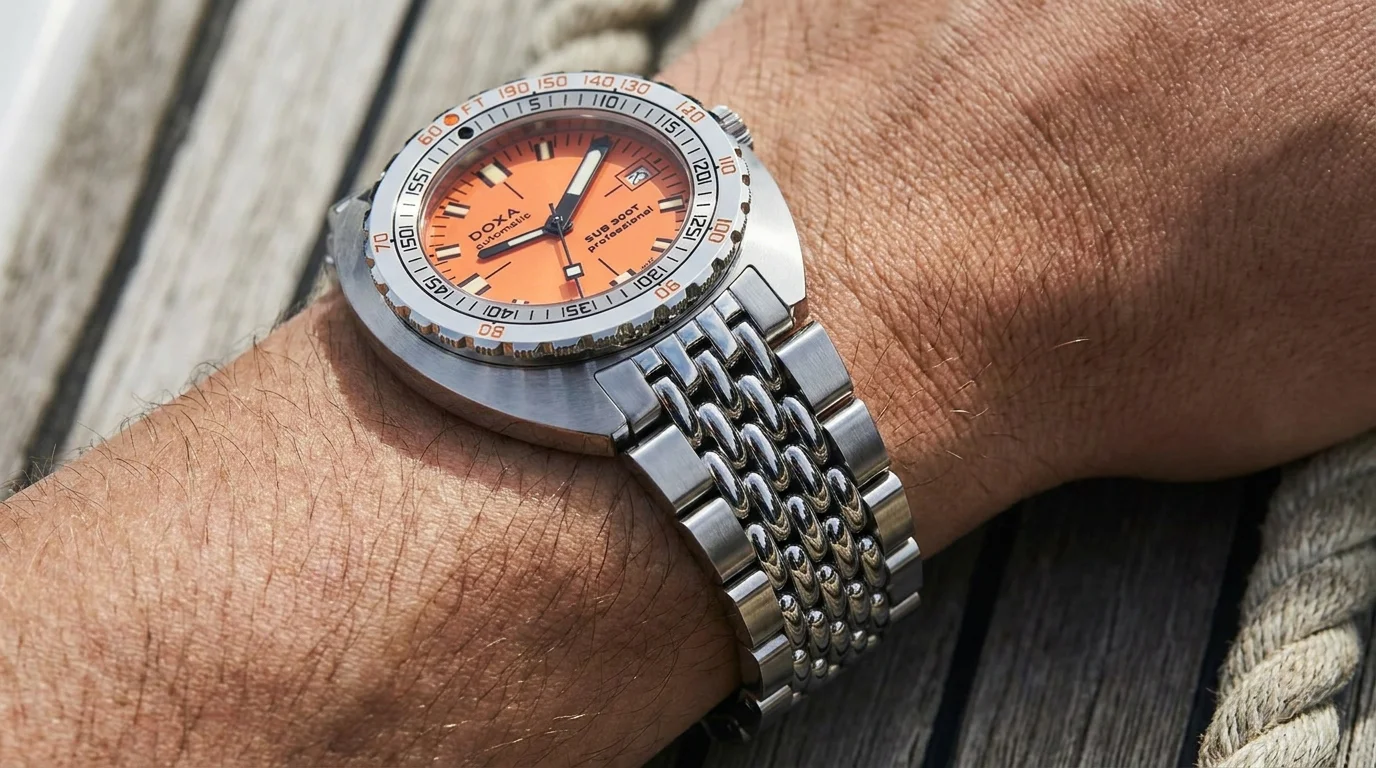 The beads-of-rice bracelet is as much a Doxa signature as the orange dial itself. Check the pin links for stretch before buying pre-owned.
Where to buy
Doxa does not run the same authorized-dealer network as Rolex or Omega, so grey market and pre-owned channels carry more of the volume than they would for a bigger name. Our Grey Market vs Authorized Dealer vs CPO breakdown covers how that difference affects warranty coverage and what to verify before you buy.
Which Doxa Fits You
Buy the SUB 300 Professional if you want a genuine 300m tool watch with COSC certification and the full historical weight of the orange dial behind it. Buy the SUB 200 II if the Doxa look and cushion case appeal to you more than the technical diving spec sheet, and the lower price matters. Buy the SUB 200 T.GRAPH II if you specifically want the chronograph function and the deepest cut in Doxa's own catalog.
Doxa built its reputation in the water, not in a boutique window, and that is still the most honest way to evaluate it today.
Browse authenticated pre-owned dive watches at 5dwatches.com.
Related Reading
- The Doxa SUB 200 T.GRAPH II: A 2026 Heritage Reissue Done Right
- Best Dive Watches 2026
- Helium Escape Valve Explained
- Grey Market vs Authorized Dealer vs CPO: Where Should You Actually Buy?
Frequently Asked Questions
Is Doxa older than Rolex?
Yes. Doxa was founded in 1889 in Le Locle, Switzerland, which predates Rolex's 1905 founding by 16 years. Doxa spent decades as a general Swiss watchmaker before its 1967 SUB 300 launch made it a dive-watch name.
Why are Doxa dials orange?
Doxa chose orange for the SUB 300 in 1967 because orange stays visible longest underwater as depth filters out the rest of the color spectrum. It was a practical safety choice for divers, not a styling decision, and it became the brand's signature.
What is the difference between the Doxa SUB 300 and SUB 200?
The SUB 300 Professional is COSC chronometer certified, rated to 300m water resistance, and comes on a beads-of-rice bracelet starting around $2,890. The SUB 200 II drops to a standard automatic movement, 200m water resistance, and a mesh bracelet, starting around $1,690, making it the more accessible entry point.
Did Doxa invent the helium escape valve?
Doxa built the first commercially available dive watch with a helium escape valve in 1969, on the SUB 300T. Rolex added a similar valve to the Sea-Dweller two years later in 1971 and receives most of the public credit for the innovation today.
Is Doxa a good value on the pre-owned market?
Yes. Doxa depreciates harder than Rolex or Omega mainly because fewer buyers recognize the name, not because of any quality shortfall. That makes pre-owned Doxa one of the stronger value plays among genuine Swiss dive watches with real historical credibility.