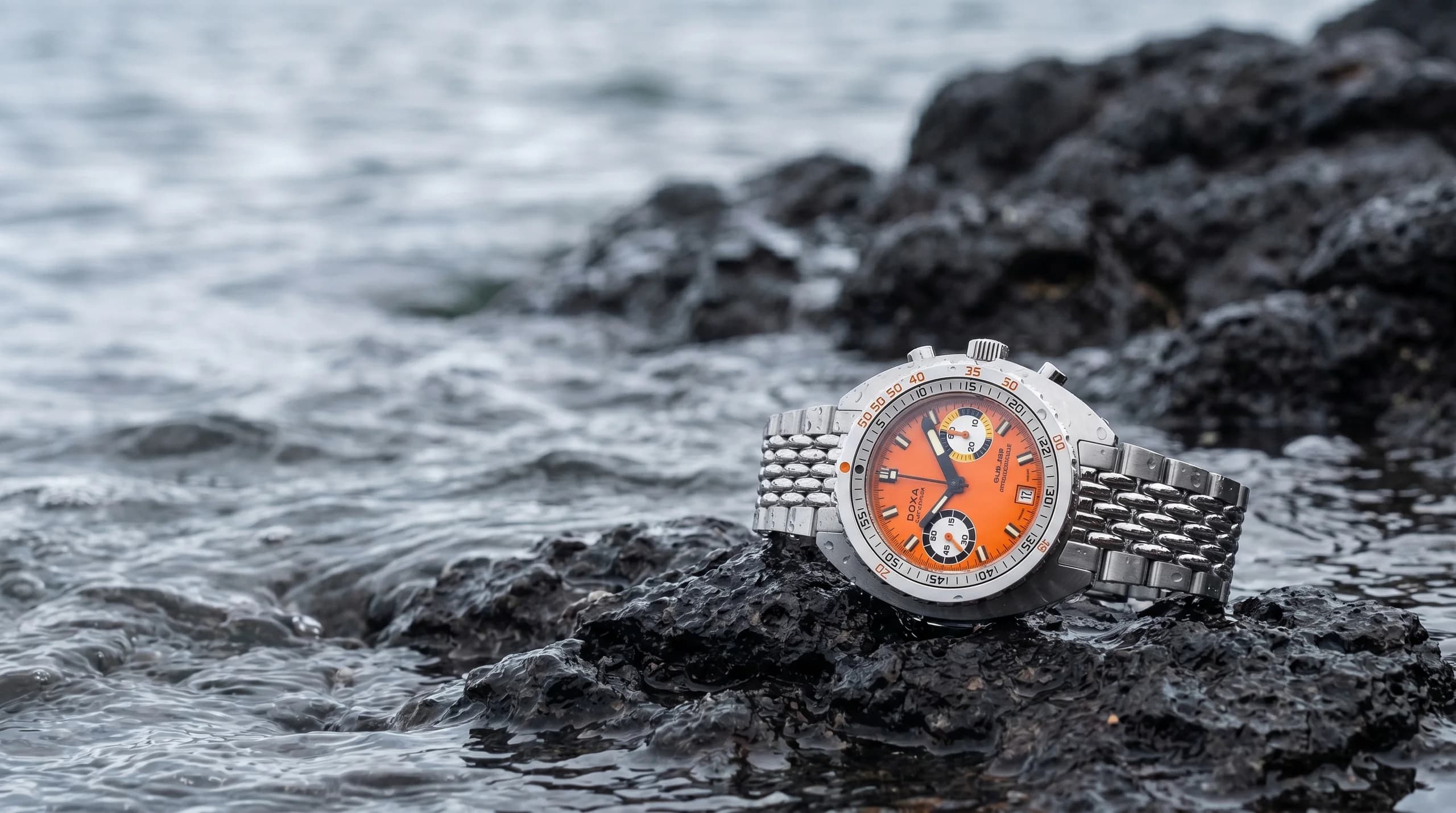
Ask ten people to name a Swiss watch brand and you will hear Rolex, Omega, maybe Tudor. You will almost certainly not hear Doxa. Yet inside dive-watch circles, Doxa is royalty, and one of the most quietly impressive watch releases of 2026 carries its name.
The new Doxa SUB 200 T.GRAPH II revives a 1969 dive chronograph that collectors have chased for years. More interesting than the watch itself is what it gets right. This is a clinic in how to reissue a heritage piece without ruining it.
The images in this post are AI-generated illustrations for editorial purposes and may not exactly represent the actual watch, its dial, or its finishing.
The short answer
Doxa brought back its cult dive chronograph as a slightly smaller, more wearable watch: a 42mm steel cushion case, a modern Sellita SW510 automatic chronograph, 200m of water resistance, and four dials including a new Caribbean blue. It runs $4,250 on rubber and $4,290 on the beads-of-rice bracelet. The restraint is the story. Doxa fixed the one real flaw, kept everything that mattered, and resisted the urge to chase hype. For the full picture of where this sits in Doxa's catalog, see our Doxa Buying Guide covering the SUB 300 and SUB 200 core lineup.
Who is Doxa, and why have you not heard of it
Doxa is older than most of the names it sits next to, and it never played their game.
Founded in 1889 in Le Locle, Doxa spent its first decades making pocket and dress watches. Its legend was built in the 1960s, when it set out to make a dive watch for ordinary divers rather than navies. The SUB 300 of 1967 introduced two ideas that the whole category later borrowed: a bright orange dial, chosen because orange stays visible longest as water filters out color with depth, and a bezel marked with no-decompression limits, putting dive-table data right on the wrist.
It earned its credibility in the water, not in advertising. Doxa SUBs were distributed through Jacques Cousteau's diving company, and the brand became a fixture of that golden age of exploration. It even rode on the wrist of Dirk Pitt across dozens of Clive Cussler novels. Doxa never built the boutiques or marketing machine that Rolex and Omega did, faded through the quartz years like much of Swiss watchmaking, and came back as an enthusiast brand. That is exactly why purists love it and most people have never heard the name.
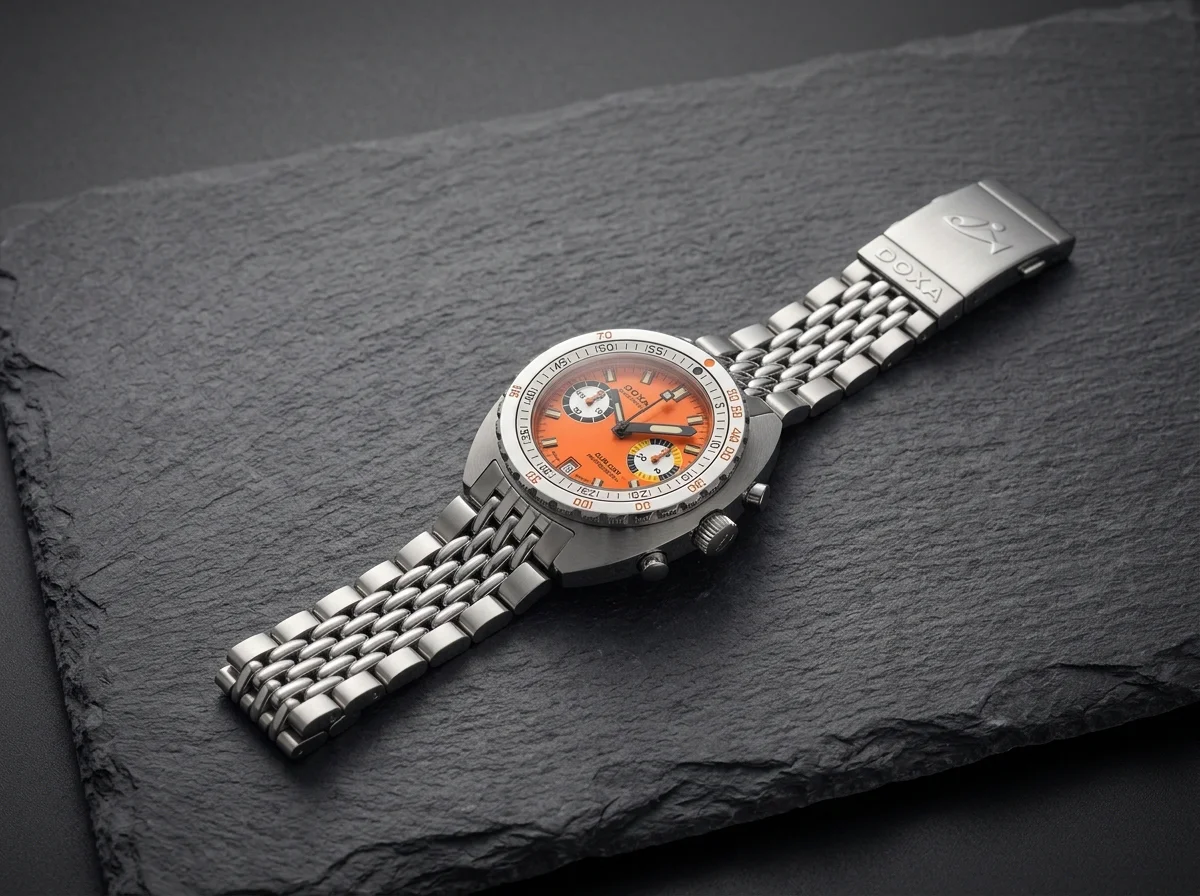 The cushion case, orange dial, and no-deco bezel are pure 1960s Doxa. (AI-generated illustration.)
What the T.GRAPH actually was
The T.GRAPH is the deep cut even within Doxa's own catalog.
When Doxa added a chronograph to the SUB in 1969, a dive watch with a stopwatch was still a strange idea. The point was practical: the chronograph timed surface intervals between dives, while the rotating bezel handled elapsed time underwater. Two timers, two jobs, one legible dial. Worn & Wound notes there is arguably no watch in Doxa's catalog with more lore attached to it than the T.GRAPH, and a brief reissue in 2019 only sharpened the appetite for a proper return.
It was always a dive watch first and a chronograph second, and the new version keeps that order of priorities exactly.
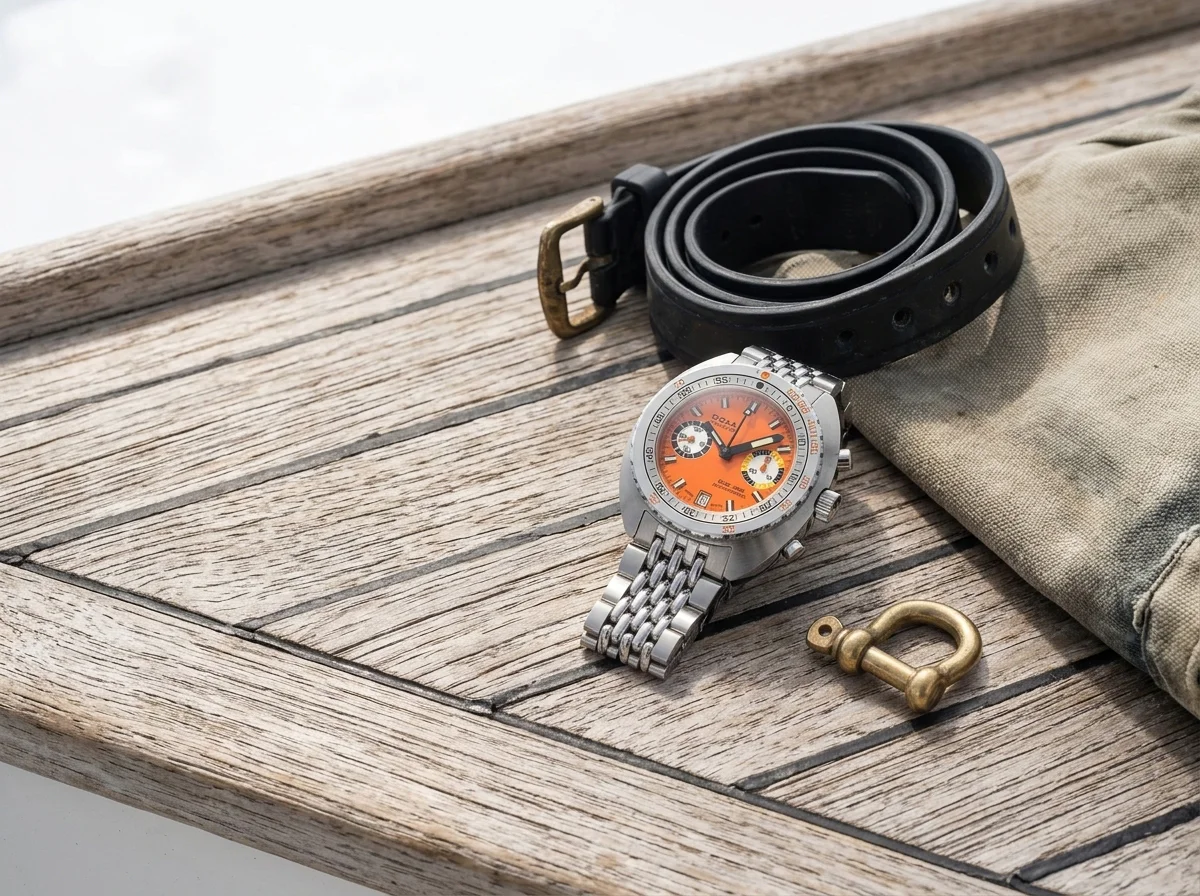 A dive watch first, a chronograph second. The bezel still does the underwater timing. (AI-generated illustration.)
What is new in the II
Doxa changed the few things that needed changing and left the rest alone.
The headline is size. The previous modern T.GRAPH wore large at 43mm wide and 15.15mm thick, a lot of watch even by cushion-case standards. The II trims to 42mm and 14.6mm, which sounds minor on paper and matters a great deal on the wrist. Inside is the Sellita SW510, a robust automatic chronograph beating at 4Hz with a 56-hour reserve, built on the proven Valjoux 7750 architecture.
| Spec | Doxa SUB 200 T.GRAPH II |
|---|---|
| Case | 42mm steel cushion, 14.6mm thick, 44.5mm lug-to-lug |
| Bezel | Unidirectional steel, no-deco and 60-minute scale |
| Movement | Sellita SW510 automatic chronograph |
| Power reserve | 56 hours |
| Water resistance | 200m |
| Crystal | Sapphire with AR coating |
| Dials | Professional orange, Searambler silver, Sharkhunter black, Caribbean blue |
| Strap | Beads-of-rice steel bracelet or rubber, wetsuit extension |
| Price | $4,250 (rubber) / $4,290 (bracelet) |
The dial stays clean despite the added complication: a 30-minute counter at 3 o'clock, running seconds at 9, a date at 6, and Doxa's printed baton markers packed with Super-LumiNova. The one genuinely new note is Caribbean blue, a color long used elsewhere in the SUB line but never offered on a T.GRAPH until now. Gear Patrol describes the result as respectfully untouched, a retro tool watch made relevant by the new size, movement, and straps.
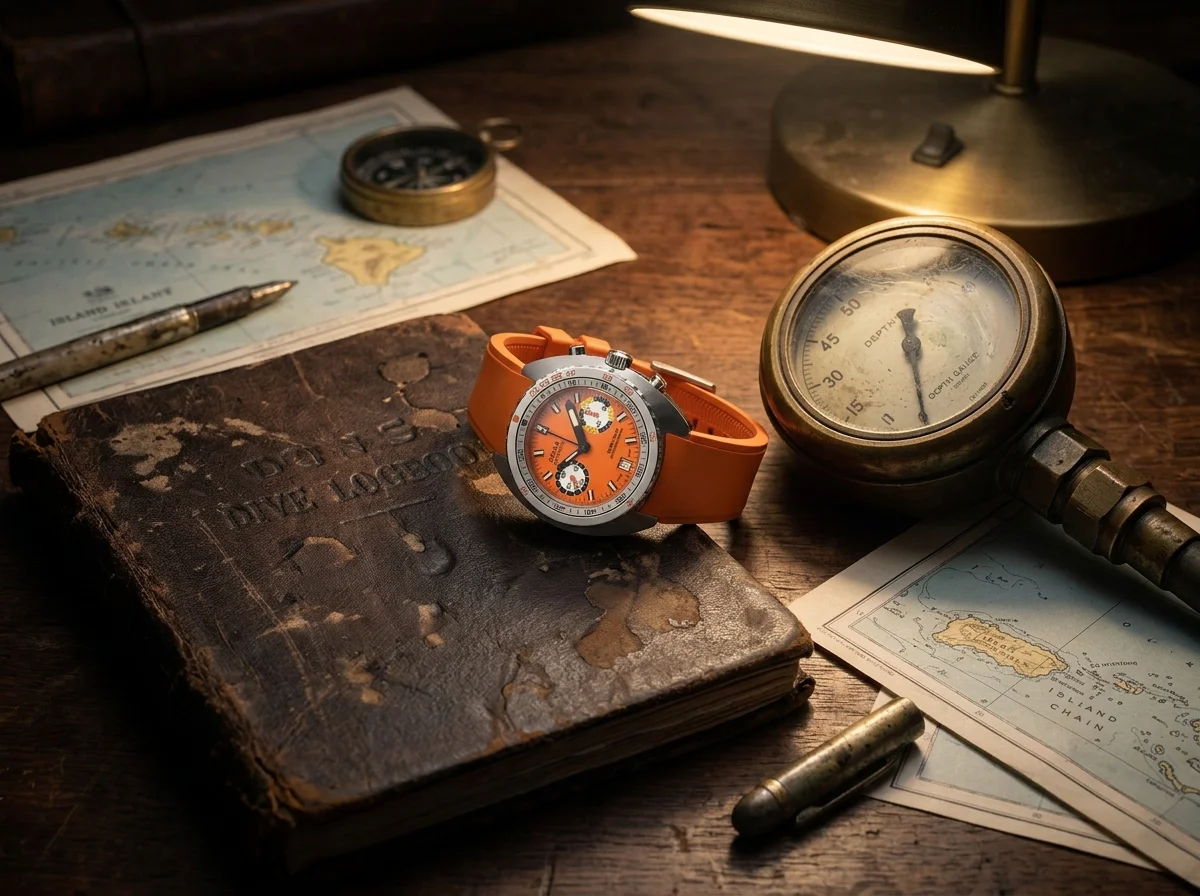 Sellita inside, not a fake in-house story. The right call for a tool watch. (AI-generated illustration.)
Why this is a reissue done right
Most heritage relaunches get one of two things wrong. Doxa avoided both.
The first failure mode is over-restoration, sanding off the character that made the original worth reviving. The second is hype, turning a tool watch into a limited-edition lottery ticket priced for flippers. The T.GRAPH II does neither. Doxa fixed the single legitimate complaint, the size, and changed almost nothing else. It is not a limited edition, so there is no artificial scarcity to game.
The movement choice tells the same story. Doxa used a Sellita rather than inventing an in-house calibre to justify a higher price. For a watch built to go in the water, an honest, serviceable, widely understood movement is the correct engineering decision, not a compromise. A tool-watch company behaving like a tool-watch company is rarer than it should be.
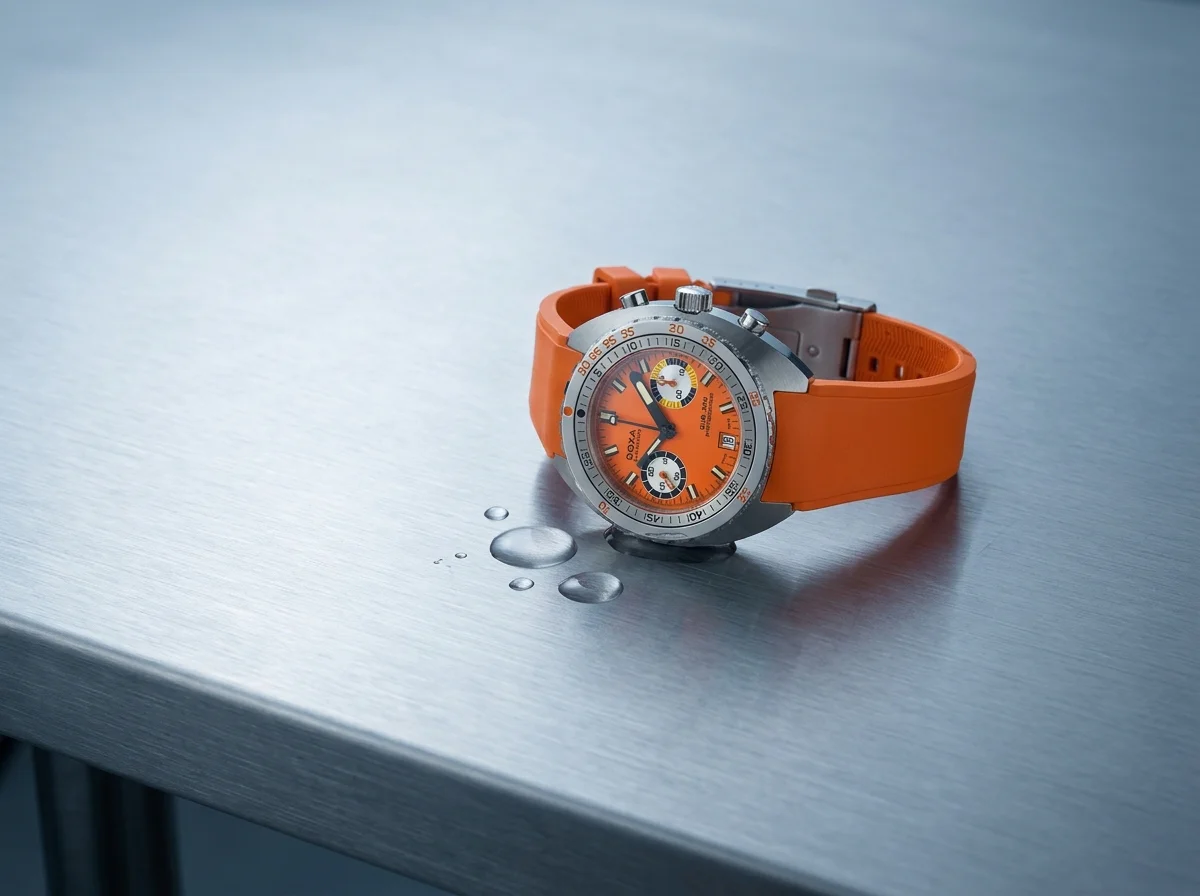 Not limited, not hyped, fairly priced. A tool watch acting like one. (AI-generated illustration.)
A working dealer's read
At roughly $4,250, this is a Swiss automatic dive chronograph with more than fifty years of genuine dive-watch lineage behind it, undercutting most of the name-brand dive chronographs it competes with. You are not paying a hype tax, because there is no hype to tax.
It is not for everyone. The cushion case wears like nothing else and is a genuine acquired taste, and a chronograph diver is a deliberately niche tool. But that specificity is the appeal. The T.GRAPH II is aimed squarely at people who actually care about dive watches, and it rewards them.
If a watch with a real cult following and no mainstream noise is your kind of thing, the same instinct runs through other corners of the hobby worth knowing. That is the thread I pulled on in the guide to Seiko's Prospex line as a gateway to serious tool watches: another range built for people who use the watch, beloved by purists, and largely ignored by everyone else. Doxa belongs in exactly that conversation.
For the rest of Doxa's current lineup, including the SUB 300 Professional and the more accessible SUB 200 II, see our full Doxa Buying Guide.