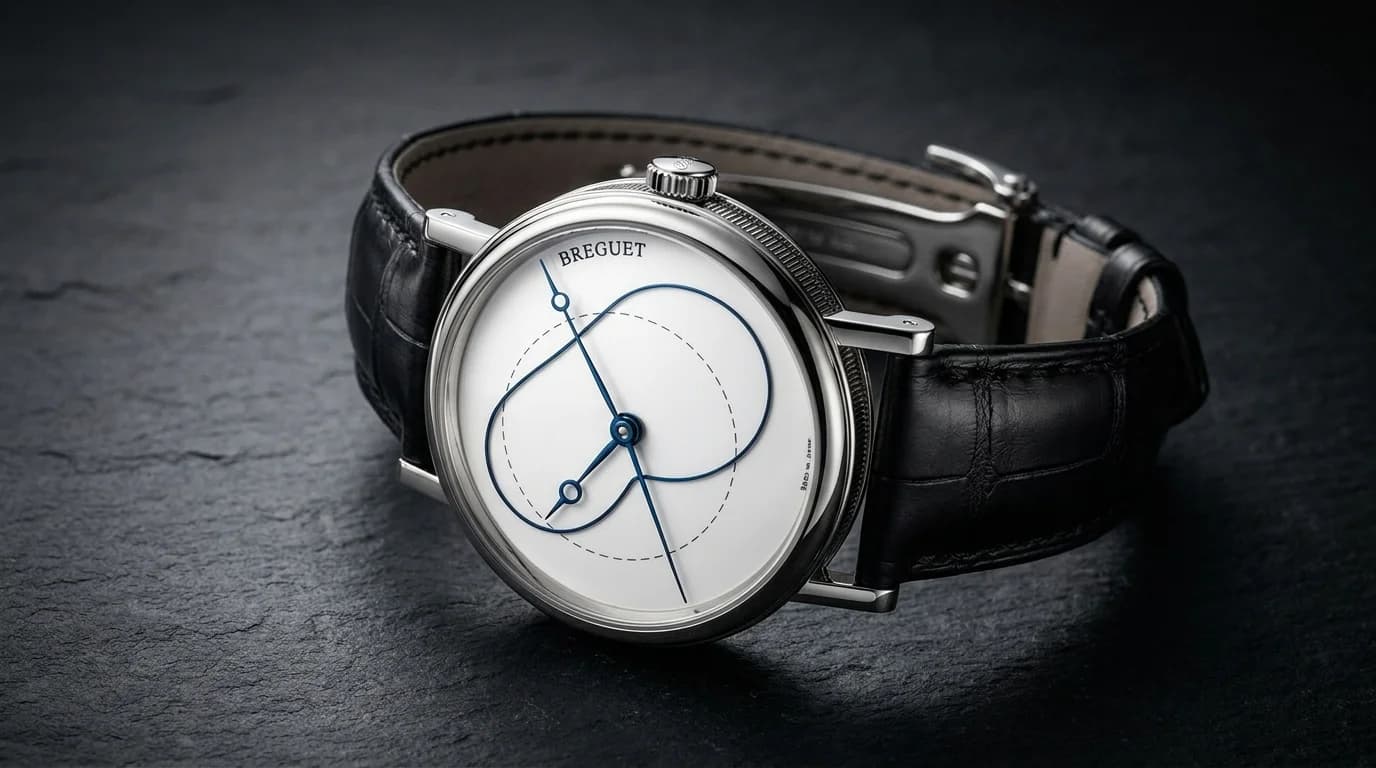
A sundial and a wristwatch almost never agree, and the gap between them can run past a quarter of an hour in either direction. That gap has a name, the equation of time, and a handful of watchmakers have spent three centuries building mechanisms to display it on your wrist.
The images in this article were generated with AI for illustration. They show recognizable equation of time watches and mechanisms based on real reference photography, but are not photographs of a specific watch for sale.
The Short Answer
- The equation of time is the gap between solar time (what a sundial shows) and mean time (what a clock shows), caused by Earth's elliptical orbit and its axial tilt.
- That gap runs from roughly minus 16 minutes in early November to plus 14 minutes in mid-February, and it hits zero only four times a year.
- Watches display it with a kidney-shaped cam, a component whose curved profile physically encodes the yearly variation.
- Breguet built the first wristwatch version in the early 1990s, priced around $170,000 at the time, with fewer than 20 made per year.
- Modern examples include the Breguet Classique 7147 and Marine Equation Marchante, the Audemars Piguet Jules Audemars Equation of Time, and Blancpain's Equation Marchante.
Why Solar Time and Clock Time Disagree
A sundial tells you the truth about where the sun actually is. A clock tells you a useful lie everyone agreed to believe.
Earth's orbit is not a circle
Earth moves faster around the sun when it is closer, near early January, and slower when it is farther away, near early July. That uneven speed means the actual solar day, the time between the sun crossing your local meridian on consecutive days, is not a constant 24 hours. Clocks average all of that out into one uniform length called mean time.
The tilt adds a second distortion
Earth's axis sits tilted about 23.5 degrees relative to its orbital plane. As the sun's apparent path crosses the sky at an angle instead of straight along the equator, that angle itself introduces timing drift independent of the orbital speed issue. The two effects combine and partially cancel at different points in the year, which is why the equation of time curve is not a smooth simple wave.
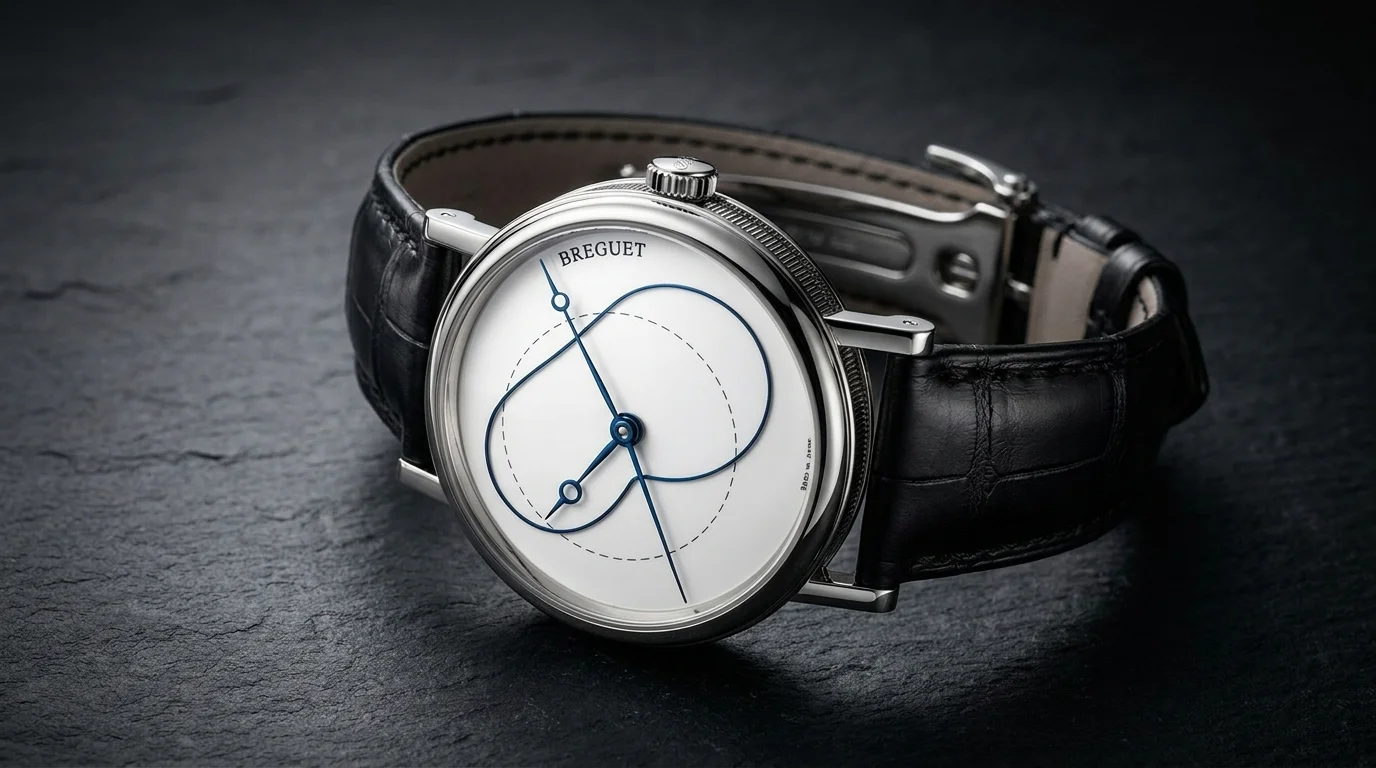 The figure-eight analemma is the visual signature of the equation of time, a graph of where the sun actually sits at the same clock time across a full year.
Solar time and mean time agree exactly only four times a year, roughly mid-April, mid-June, early September, and late December. Every other day of the year, your sundial and your watch are telling two different truths.
How Much the Two Times Actually Diverge
The gap is bigger than most people assume.
The extremes
Solar time falls as much as 16 minutes behind mean time in early November, then swings to roughly 14 minutes ahead of mean time in mid-February. That is a real, walk-outside-and-check-the-shadow difference, not a rounding error.
Why this used to matter more
Before railroads forced standardized time zones in the 1800s, many cities ran on local solar time set by their own sundials. Geneva adopted mean time in 1780, England in 1792, and Berlin in 1810, each city trading the sun's literal truth for a more practical, uniform standard. The equation of time complication exists because watchmakers wanted to preserve a way to see both truths at once.
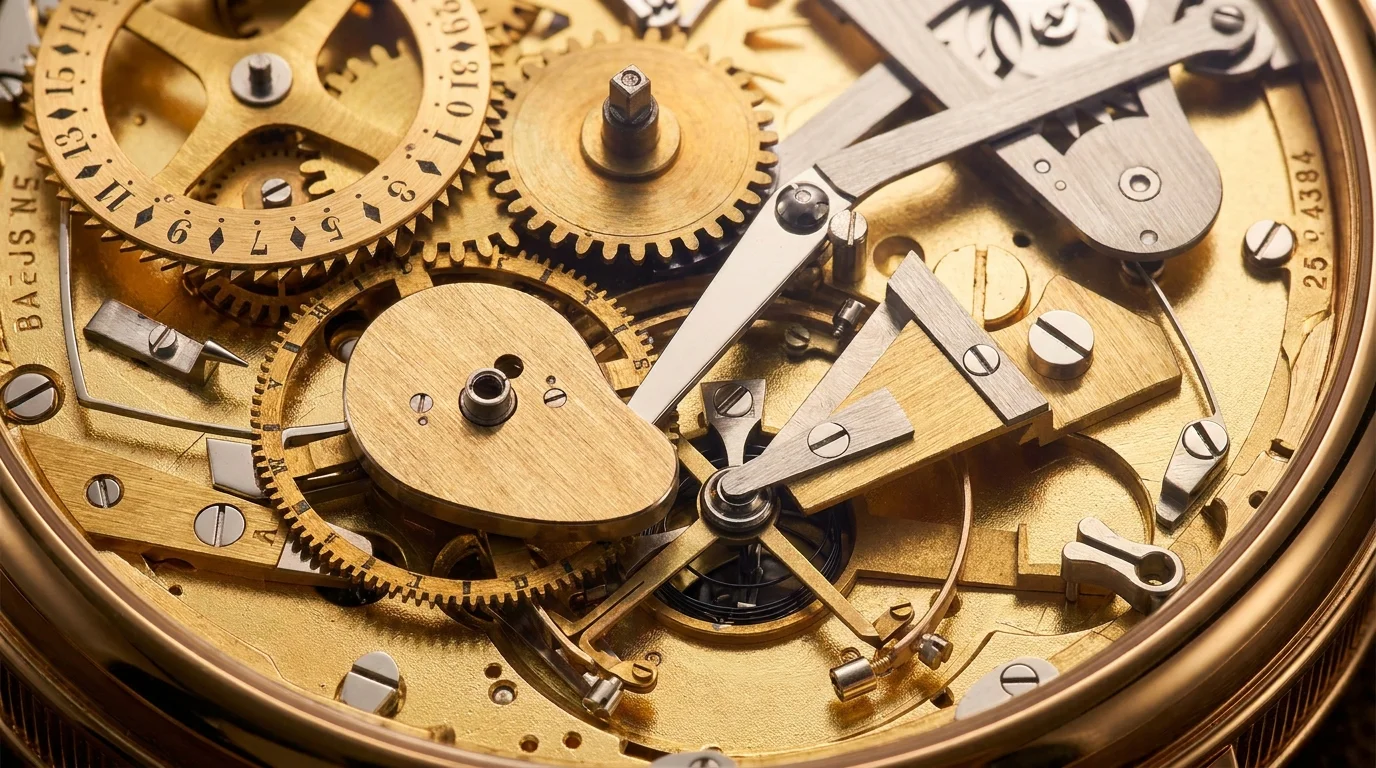 The kidney-shaped cam's curved edge is the entire mechanism's memory. Its shape at any point in its yearly rotation is the equation of time value for that date.
How the Mechanism Actually Works
The complication comes down to one carefully shaped piece of metal doing all the work.
The kidney-shaped cam
A cam shaped like a kidney bean, its profile calculated from the equation of time's yearly curve, rotates once per year. A spring-loaded lever rides against the cam's edge, and the lever's position at any moment corresponds to that day's equation of time value. Every part of that curve is mechanically stored in the cam's physical shape.
Two ways to show the result
Most equation of time watches drive a small hand on a subsidiary dial, reading a plus or minus value in minutes that you mentally add to or subtract from the main time display. The rarer and more technically demanding version is the marchante, or "running," display, where a second, independently moving hand sweeps the main dial showing true solar time directly, no mental math required.
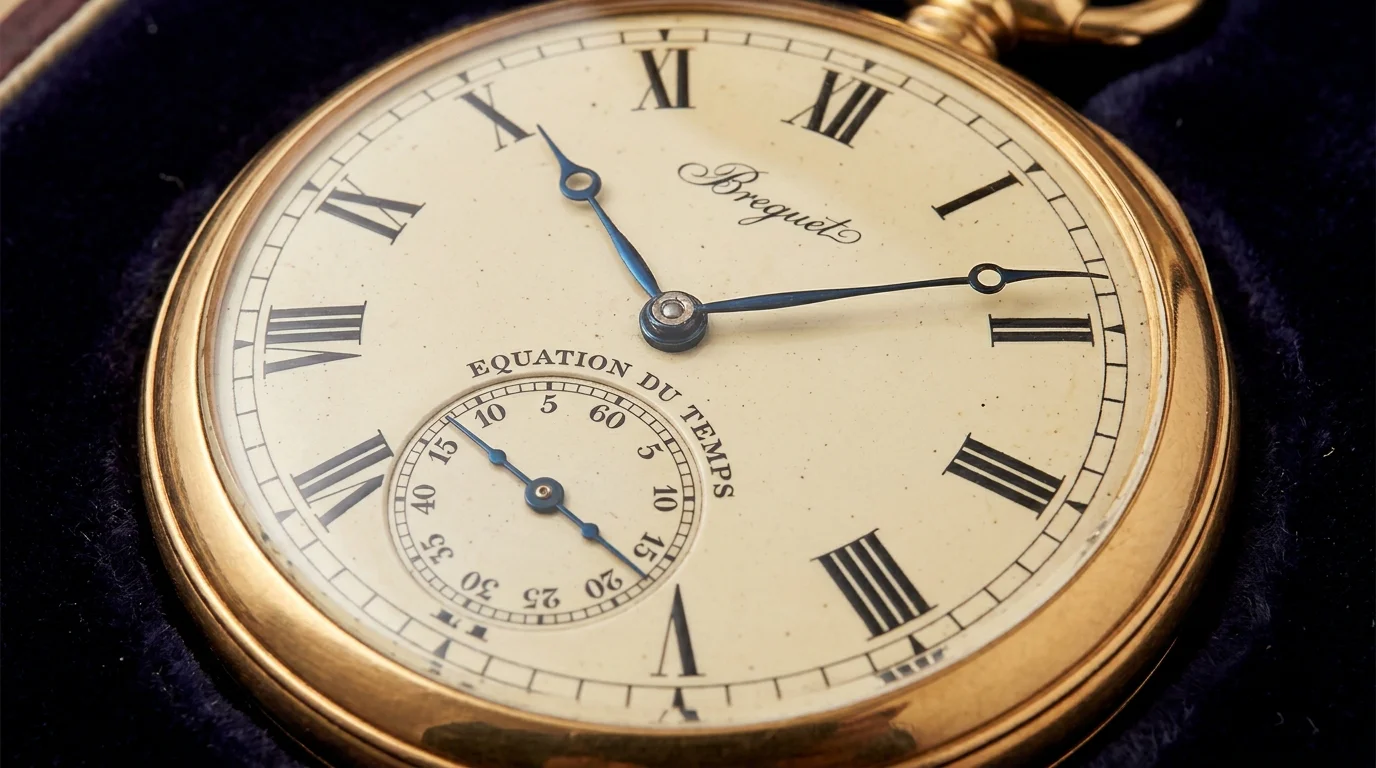 Early equation of time work happened almost entirely in pocket watches and clocks, generations before the complication made it to the wrist.
A Short History
The equation of time is one of horology's oldest complications, and it predates the wristwatch by centuries.
- 1719: Watchmaker Joseph Williamson claims credit for one of the first equation clocks.
- 18th century: Thomas Tompion and Ferdinand Berthoud both produce notable equation-of-time clocks and pocket watches, refining the kidney-cam approach.
- 1780 to 1810: Geneva, England, and Berlin each formally adopt mean time for civil use, phasing out local solar time as the practical standard.
- Early 1990s: Breguet builds the first equation of time wristwatch, priced around $170,000 at launch, with fewer than 20 pieces made annually.
- 2000: Audemars Piguet releases the Jules Audemars Equation of Time, and Patek Philippe unveils the one-of-a-kind Star Caliber 2000.
- 2004: Blancpain and Jaeger-LeCoultre both push the complication further, with Blancpain's Le Brassus Equation Marchante and Jaeger-LeCoultre's Gyrotourbillon 1.
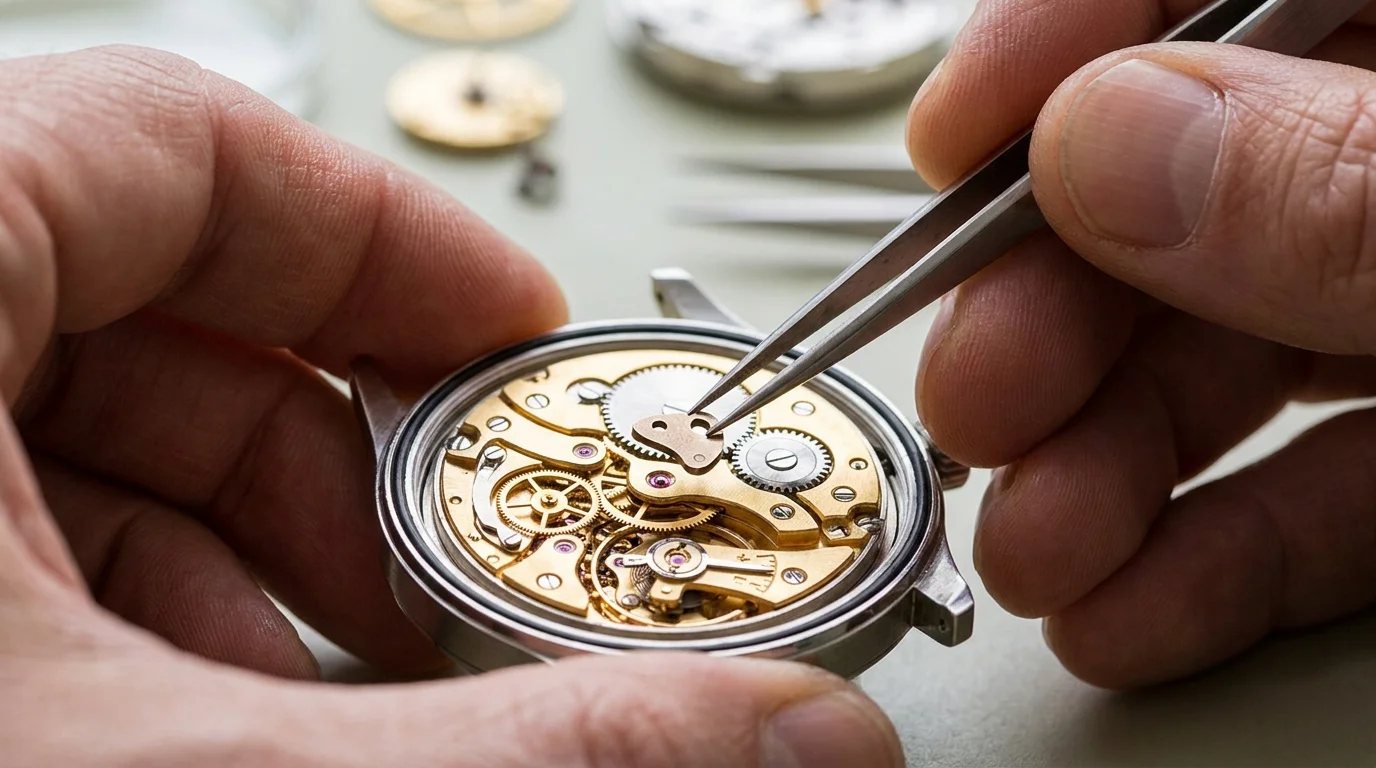 Cutting a kidney cam to the correct annual curve is a precision job. A fraction of a millimeter of error throws off the reading for weeks at a time.
Notable Examples
| Watch | Notable feature | Approx. context |
|---|---|---|
| Breguet Classique 7147 | Subsidiary equation of time display, Breguet's core modern reference | Six-figure range |
| Breguet Marine Equation Marchante 5887 | Running solar hand (marchante) plus perpetual calendar | High six figures |
| Audemars Piguet Jules Audemars Equation of Time | Combined with a perpetual calendar and moonphase | High six figures |
| Blancpain Le Brassus Equation Marchante | Running solar display, very limited production | Six figures |
| Patek Philippe Star Caliber 2000 | One-of-a-kind, among the most complicated watches ever made | Not for sale |
The Breguet Classique line remains the most accessible entry into a genuine equation of time complication, largely because Breguet has kept building it in small numbers since the early 1990s rather than treating it as a one-off flex piece.
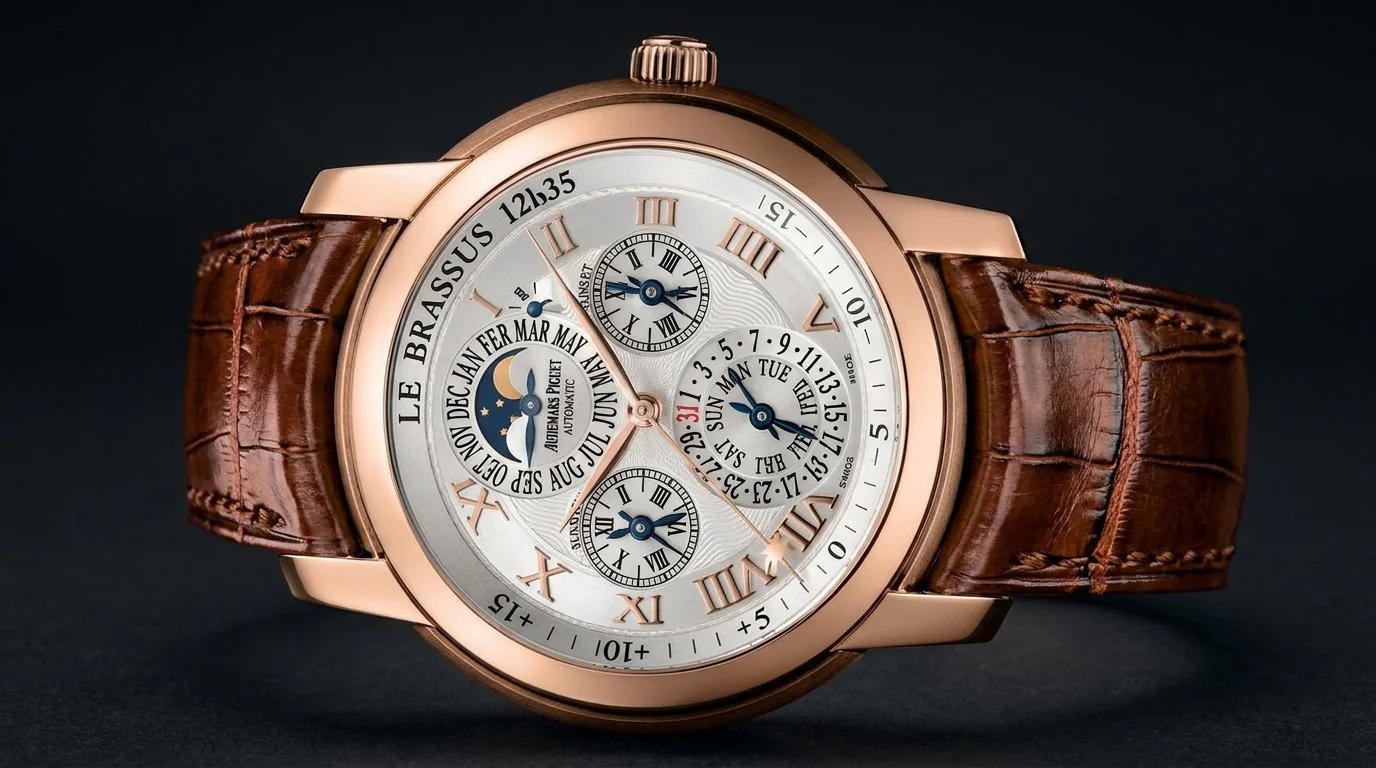 Audemars Piguet pairs its equation of time display with a full perpetual calendar, stacking two of horology's hardest complications on one dial.
Is an Equation of Time Watch Worth Owning
Buy one if the idea of carrying a mechanical model of Earth's actual orbit on your wrist genuinely appeals to you, not because you need to correct your commute by fourteen minutes. This complication has had zero practical use since mean time became the civil standard two centuries ago, and every buyer today is paying for the astronomy, not the utility.
For a different angle on complications that model something bigger than the watch itself, our What Is a Tourbillon? piece covers a mechanism built to fight gravity rather than track the sun. A world time watch tackles a related but different problem, showing every global time zone at once rather than the sun's yearly drift. Our World Time Complication Explained piece covers that mechanism in depth.
Related Reading
- What Is a Tourbillon?
- Perpetual Calendar Explained: How a Watch Knows It's Not February 30th
- What Is a Regulator Dial?
- World Time Complication Explained: Every Time Zone, One Dial
- Angelus Revives the 1958 Tinkler Quarter Repeater
Frequently Asked Questions
What is the equation of time in simple terms?
The equation of time is the difference between solar time, what a sundial shows, and mean time, what a standard clock shows. The difference exists because Earth's orbit is not a perfect circle and its axis is tilted, both of which cause the length of a true solar day to vary slightly throughout the year.
How many minutes can the equation of time differ by?
The gap runs from roughly 16 minutes behind mean time in early November to about 14 minutes ahead of mean time in mid-February. Solar time and mean time match exactly only about four times a year.
How does a watch display the equation of time?
Most equation of time watches use a kidney-shaped cam that rotates once per year, with a lever riding its edge to drive a subsidiary hand showing the daily variation in minutes. The rarer marchante version uses that same cam to drive a second hand that sweeps the main dial, showing true solar time directly.
Who invented the equation of time complication?
Watchmaker Joseph Williamson is credited with one of the first equation clocks around 1719. Thomas Tompion and Ferdinand Berthoud both built notable examples in the 18th century, and Breguet built the first wristwatch version in the early 1990s.
Is an equation of time watch practical to own?
Not in any functional sense. Civil time has run on standardized mean time since cities like Geneva, England, and Berlin adopted it between 1780 and 1810, so the complication has no practical application today. It survives purely because collectors value the mechanical achievement of modeling Earth's orbit on a wrist.