Ask a room of serious collectors which watchmaker they respect most, and after the big names are out of the way, one answer keeps coming up: F.P. Journe. It is the brand people buy once they already own everything else.
François-Paul Journe signs his dials with two words, Invenit et Fecit, Latin for invented and made. It is not marketing. Journe designs the mechanisms himself and builds them in-house, at a rate of only around 900 watches a year. The result is the rare modern brand that connoisseurs treat as the standard against which independents are measured.
This is a working dealer's read on what makes Journe special, what the watches cost, and how to buy one. To be clear: 5D Watches does not stock F.P. Journe. This is an education piece for the collector who keeps circling the brand.
The short answer: F.P. Journe builds its movements from solid 18k rose gold, invents genuinely new mechanisms like the resonance regulator, and makes very few watches. Retail runs from around $38,000 for the Chronometre Bleu to six figures for the complications, but scarcity means the secondary market often multiplies that: a Chronometre Bleu trades near $190,000 to $210,000. This is a connoisseur's brand, understated on the outside and radical on the inside.
The images in this article were generated with AI for illustration, conditioned on real reference photography of F.P. Journe watches. They depict recognizable models but are not photographs of specific watches for sale.
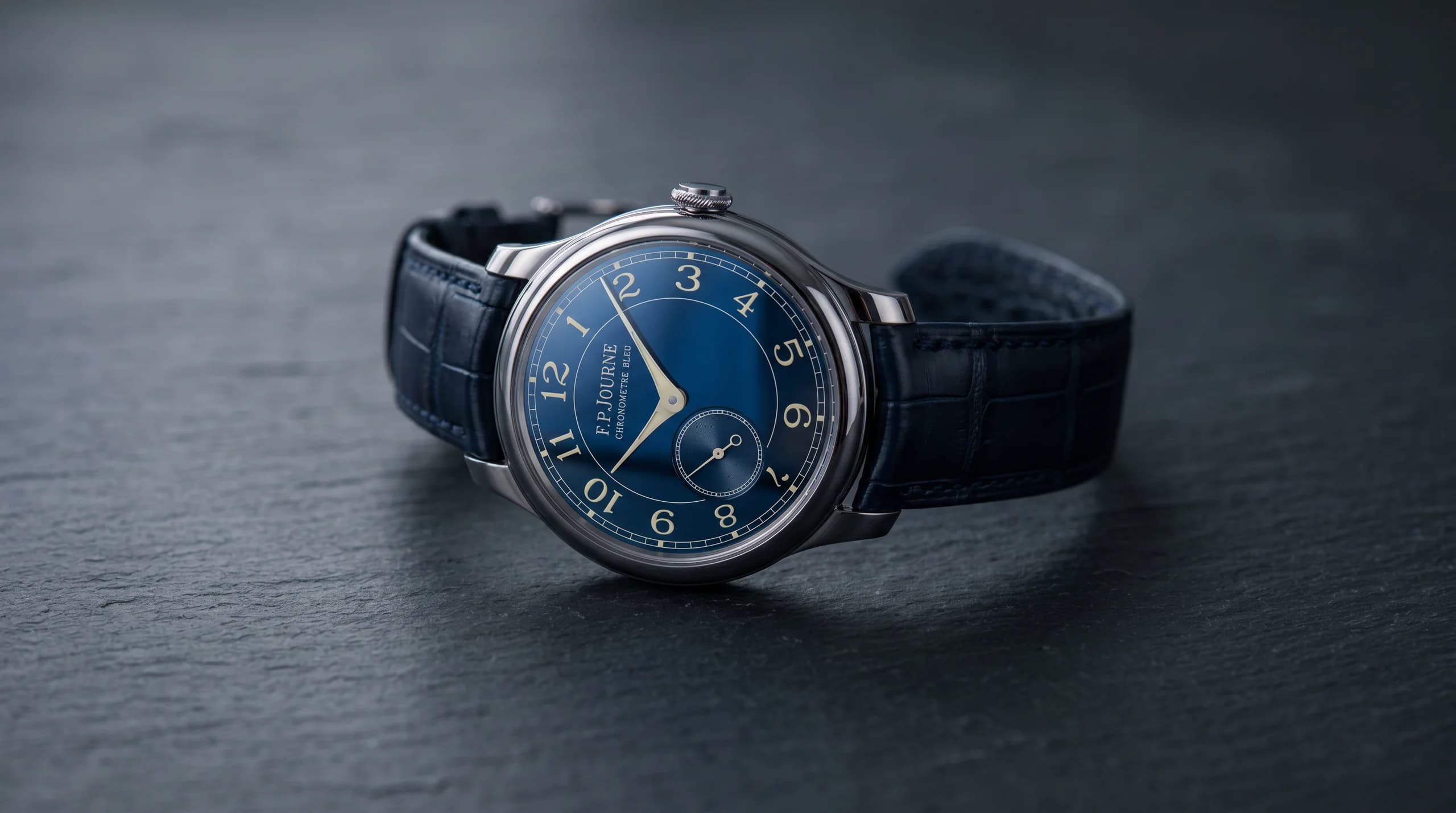
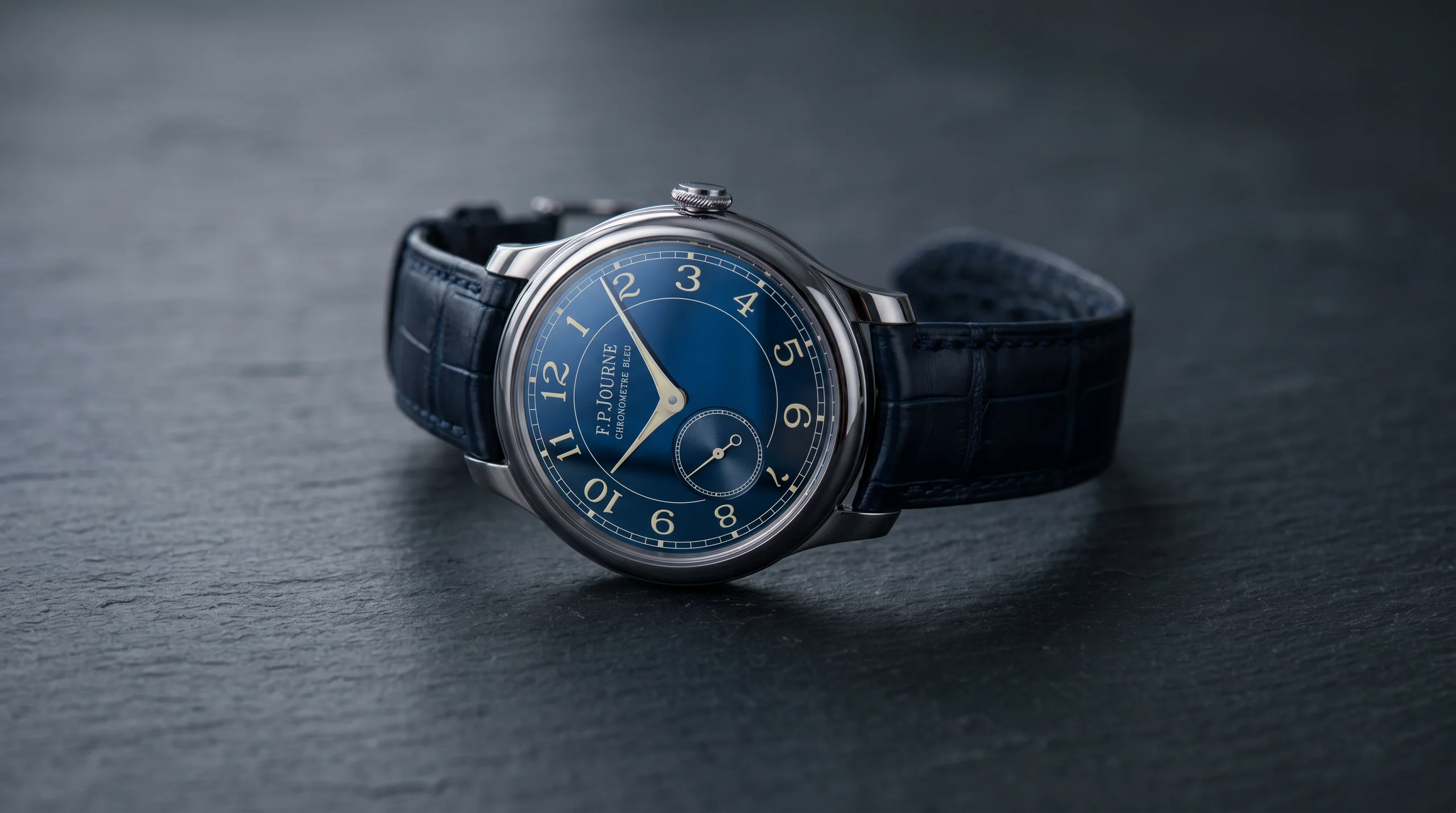 The F.P. Journe Chronometre Bleu. Quiet on the wrist, radical inside, and the watch that pulls most collectors into the brand.
What Makes F.P. Journe Different
Journe is not chasing the biggest complication or the loudest design. The brand's whole appeal is that the important parts are the ones you cannot see across a room.
Start with the movement. Since 2004, F.P. Journe has built the bridges and mainplates of its movements from solid 18k rose gold, where nearly every other maker uses brass or German silver. It is expensive, it is unusual, and it is the kind of decision only a watchmaker running his own company would make.
The Inventions Are Real
The signature is technical invention, not just finishing. In 2000, Journe released the first wristwatch to use acoustic resonance for timekeeping, with two balance wheels mounted close enough to fall into sympathy and steady each other.
Many Journe calibres also carry a remontoir d'égalité, a constant-force device that feeds the escapement even power for more stable rate. These are not marketing complications. They are attempts to make the watch keep better time, which is the whole point of a chronometer. Our constant force explainer covers how that device compares to a fusee and chain and to Girard-Perregaux's silicon constant escapement.
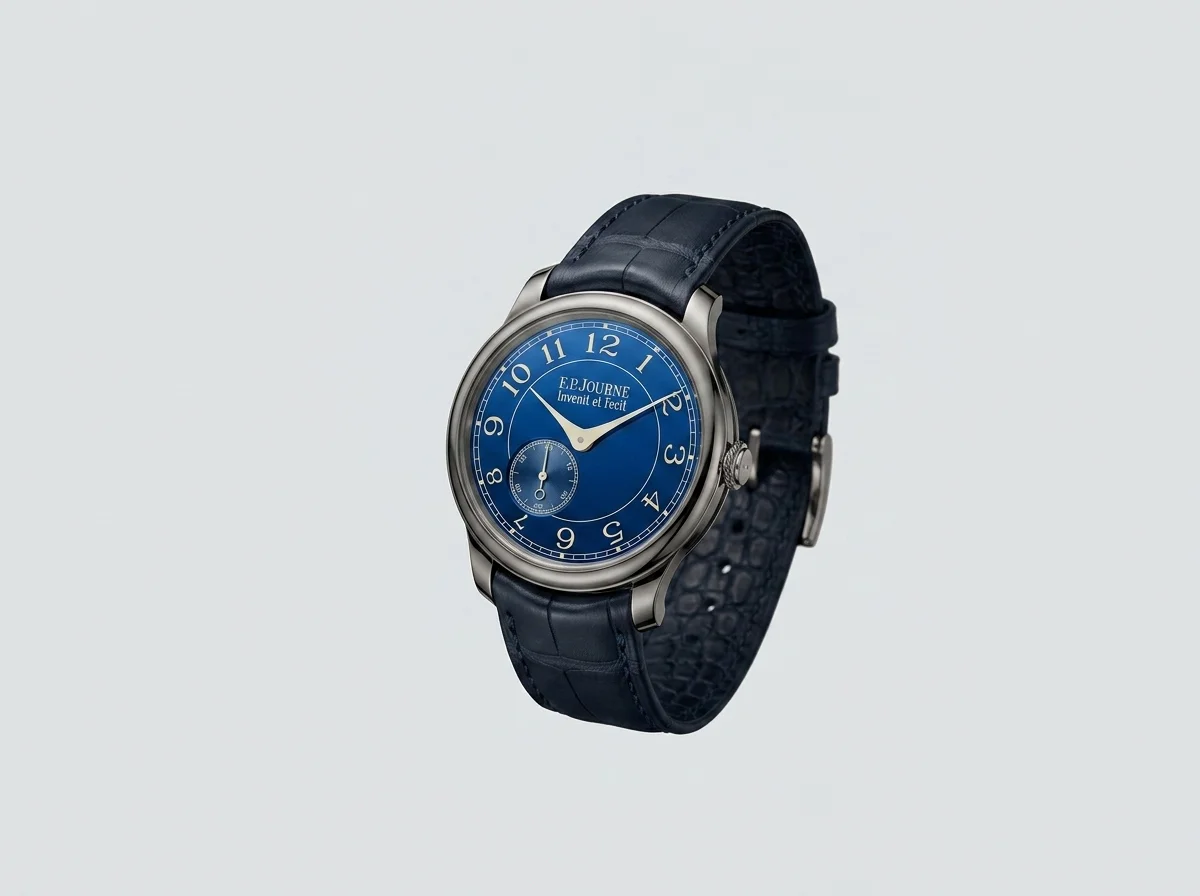 The Chronometre Bleu's case is tantalum, a dense, hard, corrosion-proof metal few brands bother to machine.
The Watches That Matter
A handful of references define the brand for most buyers, and they sit at very different price points.
The Chronometre Bleu, the Gateway Grail
The Chronometre Bleu is the watch that starts most Journe collections. It pairs a 39mm case in tantalum, a dense and hard metal with a grey-blue tone, with a chrome blue dial built from layers of lacquer polished to a mirror between each coat.
Here is the strange part. It retails around $38,000, one of the more accessible Journe watches, but production is tiny and demand is enormous, so the secondary market runs to roughly $190,000 to $210,000. Few watches show the gap between retail and reality this starkly.
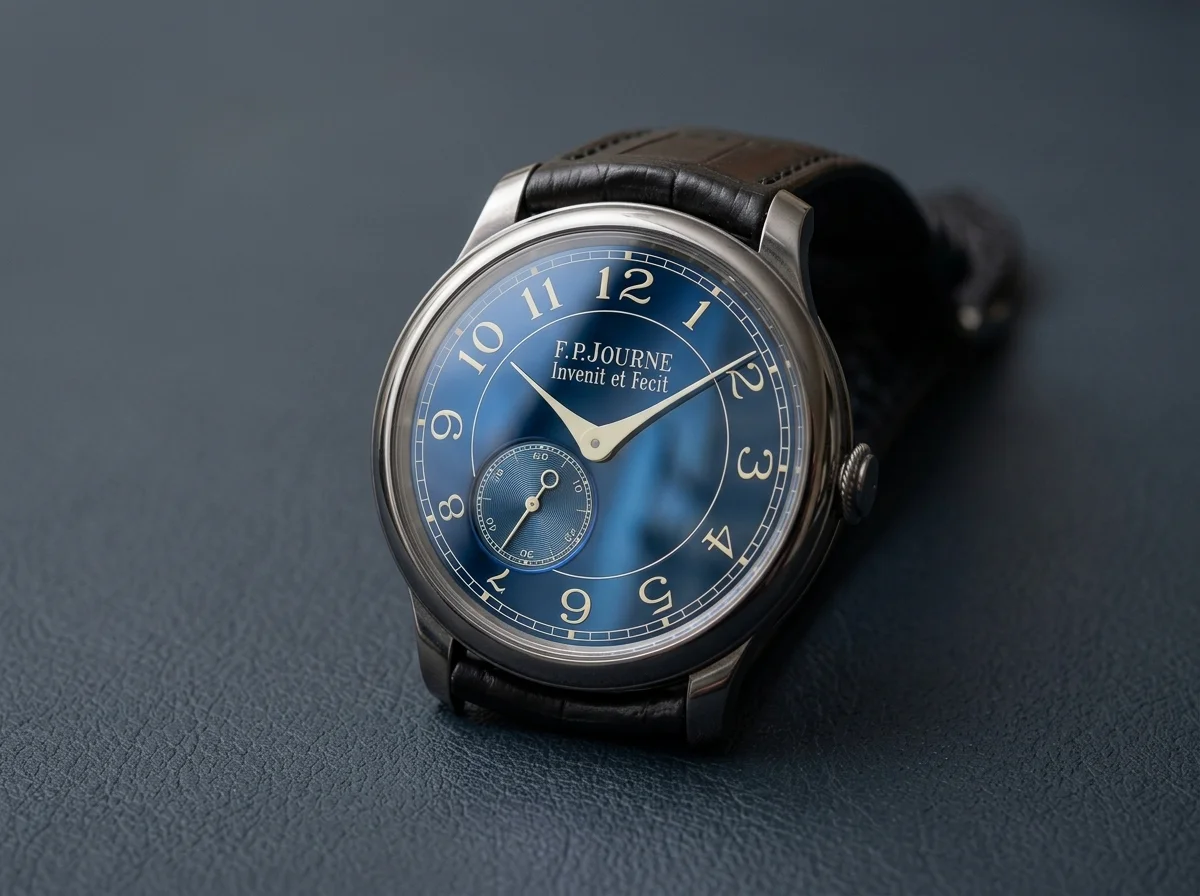 The chrome blue dial shifts from bright to near-black with the light. The off-centered seconds is pure Journe.
The Chronometre Souverain and the Résonance
For purists, the Chronometre Souverain is the time-only Journe, clean and precise, trading around $140,000 pre-owned. Above it sits the Chronomètre à Résonance, the resonance watch, in rose gold at roughly $101,400 retail.
The Résonance is also where the brand's collector heat is most visible. In June 2026, an early souscription Résonance, number 007, sold for $13,922,000 at Phillips in New York, the highest price ever paid for a watch by any independent watchmaker.
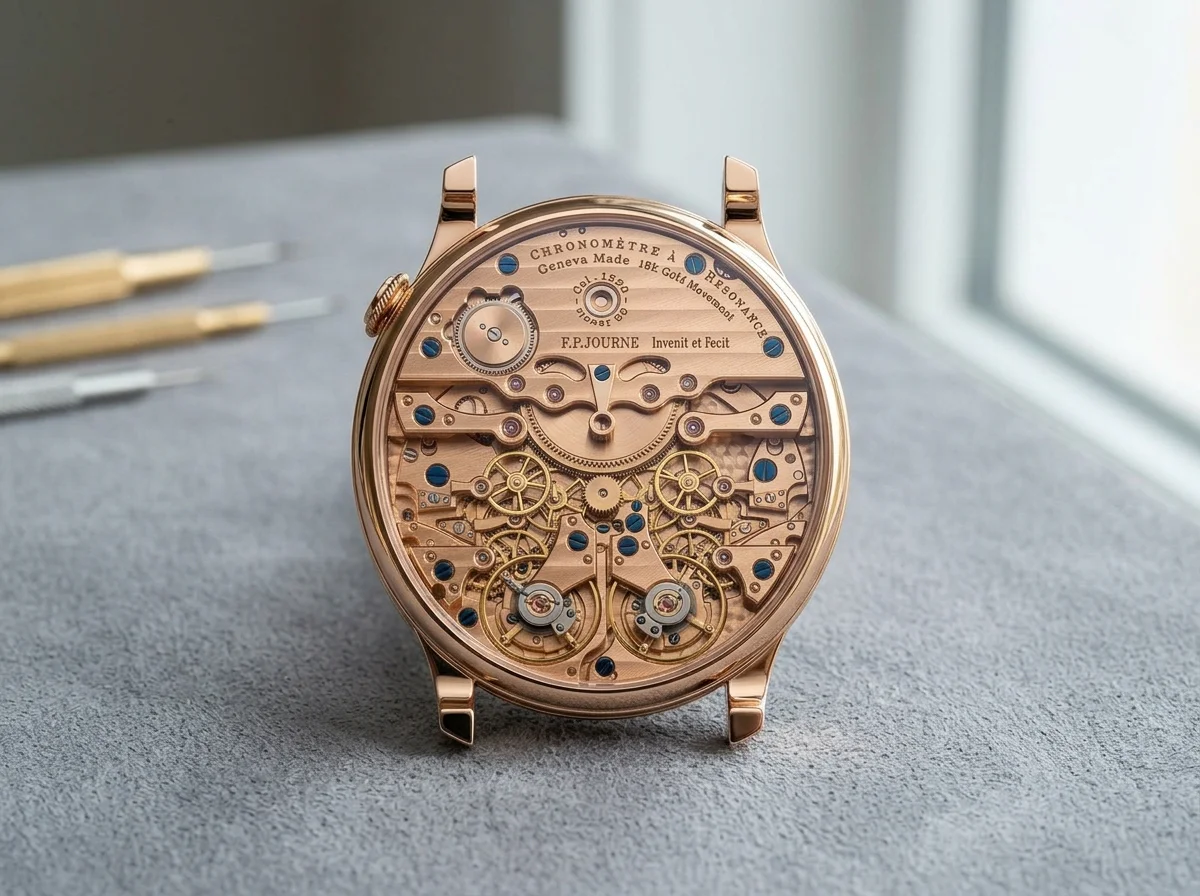 The reason to flip a Journe over: bridges and mainplate in solid rose gold, finished by hand. Almost no one else does this.
Why the Values Hold
The math is the same as every scarce thing, applied to a brand that makes almost nothing.
F.P. Journe produces around 900 watches a year for the entire world, sold through a short list of boutiques to established clients. When supply is that thin and the watchmaking is this respected, prices do not sag. Most references depreciate only slightly at worst, and the wanted ones, led by the Chronometre Bleu, trade at large multiples of retail.
The brand also enjoys something rare: its owners defend it. Journe collectors tend to be knowledgeable and loyal, which keeps demand deep even when the broader market cools.
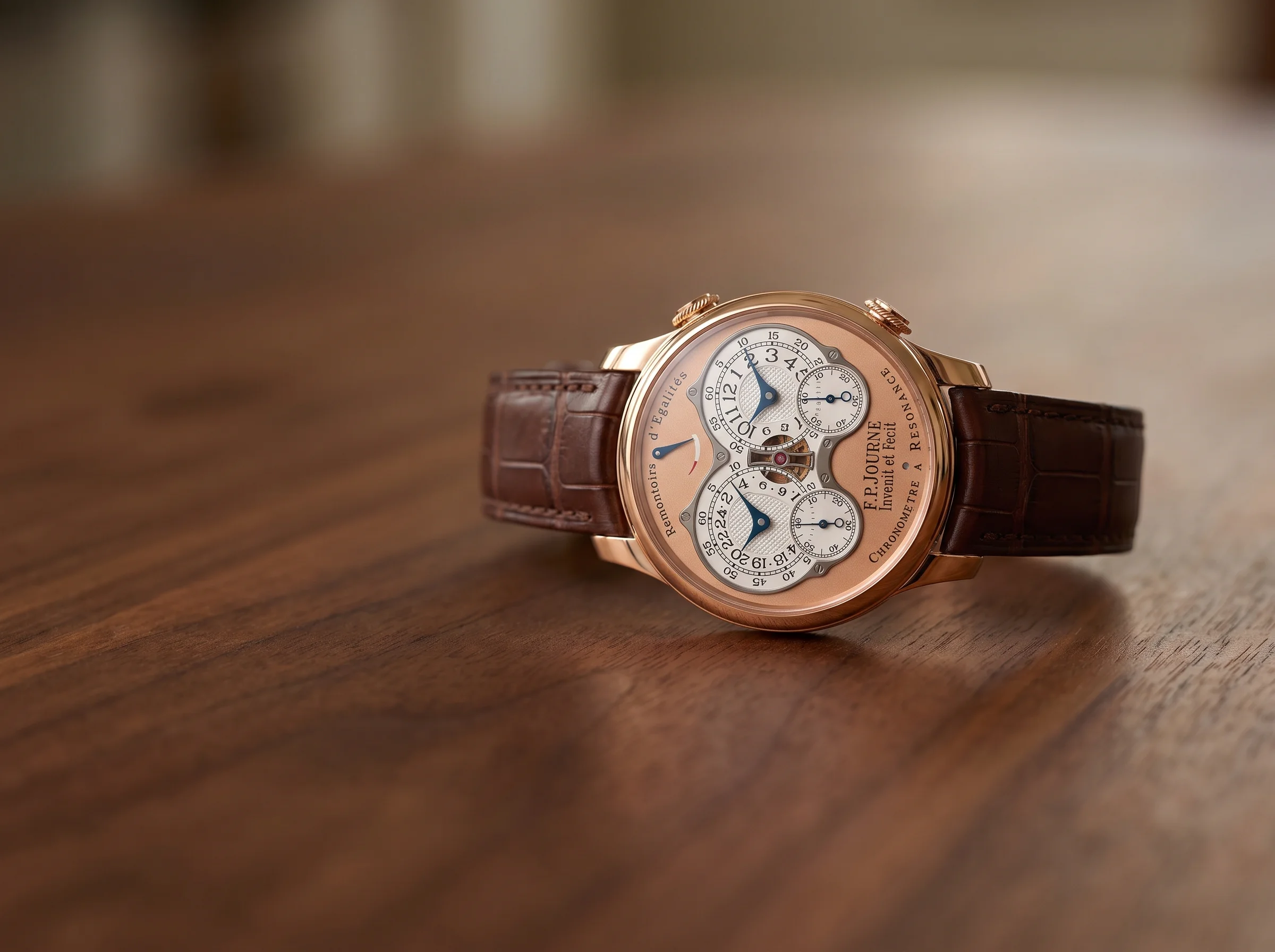 The Chronomètre à Résonance and its twin dials. The model that set a $13.9 million record in 2026.
How to Buy One
New allocation is close to impossible unless you have a long relationship with a boutique, so for most buyers pre-owned is the only route.
That makes authenticity and completeness the whole game. Buy only with the full set, box, and papers, from a dealer who authenticates and stands behind the watch, and treat service history as a real part of the value, since Journe servicing is specialized. Expect to pay well over original retail on the wanted references, and understand that you are buying into a small, knowledgeable community as much as a watch.
The Bottom Line
F.P. Journe is the independent that collectors graduate into, not out of. The watches are quiet on the wrist and radical underneath, and the brand has earned its reputation the hard way, by inventing mechanisms and building them to a standard almost no one matches.
Journe is the watch you buy once you have owned everything else, and most collectors get there through the classics first. If you are still on that road, the same restraint and serious watchmaking runs through the pre-owned Patek Philippe we do carry, the usual step before the independents.
Frequently Asked Questions
What makes F.P. Journe special?
Three things. The movements are built from solid 18k rose gold rather than brass, which almost no other brand does. The mechanisms are genuinely invented, including the first wristwatch to use resonance and frequent use of a constant-force remontoir. And production is tiny, around 900 watches a year, which makes them scarce and highly respected among collectors.
How much is an F.P. Journe?
Retail starts around $38,000 for the Chronometre Bleu and climbs into six figures for the complications, such as the Chronomètre à Résonance near $101,400. On the secondary market, scarcity pushes prices far higher: a Chronometre Bleu commonly trades between $190,000 and $210,000.
Why is the Chronometre Bleu so hyped?
It combines a tantalum case, a striking mirror-polished chrome blue dial, and classic Journe details at what was, on paper, an accessible price. Tiny production against huge demand means it trades at a large premium, roughly $190,000 to $210,000, despite a retail near $38,000. It is the watch that pulls most collectors into the brand.
What is the F.P. Journe Résonance?
The Chronomètre à Résonance uses two balance wheels mounted close together so they synchronize through acoustic resonance, steadying each other for better timekeeping. Journe released the first resonance wristwatch in 2000. In June 2026, an early example sold for $13.9 million, a record for any independent watchmaker.
Can you still buy F.P. Journe new?
Rarely. The brand makes around 900 watches a year, sold through a small boutique network to established clients, so waitlists are long and allocation is limited. For most buyers, pre-owned is the realistic route. Authenticate carefully, insist on a full set, and expect to pay a premium over original retail.
Related Reading
- The F.P. Journe Buying Guide: Every Current Model, Real Reference Numbers, and What It Costs
- What Is a Resonance Watch? The Physics-Based Complication, Explained
- What Is Constant Force? The Complication That Fixes a Mainspring's Biggest Flaw
- The A. Lange & Söhne Lange 1 Buying Guide: The Independent Benchmark, Read by a Dealer
- H. Moser & Cie: The Rebel Independent That Made Minimalism a Statement