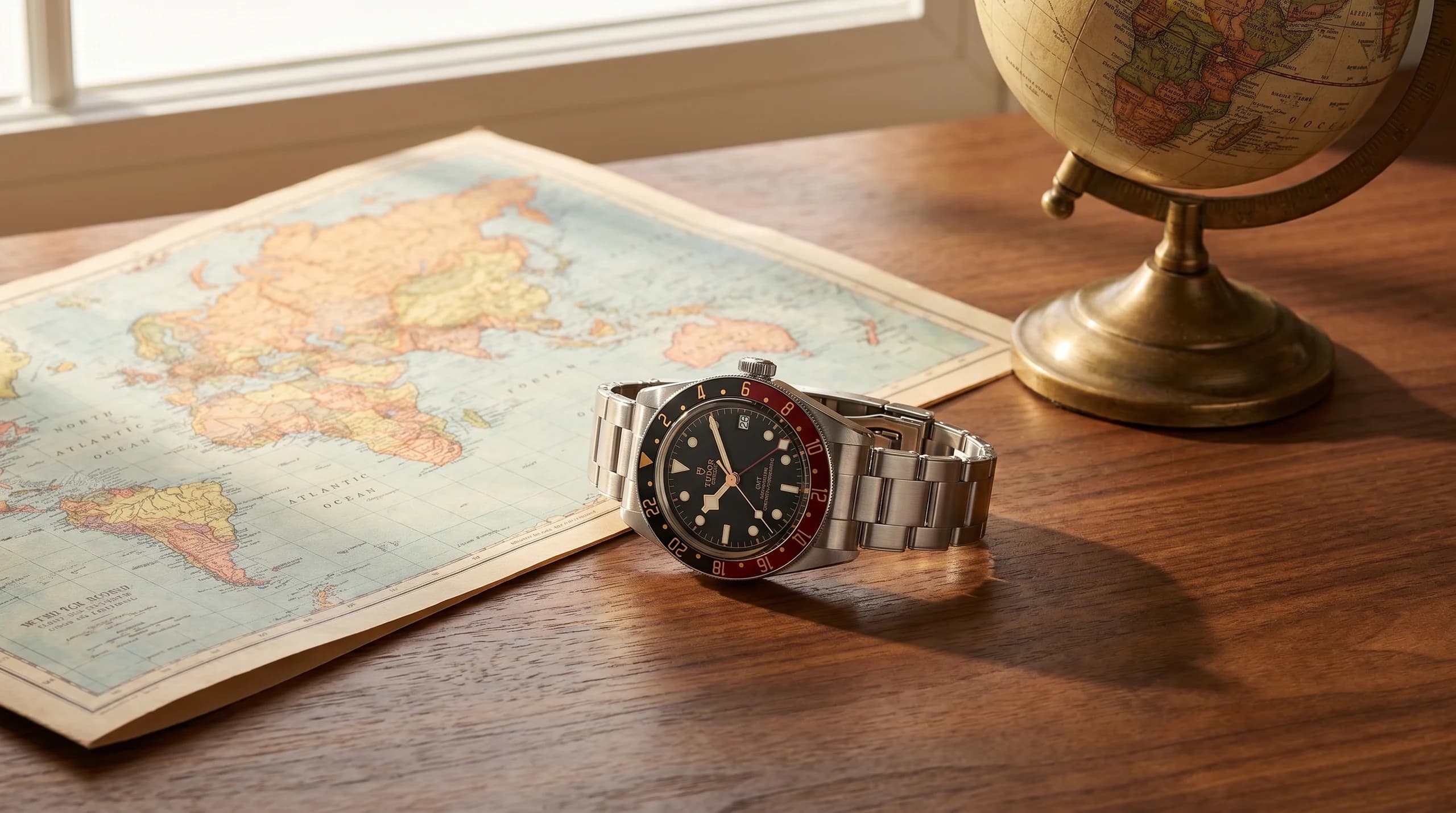
Two watches can both track time around the world and still have almost nothing in common under the dial. The GMT and the world timer are the two great travel complications, they are constantly confused for each other, and they suit completely different kinds of traveler. Here is how to tell them apart, and which one earns a place on your wrist.
The images in this post are AI-generated illustrations for editorial purposes and may not exactly represent specific watches.
The short version
A GMT adds one extra hand to track a second time zone, read against a 24-hour bezel or scale. A world timer puts all 24 zones on the dial at once, using a ring of cities and a rotating 24-hour ring, so you never do the math. The first is a fast, sporty tool watch; the second is a dressier, more complex showpiece. Which is right comes down to how you actually move through the world.
How a GMT works
The GMT is the simpler and more practical of the two.
Alongside the normal 12-hour hand, a GMT watch carries a second hand that circles the dial once every 24 hours, set to a different zone. You read that second zone against a 24-hour bezel or an inner scale, and a rotating bezel can let you track a third. The format traces to 1954, when Rolex built the GMT-Master for Pan Am pilots crossing time zones, and while Longines and Glycine got there earlier, Rolex defined the template and the name.
There is one wrinkle worth knowing before you buy. Some GMTs let you jump the local hour hand on landing, the traveler-friendly kind, while others move only the 24-hour hand for tracking a zone from your desk, and we broke that whole distinction down in our guide to the flyer versus caller GMT.
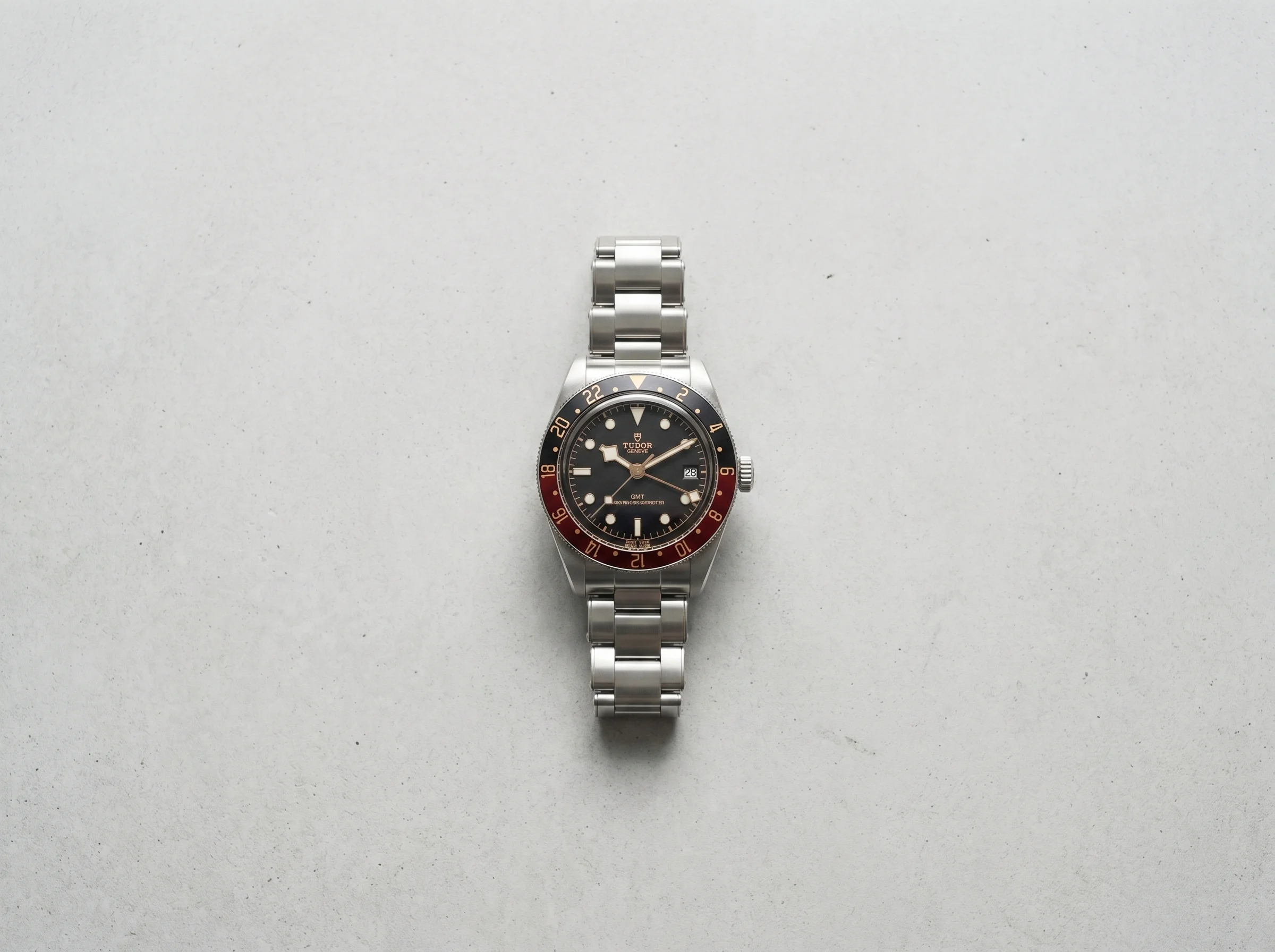 A GMT adds one 24-hour hand, read against a 24-hour bezel. Two zones, fast. (AI-generated illustration.)
How a world timer works
The world timer answers a bigger question: what time is it everywhere, right now?
Its dial carries a ring of 24 cities, one per zone, around a rotating 24-hour ring. You line your home city up with local time, and from then on every other city reads off directly, with no offsets or arithmetic. The mechanism goes back to Louis Cottier in the 1930s, as Worn & Wound details, and it stays a signature of high-end houses because squeezing that much information onto a legible dial is genuinely hard.
The trade-off is complexity. World timer dials are busier, harder to read at a glance for a single zone, dressier in character, and generally a good deal more expensive than a GMT.
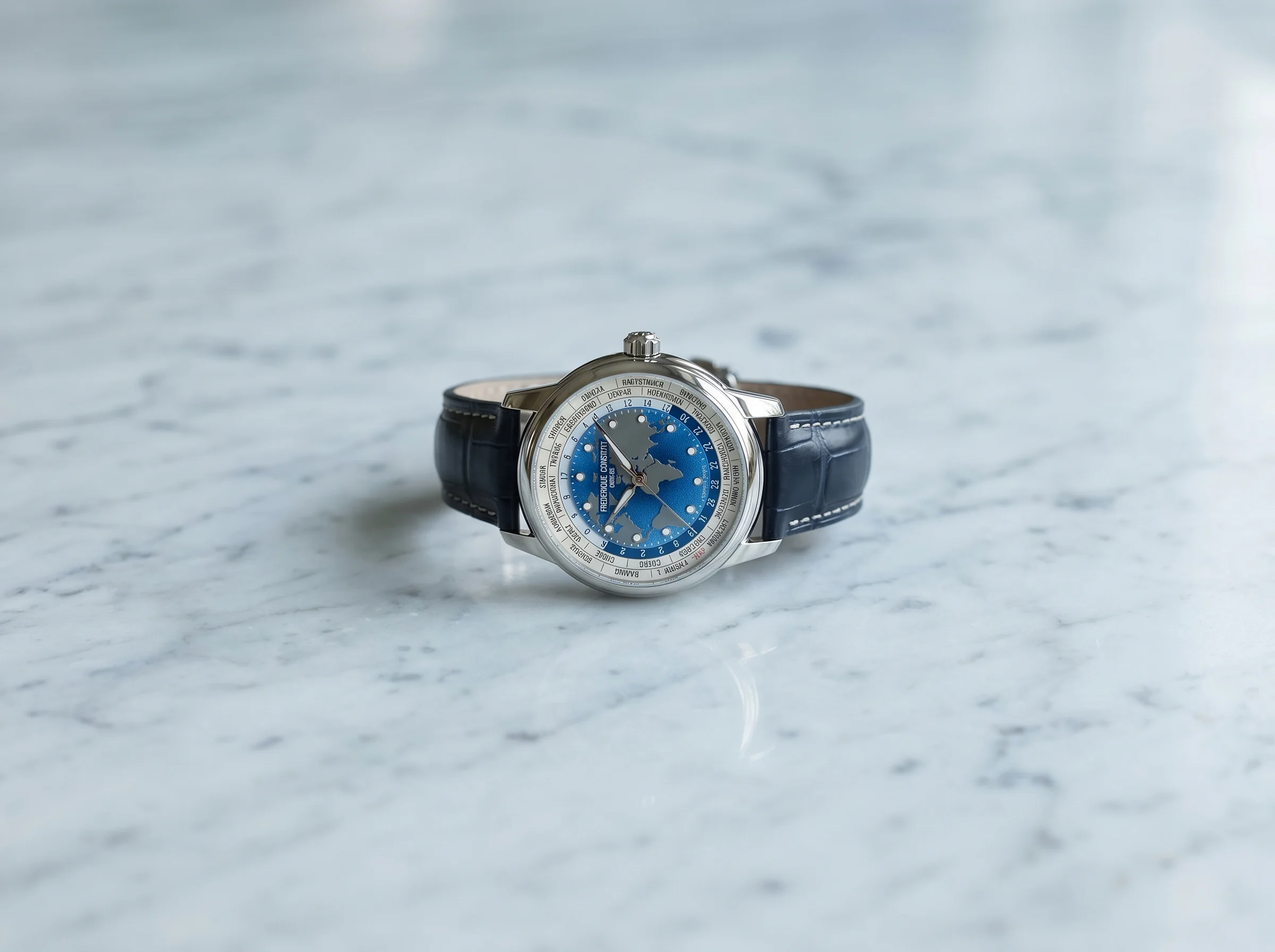 A world timer shows all 24 zones at once through a city ring. No math required. (AI-generated illustration.)
Don't forget dual time
There is a quieter third option that sits between the two.
A dual-time watch shows a second zone on a sub-dial or in a window, usually in a familiar 12-hour format with a day-night indicator. It is the most intuitive display of the three for tracking two zones, and it tends to live on dressier watches. If you only ever follow home and one other place, it is worth a look alongside a GMT.
 Three complications, one job: knowing the time somewhere other than here. (AI-generated illustration.)
So which should you buy?
Match the complication to how you travel, not to the spec sheet.
| You are... | The watch |
|---|---|
| A frequent flyer who wants one sporty watch | GMT |
| Tracking one home zone from a desk | GMT (caller) or dual time |
| Coordinating teams across many cities at once | World timer |
| After traditional high horology and a dress look | World timer |
| Buying your first travel watch | GMT |
A working dealer's read
Here is how this shakes out on the floor.
For most buyers, the GMT is the smart-money travel watch. It is legible, robust, suit-or-t-shirt versatile, and the steel sports references hold value and stay liquid, which matters when you eventually sell or trade. The Rolex GMT-Master II is the benchmark, and the Tudor Black Bay 58 GMT delivers the same function at a fraction of the wait and the price.
The world timer is a different purchase. It is a step into high horology, led by Patek Philippe and Vacheron Constantin, with accessible options from the likes of Frederique Constant, and it rewards people who love the complication for its own sake more than its resale. Yes, your phone does all of this instantly and for free. The reason these watches endure is that a phone tells you the time, while a mechanical travel watch tells a story about where you have been. If a GMT is where you are starting, our Rolex GMT-Master II selection is a good place to see what the format looks like in the metal.
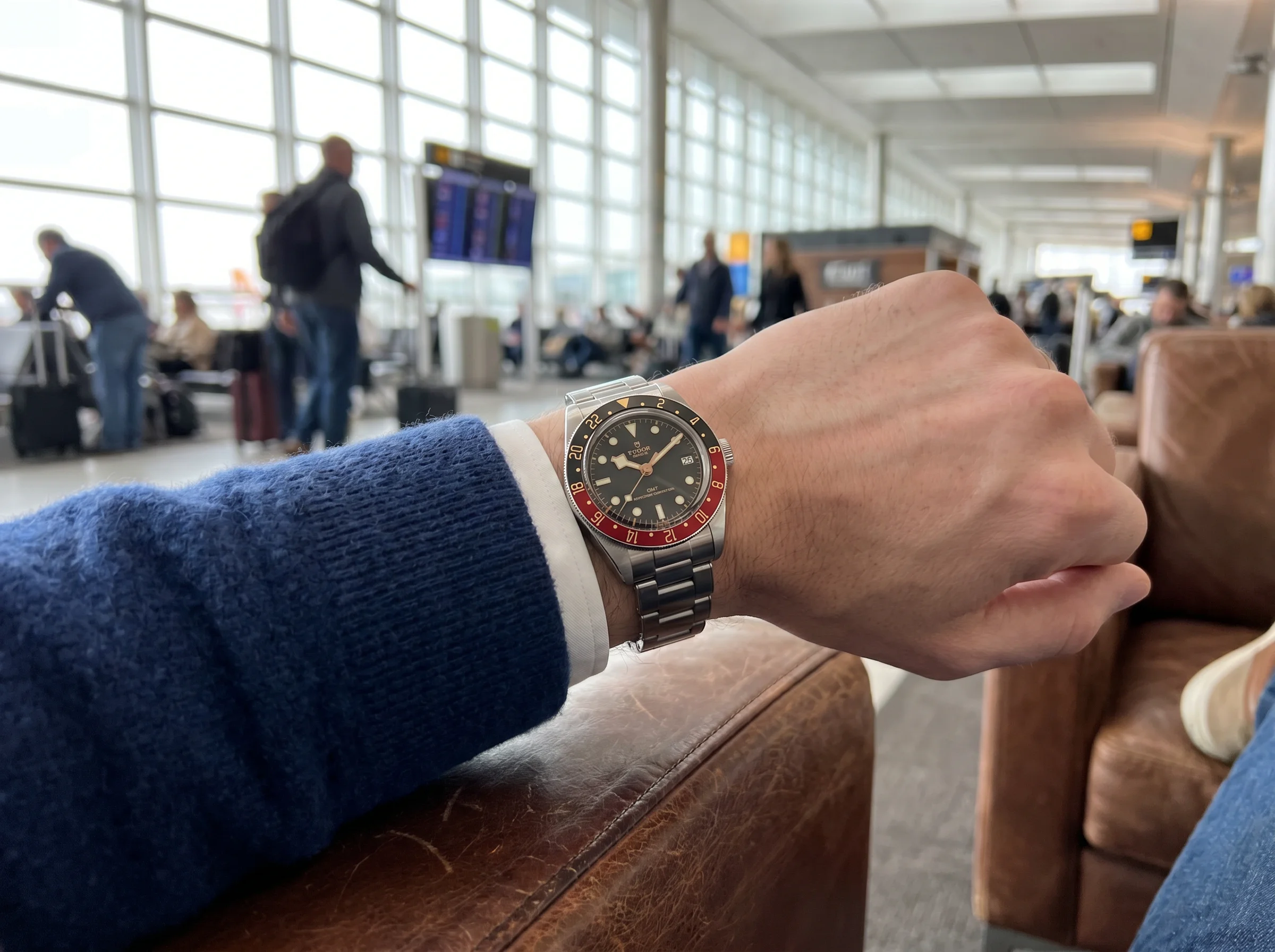 For most travelers, the GMT is the practical, liquid pick. (AI-generated illustration.)