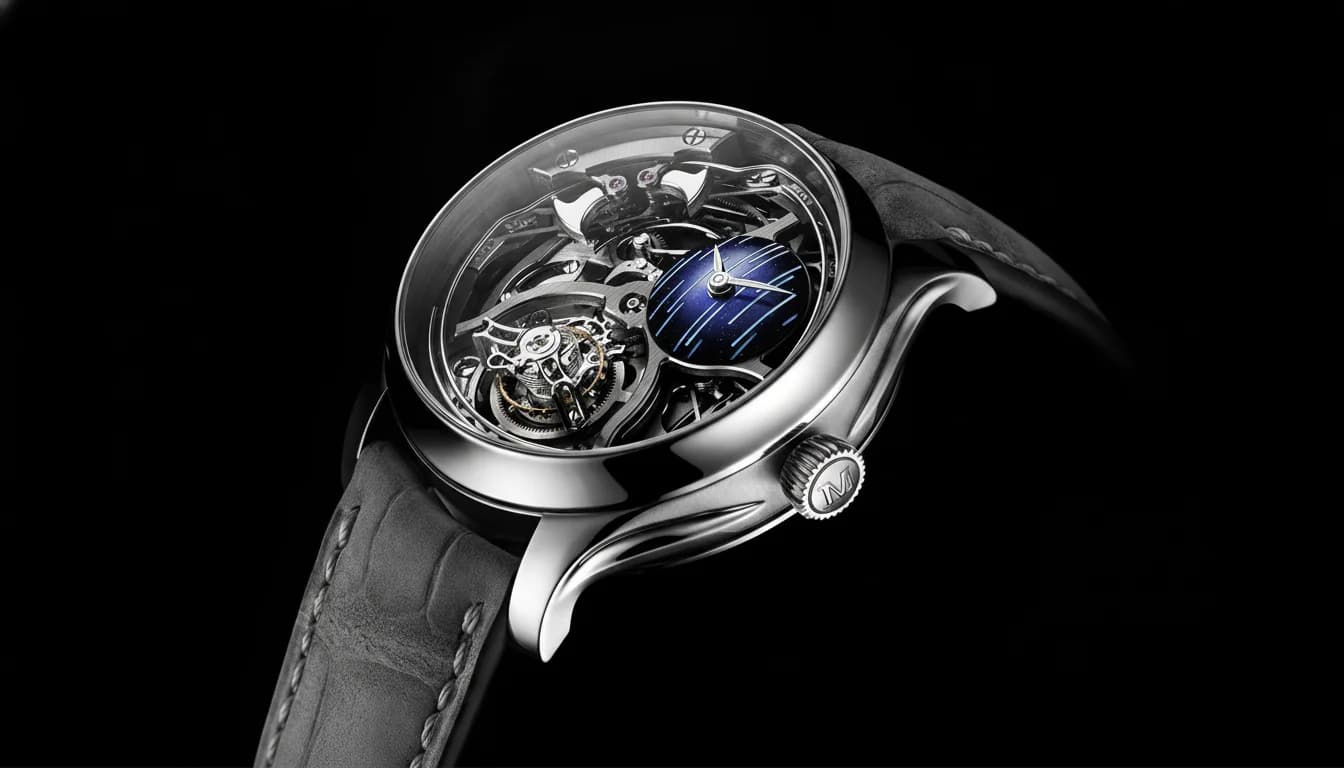
The short answer: H. Moser & Cie. just released the Endeavour Minute Repeater Cylindrical Tourbillon Skeleton "Cosmic Rain," a 40mm titanium watch priced at CHF 378,350 (roughly $465,000 at current exchange rates), limited to 20 pieces. It pairs a minute repeater with a flying tourbillon that uses a cylindrical hairspring instead of a flat one, a combination almost nobody else builds, inside a fully skeletonized case that doubles as its own soundbox.
AI disclosure: this post was researched from primary watch-industry sources and written with AI drafting assistance, then reviewed by a working dealer before publication.
Most minute repeaters hide their mechanism behind a solid dial and let you imagine what is happening inside. Moser did the opposite. It stripped the movement bare, dropped a blue aventurine "night sky" straight into the middle of it, and dared you to watch the hammers strike while you listen. That is the whole pitch, and it mostly works.
What the Cosmic Rain Actually Is
The Endeavour Minute Repeater Cylindrical Tourbillon Skeleton Cosmic Rain is not a new case or a new movement platform. It is Moser's existing skeletonized minute repeater tourbillon, dressed in a new dial treatment built around a domed blue aventurine sub-dial at 2 o'clock.
The Dial and the "Night Sky" Effect
The sub-dial uses a fumé aventurine glass with mother-of-pearl inlays scattered underneath, meant to read as streaks of shooting stars catching light as the wrist moves. The rest of the dial is fully open, with the minute repeater's hammer bridges visible near 12 o'clock and the flying tourbillon at the opposite side of the dial.
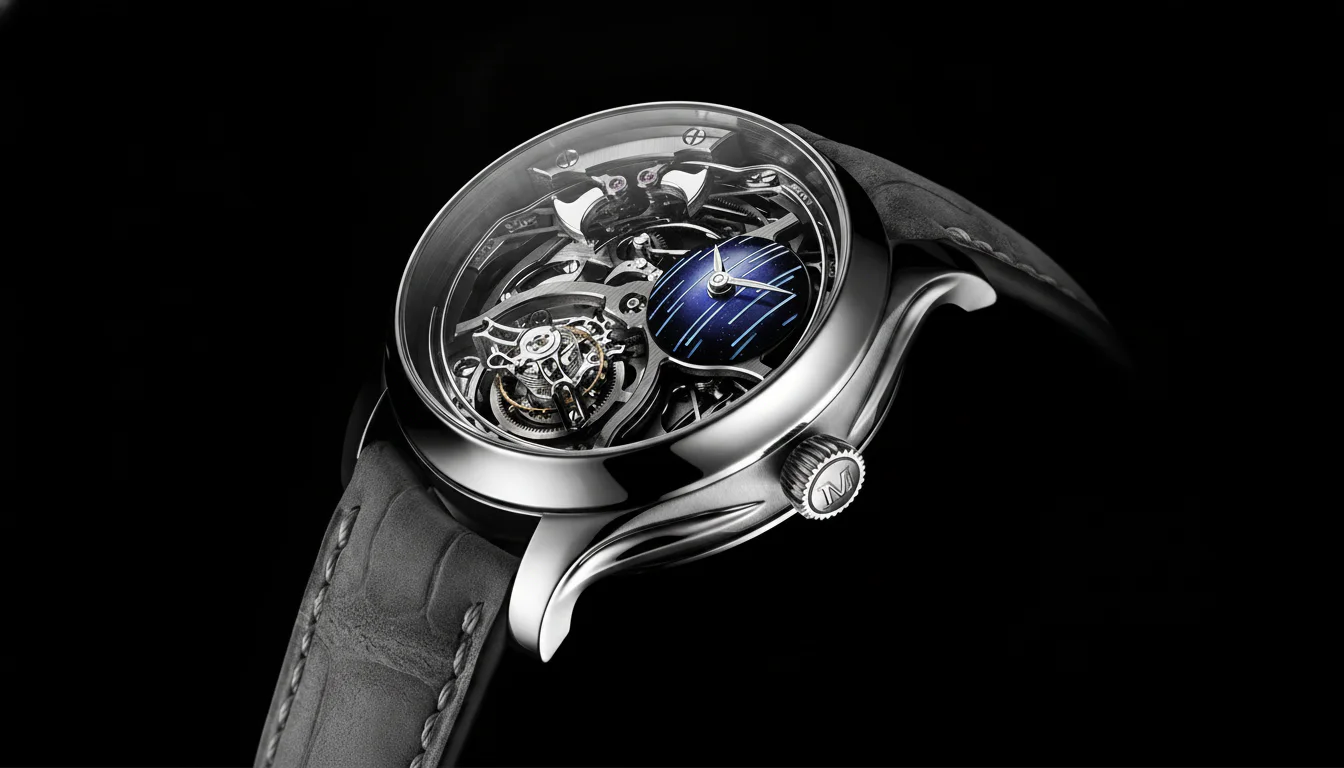 The Cosmic Rain's dial at a three-quarter angle: the flying tourbillon lower left, the repeater's hammer bridges near 12 o'clock, and the blue aventurine "shooting star" sub-dial upper right.
Leaf-shaped hour and minute hands mount through the center of the aventurine sub-dial itself rather than a conventional chapter ring, which is part of why the watch reads as more sculpture than instrument at a glance.
The Case: Titanium as a Soundbox
The case is 40mm across and 14.4mm tall, small by haute horlogerie minute-repeater standards, and it is titanium rather than the platinum or gold most repeaters default to. Moser hollowed the case middle so it functions as a resonance chamber, which is the harder engineering problem here: a repeater's sound quality depends heavily on how the case transmits the gongs' vibration, and titanium behaves differently than precious metal.
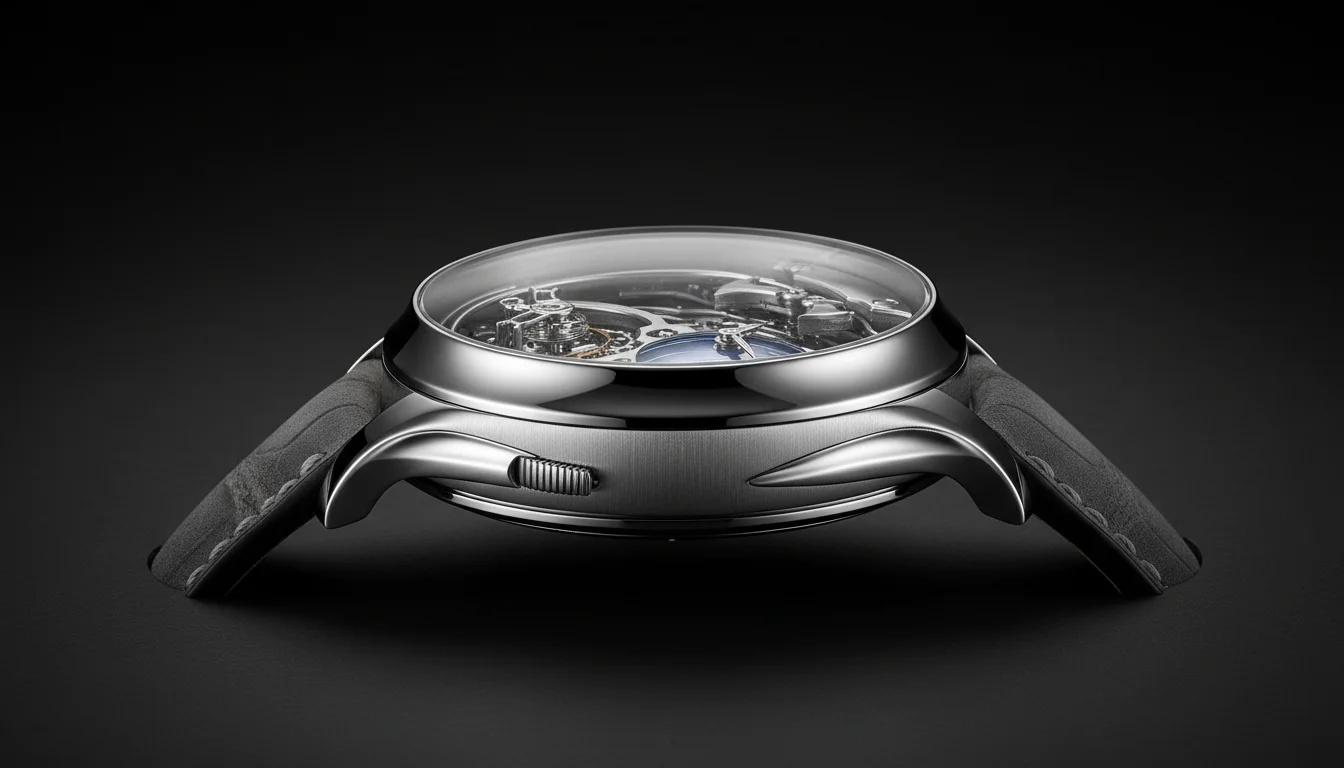 Case-side profile showing the 14.4mm height and the repeater activation slide on the flank.
The Movement: HMC 909
Inside is the manual-wind caliber HMC 909, a movement built from 415 components and finished to be seen from both sides.
| Spec | Detail |
|---|---|
| Movement | HMC 909, manual wind |
| Power reserve | 90 hours |
| Frequency | 21,600 vph (3Hz) |
| Jewels | 35 |
| Complications | Minute repeater, one-minute flying tourbillon with cylindrical hairspring |
| Components | 415 |
| Case | 40mm x 14.4mm titanium |
| Price | CHF 378,350 |
| Edition | Limited to 20 pieces |
Why the Cylindrical Hairspring Matters
A standard tourbillon uses a flat balance spring, which breathes slightly asymmetrically as it coils and uncoils. Abraham-Louis Breguet solved that problem in the early 1800s by curving the spring's outer coil upward into a helix, and a small number of independents, Moser included, have gone a step further with a true cylindrical spring that coils evenly around the whole balance. It is harder to make, harder to regulate, and genuinely improves isochronism. If you want the full mechanics of how a tourbillon fights gravity in the first place, we cover that in our tourbillon explainer.
 Macro detail of the flying tourbillon, showing the cylindrical hairspring coiled around the cage.
Why the Minute Repeater Is the Harder Sell
A minute repeater chimes the time on demand using a rack-and-snail mechanism and tiny hammers on gongs, no battery, no speaker, just mechanical striking. It is the most difficult complication to execute well because sound quality cannot be faked with finishing. We go deep on how the rack-and-snail system works in our minute repeater explainer, but the short version is that most of what you are paying for here is acoustics you cannot photograph.
 The HMC 909 movement through the skeletonized caseback, showing the hand-finished bridges and the repeater's rack and snail.
What It Costs, and Who Actually Buys This
At CHF 378,350 including taxes, the Cosmic Rain sits well above Moser's Streamliner sports line and closer to the brand's other tourbillon repeaters. Twenty pieces is a real limited edition, not a marketing number attached to unlimited production, and Moser's repeaters have historically sold out at the boutique level before reaching secondary market listings in any volume.
This is not a first Moser. It is a watch for someone who already owns an Endeavour or a Streamliner and wants the brand's most technically demanding complication in a case small enough to actually wear.
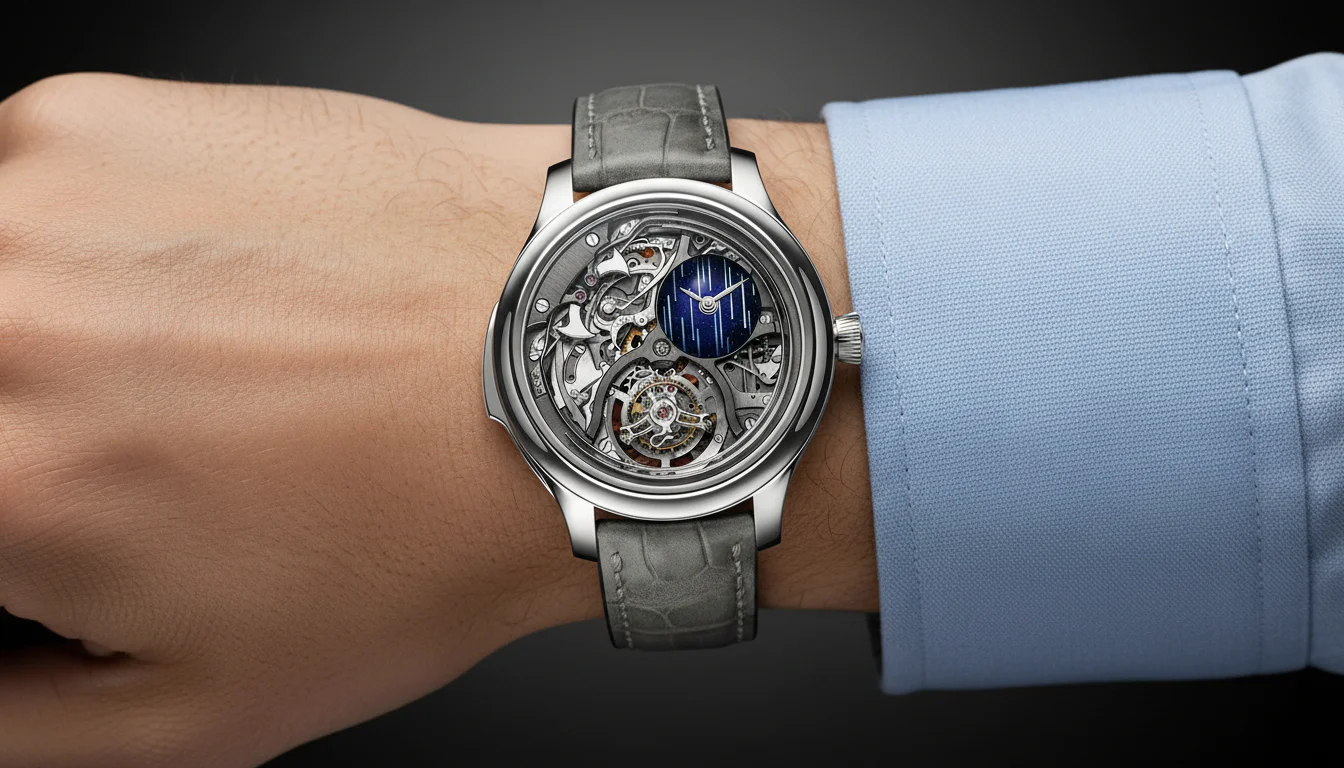 The Cosmic Rain on the wrist, on its grey nubuck leather strap with titanium pin buckle.
How It Wears
At 40mm and 14.4mm, the Cosmic Rain wears smaller and slimmer than most minute repeaters, which tend to run thick to accommodate the gongs. That case discipline is arguably the most underrated part of the release.
Related Reading
What Is a Tourbillon, and Is It Ever Worth the Money?, What Is a Minute Repeater? The Chiming Complication, Explained, and H. Moser & Cie: The Rebel Independent That Made Minimalism a Statement.
FAQ
What does the H. Moser Cosmic Rain cost?
CHF 378,350 including taxes, roughly $465,000 at current exchange rates, limited to 20 pieces.
What movement is inside the Cosmic Rain?
The manual-wind HMC 909, a 415-component movement with a 90-hour power reserve, running at 21,600 vph with 35 jewels.
Is the Cosmic Rain a tourbillon and a minute repeater in the same watch?
Yes. It combines a one-minute flying tourbillon with a cylindrical hairspring and a full minute repeater striking hours, quarter-hours, and minutes on demand.
Why is the case titanium instead of gold or platinum?
Moser hollowed the titanium case middle to act as a resonance soundbox for the repeater's chime, and titanium also keeps the watch lighter and thinner than a precious-metal case of the same dimensions would allow.
How many were made?
Twenty pieces.