A pre-owned Rolex can be one of the smartest watch purchases you will ever make, or one of the most painful.
The difference is authentication. Counterfeits have gotten genuinely good. The best fakes now use aftermarket movements that look like Rolex calibers at a glance, real ceramic bezels, and case finishing that passes the 30-second test. The 30-minute test is where they fall apart.
A note on the images in this post. The photos throughout this article are AI-generated for illustration purposes only. They are meant to show the general area or component being discussed, not serve as authentication references. Do not use these images to verify the authenticity of any watch. For real authentication, compare against official Rolex product photography on rolex.com, or, ideally, hand the watch to a qualified watchmaker.
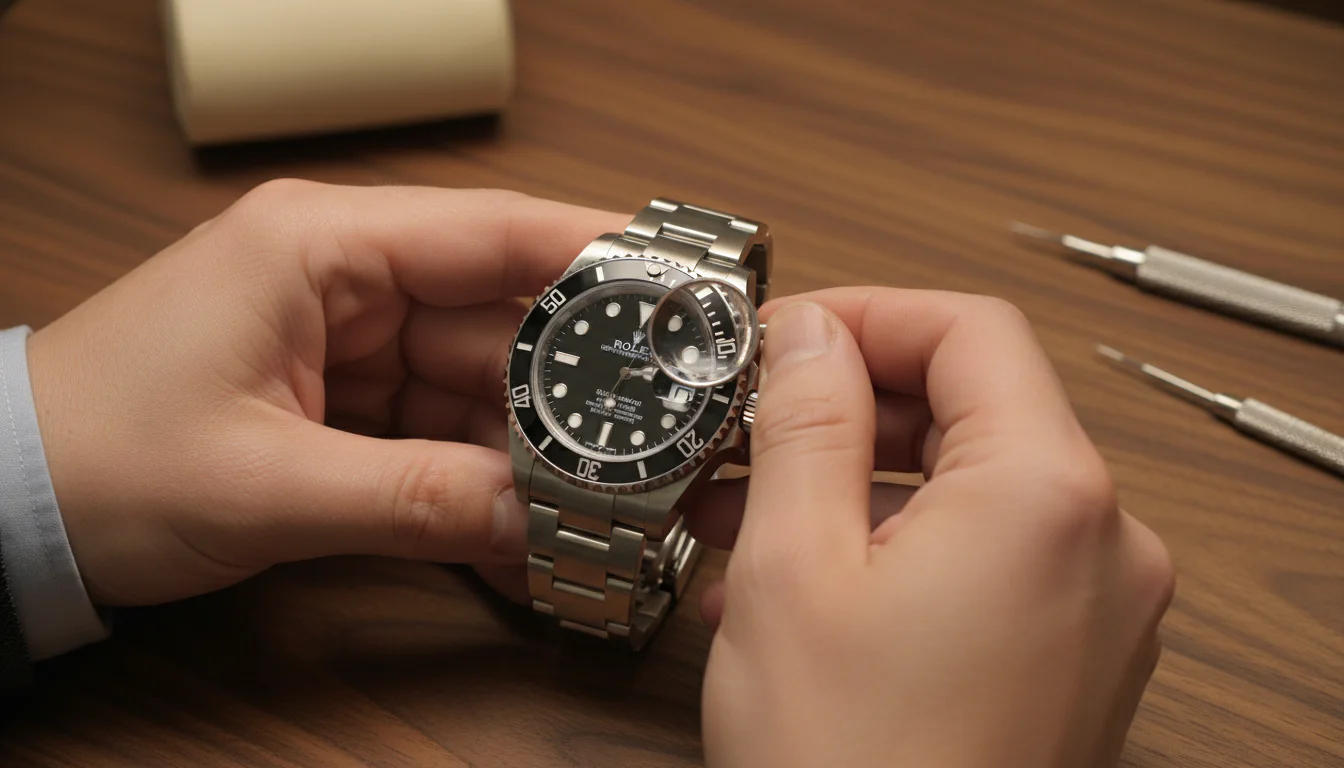 A professional authentication inspection uses a jeweler's loupe and a structured six-layer process. Anything less skips steps that counterfeiters exploit.
Here is the checklist a working dealer uses before we quote on a pre-owned Rolex. You can use it yourself before you buy.
The short answer
Authentication is a layered process: documentation, external case and bezel, dial and hands, caseback and serials, movement, and bracelet. A legitimate pre-owned Rolex passes all six layers. A fake or franken-watch fails at least one, usually two. If a seller will not let you inspect all six, walk.
Before you inspect anything: ask questions
Three questions separate serious sellers from risky ones:
- Where did the watch come from? A dealer should know the acquisition source in broad terms (trade-in, consignment, estate, watch show). "I don't remember" is a red flag.
- Has it been serviced, and by whom? Rolex Service Center, independent watchmaker, or unknown. Each is a different risk profile.
- Can I see the movement? Legitimate sellers of genuine Rolex watches will open the caseback for a qualified inspection. Refusing is a red flag.
If a seller pushes back on these, the answer does not get better from there.
Layer 1: Documentation
Rolex documentation is a strong authenticity signal, but it is not absolute. Boxes and papers can be swapped. Papers can be matched to the wrong watch.
What to check
- Warranty card. Modern Rolex warranty cards (2011 onward) are the credit-card-sized plastic cards with a coded serial number. The reference number on the card must match the watch. The serial number must match the watch.
- Card punched date. The authorized dealer punches a sale date. An unpunched card is suspicious on any watch more than a few months old.
- Booklets. Rolex includes model-specific instruction booklets. The language, print quality, and paper weight are consistent across genuine booklets.
- Box. The outer cardboard box has a reference and model label. Inner wood or plastic boxes vary by era. A mismatch between the box model tag and the watch reference is a red flag.
Papers can add 10-25% to a watch's value at resale, but a watch-only sale from a reputable dealer is fully legitimate. Plenty of genuine watches trade without original papers.
Layer 2: External Case and Bezel
The first thing counterfeiters get wrong is proportions. Rolex cases have specific, measured dimensions. Fakes are almost always off by fractions of a millimeter.
What to check
- Case diameter. Measure with calipers. A modern Submariner 126610LN is 41mm. A modern GMT-Master II 126710BLNR is 40mm. A Datejust 41 is 41mm. Off by 0.5mm, you are looking at a fake.
- Case finish. Rolex uses specific combinations of brushed and polished surfaces. Lug tops are brushed, lug sides are polished, case sides are brushed. The transitions between surfaces are crisp.
- Crown. Genuine Rolex crowns have the coronet logo engraved with specific proportions. The depth and precision of the engraving differs on fakes.
- Crown guards (on sport models). The proportions and chamfer of the crown guards are specific. Compare against manufacturer photos.
- Bezel action. Rolex sport bezels click in 120 positions (half-click each) with firm resistance and no backplay. A loose or sticky bezel is suspicious.
Bezel specifics for ceramic (Cerachrom) models
- Cerachrom fade. Cerachrom does not fade under normal UV exposure. A faded bezel on a modern ceramic watch is a fake insert.
- Bezel printing. The numbers on a Cerachrom bezel are PVD-deposited platinum or gold. They should have slight relief when viewed at an angle.
- Color uniformity. Cerachrom is colored through the ceramic, not surface-painted. Chips should show the same color underneath.
Layer 3: Dial and Hands
The dial is where counterfeits have improved most. Where they still fail is at high magnification.
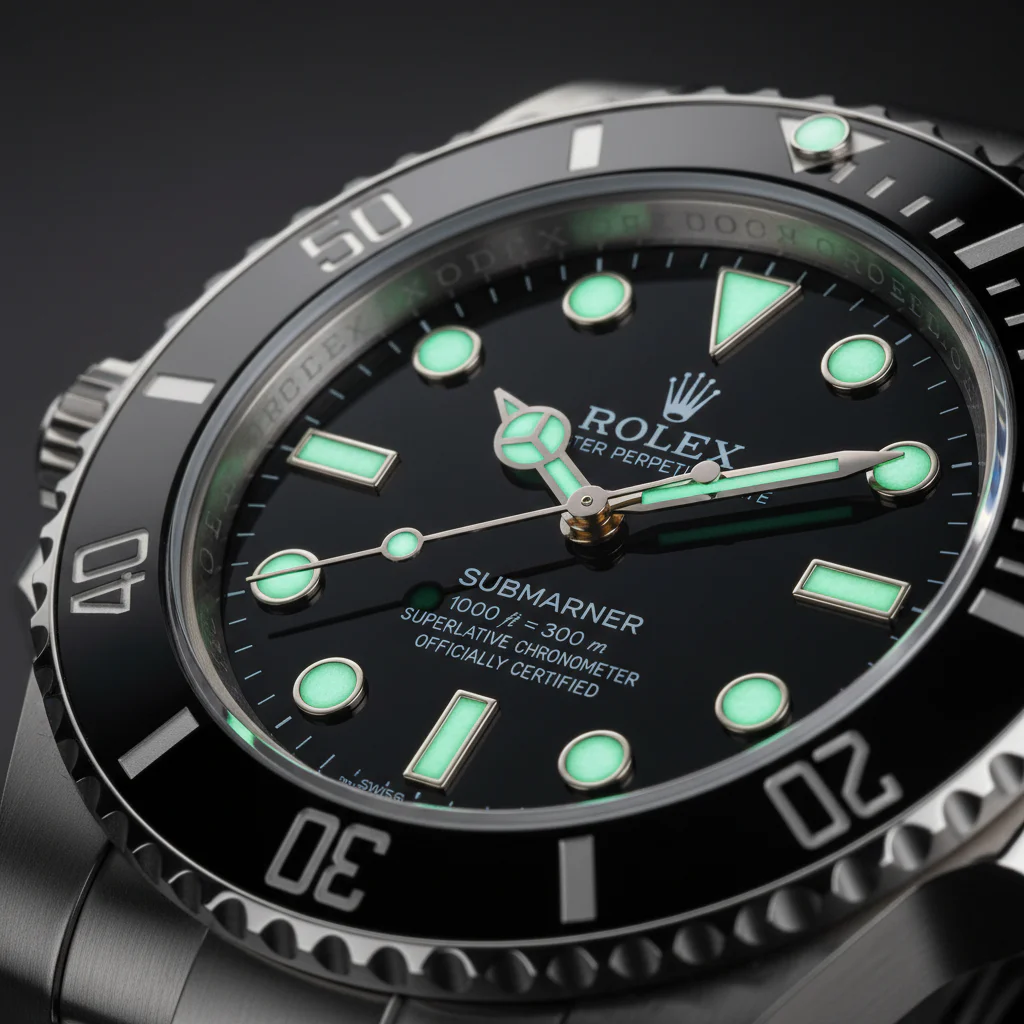 Illustrative only. On a genuine Rolex, applied indices show dimensional relief when viewed at an angle, and the coronet logo at 12 o'clock has precise proportions that counterfeiters consistently get slightly wrong. Compare suspect watches against official Rolex product photography on rolex.com.
What to check
- Applied indices. Rolex hour markers are applied, not printed. They should have slight relief when viewed at an angle. The cutouts in the markers for lume plots should be clean and consistent.
- Printing. All text on a Rolex dial is crisp at 10x magnification. Jagged edges, blurred text, or inconsistent font weight are giveaways.
- Coronet logo. The coronet at 12 o'clock should be precisely proportioned. The points of the coronet have specific shapes and angles. Compare against high-resolution manufacturer images.
- Chromalight or Super-LumiNova plots. Should be even, with consistent color and aging. Uneven lume or mismatched colors between dial, bezel pip, and hands suggests replacement.
Hand specifics
- Hand shape. Each Rolex model has specific hand shapes. Submariner Mercedes hand, Datejust baton, GMT-Master arrow. Wrong shape is a franken-watch or fake.
- Hand finish. Polished hands should have uniform polish. Blued hands should have uniform blue.
- Secondhand meets indices. At the exact top of every minute marker, the seconds hand should pass cleanly over the center of the marker. Alignment issues suggest a replaced hand.
Layer 4: Caseback and Serial Numbers
The caseback is Rolex's fingerprint. Genuine Rolex casebacks are engraved with specific information in a specific way.
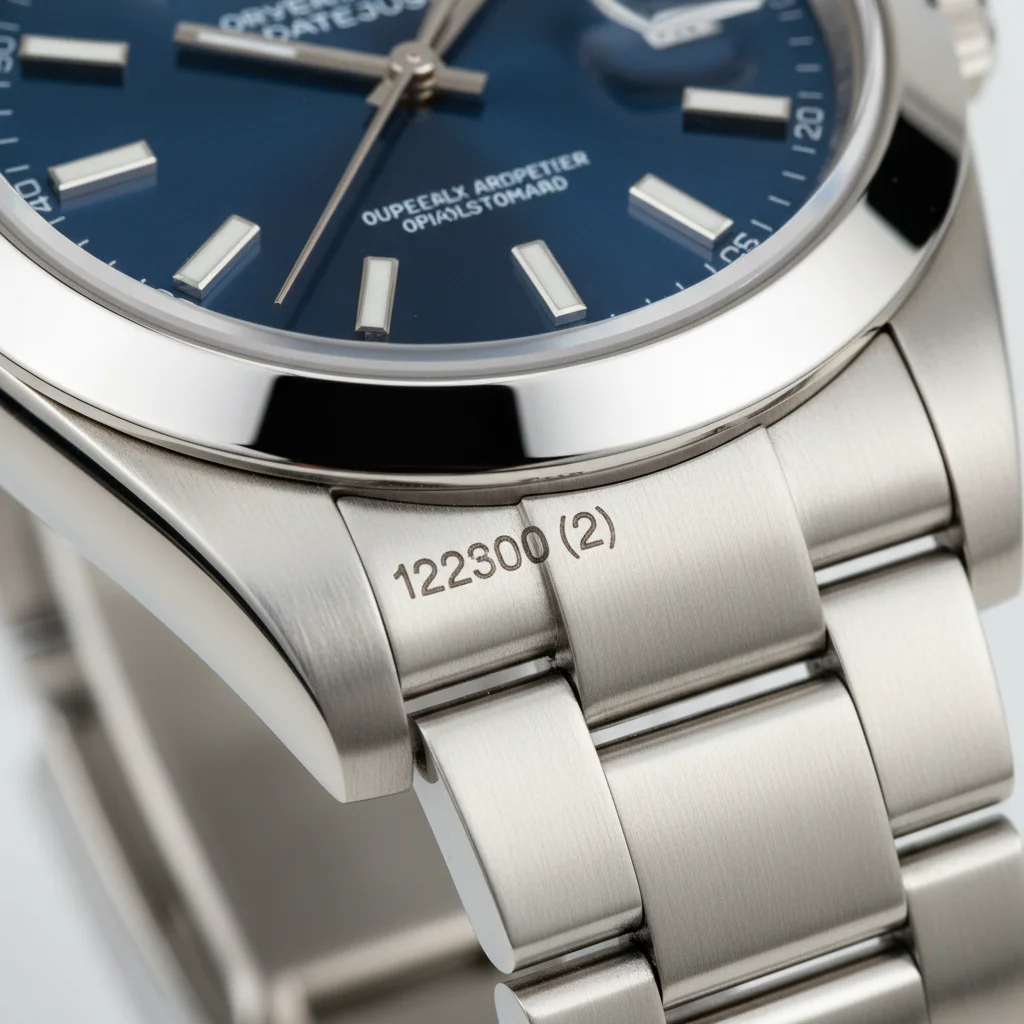 Illustrative only. Genuine Rolex serial engravings between the lugs at 6 o'clock (modern watches, 2005 onward) are crisp, deep, and perfectly aligned. Shallow, uneven, or sandblasted-looking engravings are a giveaway. For real reference photography, consult rolex.com or hand the watch to a qualified watchmaker.
What to check
- Caseback plain or engraved. Most modern Rolex casebacks are plain solid steel. Rolex does not engrave personal dedications on most standard production watches. An engraved dedication on a pre-owned watch reduces value but does not indicate a fake.
- Exhibition casebacks. Rolex has not generally made exhibition casebacks on standard production watches. The 2026 Rolesium Daytona is a notable exception. An exhibition caseback on a Submariner, GMT, or Datejust is a fake.
- Serial number. Engraved between the lugs at 6 o'clock on modern watches (2005 onward). Earlier watches had serials between the lugs under the bracelet. The engraving should be crisp, deep, and aligned.
- Reference number. Engraved between the lugs at 12 o'clock on modern watches. Should match the warranty card reference exactly.
Serial number lookup tools can flag stolen watches but cannot confirm authenticity. A real serial on a fake case is a known counterfeiting tactic.
Layer 5: Movement
This is where authentication becomes definitive. No counterfeit Rolex movement is close to a real Rolex caliber under inspection.
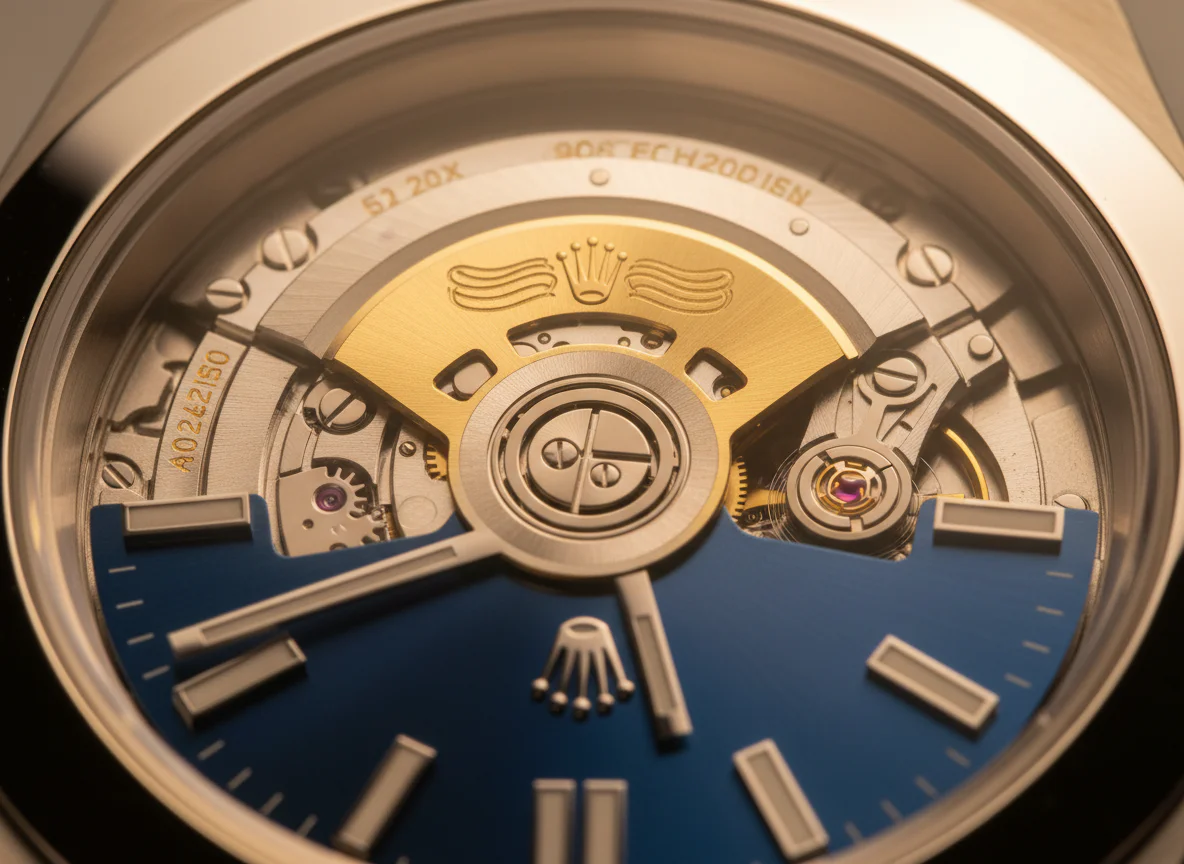 Illustrative only. A genuine caliber 3235 should show crisp caliber markings, consistent perlage finishing, the distinctive blue Parachrom hairspring, and a full-size gold rotor with Rolex branding. For real movement reference photography, Rolex's official caliber documentation and watchmaker resources are the authoritative source.
What to look for
A legitimate dealer will open the caseback for a qualified buyer. Here is what you are checking:
- Caliber markings. The movement should be clearly engraved with the caliber (3235, 3285, 3230, etc.). The engraving quality is sharp and consistent.
- Finishing. Rolex movements have machine-finished plates with consistent perlage (circular grain), polished screw heads, and specific bridge architecture for each caliber.
- Rotor. Full-size gold or tungsten rotor with Rolex branding. Smooth rotation, no wobble.
- Balance wheel. Free-sprung balance with Microstella regulating weights on modern calibers. The Parachrom hairspring is a distinctive blue color.
- Serial on the movement. Modern Rolex movements carry a caliber serial separate from the case serial. Absence of this is a red flag.
Movement inspection is the single most diagnostic authentication step. The best external fake cannot replicate a genuine 3235 movement under a loupe.
Layer 6: Bracelet
Bracelets are often overlooked. They are also one of the most swapped parts, which matters both for authenticity and for value.
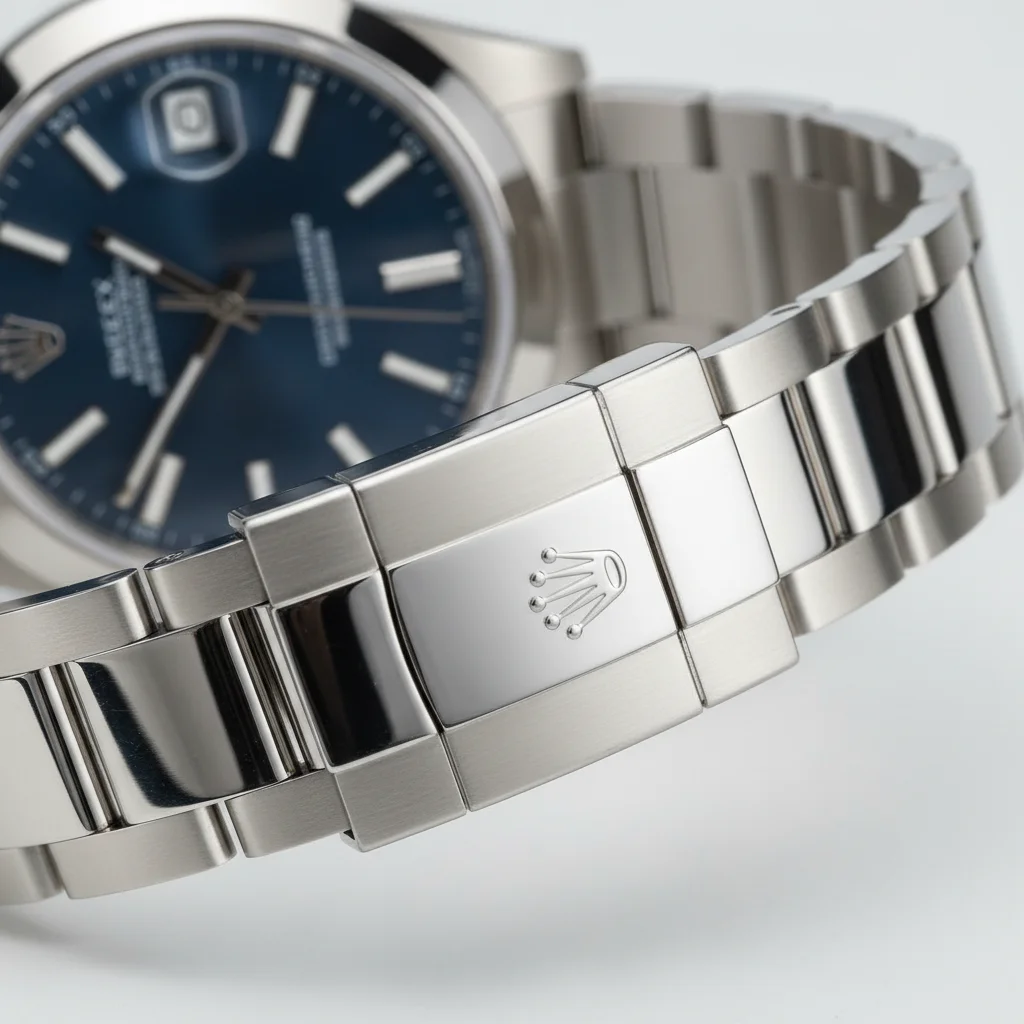 Illustrative only. On a genuine Rolex, the engraved coronet on the Oysterlock clasp is sharp and deep, not stamped or shallow. Bracelet references engraved inside the clasp should match the watch era. Reference Rolex's official documentation for exact clasp specifications.
What to check
- Bracelet reference. The inside of the clasp is engraved with a bracelet reference number. Common references include 97200 (Oyster) and 55210 (Jubilee for sport watches). The reference should match the model era.
- Endlinks. Solid endlinks, proper fit against the case with no gaps. Aftermarket or wrong-reference endlinks sit slightly off.
- Clasp mechanism. Genuine Rolex clasps have specific mechanisms for their era. Glidelock on sport watches, Easylink on dress watches, Oysterlock on most professional models. Each has a distinct feel.
- Crown engraving on clasp. Modern clasps have an engraved coronet on the exterior. Sharp and deep, not stamped or shallow.
A genuine watch on an aftermarket or swapped bracelet is still genuine, but the price should reflect the bracelet swap and it should be disclosed.
Red flags that end the inspection
Any one of these means stop:
- Seller refuses to open the caseback
- Papers do not match the watch reference and serial
- Serial number engraving is shallow, uneven, or sandblasted in appearance
- Case dimensions are off by more than tolerance (typically 0.2mm)
- Movement shows modern rotor with vintage caliber or vice versa
- Lume plots show mixed colors or inconsistent aging
- Coronet logo on dial, crown, or clasp shows incorrect proportions
- Dial printing is blurred at 10x magnification
When to walk away entirely
- Seller will not provide clear macro photos of dial, caseback, and movement
- Listed price is significantly below market with "no questions asked" framing
- Payment method requested is irreversible (wire, crypto, cash app) with no return option
- Seller is evasive about the watch's history, service, or prior ownership
The best authentication is buying from a dealer who has already done it. A reputable pre-owned Rolex dealer authenticates every watch before listing. Ask what their process is.
How we authenticate at 5D Watches
For transparency, here is what we do on every watch before it goes up:
- External inspection with calipers and loupe, comparing dimensions against manufacturer spec
- Documentation review and serial matching
- Caseback opened for movement inspection and photography
- Dial inspection under 10x magnification
- Bracelet reference verification and clasp inspection
- Functional testing (timekeeping, water resistance, bezel action, crown function)
- Service history review and disclosure
If a watch fails at any point, it does not get listed. If it has a disclosed flaw, that flaw is documented in the listing and reflected in the price.
The takeaway
Pre-owned Rolex is a genuinely great market. The watches hold their value, they come from one of the most reliable manufacturers in watchmaking, and the secondary market offers real discounts to authorized dealer retail on many references.
But the authentication gap between a legitimate pre-owned dealer and an open marketplace is real. The six-layer checklist above is the minimum. A dealer should be doing it for you. If they are not, you are doing it yourself, or you are taking unnecessary risk.
The same framework applies across brands. If Omega is more your speed, our Omega authentication checklist covers the same five-point process for Speedmasters and Seamasters: serial numbers, movement finishing, dial printing, and the paperwork.
For a practical application of this framework on a specific reference, see our Submariner 126610LN buying guide. For a sense of what is worth authenticating in the current market, our Pepsi discontinuation analysis breaks down why authentication matters more on discontinued references.
Shop our authenticated pre-owned Rolex inventory at 5dwatches.com/shop/rolex. Every piece goes through the full six-layer inspection above before we list it, with movement photography and service history disclosure in every listing.