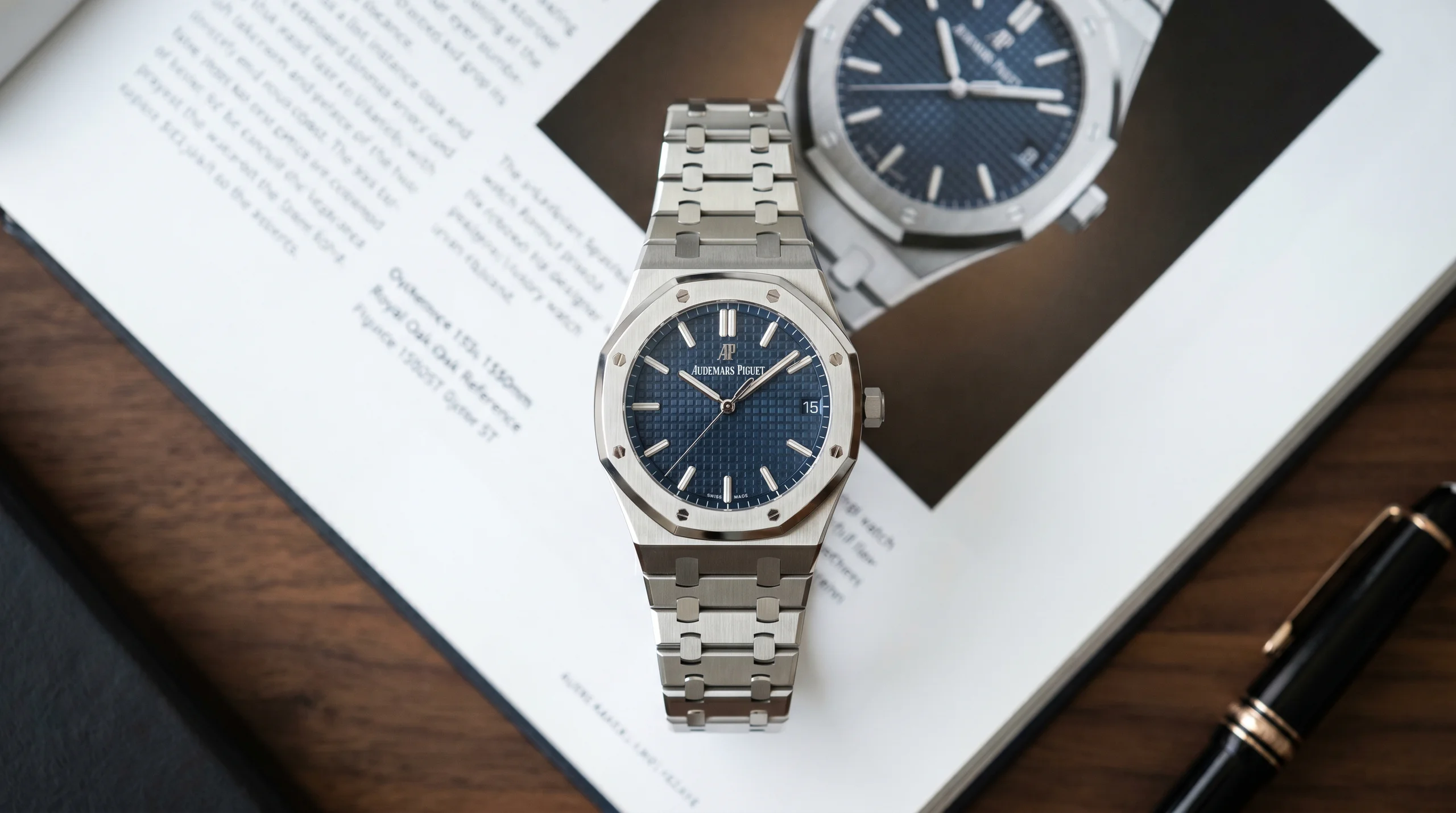
You walk into an authorized dealer in Beverly Hills. You ask to see the Audemars Piguet Royal Oak. The sales associate's eyebrow moves.
You said "Ah-deh-mars Pig-wet." It should have been "Oh-duh-MAR pee-GAY."
The next twenty minutes go differently than you'd hoped.
Watch brand pronunciation is one of the few hard credibility filters in luxury retail. Dealers, brand reps, and seasoned collectors notice. They don't say anything, and they shouldn't. But the way you say "Vacheron Constantin" or "Jaeger-LeCoultre" tells them in three seconds whether you're a seasoned buyer or someone they need to explain water resistance to.
This is the working dealer's pronunciation guide. Twenty-five brands, the phonetic spelling that actually works, the common mistakes to avoid, and a native-speaker video for each so you can hear it before you say it.
The featured image in this post is AI-generated and may not perfectly represent the actual watches discussed. It is intended for illustration only.
Listen first: every major luxury watch brand in one video
Before the brand-by-brand breakdown, here is the single most authoritative pronunciation video on the internet for watch brands. A native French-Belgian speaker pronouncing 31 brand names in a row. Five minutes, every brand you need:
If you only have time for one thing, that is it. The rest of this post breaks down each brand individually with the origin, the common mistake, and a focused video for the trickier names.
The short answer
The pronunciation cheat sheet, in priority order. Bold is the English approximation you can use confidently.
| Brand | Pronunciation | Origin |
|---|---|---|
| Audemars Piguet | Oh-duh-MAR pee-GAY | French (Swiss) |
| Patek Philippe | Pah-TEK fee-LEEP | French (Swiss) |
| Vacheron Constantin | Vah-shuh-RON kon-stan-TAN | French (Swiss) |
| Jaeger-LeCoultre | ZHAY-zhair luh-KOOLTR (also YAY-ger luh-KOOLT-ruh) | French/German (Swiss) |
| A. Lange & Söhne | Ah LAHNG-eh unt ZUR-neh | German |
| Hublot | Oo-BLOW | French (Swiss) |
| Breguet | Breh-GAY | French (Swiss) |
| Blancpain | Blahn-PAN | French (Swiss) |
| Cartier | Kar-TYAY | French |
| Chopard | Sho-PAR | French (Swiss) |
| Piaget | Pyah-ZHAY | French (Swiss) |
| Baume & Mercier | Bohm eh Mehr-SYAY | French (Swiss) |
| Longines | Lohn-ZHEEN | French (Swiss) |
| Ulysse Nardin | Oo-LEES nar-DAN | French (Swiss) |
| Montblanc | Mohn-BLAHN | French (German company) |
| Panerai | Pah-neh-RYE | Italian |
| Officine Panerai | Off-ee-CHEE-neh Pah-neh-RYE | Italian |
| Bulgari (BVLGARI) | BOOL-gah-ree | Italian |
| Glashütte Original | Glahs-HOO-teh Oh-rih-gee-NAHL | German |
| TAG Heuer | TAG HOY-er | German (Swiss) |
| Breitling | BRIGHT-ling | German (Swiss) |
| IWC Schaffhausen | I-W-C SHAF-how-zen | German (Swiss) |
| Tissot | Tee-SOH | French (Swiss) |
| Omega | OH-meh-gah | Greek/French (Swiss) |
| Tudor | TOO-dur | English |
The rest of this post is the why behind each one and a focused video where the brand earns the extra attention.
The Holy Trinity: the three you cannot afford to say wrong
Audemars Piguet
Oh-duh-MAR pee-GAY
Founded 1875 in Le Brassus, in the French-speaking Vaud canton of Switzerland. Both names are French. Jules Louis Audemars and Edward Auguste Piguet were the founders. The brand has been family-owned for 151 years.
The two traps: the S in Audemars is silent, and the T in Piguet is silent. The U in Piguet is also not pronounced. "Pig-wet" or "Pee-go-et" are both wrong. The correct sound is short and ends sharply on a closed "ay" without the English drawn-out diphthong glide.
If you only learn one pronunciation in this entire post, learn this one. Audemars Piguet is the brand non-collectors most commonly butcher, and the brand collectors will quietly judge you for the most.
Patek Philippe
Pah-TEK fee-LEEP
Founded 1839 in Geneva. The Patek and Philippe names are French in origin, and Philippe is pronounced like the French given name, not the English "Phillip" or the Italian "Filippo."
Both i's in Philippe sound the same. Many English speakers pronounce them differently, with the first as "ih" and the second as "ee." Both should be "ee." Short, tight, and stressed on the second syllable.
"Pa-tek Phi-LIP-ee" is the most common American mispronunciation. The brand name has no trailing vowel sound. It ends on the P.
Vacheron Constantin
Vah-shuh-RON kon-stan-TAN
Founded 1755 in Geneva. The oldest continuously operating watch manufacturer in the world. The name combines founder Jean-Marc Vacheron with his 1819 business partner François Constantin.
This is the hardest of the three to pronounce because the word contains three different French nasal vowels: "on" in Vacheron, "an" in Constantin, and "in" at the end of Constantin. Each is a distinct sound in French, but English speakers tend to collapse them into similar-sounding versions.
The most common American mistake is to anglicize Constantin as "Constantine" or "Con-stan-TEEN." That is wrong. The final "-tin" is a nasal vowel, not the English "tine" or "teen" sound. The N is barely pronounced, almost swallowed.
The other French and Swiss-French brands
Jaeger-LeCoultre
ZHAY-zhair luh-KOOLTR (or YAY-ger luh-KOOLT-ruh)
This is the brand with the most honest answer in the entire post: there is no single correct pronunciation, and the brand's own staff use two different ones.
The all-French version is "ZHAY-zhair luh-KOOLTR." This is what former CEO Jérôme Lambert uses in interviews and what the brand's own promotional materials reflect when the speaker is French. It is the most defensible pronunciation if you want to demonstrate deep knowledge.
The Germanic-Jaeger-plus-French-LeCoultre version is "YAY-ger luh-KOOLT-ruh." This is what JLC boutique staff in Geneva, Zurich, Berlin, and the United States service center actually say when answering the phone. Edmond Jaeger himself was French-Alsatian, working in Paris, which means his name has a defensible French pronunciation as well as a defensible Germanic one.
Both are heard inside the company. Either is accepted in collector circles. The all-French version reads as more knowledgeable. Either version reads as informed. Just don't say "JAY-ger Lee-COAL-tree."
Many collectors solve this by simply saying "JLC."
Hublot
Oo-BLOW
Founded 1980 in Nyon, Switzerland. The name is French for "porthole," referring to the case shape. The H is silent. The T at the end is silent. The U is the French "u" sound (lips rounded, "ee" position), which most English speakers approximate as "oo."
"Hew-blow," "Hub-lot," and "You-blow" are all wrong. The H disappears entirely. The whole word is two short syllables.
Breguet
Breh-GAY
Founded 1775 in Paris by Abraham-Louis Breguet, arguably the most influential watchmaker in history. Now owned by the Swatch Group.
Silent U, silent T. The closing "et" is the same French "ay" sound as in Audemars Piguet. Not "Bre-gwet," not "Bra-gay." Two short syllables, stress on the second.
Cartier
Kar-TYAY
Founded 1847 in Paris. French jewelry maison that also makes serious watches. The Tank and the Santos are both Cartier originals.
The two traps: the stress goes on the second syllable, and the second R is silent. American speakers commonly say "CAR-tee-ay" with the stress on the first syllable, which is wrong. The French version places the emphasis on the closing "-tier" sound, with the R disappearing entirely.
Chopard
Sho-PAR
Founded 1860 in Sonvilier, Switzerland by Louis-Ulysse Chopard. The D at the end is silent. The CH at the start is the French "sh" sound, not the English "ch" sound. "Show-pard" with a hard D is the most common American mistake.
Piaget
Pyah-ZHAY
Founded 1874 in La Côte-aux-Fées, Switzerland by Georges Piaget. The brand name is French, not Italian. The G is soft (a French "zh" sound, like the S in "treasure"), not a hard English G. The T at the end is silent.
"Pee-AH-get" with a hard G and pronounced T is wrong. The correct version is fluid, three syllables blended together with the stress on the last.
Blancpain
Blahn-PAN
Founded 1735 in Villeret, Switzerland by Jehan-Jacques Blancpain. The oldest continuously registered watch brand in the world. The name literally means "white bread."
The C in Blancpain is silent. The N is part of a nasal vowel, not a hard consonant. The two nasal sounds (the "an" in Blanc and the "ain" in pain) are technically different in French, but the English approximation "Blahn-PAN" is close enough that you will not get judged for it.
"Blanc-pain" with hard consonants is what English speakers default to. That is wrong.
Baume & Mercier
Bohm eh Mehr-SYAY
Founded 1830 by the Baume brothers in Les Bois, Switzerland. The ampersand is pronounced "eh" (the French "et" meaning "and"), not the English "and."
The E at the end of Baume is silent. The R at the end of Mercier is silent. The second syllable of Mercier is "SYAY," with a short clipped "ay" sound.
"BOWM and MER-see-er" is the most common American mistake. The French version is shorter, faster, and ends on a closed sound.
Longines
Lohn-ZHEEN
Founded 1832 in Saint-Imier, Switzerland. The S at the end is silent. The G is soft (the French "zh" sound). The stress is on the second syllable.
"Lon-jines" with a hard J and pronounced S is wrong. The French version is two short syllables, stress on the last.
Ulysse Nardin
Oo-LEES nar-DAN
Founded 1846 in Le Locle, Switzerland by Ulysse Nardin. The brand is known for marine chronometers and complications.
The U in Ulysse is the French rounded U, which English speakers approximate as "oo" (some sources render it as "you-LEES," but the cleaner French version is "oo-LEES"). The E at the end of Ulysse is silent. The IN in Nardin is a French nasal vowel, ending with the N barely pronounced.
"You-liss Nar-din" with a hard, fully-pronounced ending is the most common American mistake.
Montblanc
Mohn-BLAHN
Founded 1906 in Hamburg, Germany, but with a French name (referring to Mont Blanc, the highest peak in the Alps). The brand makes Swiss-made watches but is structurally a German pen and accessories company.
The T in Mont is silent. The C in Blanc is silent. Both syllables end in French nasal vowels, but they are different nasal vowels. "Mont-Blank" with both consonants pronounced is wrong.
The Italian brands
Panerai
Pah-neh-RYE
Founded 1860 in Florence, Italy. Three syllables, all short, with the stress on the last. "Pa-neh-RYE."
The final syllable rhymes with "high" or "rye." Not "Pan-er-ay" and not "Pa-NAIR-ee." Italian R is a brief tap, not the rolling R of Spanish or the throaty R of French.
Officine Panerai
Off-ee-CHEE-neh Pah-neh-RYE
The full corporate name. Officine is Italian for "workshops." The CI in Italian is pronounced "chee" (like "cheese"), not the English "see" or "kee."
"Off-ee-SEEN-ee Panerai" is the most common American mistake. The correct version has four short Italian syllables before Panerai.
Bulgari (BVLGARI)
BOOL-gah-ree
Founded 1884 in Rome by Sotirios Voulgaris, a Greek silversmith who Italianized his name. The unusual BVLGARI spelling on the brand's storefronts uses Latin-style V in place of U, reflecting classical Roman inscriptions where U and V were interchangeable. It is still pronounced "BOOL-gah-ree."
"Bul-GAR-ee" with the stress on the middle and "Bull-gary" pronounced as English are both wrong. The Italian version has three short syllables with the stress on the first.
The German and Swiss-German brands
A. Lange & Söhne
Ah LAHNG-eh unt ZUR-neh
Founded 1845 in Glashütte, Germany by Ferdinand Adolph Lange. The full name translates to "A. Lange and Sons." The current brand was re-registered in 1990 after the original was nationalized in 1948.
Multiple things to know. The ampersand is pronounced "und" (the German word for "and"), not the English "and." The Söhne contains the German umlauted ö, a sound that does not exist in English. The closest English approximation is "ZUR-neh," but the true German sound sits somewhere between "ZUR" and "ZER," with lips rounded.
The G at the end of Lange is also softer than the English hard G. It is closer to a brief "guh" with a swallowed vowel.
If you cannot do the German ö, "ZUR-neh" is the safer approximation than "ZOHN" or "SOON." Most collectors just say "Lange" and skip the rest.
Glashütte Original
Glahs-HOO-teh Oh-rih-gee-NAHL
Founded 1845 in Glashütte, Germany, with the current brand re-registered in 1994. Glashütte is also the name of the town, which is the historic center of German watchmaking. The umlauted ü in Glashütte is approximated as "oo" with rounded lips in English.
The G in Original is also softened in German, almost a brief "h" sound. Glah-SHOO-teh Oh-rih-GEE-nahl is the closest you can get without a German accent. The full word "Original" is stressed on the last syllable, German-style.
TAG Heuer
TAG HOY-er
Founded 1860 as Edouard Heuer in Saint-Imier, Switzerland. TAG was added in 1985 when the TAG Group (Techniques d'Avant Garde) acquired the company.
The German "eu" diphthong always sounds like "oy" (as in "boy"). Heuer rhymes with "boyer" without the B. The TAG is spoken as a single word, not as letters (T-A-G), even though it is technically an acronym.
"Tag Hew-er" and "Tag Hyoo-er" are both wrong. The correct version is two clean syllables, stress on the first.
Breitling
BRIGHT-ling
Founded 1884 in Saint-Imier, Switzerland by Léon Breitling. Despite being Swiss, the brand follows German pronunciation rules.
The "ei" diphthong in German sounds like the English "eye" or "I." So Breitling rhymes with "fight-ling" or "night-ling." Stress on the first syllable.
"Brate-ling" and "Brit-ling" are both wrong. The correct version uses the long English "I" sound.
IWC Schaffhausen
I-W-C SHAF-how-zen
Founded 1868 in Schaffhausen, Switzerland by American Florentine Ariosto Jones. IWC stands for International Watch Company, and most English speakers pronounce it as the three English letters: "I-W-C." That is correct and accepted globally.
The technically more authentic German version of the letters is "Ee-veh-tseh" (since the W in German is "veh" and C is "tseh"), but almost nobody outside the German-speaking watch world uses this. The English letters are fine.
Schaffhausen is the German town name. It is pronounced "SHAF-how-zen," with the "au" sounding like "ow" (as in "cow").
The "easy" ones people still get slightly wrong
Rolex
ROH-lex
Founded 1905 by Hans Wilsdorf in London, moved to Geneva in 1919. The name was deliberately chosen to be easy to pronounce in any language. It works in English exactly as you would expect.
The only nuance: the French version is shorter and ends more crisply on the "x." Some collectors say "Roh-LEX" with the stress on the second syllable to sound more European, but the standard English "ROH-lex" with stress on the first is universally accepted.
Omega
OH-meh-gah
Founded 1848 in La Chaux-de-Fonds, Switzerland. The brand name is Greek (the last letter of the Greek alphabet), but the brand uses a French-style pronunciation: stress on the first syllable, all syllables short.
"Oh-MAY-gah" with the stress on the middle is what most Americans say. That is the American English pronunciation of the Greek letter, but the brand itself uses "OH-meh-gah." Both are heard. The brand's own pronunciation is the more accurate one.
Tissot
Tee-SOH
Founded 1853 in Le Locle, Switzerland. The T at the end is silent. The S is pronounced. The closing vowel is a short closed "oh."
"Tih-SOT" with the T pronounced is the most common American mistake. The correct version is two short French syllables ending in a clean "oh" sound.
Tudor
TOO-dur (American) or TYOO-dur (British)
Founded 1926 by Hans Wilsdorf as a sister brand to Rolex. Tudor is an English word (referring to the Tudor dynasty), so the pronunciation is English. American English uses "TOO-dur" (the same as the historical dynasty in American usage). British English uses "TYOO-dur" with a slight Y glide.
Either is correct. The brand itself uses both in different markets.
The honest take
Pronouncing watch brands correctly is one of those small competence signals that means more in luxury retail than it should. A dealer or seasoned collector will not call you out if you say "Vash-er-on Constan-TEEN," but they will quietly recalibrate their assumptions about what you know.
The deeper truth: the brands themselves often have multiple internally accepted pronunciations. Jaeger-LeCoultre is the most public example, with the company's own staff using two different versions. Audemars Piguet's "uet" ending technically has a slightly different French sound than the English "ay" most collectors use. Cartier has at least three commonly-heard versions in the United States alone.
If you are buying or learning, the goal is not to sound Parisian. The goal is to demonstrate that you know enough to have considered the question, and to land somewhere defensible. The phonetic spellings in this guide are the universally-accepted English approximations that work in any luxury watch context worldwide.
For the brands you are most likely to actually discuss with a dealer or fellow collector (Rolex, Patek Philippe, Audemars Piguet, Vacheron Constantin, Omega), invest the extra two minutes to get them comfortably correct. The rest will come with conversation.
The short version, if you remember nothing else from this post:
- Audemars Piguet: Oh-duh-MAR pee-GAY (silent S, silent T)
- Patek Philippe: Pah-TEK fee-LEEP (both i's the same)
- Vacheron Constantin: Vah-shuh-RON kon-stan-TAN (NOT Constantine)
- Hublot: Oo-BLOW (silent H, silent T)
- Audemars and Vacheron are the two you cannot afford to get wrong.
Browse authenticated pre-owned luxury watches at 5dwatches.com.