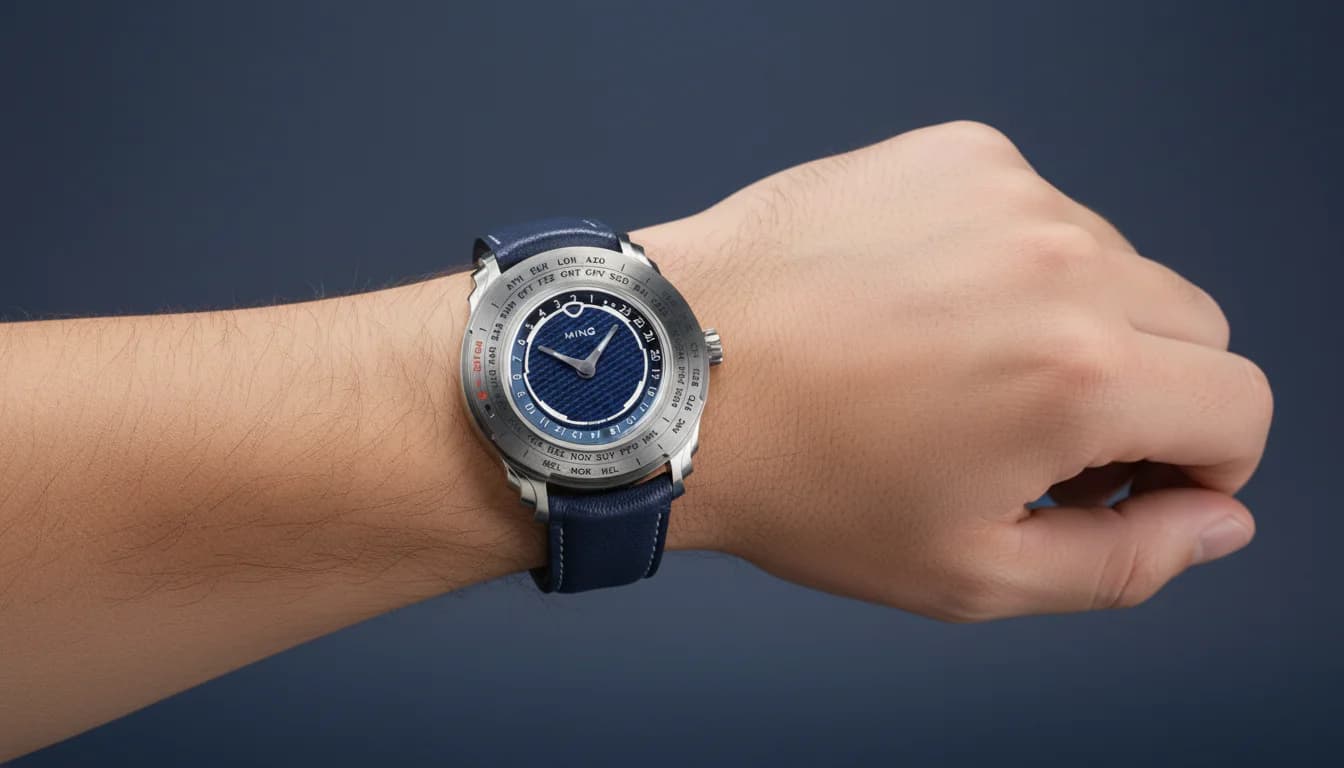
Every worldtimer has the same flaw: half its city bezel goes wrong for half the year, because daylight saving time is never printed on the dial. MING just built a bezel that fixes it, on a 200-piece limited edition priced at CHF 6,950.
The short answer: The MING 57.05 Comet is a 40mm steel worldtimer with a patent-pending bezel system that separates daylight-saving cities from fixed-time cities on two rings instead of one. It runs the Sellita-based Calibre 330.M2 automatic movement, rated to 100m water resistance, and ships on either a cobalt blue leather strap (CHF 6,950) or a titanium Polymesh bracelet (CHF 7,950). Total production is capped at 200 pieces.
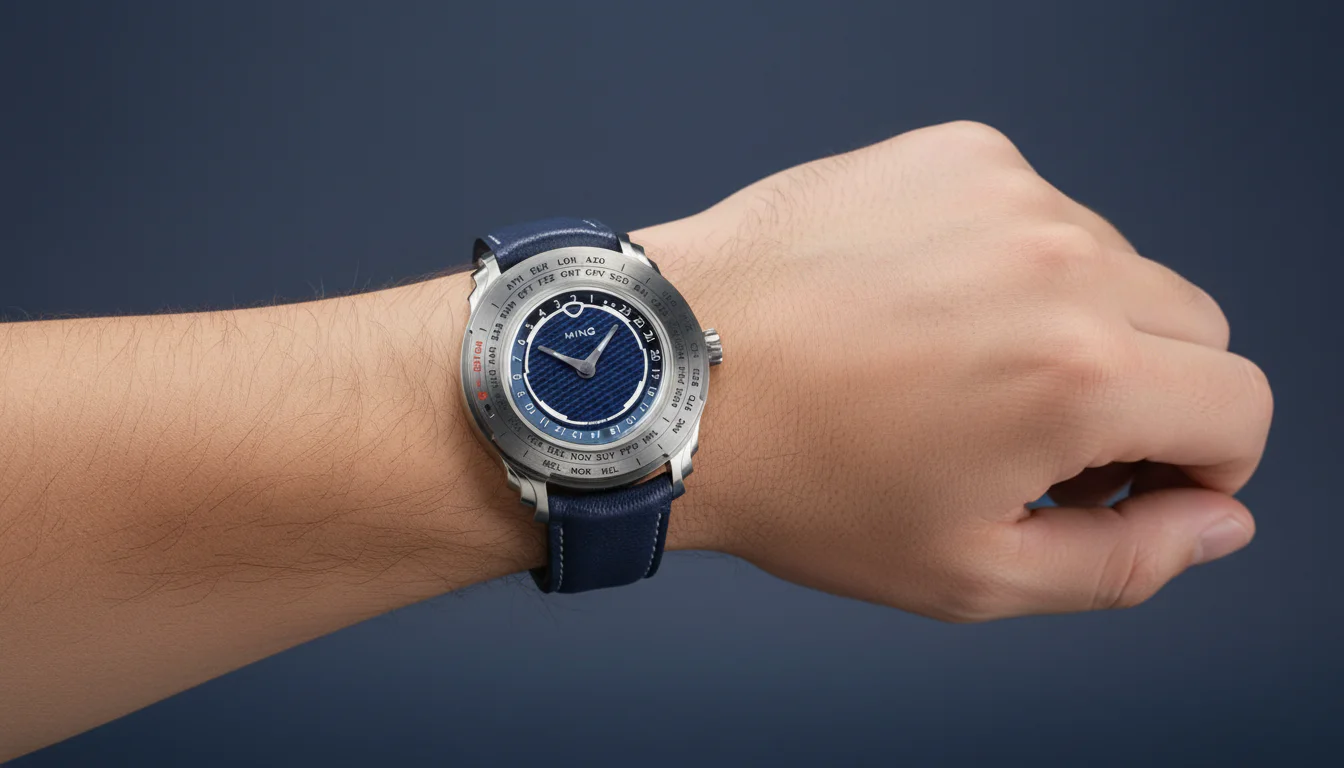 The 57.05 Comet's dual-ring bezel is the first serious mechanical answer to daylight saving time on a worldtimer.
The Problem Every Worldtimer Ignores
A traditional worldtimer prints a fixed ring of city names around a 24-hour scale. It works perfectly in winter and quietly lies to you for roughly half the year, because most of those cities observe daylight saving time on different schedules, or not at all, and the watch has no way to account for it.
Most brands treat this as an acceptable compromise. MING, the Malaysian independent known for punching above its price point on case architecture and movement selection, decided it was worth solving.
The Patent-Pending Bezel
The Comet's dial carries a rotating 24-hour worldtime ring split across two separate bezels. One tracks cities that observe daylight saving time. The other tracks cities that stay on fixed time year-round. Setting the watch means aligning both rings correctly once, rather than mentally adjusting an hour for half the cities on the dial every time you check a second time zone.
A "Comet Tail" Dial to Match the Mechanism
The dial itself uses a multilayered construction MING calls the Comet Tail, a design language distinct from the brand's usual minimalist dials. It is a busier face than most MING releases, which makes sense given how much information the worldtimer function has to display clearly.
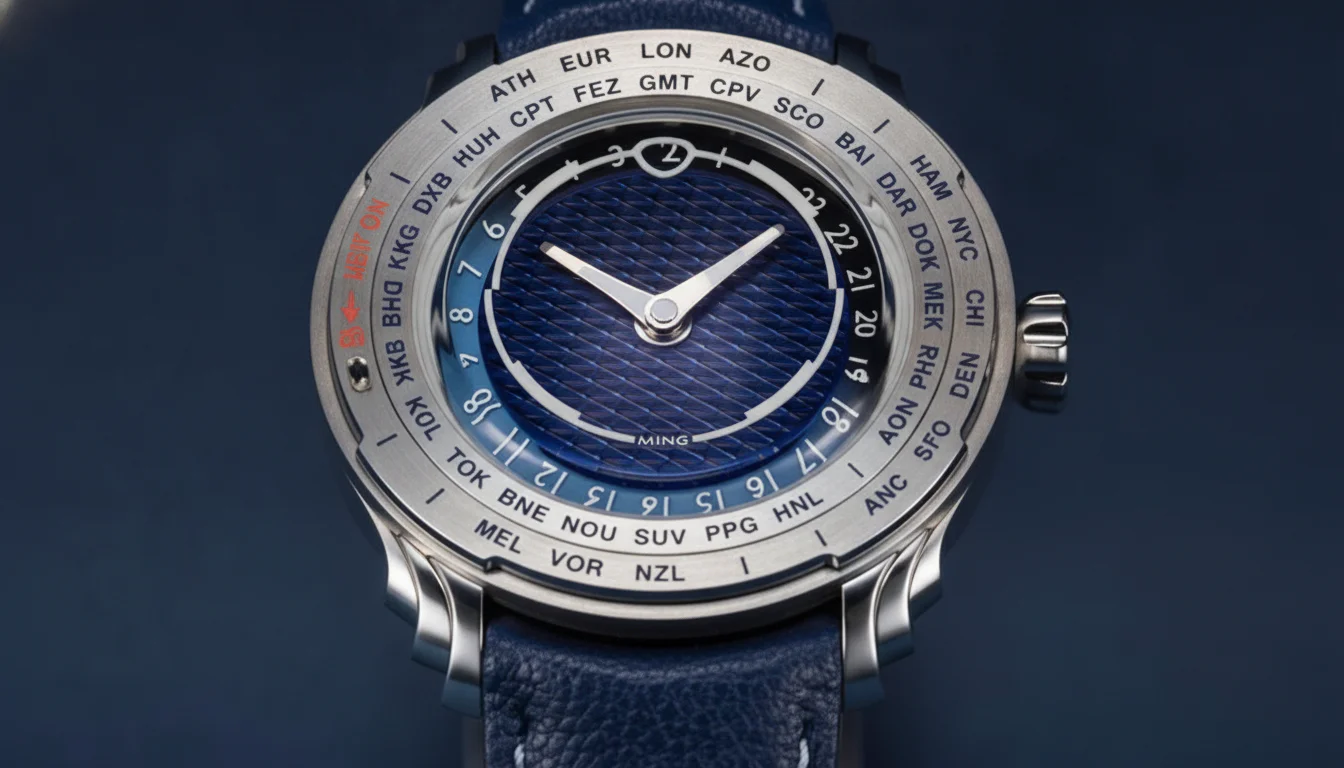 Two separate 24-hour rings, one for daylight-saving cities and one for fixed-time cities, replace the single city ring found on a conventional worldtimer.
Case and Movement
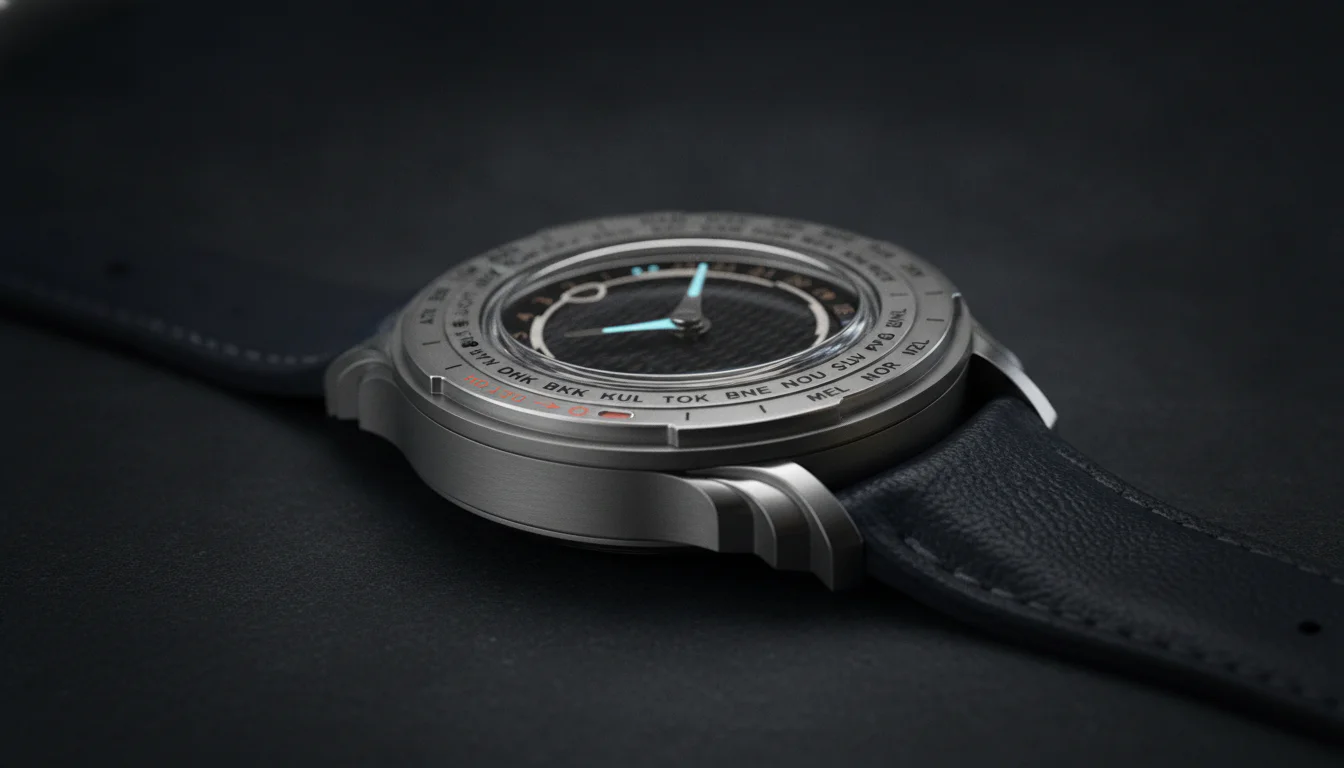 The 40mm by 10.33mm steel case keeps a 47.8mm lug-to-lug despite the added complexity of the dual bezel system.
A Sellita Base, MING's Own Calibre Designation
Inside sits the Calibre 330.M2, MING's own designation for a Sellita-based automatic movement. It runs at 28,800 vph with roughly 50 hours of power reserve, a standard, serviceable spec that keeps the watch's focus on the bezel complication rather than an exotic in-house caliber.
The 40mm by 10.33mm steel case holds a 47.8mm lug-to-lug, sized for the busier dial without ballooning into oversized territory. Water resistance lands at 100m, respectable for a complication watch that will mostly live on a desk or in a carry-on rather than underwater.
Straps, Pricing, and Availability
MING offers the Comet on a cobalt blue goat leather strap from Jean Rousseau Paris, or on the brand's own titanium Polymesh bracelet. The leather configuration runs CHF 6,950. The titanium bracelet version costs CHF 7,950.
Total production is capped at 200 pieces across both strap options. Orders opened August 27, 2026 through MING directly and its authorized retailers, standard practice for a brand that sells primarily direct-to-consumer to keep pricing below what a traditional retail markup would require.
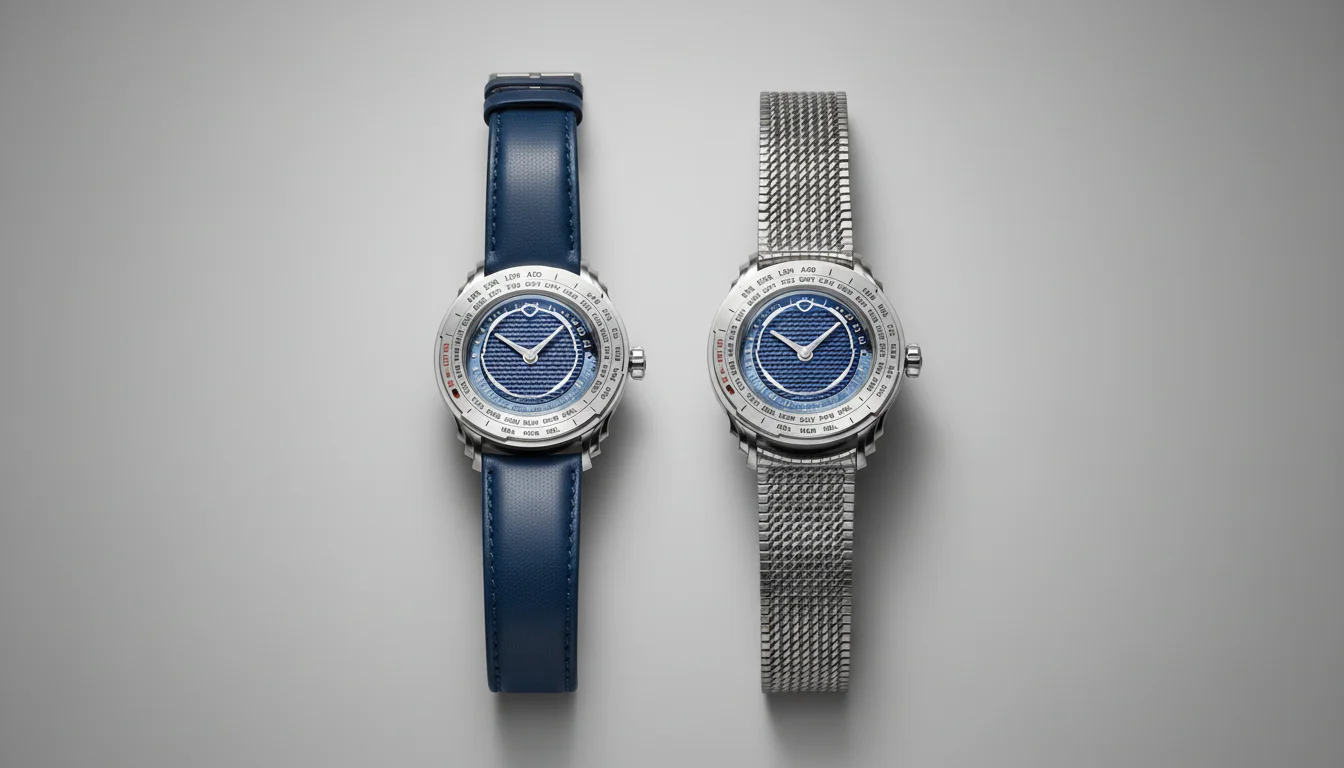 The cobalt blue goat leather strap from Jean Rousseau Paris (CHF 6,950) alongside MING's own titanium Polymesh bracelet option (CHF 7,950).
Where the Comet Sits in the Worldtimer Market
| Watch | Case | Movement | Price |
|---|---|---|---|
| MING 57.05 Comet | 40mm steel | Calibre 330.M2 (Sellita base) | CHF 6,950 to 7,950 |
| Patek Philippe World Time 5230 | 38.5mm gold/steel | Caliber 240 HU | Over $60,000 |
| Vacheron Constantin Overseas World Time | 43.5mm steel | Caliber 2460 WT | Over $70,000 |
MING is not competing with Patek or Vacheron on movement pedigree. It is competing on solving a real usability problem that neither of those far more expensive watches actually addresses. Our Vacheron Overseas guide covers what a traditional Swiss worldtimer costs at the top of the market for comparison.
FAQ
What makes the MING 57.05 Comet different from other worldtimers?
Its patent-pending bezel splits the 24-hour worldtime ring into two separate rings, one for cities observing daylight saving time and one for fixed-time cities, solving a usability problem most worldtimers ignore entirely.
How much does the MING 57.05 Comet cost?
CHF 6,950 on the cobalt blue leather strap, or CHF 7,950 on the titanium Polymesh bracelet.
Is the MING 57.05 Comet a limited edition?
Yes. Total production across both strap configurations is capped at 200 pieces.
What movement is inside the MING 57.05 Comet?
The Calibre 330.M2, MING's own designation for a Sellita-based automatic movement, running at 28,800 vph with about 50 hours of power reserve.
Where can I buy a MING 57.05 Comet?
MING sells primarily direct-to-consumer through its own website and a small network of authorized retailers, rather than through traditional boutique distribution.
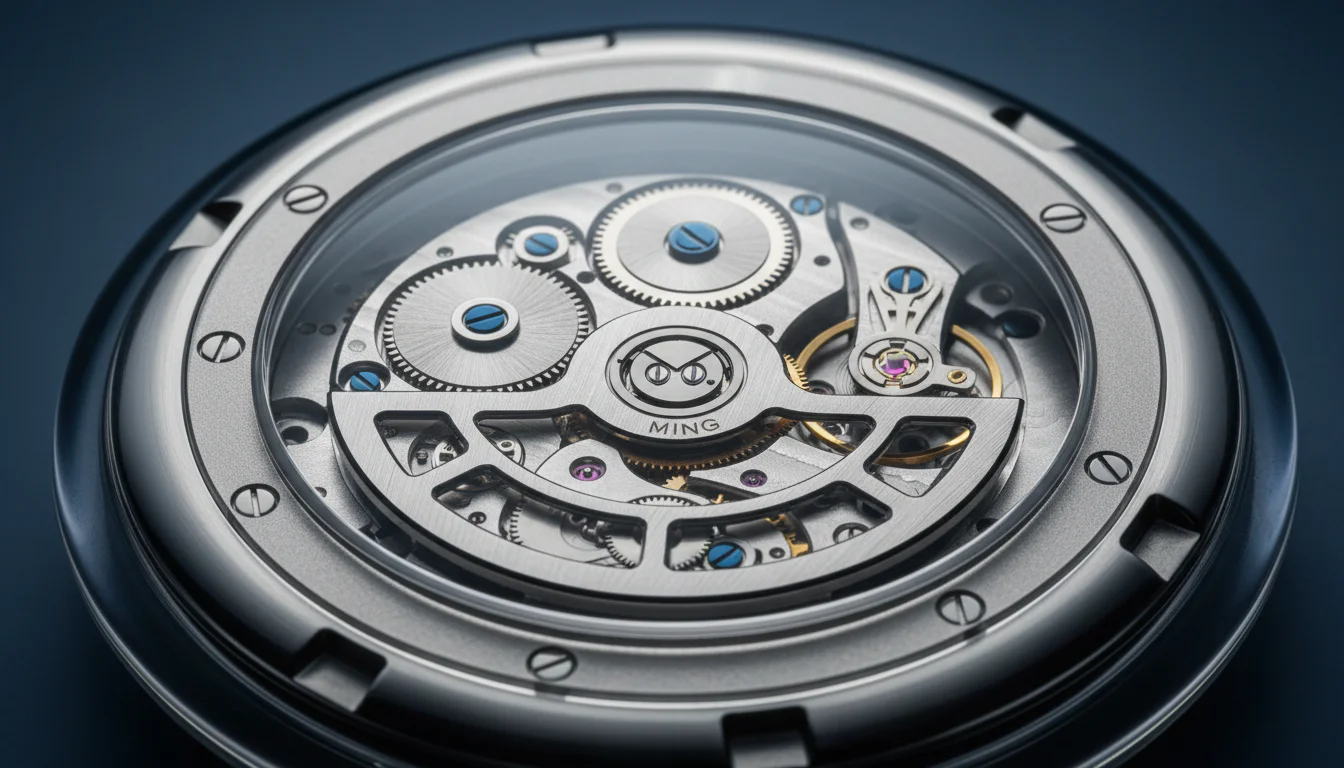 The Sellita-based Calibre 330.M2, visible through the sapphire caseback, keeps the Comet's focus and cost on the dial-side complication.