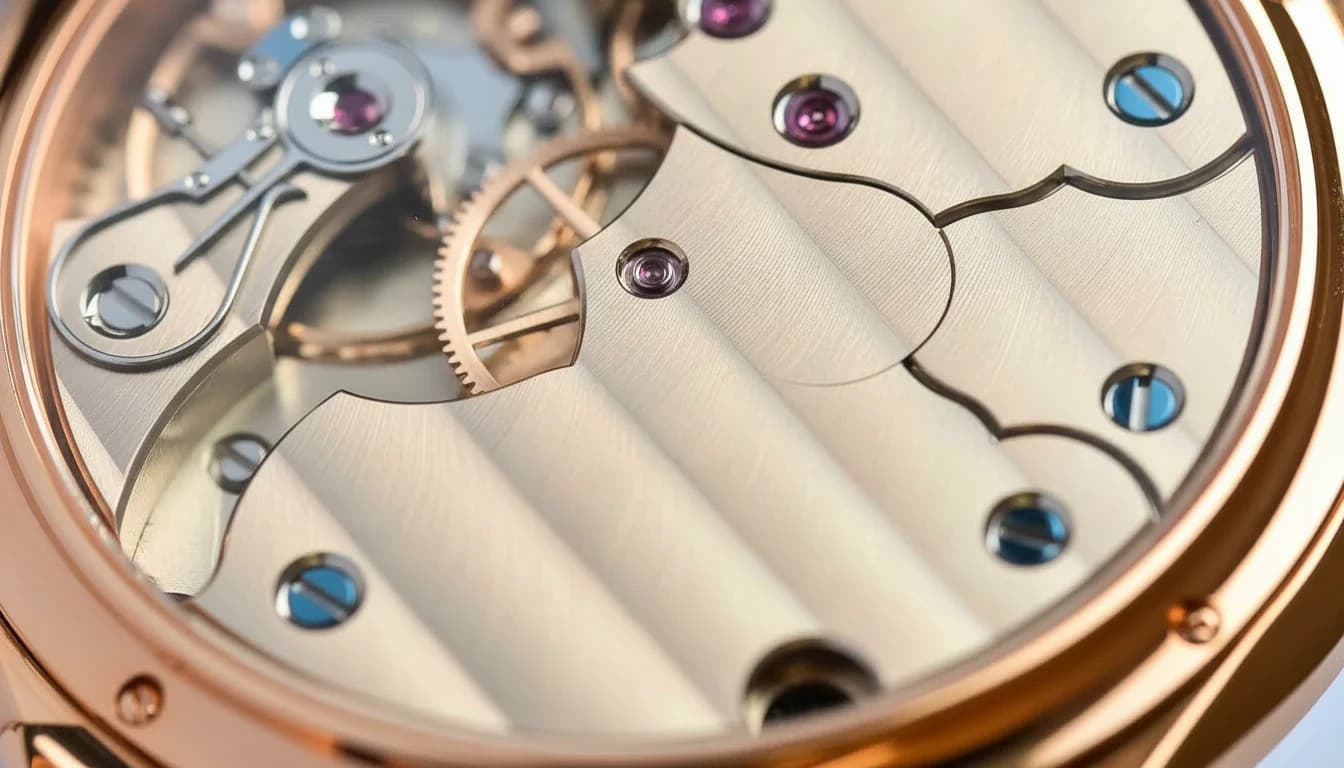
Flip a Patek Philippe over and the parts you cannot see with your eyes are finished as carefully as the dial. Geneva stripes, perlage, and beveled edges started as dust traps and stress-crack prevention. None of them matter mechanically anymore, and collectors will pay tens of thousands of dollars for them anyway.
The short answer: Movement finishing covers the decorative work applied to a watch's internal components. Côtes de Genève (Geneva stripes) are parallel ridged lines across bridges. Perlage is overlapping circular graining on plates. Anglage (beveling) is hand-polished, mirror-finished edges at roughly 45 degrees, the hardest and most prized technique. Black polishing turns steel parts mirror-flat until they read as black at an angle. All four started as functional dust or stress management and are now almost entirely aesthetic, forming the backbone of what the Geneva Seal certifies.
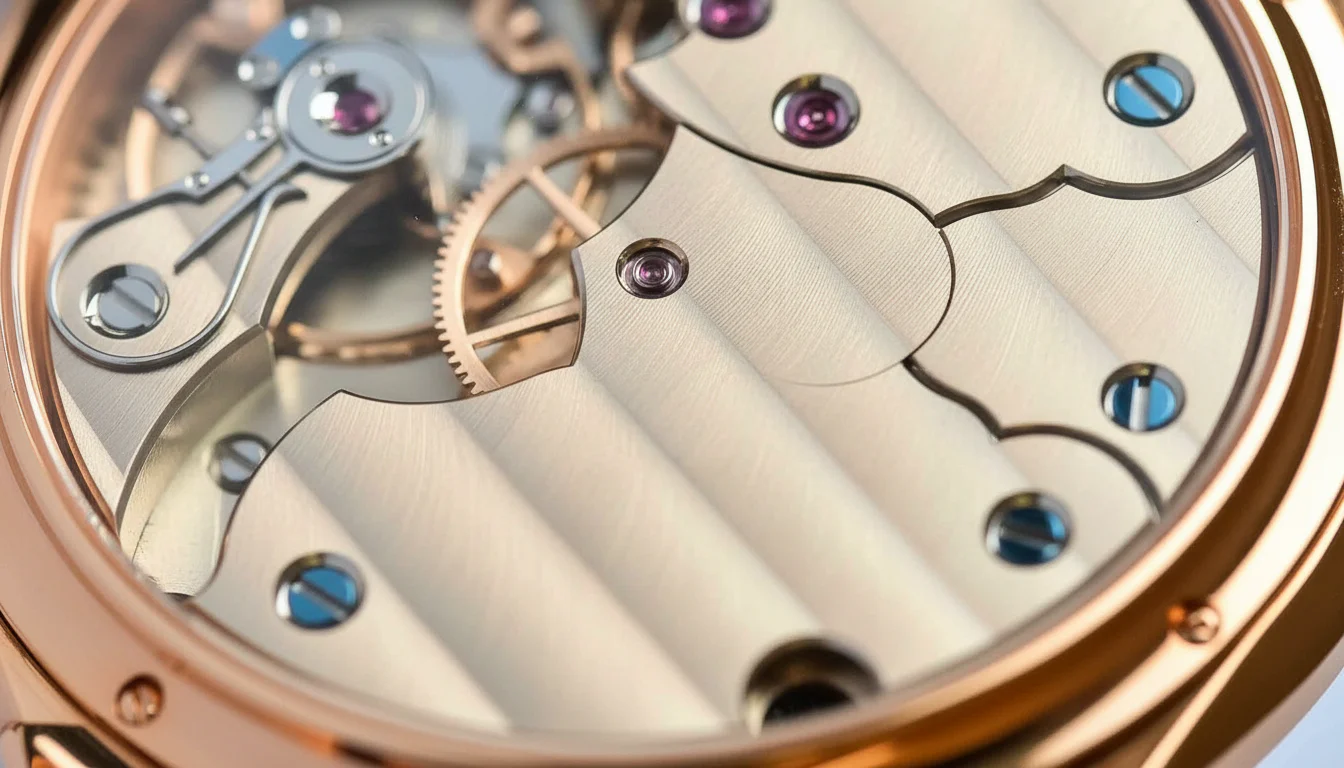 Côtes de Genève catch light differently depending on viewing angle, the same optical trick that made them useful for hiding scratches a century ago.
Why Finish a Part Nobody Will Ever See
Most movement finishing exists because early watchmakers needed a practical solution and stumbled into something beautiful. Cases were not dust-resistant, so parts got textured to trap stray particles before they reached the escapement. Sharp internal edges concentrated stress and cracked under shock, so edges got beveled to spread the load.
Modern cases seal out dust completely and modern alloys resist stress fractures without help. The techniques survived anyway, because once collectors could see them through a display caseback or a loupe at a boutique, the labor itself became the value. A CNC machine can approximate any of these finishes in minutes. A trained finisher takes years to do it by hand, and the difference is visible under magnification even if it is invisible to the naked eye.
Cotes de Geneve: The Stripes Everyone Recognizes
Côtes de Genève, known in English as Geneva stripes, are the parallel ridged lines that appear across bridges and plates on higher-end movements. They are the single most recognizable movement decoration, the one most people picture when they hear "fancy watch movement."
How They're Actually Made
An abrasive tool moves across the part at a precise, consistent angle, either by hand with tools from specialist suppliers or via CNC machinery for production-scale work. Vacheron Constantin is known for hand-applied stripes the brand describes as the deepest and most defined in the industry. Omega runs a variant called Geneva Waves in Arabesque, an overlapping spiral pattern rather than straight lines.
Perlage: The Circles That Fill Empty Space
Perlage, sometimes called circular graining, is the pattern of overlapping small circles found on plates and in areas too tight for straight-line stripes. It is the technique most likely to appear on parts you would never think to look at.
 Perlage's overlapping circles are applied one impression at a time, hand or machine, with hand-application prized for pattern uniformity across an entire plate.
Why It's Everywhere on High-End Movements
A rotating abrasive peg presses overlapping circular impressions into the metal, one at a time, hand-applied or machine-applied depending on the tier of the watch. Jaeger-LeCoultre, Patek Philippe, and independent Philippe Dufour all maintain hand-perlage traditions. Getting the pattern uniform across an entire plate by hand takes years to master, since any inconsistency in pressure or spacing shows immediately under a loupe.
Anglage: The Hardest Technique to Get Right
Anglage, or beveling, is where movement finishing becomes genuinely difficult. It is polished, mirror-flat edges cut at roughly 45 degrees along the visible flanks of bridges and levers, and it is the technique most closely associated with haute horlogerie in the strictest sense.
 Internal angles, where two beveled edges meet to form a V-shape, are the single hardest anglage work to execute by hand.
From Steel File to Mirror Finish
The process starts with small steel files to rough in the angle, moves to finer abrasive papers, and finishes with traditional gentian wood sticks charged with diamond paste for the final mirror polish. Internal angles, where two beveled edges converge into a V, are the hardest passage in the whole craft. A. Lange & Söhne, Patek Philippe, and Audemars Piguet are consistently cited for handmade anglage precise enough to qualify for Geneva Seal certification, which will not pass a bevel with visible flat spots or inconsistent width.
Black Polishing: When Steel Reads as Black
Black polishing, sometimes called poli noir or spéculaire polish, is the finish applied to small steel components like screw heads, levers, and swan-neck regulators. Done correctly, the surface goes so perfectly flat that it reflects light in a single direction and appears black rather than silver from most viewing angles.
A Technique That Takes a Year to Learn
Black polishing uses diamond paste or lapping film worked in a repeated circular motion against a flat metal block, with pressure and paste quantity both critical to the result. Finishers commonly cite a full year or more of practice before reliably producing a clean black polish. Philippe Dufour, Patek Philippe, and A. Lange & Söhne's swan-neck regulators are frequently held up as the standard.
 Black polished steel reflects light in a single direction, appearing mirror-bright or nearly black depending on the viewing angle.
The Four Techniques Compared
| Technique | Appearance | Hardest Part | Notable Brands |
|---|---|---|---|
| Côtes de Genève | Parallel ridged stripes | Uniform depth and spacing | Vacheron Constantin, Omega |
| Perlage | Overlapping circular graining | Consistent pattern across a plate | JLC, Patek Philippe, Philippe Dufour |
| Anglage | Mirror-polished 45° bevels | Internal V-shaped angles | A. Lange & Söhne, Patek Philippe, AP |
| Black polishing | Mirror-flat, reads as black | Achieving true flatness | Philippe Dufour, A. Lange & Söhne |
Where the Geneva Seal Fits In
The Poinçon de Genève, or Geneva Seal, is a certification tied specifically to finishing standards rather than accuracy. Its criteria require complete removal of visible machining traces, beveled and polished edges throughout, circular graining or perlage on wheels and flat surfaces, and polished jewel sinks, all inspected by hand.
Our Chopard L.U.C collection guide covers one of the handful of brands, alongside Vacheron Constantin and Roger Dubuis, that still pursues third-party Geneva Seal certification today. Patek Philippe finishes to the same standard or beyond it but tests its own movements in-house rather than submitting to the outside body.
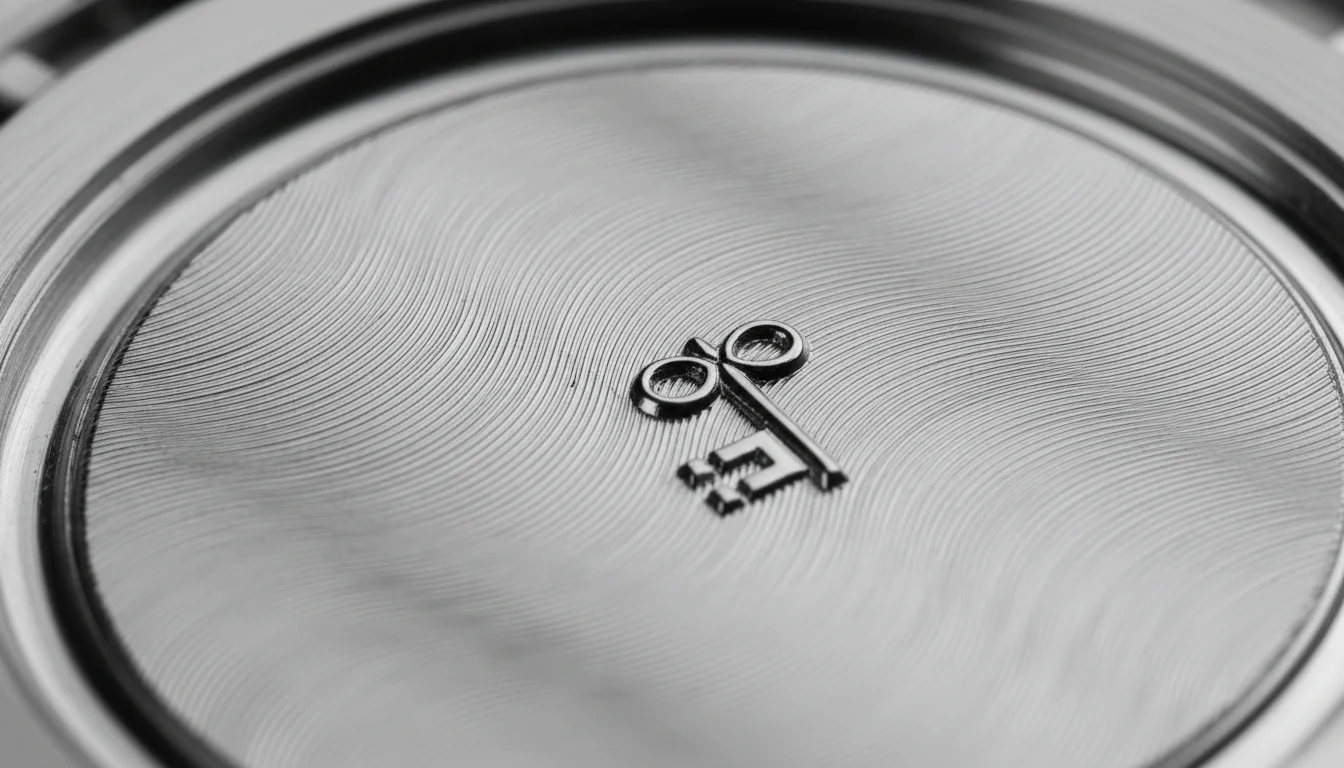 The Geneva Seal hallmark, stamped directly onto a bridge, certifies finishing standards rather than timekeeping accuracy.
FAQ
What is Côtes de Genève?
Côtes de Genève, or Geneva stripes, are parallel ridged lines applied to a movement's bridges and plates, originally meant to trap dust and now used purely for visual effect.
What is the difference between perlage and Côtes de Genève?
Perlage is a pattern of overlapping small circles, typically used on plates and tight spaces. Côtes de Genève is a pattern of parallel straight or spiral stripes, typically used on larger bridge surfaces. Both serve the same decorative purpose today.
What is anglage on a watch movement?
Anglage, or beveling, is the hand-polished, mirror-finished edge cut along the flanks of bridges and levers at roughly 45 degrees. It is widely considered the most difficult and most prized movement finishing technique.
Does movement finishing affect how a watch runs?
No. All four major finishing techniques originated as functional solutions to dust and stress problems that modern manufacturing has already solved. Today they are decorative, valued for the hand labor involved rather than any mechanical benefit.
Which brands are known for the best movement finishing?
A. Lange & Söhne, Patek Philippe, Vacheron Constantin, and independent watchmaker Philippe Dufour are consistently cited among collectors and industry sources for the highest standard of hand-applied movement finishing.
Movement finishing techniques like these remain the clearest sign of hand craftsmanship left in modern watchmaking.