The Omega Aqua Terra has one of the stranger depreciation profiles in the mid-tier Swiss watch market. At $6,700–$7,400 retail, it is a METAS-certified Master Chronometer with a Co-Axial movement, 150m water resistance, and an integrated bracelet. Pre-owned examples in excellent condition trade around $3,000–$4,500 depending on age, configuration, and full set status — a 30–45% retail discount.
That is standard Omega. The interesting part is what you are getting for that discount relative to everything else at $3,000–$4,500 pre-owned.
Images in this post are AI-generated for editorial illustration. They may not represent the exact watch configuration. For accurate product photography, visit omegawatches.com.
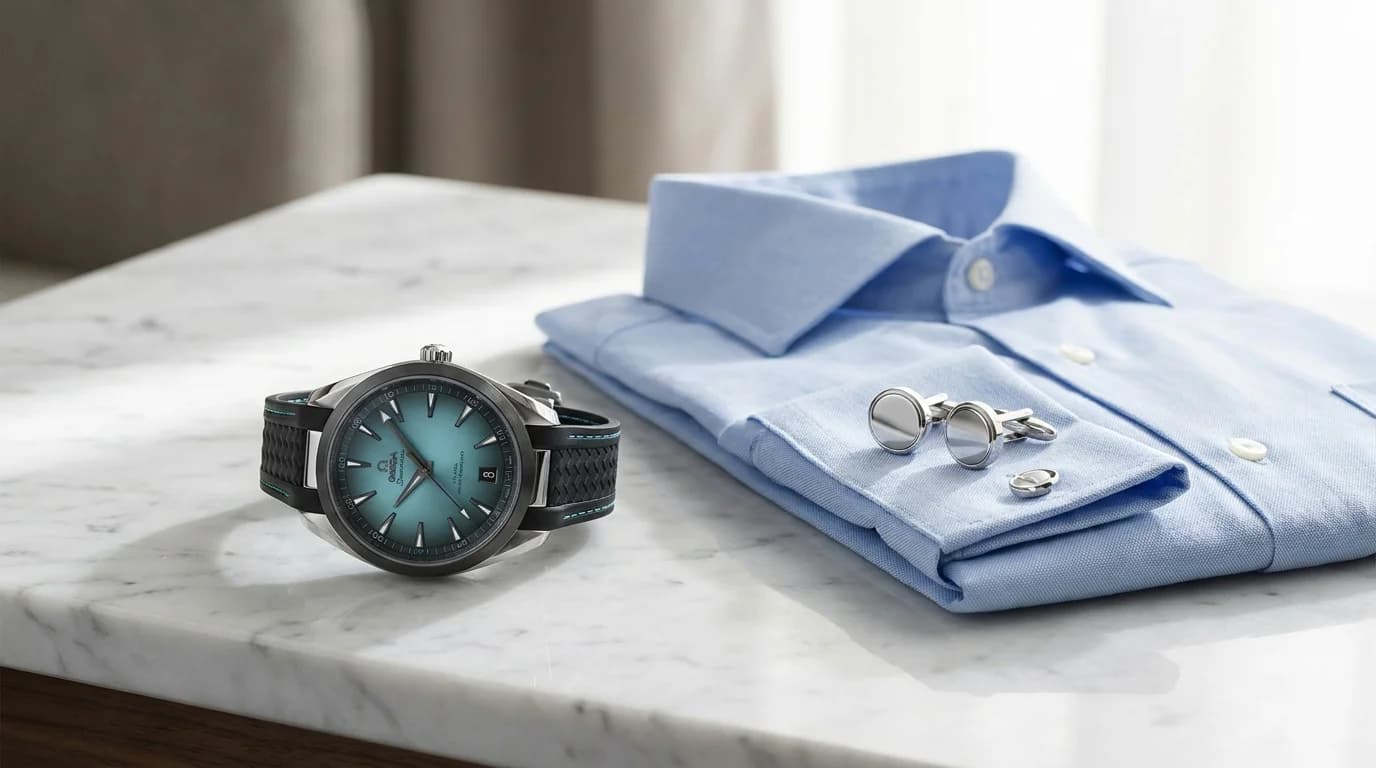
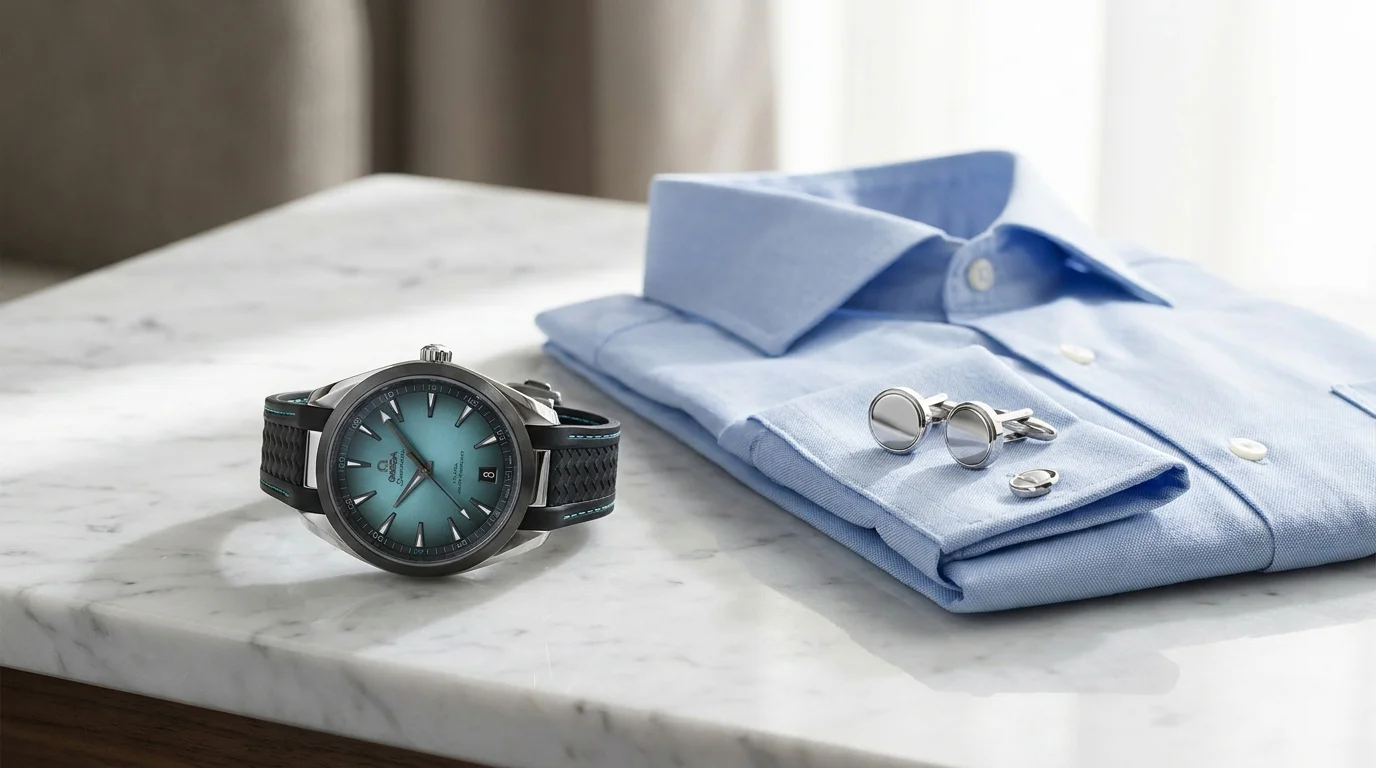 Omega Seamaster Aqua Terra 150M 41mm, Calibre 8900 Master Chronometer, retail $7,400. Pre-owned excellent condition: $3,500–$4,800. AI-generated editorial image.
The Dress-Sport Positioning Problem — and Why It Works
The Aqua Terra sits in an awkward category by design. It is not a dive watch — the Seamaster Diver 300M handles that. It is not a dress watch — the De Ville and Constellation handle that. The Aqua Terra is specifically a "go anywhere" watch: formal enough for a business dinner, robust enough for sailing, 150m water resistant, and styled around the teak-pattern dial that references luxury boat deck construction.
That positioning reads as unfocused to buyers who want a clear category answer. It reads as useful to buyers who want one watch that works across contexts.
The Aqua Terra competes directly with the Rolex Datejust in this "versatile steel sport-dress" territory. The Datejust 36 retails at $7,200 and trades above retail at $8,000–$10,000+ pre-owned. The Aqua Terra 38mm retails at $6,700 and trades at $3,000–$4,200 pre-owned. Both are in-house movements, both are formally appropriate for most settings, both run COSC-level or above accuracy. The pre-owned gap is entirely about hype and allocation dynamics, not the watches themselves.
For a buyer who has evaluated both honestly and can live without the Rolex name, the Aqua Terra is the better value by a wide margin.
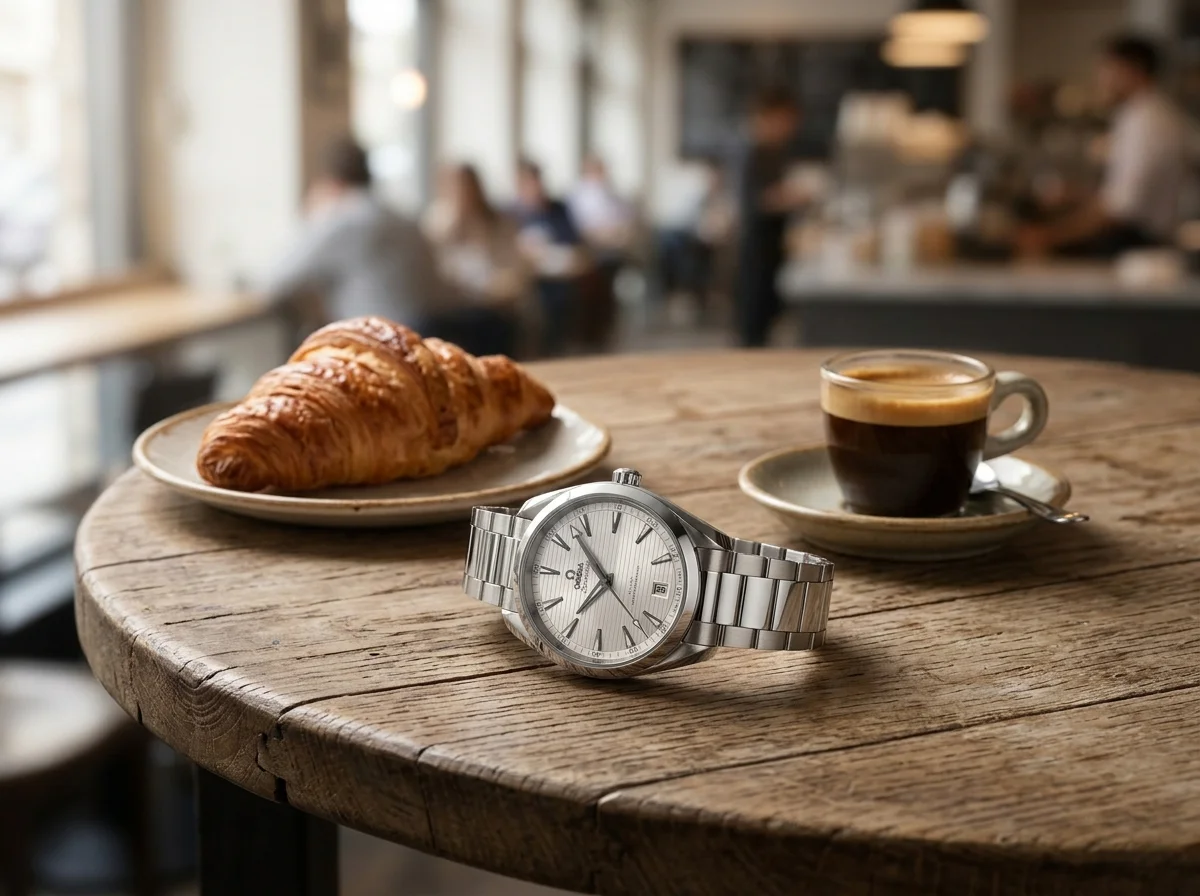 The 38mm Aqua Terra — dress-appropriate, robust enough for daily use, and one of the most versatile sizes in the collection. AI-generated editorial image.
The Movement: What Master Chronometer Actually Means
Every current Aqua Terra runs a Master Chronometer-certified movement. This is not marketing language — it is a specific two-stage certification process administered by METAS, the Swiss Federal Institute of Metrology.
Stage one: the movement passes ISO 3159 chronometer certification at -4/+6 seconds per day. Stage two: the complete assembled watch head passes eight additional METAS tests, with a stricter accuracy standard of 0/+6 seconds per day and proof of magnetic resistance to 15,000 gauss — more than an MRI machine.
The 15,000 gauss figure matters in practice. Most watch movements become inaccurate when exposed to magnetic fields from laptop speakers, phone cases, and induction hobs. The Aqua Terra's silicon balance spring is unaffected by these fields. Owners who wear the watch through everyday magnetic environments — which is everyone — do not need to demagnetize it.
The 38mm Aqua Terra uses Calibre 8800, the 41mm uses Calibre 8900. Both are Co-Axial Master Chronometer movements with 55-hour power reserves. The Co-Axial escapement reduces friction compared to a traditional lever escapement, meaning longer service intervals — Omega recommends service every 5–8 years rather than the 3–5 typical of non-Co-Axial movements.
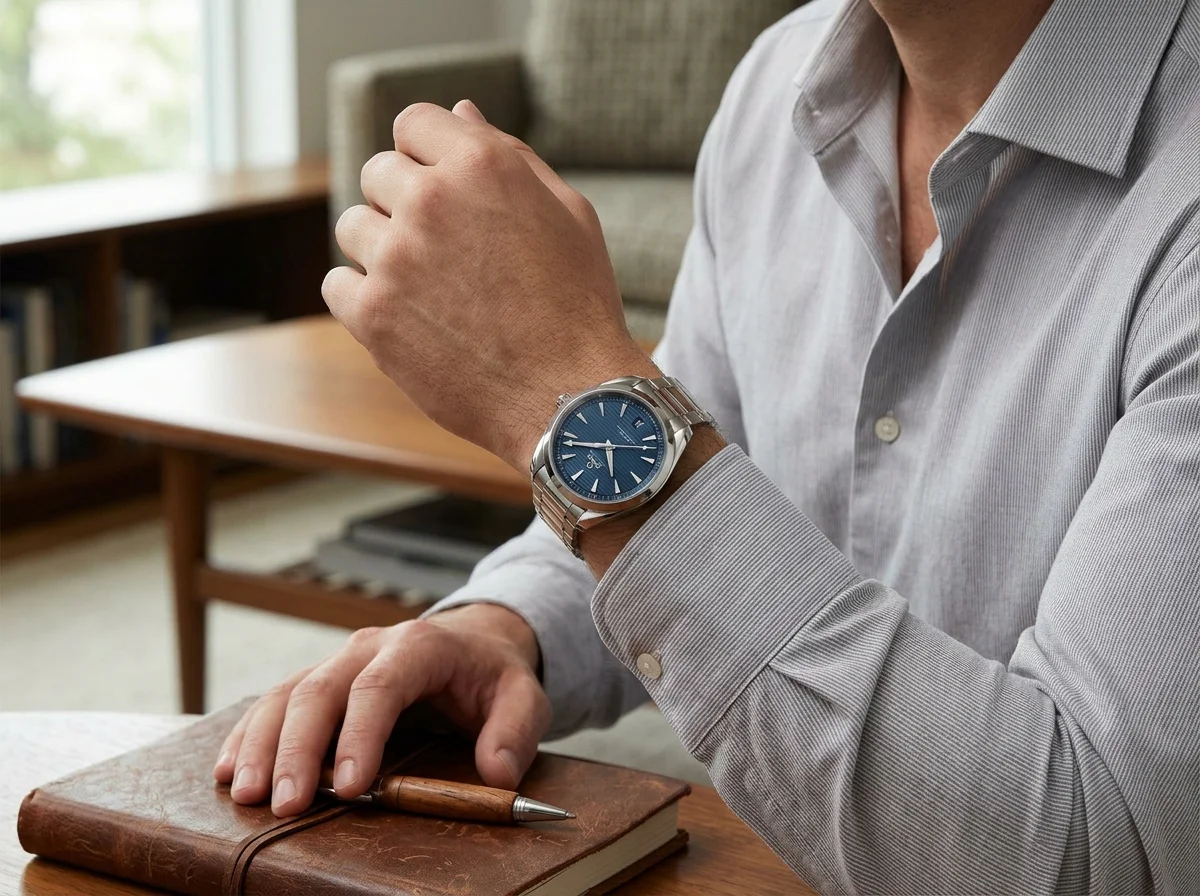 The Aqua Terra wears as formally as the occasion requires. The integrated bracelet sits well under a dress shirt. AI-generated editorial image.
The 38mm vs 41mm Decision
The size question matters more on the Aqua Terra than on a sport watch because of how the watch is used. At 38mm it is genuinely small — appropriate for smaller wrists and formal settings where a 41mm steel watch feels assertive. At 41mm it fills the wrist more confidently and reads as a modern sport-dress watch.
Both run Co-Axial Master Chronometer movements. The 38mm uses Calibre 8800, the 41mm uses 8900 — functionally identical in certification and performance, different in diameter to fit their respective cases.
Pre-owned pricing gap between them is approximately $500–$800 in favor of the 38mm, reflecting lower new price and historically lower demand. For buyers who want the smaller size, this is the correct outcome — the movement is the same, the savings are real.
The 2025 turquoise ceramic bezel variants added a new configuration at both sizes — ceramic fixed bezel in turquoise, rubber strap, gradient turquoise dial. These trade at a premium over the standard references ($4,500–$5,800 pre-owned) because they are newer and command collector interest. The standard references are the right buy for someone optimizing for value.
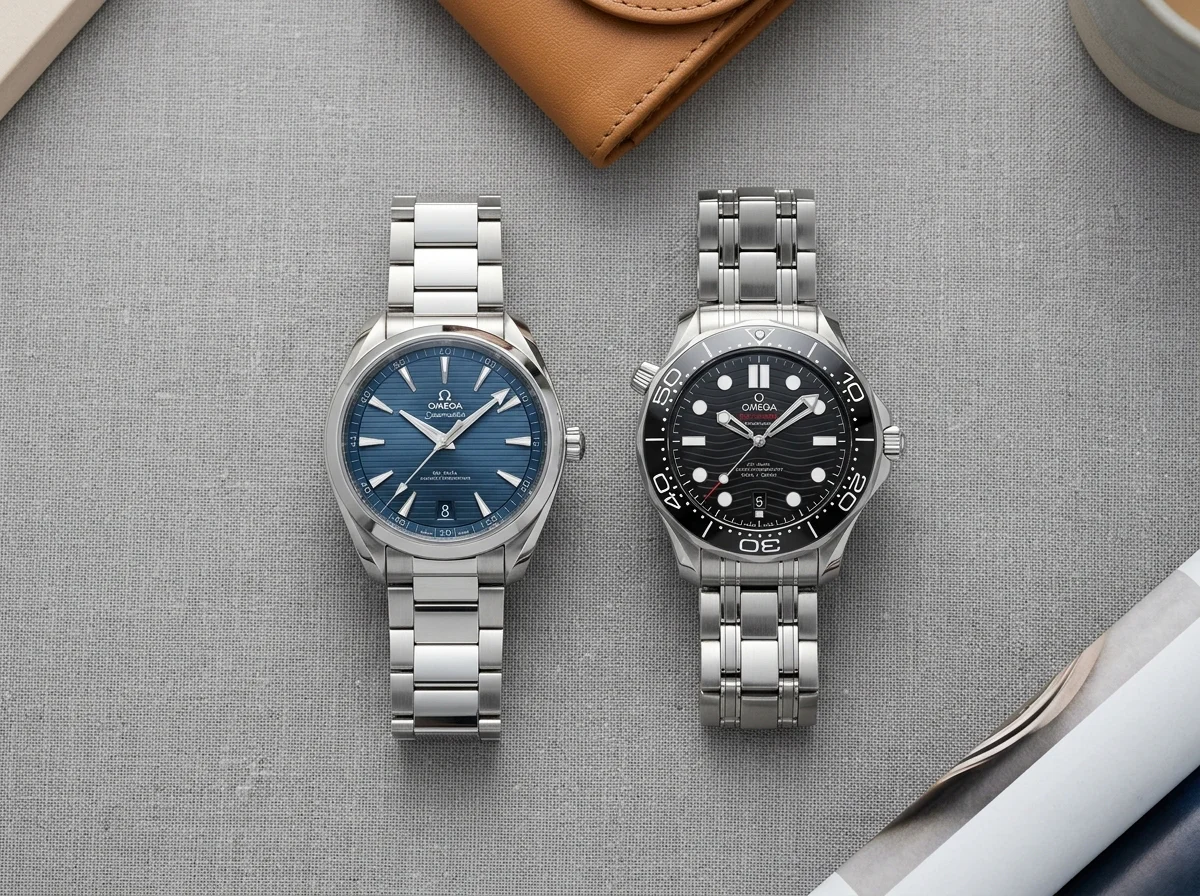 Aqua Terra (dress-sport, 150m) versus Seamaster Diver (pure sport, 300m). Both Co-Axial Master Chronometer. Different positioning, similar pre-owned pricing. AI-generated editorial image.
Pre-Owned Pricing Map
| Reference | Size | Calibre | Pre-Owned Range |
|---|---|---|---|
| 220.10.38.20.03.001 (blue) | 38mm | 8800 | $3,000–$4,200 |
| 220.10.41.21.01.001 (black) | 41mm | 8900 | $3,200–$4,500 |
| 220.10.41.21.03.002 (blue) | 41mm | 8900 | $3,500–$4,800 |
| 2025 Turquoise ceramic | 38 or 41mm | 8800/8900 | $4,500–$5,800 |
| Pre-2020 (non-MChr) | 41mm | 8500 | $2,500–$3,500 |
The pre-2020 references use the older Calibre 8500/8501 — Co-Axial but not Master Chronometer certified. Still excellent movements, but without the METAS magnetic resistance testing. These trade $500–$800 cheaper than the current generation, which is fair.
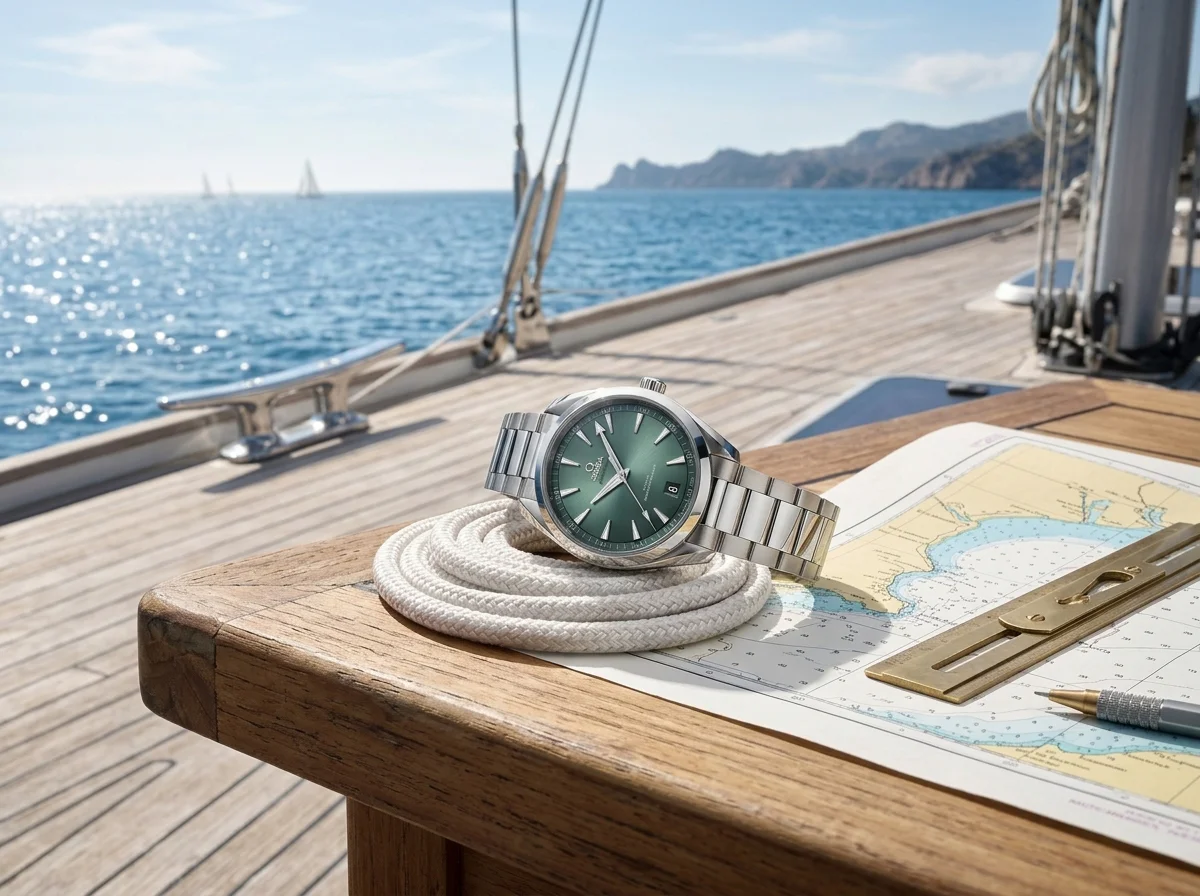 The Aqua Terra's 150m water resistance and maritime heritage are not decoration. AI-generated editorial image.
The Honest Comparison
At $3,500–$4,800 pre-owned for a current-generation blue dial 41mm, the Aqua Terra competes with the Tudor Black Bay 58 ($2,800–$3,500), the Rolex Explorer 124270 ($6,800–$7,500), and the Grand Seiko Snowflake SBGA211 ($4,800–$5,600).
The Aqua Terra wins the value argument cleanly against the Explorer on specification for money. It wins against the BB58 in formal versatility. It loses against the Snowflake on technical interest, and it loses against both Rolex references on name recognition and resale depth. Which matters depends entirely on the buyer.
What carries the most rigorous independent movement certification in the industry, does not depreciate like a dress watch, and works across formal and casual contexts at $3,500–$4,800 pre-owned is a compelling brief — and one most buyers are not actively searching for.
The Rolex vs Omega 2026 head-to-head covers the secondary market comparison in detail across the full lineup.
Browse Omega Aqua Terra pre-owned at 5dwatches.com/shop/omega?series=Aqua+Terra.