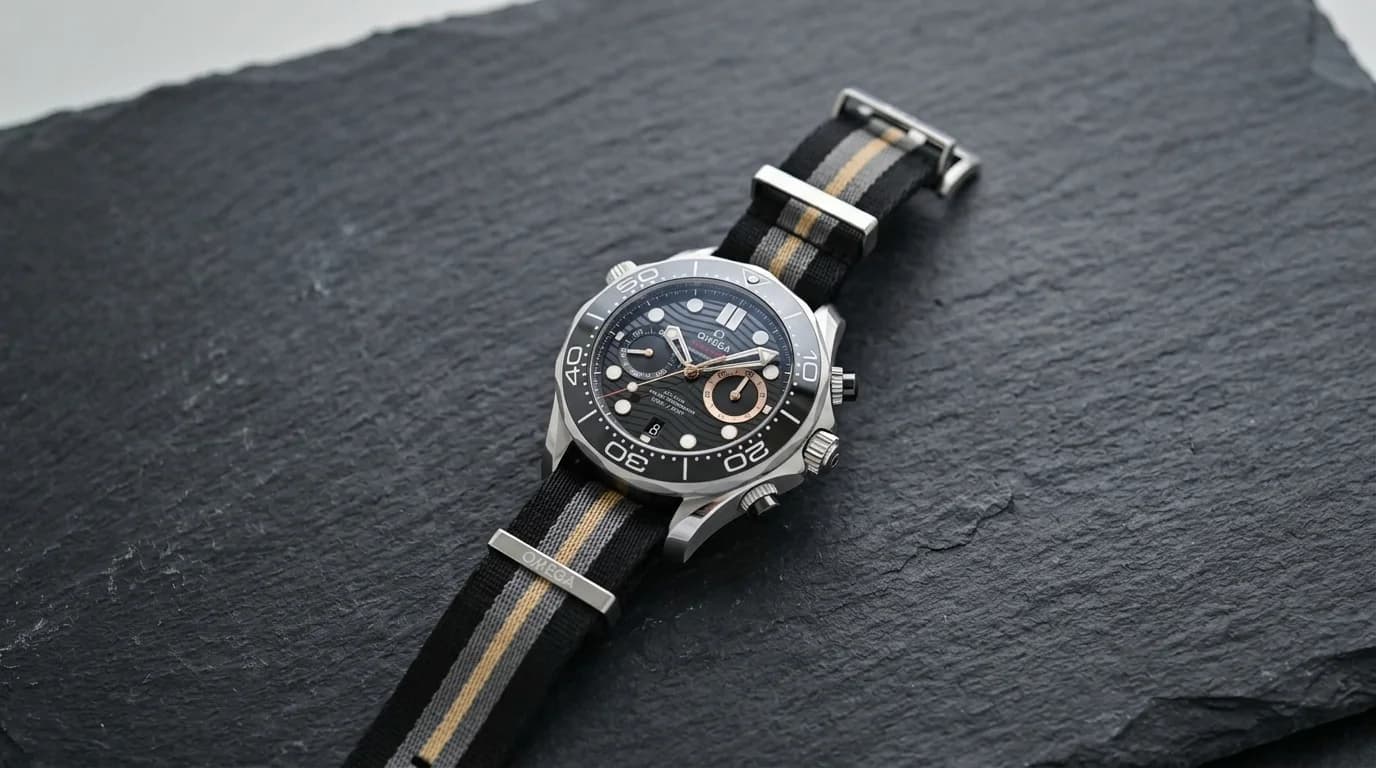
Omega just released the first chronograph in the 31-year history of the James Bond Seamaster. It launched May 21, 2026, at $9,400 USD retail. It came from a video game.
The reference 210.32.44.51.01.002, formally called the Seamaster Diver 300M Chronograph 007 First Light, breaks two precedents at once. It is the first time a Bond Omega has originated from a non-cinematic property. And it is the first time the Bond-branded Seamaster line has carried a chronograph at all. Both firsts matter for collectors and for the pre-owned market.
All images in this post are AI-generated and may not perfectly represent the actual watch references discussed. They are intended for illustration only.
The Short Answer
The Seamaster Diver 300M Chronograph 007 First Light is a 44mm stainless steel chronograph on a tri-color NATO strap, retailing at $9,400 USD and not produced as a limited edition. It debuts at the launch of the 007 First Light action-adventure game from IO Interactive and Amazon MGM Studios, shipping worldwide May 27, 2026. The watch carries Omega's Co-Axial Master Chronometer Calibre 9900, a black ceramic bezel and dial, and a PVD bronze gold subdial ring at 3 o'clock that ties it visually to the in-game spy gear.
It is the first chronograph in the Bond Seamaster lineage and the first Bond Omega tied to a game rather than a film.
What's Actually New About This Watch
The case, movement, and core architecture are not new. The 44mm Seamaster Diver 300M Chronograph platform launched in 2019 and has carried the in-house Calibre 9900 since. What's new is the specific configuration and the cultural anchor.
The defining visual cue is the PVD bronze gold subdial ring at 3 o'clock, paired with a matching central chronograph seconds hand. Everything else on the dial reads modern Seamaster: black ceramic with the laser-engraved wave pattern, red "Seamaster" inscription, date aperture at 6 o'clock, rhodium-plated hands and indexes filled with white Super-LumiNova.
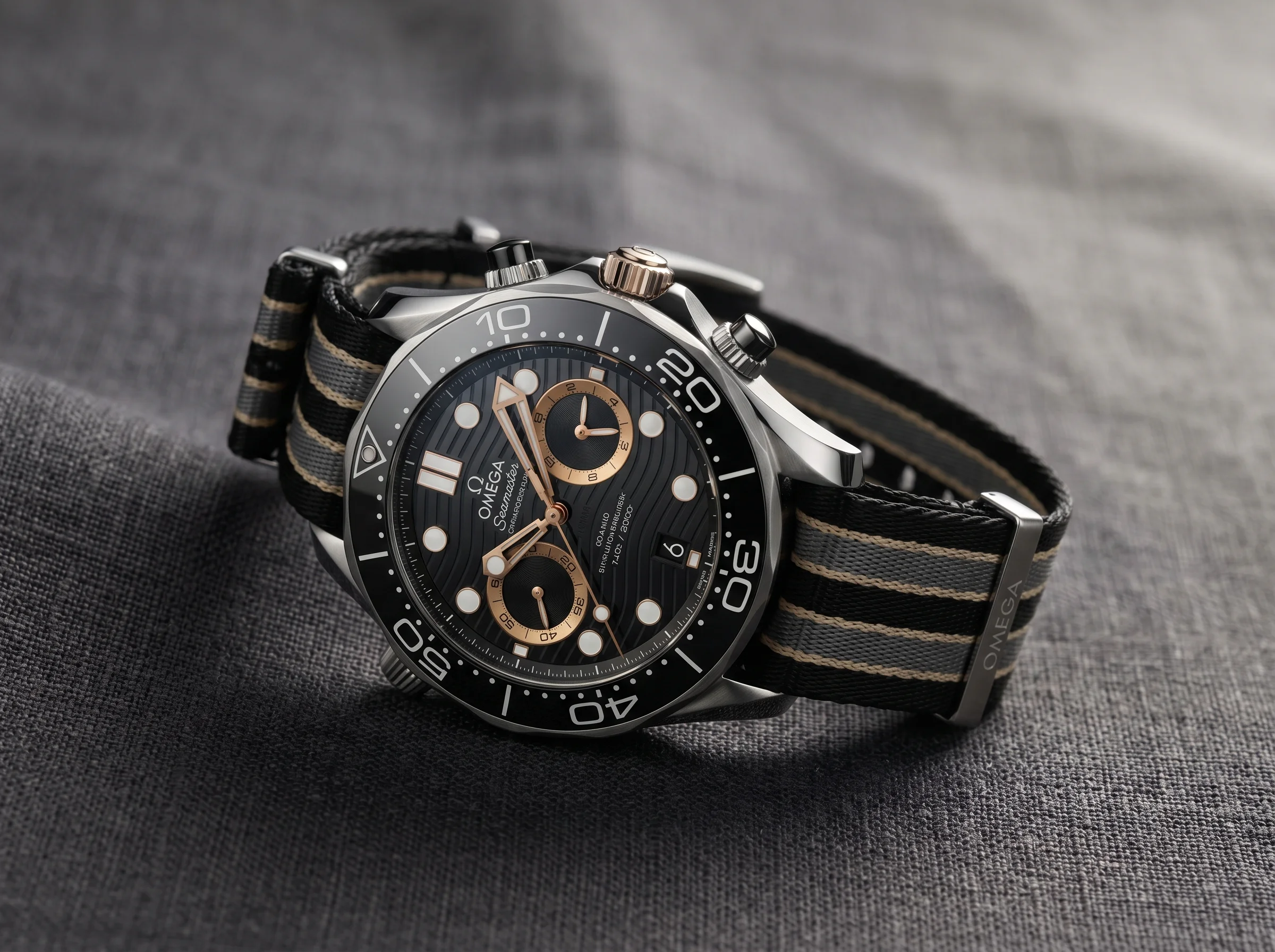 The bronze gold ring at 3 o'clock is the defining visual cue. Everything else on the dial reads modern Seamaster.
The bezel and pushers are polished black ceramic with a white enamel diving scale. The watch ships on a black, grey, and beige NATO strap with Grade 5 titanium hardware. A sapphire caseback shows the movement plus a metallic 007 First Light medallion specific to this edition.
Per Omega's product listing, the dimensions are 44mm diameter, 17.2mm thick, 52.8mm lug-to-lug. Water resistance is the Seamaster Diver line's standard 300 meters.
The Specs That Matter
| Detail | Spec |
|---|---|
| Reference | 210.32.44.51.01.002 |
| Case diameter | 44mm |
| Case thickness | 17.2mm |
| Lug-to-lug | 52.8mm |
| Movement | Omega Co-Axial Master Chronometer Calibre 9900 |
| Frequency | 4 Hz (28,800 vph) |
| Power reserve | 60 hours (two barrels in series) |
| Anti-magnetic rating | 15,000 gauss (METAS certified) |
| Bezel | Polished black ceramic, white enamel diving scale |
| Pushers | Polished black ceramic |
| Dial | Black ceramic, laser-engraved waves, PVD bronze gold subdial ring at 3 o'clock |
| Strap | Black/grey/beige NATO, Grade 5 titanium hardware |
| Water resistance | 300 meters |
| Retail (US) | $9,400 (excl. tax) |
| Limited edition | No |
Why "First Chronograph" Actually Matters
Omega has produced 007-branded Seamasters since 1995, when Pierce Brosnan first wore the reference 2541.80 in GoldenEye. Every Bond film since has featured at least one Omega. That partnership has now produced commemorative editions for Skyfall, Spectre, No Time to Die, the 60th anniversary of the franchise, and several others.
Not one of them was a chronograph.
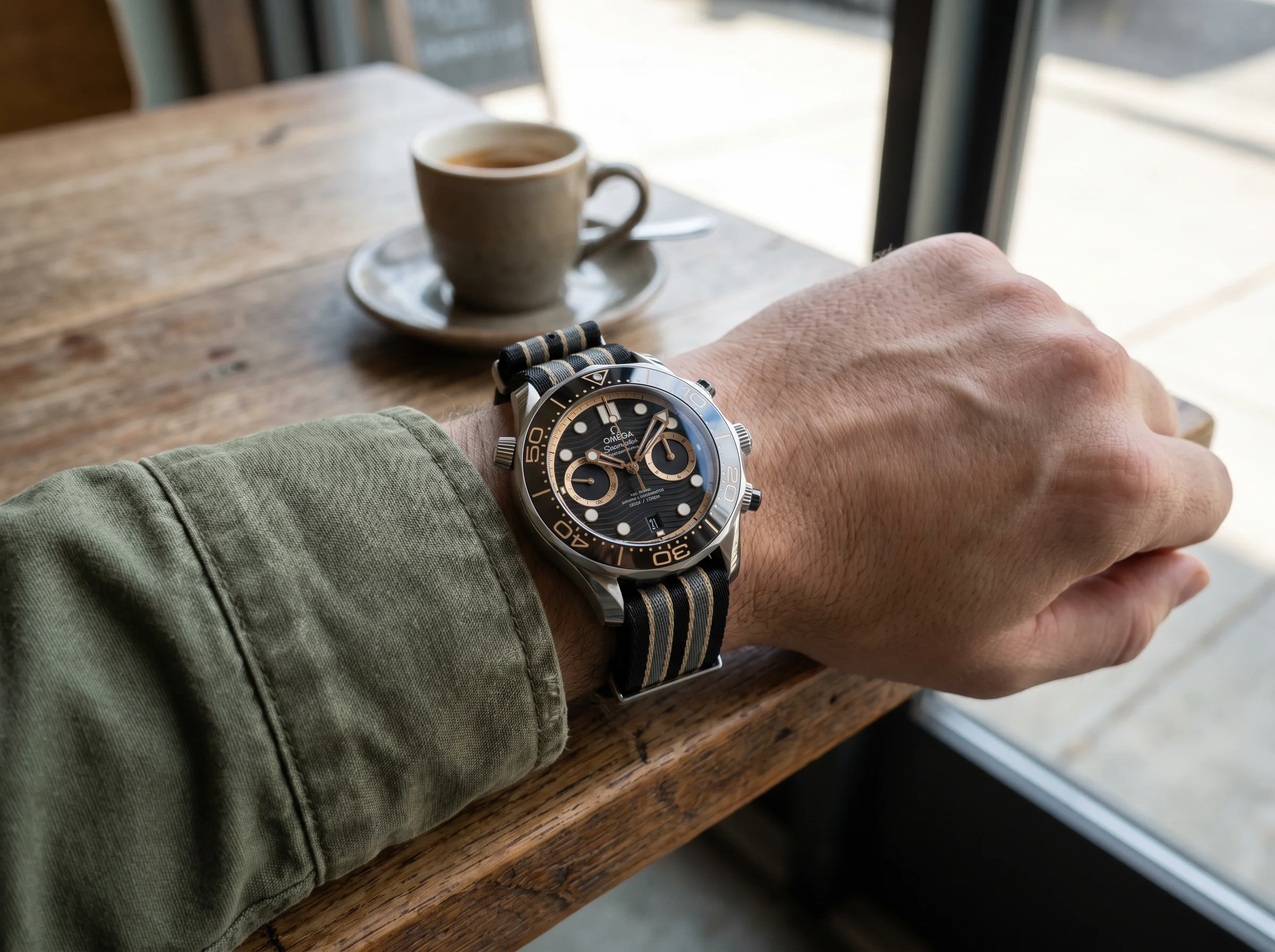 At 44mm and 17.2mm thick, the First Light is more chronograph than dress watch. The NATO softens the wear but the case still announces itself.
That gap was structural. The original 1995 Seamaster was a time-and-date dive watch, and every Bond-specific release stayed within that template. Costume designer Lindy Hemming chose the Seamaster in 1995 because it suited Bond's naval background. The brief was a tool watch, not a chronograph.
For collectors tracking the lineage, the 210.32.44.51.01.002 is a one-of-one within the Bond Seamaster sub-canon. That alone gives it a specific archival weight, separate from how it performs on the secondary market.
What Standard 44mm Seamaster Chronographs Trade At
The non-Bond version of this chronograph platform is the 210.30.44.51.01.001 (black dial, steel bracelet). It retails around $8,400 from authorized dealers and shows up new from grey market retailers for roughly $8,160 at Watchmaxx. The America's Cup chronograph variant, reference 210.30.44.51.03.002, retailed at $9,250 and currently trades around $7,950 brand new on the secondary market.
WatchCharts data through April 2026 shows the 44mm Seamaster Chronograph in the 22% below retail zone over the past year, in line with the broader Seamaster index. The 42mm time-and-date Seamaster trades roughly 36% below retail at $4,286 against a $6,700 MSRP.
That's the baseline. The First Light premium over the standard black dial chronograph at retail is roughly $1,000, and the question for buyers becomes whether that premium holds, grows, or compresses on the secondary market.
From Video Game to Wrist: The New Bond Playbook
The cultural angle here is bigger than the watch. For 31 years, Omega's Bond strategy ran through the cinematic franchise. Every commemorative edition tied to a film release, a premiere, an anniversary. The pipeline was the movies.
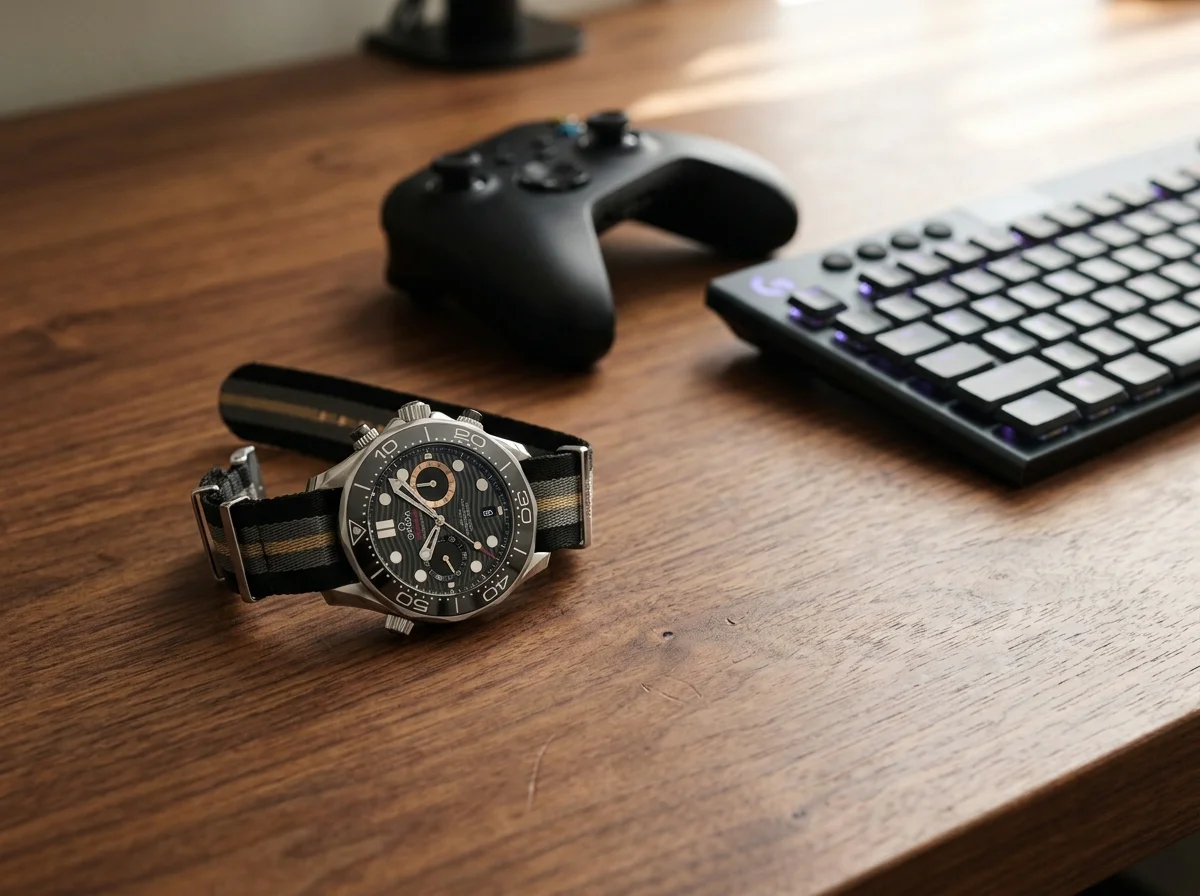 The First Light skips the cinema-first pipeline entirely. The watch debuts six days before the game it appears in.
That pipeline is paused. Amazon MGM Studios acquired creative control of the Bond franchise in early 2025. No new Bond film is currently on the calendar. Casting only officially kicked off in May 2026. The next theatrical Bond is years out.
Meanwhile, 007 First Light ships May 27, 2026, developed by IO Interactive (the Hitman studio) in partnership with Amazon MGM Studios. The game tells a standalone origin story for a 26-year-old Bond. Omega's chronograph appears as a functional in-game mission tool, fitted with fictional hacking and laser capabilities.
The watch arrives six days before the game. That timing is the marketing.
Why This Move Is Strategic, Not Reactive
Omega could have waited for the next film. Releasing a Bond chronograph for a video game looks at first like a stopgap. It isn't.
Games sit in the hands of buyers far longer than films sit on screens. A theatrical run lasts weeks. A blockbuster game stays on consoles for months and lives on streaming/social channels for years. The audience is younger, more active in collectible spending, and far more likely to make a digital-to-physical buying decision. Omega has just created a flywheel where every player who picks up the controller is exposed to the Seamaster Chronograph as Bond's actual working tool.
That is a different mechanism than a two-hour cinema appearance.
The Movement: Calibre 9900 in Context
The Calibre 9900 is Omega's flagship in-house automatic chronograph movement. It runs at 4 Hz, carries a column-wheel chronograph with vertical clutch, uses a free-sprung balance with silicon balance spring, and stores 60 hours of power reserve across two barrels mounted in series.
Master Chronometer certification means each individual movement, then each fully cased watch, passes the METAS-administered eight-test protocol covering accuracy (0/+5 seconds per day, certified by COSC first, then independently by METAS), magnetic resistance to 15,000 gauss, water resistance, and power reserve performance. It is, by any objective measure, one of the most rigorously certified chronograph movements in the industry.
The practical implication for buyers: a properly maintained 9900 should run within COSC tolerances for seven to ten years between services, and the movement is robust enough to live on a wrist daily without ceremony.
How It Compares to the Standard 44mm Seamaster Chronograph
| First Light 210.32.44.51.01.002 | Standard 210.30.44.51.01.001 | |
|---|---|---|
| Retail | $9,400 | ~$8,400 |
| Strap/bracelet | NATO (steel hardware) | Steel bracelet |
| Bezel | Black ceramic | Black ceramic |
| Dial | Black ceramic + PVD bronze gold ring at 3 o'clock | Black ceramic |
| Caseback | 007 First Light medallion via sapphire | Standard wave-edged sapphire |
| Movement | Calibre 9900 | Calibre 9900 |
| Limited edition | No | No |
The mechanical guts are identical. You pay the $1,000 premium for the bronze gold accent, the NATO strap, the engraved caseback, and the 007 First Light positioning.
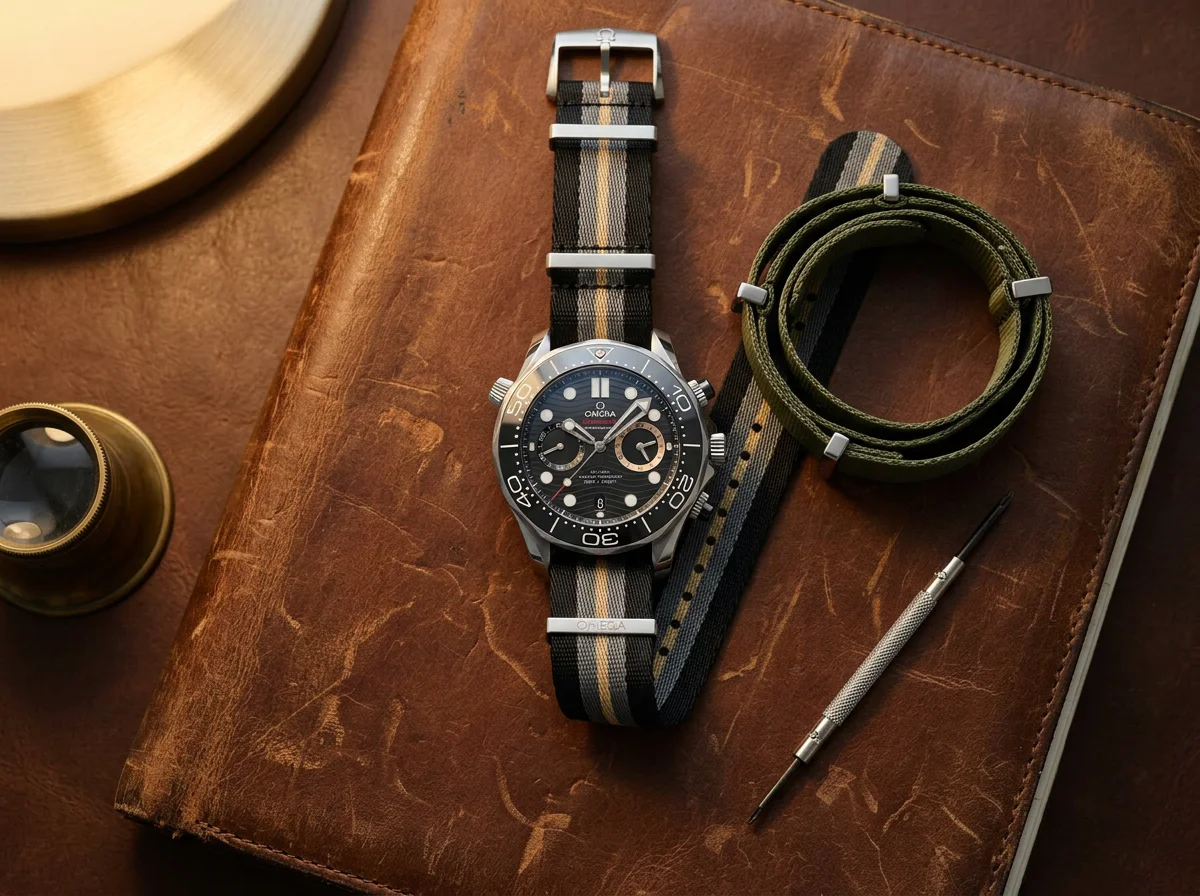 Six additional NATO straps are available separately, each modeled on a strap colorway from the game.
For some buyers that's a marketing tax. For others, the Bond connection plus a distinct visual identity is worth it. We don't editorialize on that math. We track what the market does with it.
The Pre-Owned Read: What "Not Limited" Means
This is where collectors should pay attention.
Limited 007 Omegas tend to behave differently on the secondary market than standard production. The 50 Years of 007 Seamaster from 2012 traded above retail for years. The 60th Anniversary Bond Seamaster from 2023 (reference 210.30.42.20.03.002) holds value better than standard 42mm references in the same line. Scarcity drives that.
The First Light is not a limited edition. Omega will produce it as long as demand justifies. Which means the secondary market should price it closer to the standard 44mm chronograph than to the limited 007 commemoratives.
Our working forecast: this reference will likely land in the 15% to 25% below retail range within 12 to 18 months once initial launch demand normalizes, mirroring the broader 44mm Seamaster Chronograph trajectory. That puts a realistic pre-owned floor around $7,000 to $8,000 by mid-to-late 2027.
If you want a Bond Omega that should appreciate, the limited editions remain the play. If you want the first chronograph in Bond Seamaster history at a modest premium over the standard chrono, this is the only watch that fits.
Should You Buy It?
Honest answer: depends on which buyer profile you fit.
Buy it new if:
- You're a Bond/Omega collector who wants the first chronograph in the lineage and is willing to pay retail to lock it in early.
- You play video games and the 007 First Light tie-in carries personal cultural weight.
- You wanted the 44mm chronograph anyway and the bronze gold accent appeals to you enough to justify the $1,000 premium and a NATO instead of a bracelet.
Wait for pre-owned if:
- You don't care about the bracelet swap and the bronze gold accent is neutral or negative for you.
- You want maximum value per dollar and are comfortable buying a 12-to-18-month-old example for $7,000 to $8,000.
- You already own a 44mm Seamaster Chronograph and just want the variation.
Buy a different Seamaster if:
- You want a Bond watch but care more about cinema heritage than chronograph capability. The reference 210.30.42.20.03.002 (60th Anniversary) is the more historically loaded pick.
- You want a daily wearer and the 44mm case plus 17.2mm thickness is more watch than your wrist wants. The 42mm time-and-date Seamaster Diver 300M is the smarter call.
The Working Dealer's Bottom Line
The 210.32.44.51.01.002 is the most narratively interesting Seamaster release of 2026. It's the first chronograph in 31 years of Bond Seamasters, it broke the cinema-first pipeline, and it landed six days before the game it was made for.
It is not, however, a sleeper investment. Omega's decision not to limit it caps the upside. The watch will live or die on its merits as a 44mm ceramic-bezel chronograph with a Master Chronometer 9900 inside, which is a high floor and not much ceiling.
Buy it because you want it. Don't buy it because someone told you it will appreciate.
For collectors building a Seamaster line, this slots in cleanly alongside the standard 44mm chronograph, the 60th Anniversary 42mm, and the 50th Anniversary editions. For first-time Omega buyers, the pre-owned 42mm Seamaster Diver 300M at half the price remains the smarter entry point.
Browse authenticated pre-owned Omega at 5dwatches.com/shop/omega.