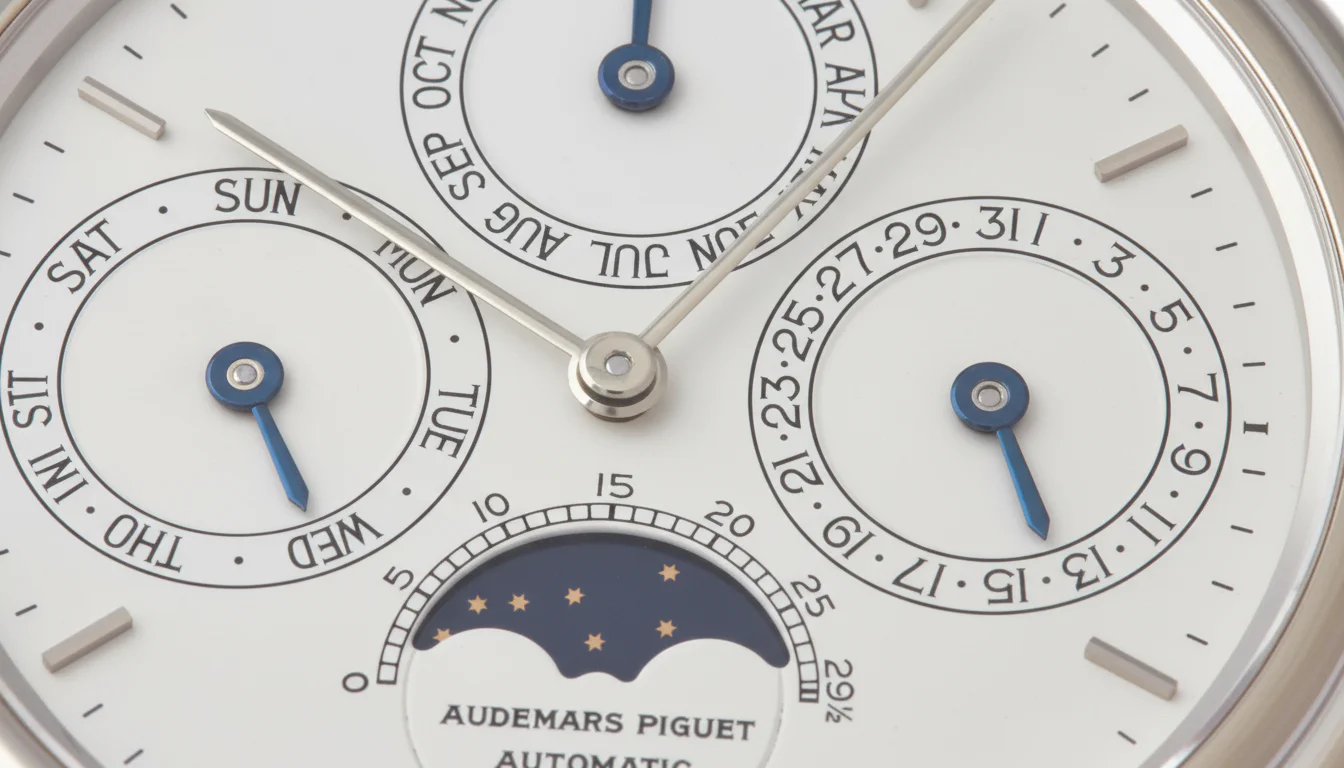
A basic date watch has no idea April only has 30 days. Every April 31st, someone has to manually push it back a day. A perpetual calendar watch never makes that mistake, and it does it with gears alone.
This post includes AI-assisted images built from real reference photos of the actual watches and mechanisms discussed. All mechanical details are researched and verified against manufacturer and horological sources, not invented.
The short answer: A perpetual calendar is a mechanical complication that automatically tracks which months have 30 days, which have 31, and which have 28 or 29, including leap years, without any manual correction. The mechanism reads the calendar programming built into a stack of cams and levers inside the movement. It only needs correcting at the rare years the Gregorian calendar itself breaks its normal leap year pattern, which will not happen again until the year 2100.
What Makes A Calendar "Perpetual" Instead Of Just "Annual"
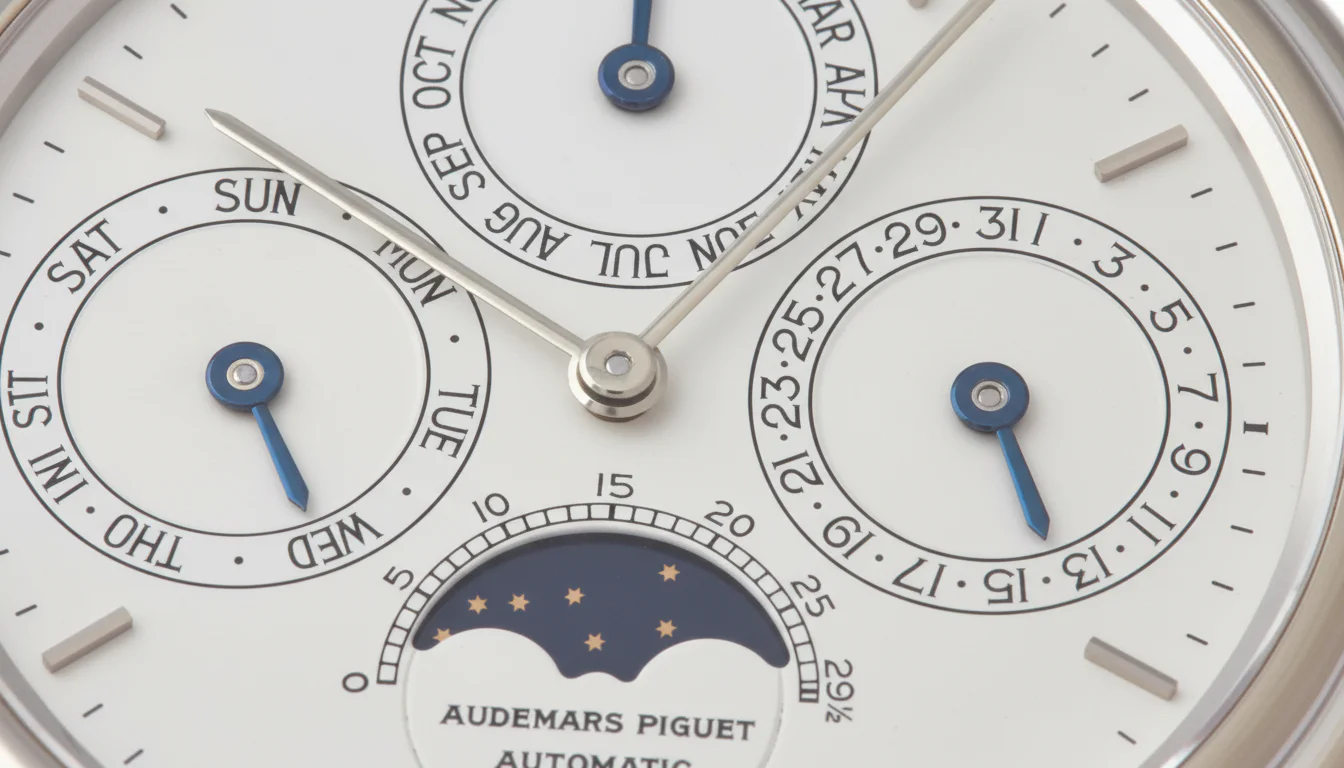 Day, date, month, and moonphase, all reading correctly without a single manual correction across the full four-year leap cycle.
Watch calendars come in three tiers. A simple date complication has no idea how long any month is and needs correcting roughly five times a year. An annual calendar knows the difference between 30 and 31 day months automatically but still needs one manual correction every year at the end of February, since it cannot distinguish a leap year on its own, a mechanism we cover in full in our annual calendar explainer. A perpetual calendar solves both problems: it correctly rolls over every month length and recognizes leap years without help.
The practical distinction that actually matters: an annual calendar needs your attention once a year. A perpetual calendar needs it once a century, and only because of a quirk in the Gregorian calendar itself rather than any limitation in the watch.
The Mechanism Is A Physical Memory Of The Calendar
The core of a perpetual calendar is a stack of specially shaped cams, most importantly a four-year cam that makes one full rotation every 48 months. Its edge is cut with a profile that physically encodes which of the four years in the cycle is the leap year. A stack of levers reads that cam's shape the same way a key reads a lock, and that reading determines whether the mechanism adds a 29th day to February that year or moves straight to March 1st.
This is why perpetual calendar movements run notably thicker and more complex than a simple date movement. The month-length logic has to exist as physical metal, not as anything closer to programmable logic. An annual calendar uses a simpler version of the same idea, a single cam cut to the length of each month, without the four-year leap tracking layered on top. A different complication, the equation of time, uses the same kind of physical-cam memory to track a completely different variable: the gap between solar time and clock time. Our Equation of Time Explained piece covers how that kidney-shaped cam works.
Why It Breaks At The Century Mark
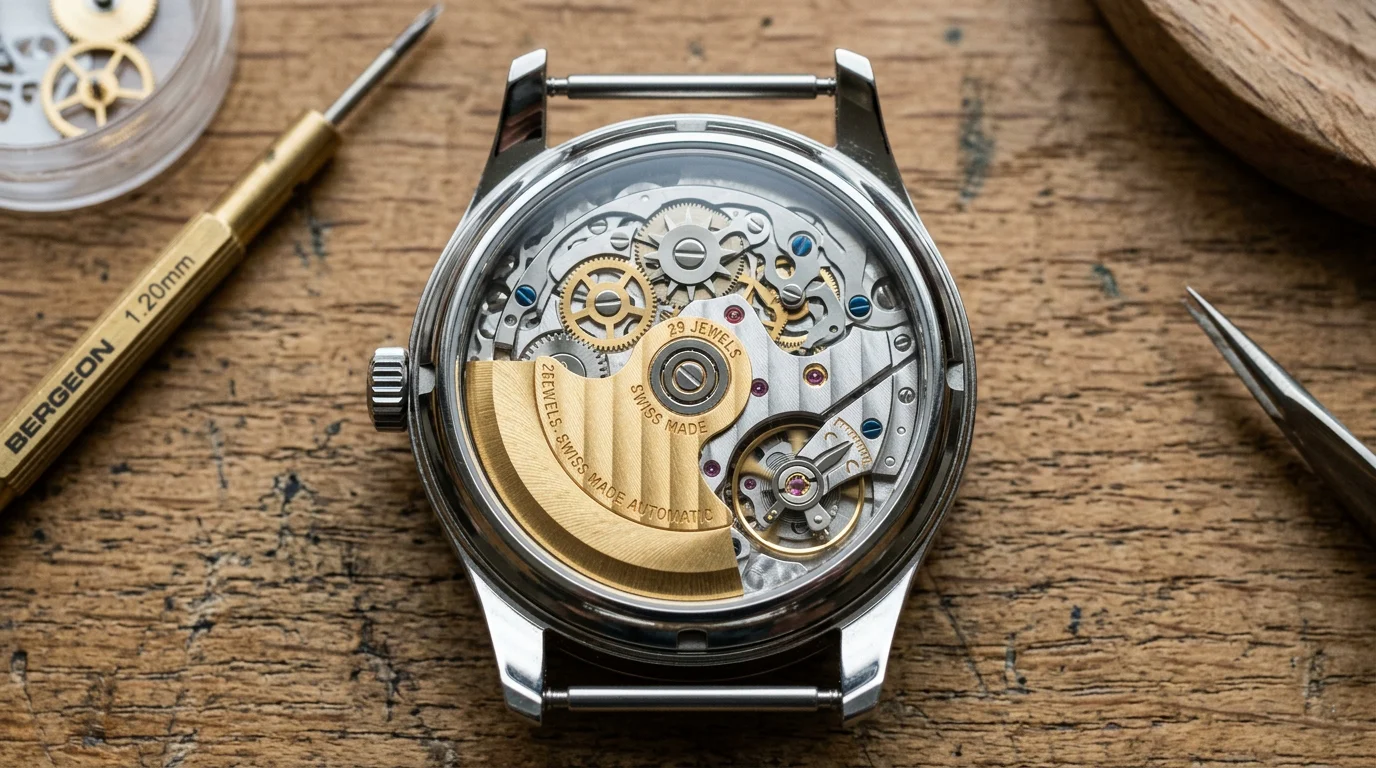 Every one of these small levers and cams is doing calendar math mechanically, with no electronics involved.
The Gregorian calendar has a rule most people never think about: a year divisible by 100 is not a leap year, unless it is also divisible by 400. That made 2000 a leap year but will make 2100 a normal 365-day year, breaking the clean four-year pattern a standard perpetual calendar mechanism assumes.
What this means practically: a standard mechanical perpetual calendar will need a single manual correction in the year 2100, the first time since the mechanism's invention that its built-in four-year cam logic will be wrong. Every other year between now and then, the watch handles itself.
A Small Number Of References Solve Even The 2100 Problem
A handful of high-complication references, generally described as "secular perpetual calendars," add extra mechanical logic specifically to handle the century-mark exception, correctly skipping the leap day in non-400-divisible century years without any manual intervention at all. These are rare and expensive even by perpetual calendar standards, since the extra century-tracking mechanism adds meaningful complexity on top of an already complex movement.
What A Perpetual Calendar Dial Actually Displays
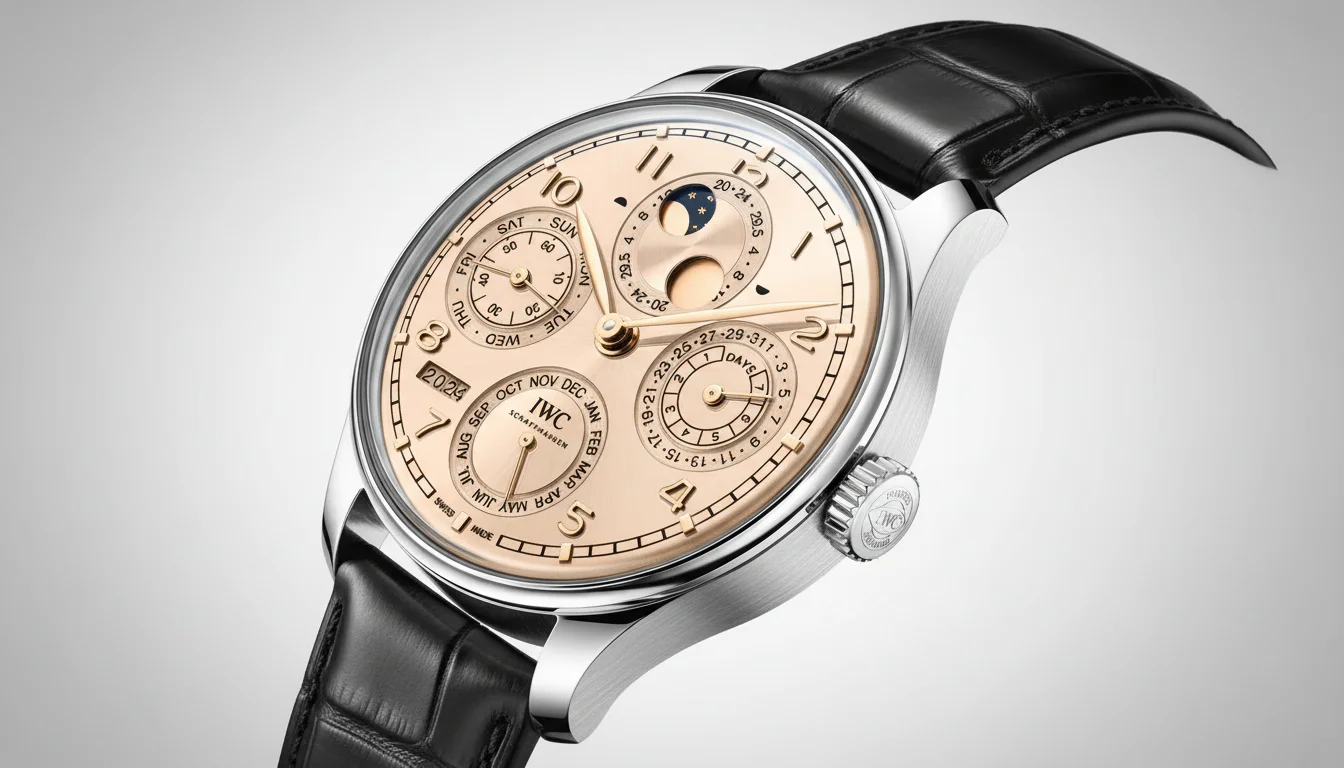 Layouts vary by brand, but nearly every perpetual calendar shows the same four pieces of information somewhere on the dial.
Nearly every perpetual calendar shows four pieces of information: the day of the week, the date, the month, and the leap year position within the four-year cycle (sometimes shown as a small subdial, sometimes tucked on the movement side rather than the dial). Many perpetual calendars also add a moonphase display, which is not technically part of the calendar logic but shares mechanical DNA with it and typically appears on the same models.
One collector distinction worth knowing: the leap year indicator is genuinely useful for a watchmaker servicing the watch, since it tells them exactly where the four-year cam sits without opening the case. For an owner, it is mostly a technical curiosity rather than a display you check day to day.
Living With A Perpetual Calendar Day To Day
 The complexity is entirely internal. On the wrist, a perpetual calendar just quietly tells correct time and date every single day.
The one genuine hazard with a perpetual calendar is letting it run down completely. Because the calendar mechanism only advances forward and many perpetual calendars cannot be safely corrected backward or during certain hours without risking damage, a stopped perpetual calendar can mean a trip back to an authorized service center to reset every display correctly, sometimes an involved and not-cheap process. Keeping the watch wound, worn regularly or on a winder, avoids that entirely.
 A perpetual calendar is doing the same job as a wall calendar, just mechanically, continuously, and without you lifting a finger.
FAQ
What is the difference between a perpetual calendar and an annual calendar?
An annual calendar automatically tracks 30 versus 31 day months but needs one manual correction each year at the end of February since it cannot detect leap years. A perpetual calendar tracks both month length and leap years automatically, needing no manual correction for decades at a time.
Does a perpetual calendar ever need correcting?
Yes, but rarely. A standard mechanical perpetual calendar will need one correction in the year 2100, the next time the Gregorian calendar's century-mark exception breaks the normal four-year leap cycle the mechanism assumes.
How does a perpetual calendar know how many days are in a month?
A specially shaped cam inside the movement, usually making one full rotation every four years, physically encodes the calendar's month-length and leap year pattern. A stack of levers reads the cam's profile to determine how the date should advance each month.
Is a moonphase part of a perpetual calendar?
Not technically. A moonphase is a separate complication that happens to share mechanical similarities with calendar mechanisms and is frequently paired with perpetual calendars on the same watch, but the two functions operate independently.
What happens if a perpetual calendar watch stops running?
The calendar display can fall out of sync, and because many perpetual calendars cannot be safely adjusted backward or during certain hours, resetting every display correctly often requires a trip to an authorized service center. Keeping the watch wound avoids the issue entirely.