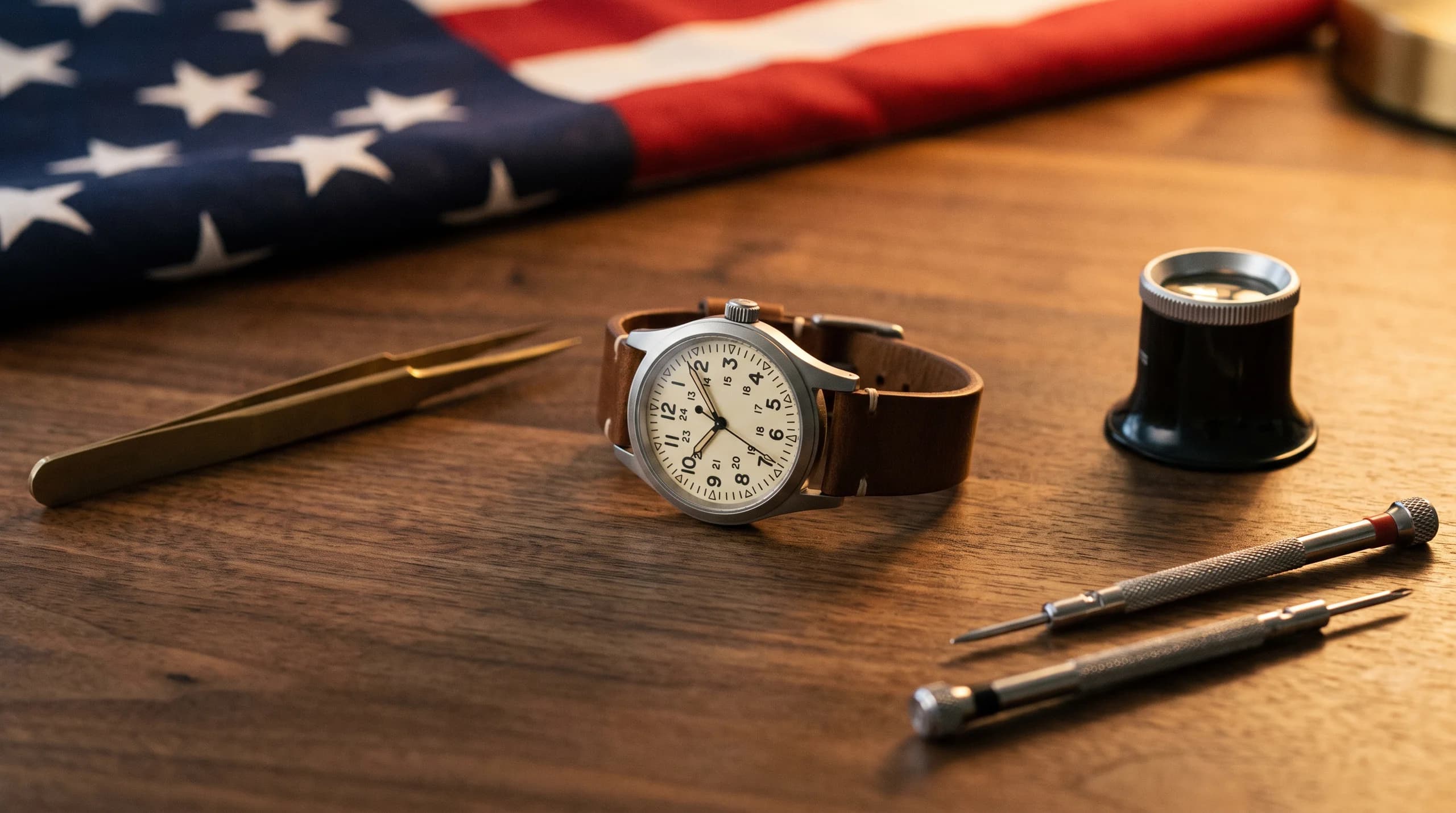
This July 4 is not a normal one. It is the semiquincentennial, America's 250th birthday, and a fitting moment to ask an awkward question: does America still make watches?
The short answer
Yes, but in a very particular way. American watchmaking collapsed in the twentieth century and has come back as something small, proud, and mostly expensive. A handful of workshops now build genuine mechanical movements on US soil, led by RGM in Pennsylvania and J.N. Shapiro in California.
"American made" turns out to be a spectrum, not a stamp. And if your goal is value rather than provenance, pre-owned Swiss still wins on almost every metric. The American story is worth knowing anyway.
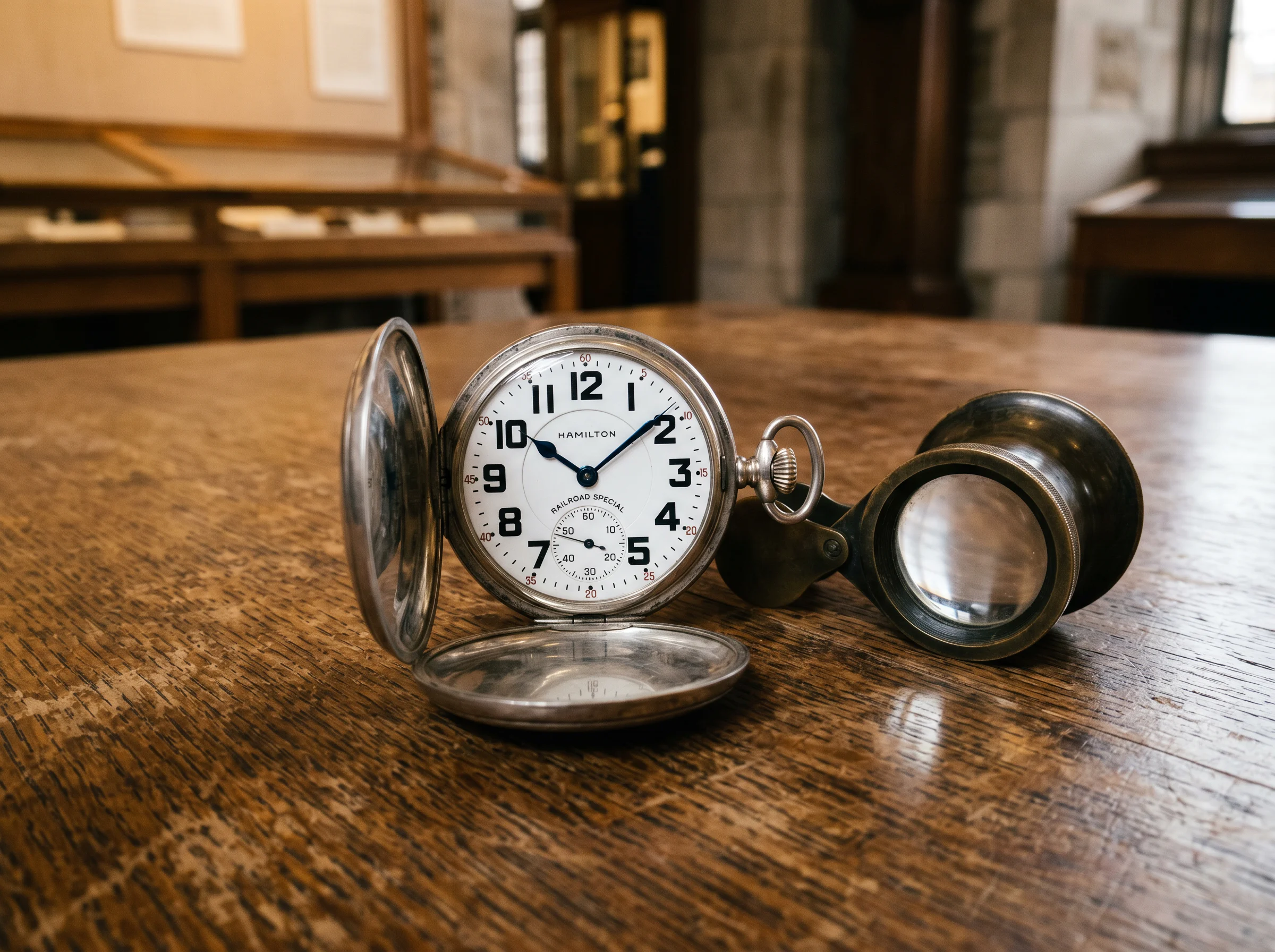
The images in this article are AI-generated editorial illustrations. They evoke American watchmaking and are not photographs of specific watches or people.
From watchmaking superpower to near zero
It is easy to forget that the United States once led the world in watches. Names like Waltham, Elgin, Illinois, and Hamilton turned out millions of precise, affordable pocket watches in the 1800s and early 1900s, many of them keeping the railroads on time.
Then it unraveled. Production shifted to Switzerland and Japan through the twentieth century, and the great American factories closed or moved on. Hamilton, founded in Lancaster, Pennsylvania in 1892, still exists, but as a Swiss brand owned by the Swatch Group. By the 1970s, homegrown mechanical watchmaking had all but vanished.
What "American made" even means in 2026
Here is the honest part most marketing skips. "Made in USA" is a legally loaded phrase. The FTC does not let a watch claim it unless virtually all components, including the movement, are made domestically, and almost no one clears that bar.
Worn & Wound, revisiting the topic for the country's 250th, argues that American watchmaking in 2026 is best understood as a term of art rather than a fixed definition.
In watches, "American made" is a spectrum, not a stamp.
The three tiers
It helps to sort the field into three honest tiers.
- Fully American made: movement, case, dial, and hands designed and built in the US. A tiny group: RGM, J.N. Shapiro, Keaton Myrick.
- American assembled: US assembly using some imported parts. This is where Weiss, Vortic, and Shinola largely sit.
- American designed: conceived in the US, manufactured overseas. This covers most of the microbrand world.
The brands doing the real work
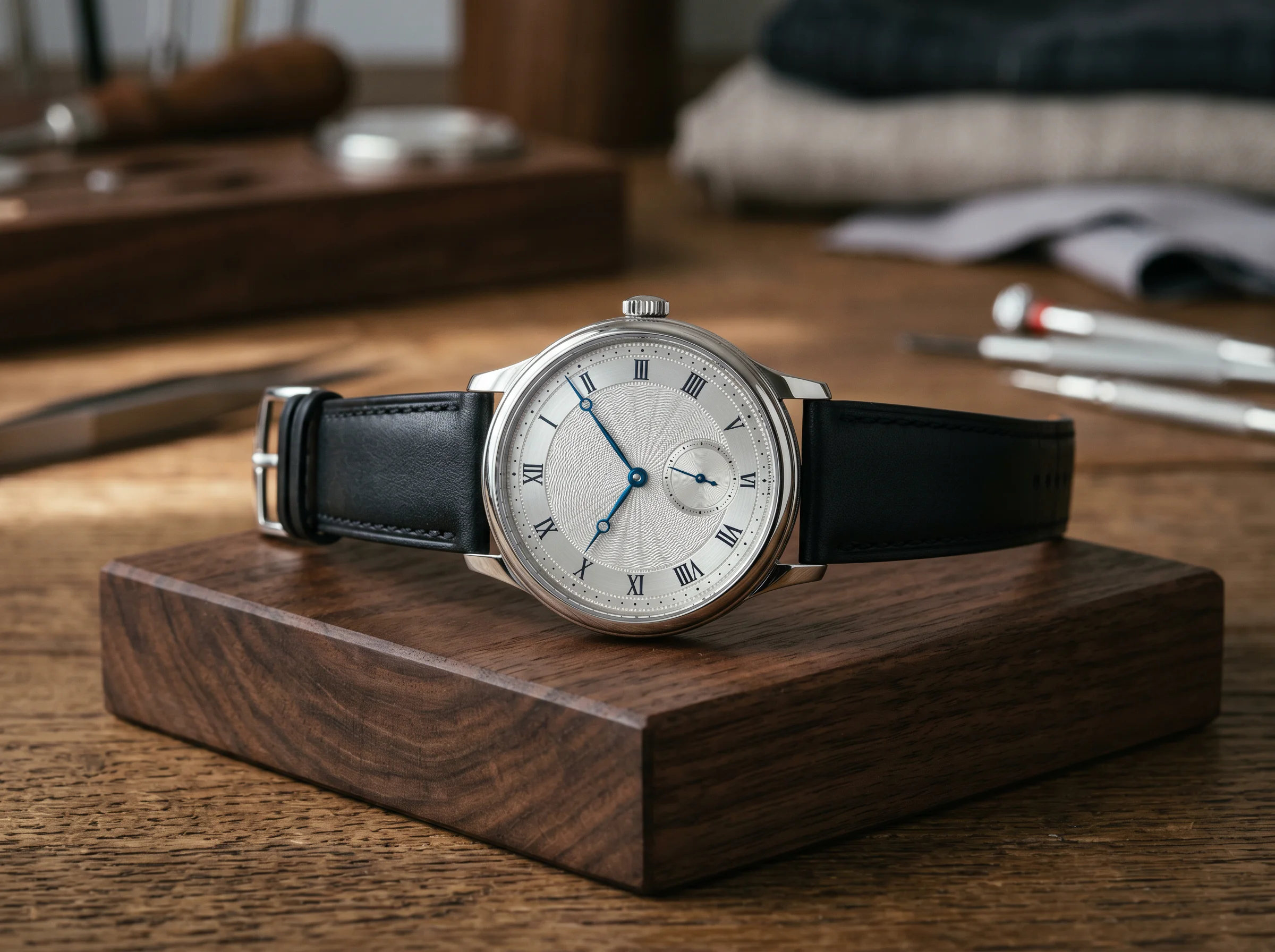
A small number of shops are doing something genuinely rare: making high-grade movements in America.
RGM
RGM is the elder statesman. Roland G. Murphy, a former Hamilton technical manager, founded it in Lancaster County in 1992. Watches of Espionage notes that in 2008 he produced the Caliber 801, the first high-grade mechanical movement made in the US in over 40 years, and the shop now offers several in-house calibers alongside Swiss-powered models. Prices start just over $3,000 for the Swiss-movement pieces and climb into tourbillon territory.
J.N. Shapiro
Josh Shapiro represents the extreme end. His Resurgence, as Gear Patrol reports, is built almost entirely in-house and is described as the first fully American-made mechanical watch since 1969, down to the movement. It is a 38mm made-to-order piece running at a deliberately vintage 2.5Hz, priced from $70,000 to $85,000, which the brand calls the most expensive time-only watch ever made in the US.
That number is not a typo, and it is the whole point. Building everything domestically, in the tradition of George Daniels and Roger W. Smith, is brutally expensive at small scale.

Weiss and Vortic
Cameron Weiss, Swiss-trained and now based in Nashville, machines cases and dials in-house and builds American field watches in batches. Vortic takes a different and charming route: it restores antique American pocket-watch movements from the likes of Waltham and Elgin and rehouses them in US-made cases, one of one.
Vortic even fought and won a five-year legal battle with Hamilton and the Swatch Group over its right to sell wristwatches built from vintage Hamilton movements. That is a lot of determination for a small shop in Fort Collins, Colorado.
What it means if you are buying
Here is the working dealer's read. American watchmaking in 2026 is real, admirable, and almost entirely a passion purchase.
| If you want | American option | The honest trade-off |
|---|---|---|
| A true US-made movement | RGM, J.N. Shapiro | $3,000 to $85,000, long waits, tiny output |
| A US-assembled watch | Weiss, Vortic | $1,000 to $4,000+, often foreign movement parts |
| A piece of US history | Vortic conversion | One of one, but large and not cheap |
| Pure value | pre-owned Swiss | The best money-to-metal ratio, every time |
If you are buying an American watch, buy it for the story and the craft, not the spec sheet. If you are buying for value and resale, the math still points to pre-owned Swiss, which is what we cover across the site, including our read on the Omega Aqua Terra versus the Rolex Datejust.
The bottom line
On America's 250th birthday, the state of American watchmaking is small, serious, and worth celebrating. A few workshops are proving that real horology can happen on US soil again, even if it costs a fortune to pull off.
For the watches most people actually buy and wear, though, the value still lives in the pre-owned market. Browse authenticated pre-owned watches at 5dwatches.com, and if you want the presidential angle on all this, our guide to the watches of American presidents makes a fitting Fourth of July read.