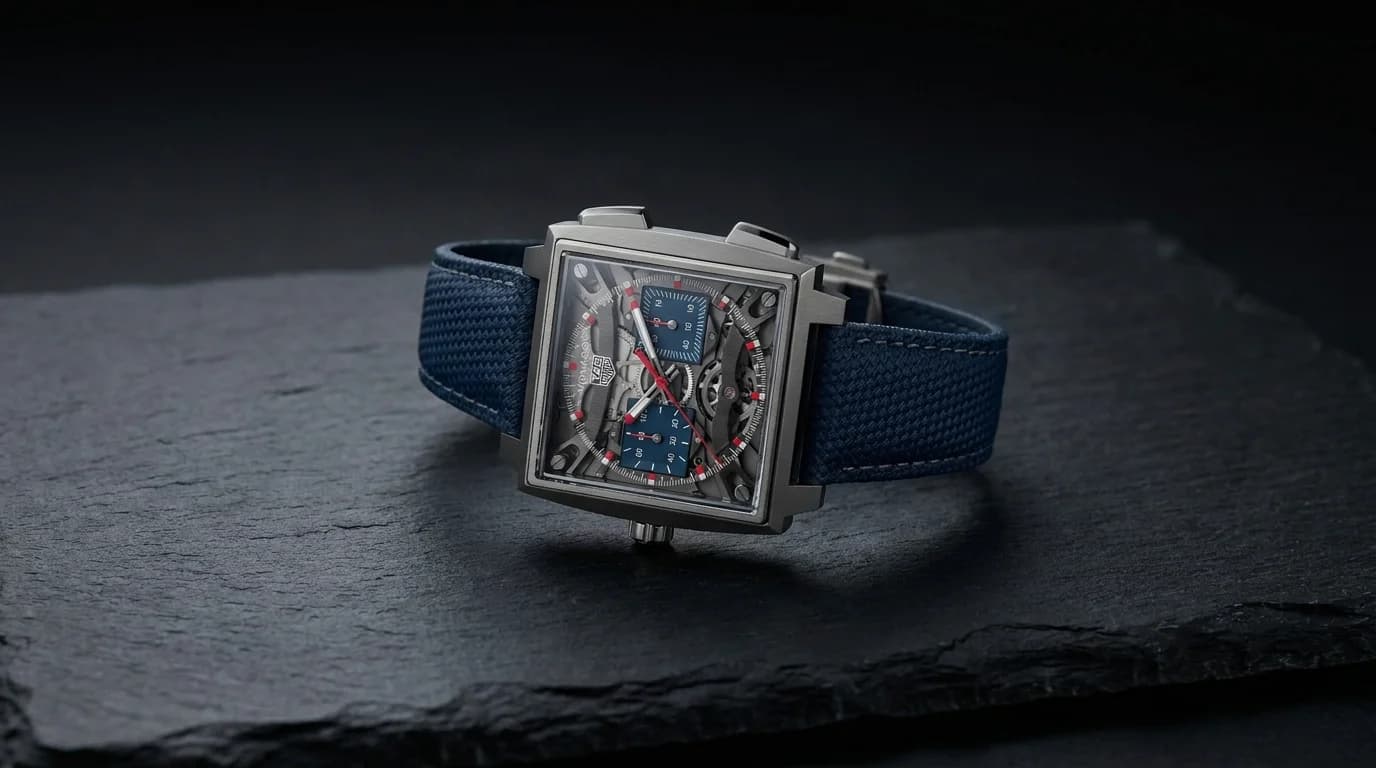
Most TAG Heuer news in 2026 is the brand refreshing its lineup. The Monaco Evergraph is different. This is TAG Heuer doing something nobody else is doing — and it shipped in April at $25,000.
The watch is built around the new Calibre TH80-00, a chronograph movement developed in partnership with Vaucher Manufacture Fleurier over four years. The engineering story is genuinely unusual: the movement abandons the traditional lever-and-spring architecture that has controlled chronographs for over a century and replaces it with flexible bistable components that bend microscopically to trigger start, stop, and reset.
That is not a refinement. It is a different mechanism.
Images in this post are AI-generated for editorial illustration. They may not represent the exact watch configuration. For accurate product photography, visit tagheuer.com.
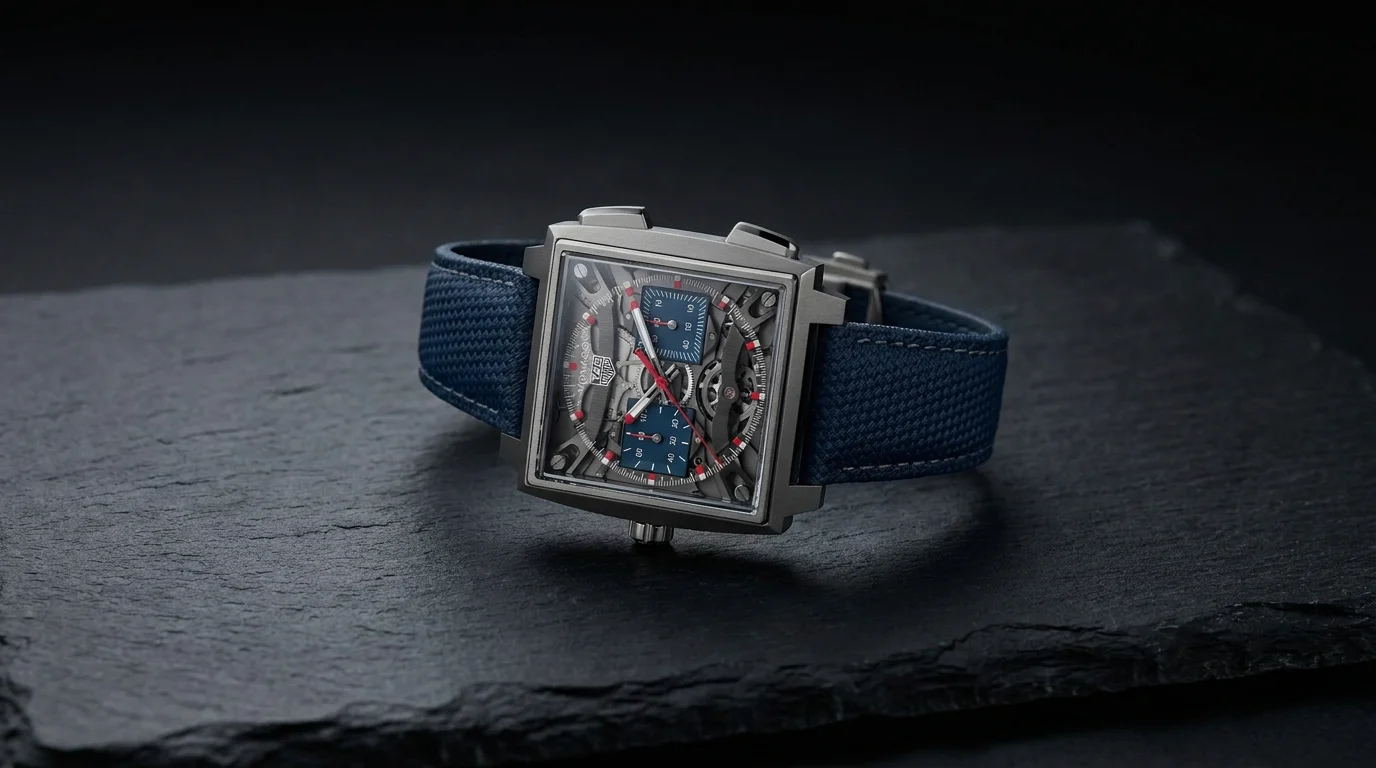 TAG Heuer Monaco Evergraph ref. CEW5181, Calibre TH80-00, Grade 5 titanium, $25,000. AI-generated editorial image.
What the Compliant Mechanism Actually Does
Standard chronograph architecture relies on a column wheel, a coupling clutch, and a system of levers and springs. The column wheel rotates to engage and disengage the clutch, which connects the chronograph seconds wheel to the gear train. This works well — it has for over a century — but it introduces variability. Springs fatigue. Pivots develop play. Tactile feel changes over thousands of actuations.
The TH80-00 replaces most of this with LIGA-fabricated flexible nickel-phosphorus components that deform elastically rather than pivoting against each other. Bistable means the mechanism snaps between two defined states — engaged or disengaged — with no intermediate position. The tactile feel of the pushers stays consistent across the watch's life because elastic deformation is inherently repeatable in a way that mechanical wear is not.
The movement was developed entirely from scratch. TAG Heuer chose not to adapt an existing base movement — the TH80-00 is square to fill the Monaco's square case natively, which is why the skeletonised dial works visually. There is no movement ring to hide. The architecture also placed the crown at 9 o'clock, echoing the historic Calibre 11 of the original 1969 Monaco.
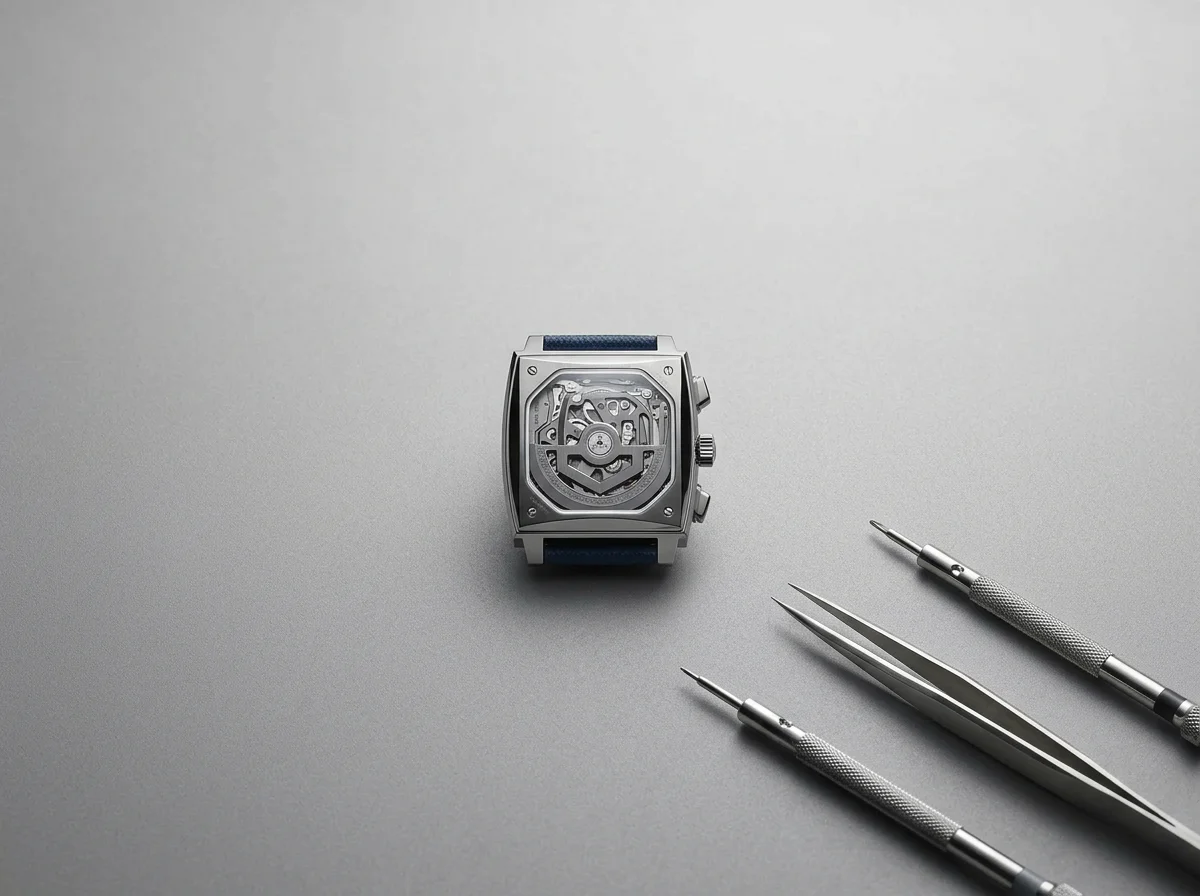 The TH80-00 through the caseback. The bistable flexible mechanism looks nothing like a conventional chronograph. AI-generated editorial image.
The Specifications
The Evergraph ships in two references: titanium with blue accents (CEW5181.FT8123) and black DLC with red accents (CEW5180.FT8122). Both are 40mm Grade 5 titanium, 100m water resistant, on rubber straps with textile embossing and a titanium folding clasp. The movement runs at 36,000 vph (5 Hz) with a 70-hour power reserve and carries COSC chronometer certification. TAG Heuer developed the TH-Carbonspring balance spring in-house.
At $25,000, both references are identically priced.
The standard Monaco Chronograph updated simultaneously, now running the Calibre TH20-11 (an evolution of the long-serving TH20-00) in Grade 5 titanium at $9,350. The TH20-11 is a strong movement. The Evergraph is a different conversation.
Why $25,000 Is the Right Number
TAG Heuer has a positioning problem that this watch solves. The brand sits in the no-man's-land between entry luxury (under $10K) and genuine haute horlogerie — a gap where it often loses to both Rolex on one side and AP/Patek on the other.
The Monaco Evergraph exits that gap. At $25,000 it is still accessible compared to a Royal Oak Chronograph ($45,000+) but the engineering story is arguably more interesting. Compliant mechanisms are a legitimately frontier application in watchmaking. TAG Heuer worked with Vaucher Manufacture Fleurier over four years developing it, choosing to build from a clean slate rather than adapting an existing architecture. That kind of development commitment reads in the final product.
The comparison that matters most for a buyer considering this watch is the Breitling Premier B01 Chronograph at $8,750 or the Omega Speedmaster Moonwatch Professional at $7,300. Both are excellent in-house chronographs. Neither changes how a chronograph works. The Evergraph does.
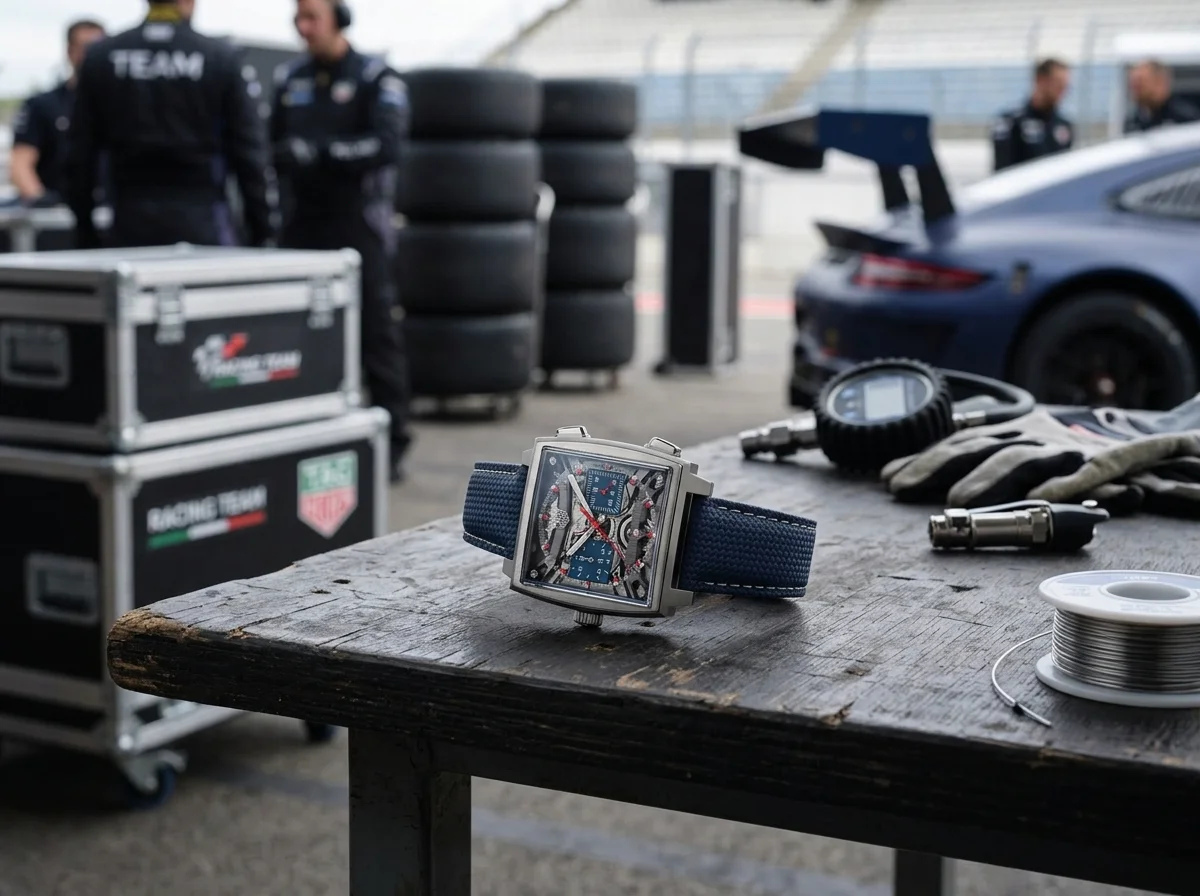 The Evergraph in the context that shaped the Monaco — motorsport. AI-generated editorial image.
The Pre-Owned Angle
The Monaco Evergraph is too new for a pre-owned market to exist. It launched in April 2026 and pre-owned examples will not appear in meaningful numbers for at least 12–18 months.
For buyers watching this space: the standard Monaco Chronograph TH20-11 at $9,350 new is the accessible entry. The pre-owned play on outgoing Monaco references typically lands around $5,500–$7,000, depending on generation and condition. The Evergraph will command a premium when it arrives on the secondary market — the engineering story and limited initial supply are both supportive.
One thing worth noting: the serviceability of compliant mechanisms is an open question. The design was built to maintain consistent tactile response and should not require special adjustments during service. But until the watches have been through service cycles in the field, that is still theoretical. A watch this technically ambitious warrants patience on the pre-owned market.
| Spec | Monaco Evergraph | Monaco Chronograph TH20-11 |
|---|---|---|
| Case | 40mm titanium | 39mm titanium |
| Movement | TH80-00 compliant | TH20-11 |
| Frequency | 36,000 vph | 28,800 vph |
| Power reserve | 70 hrs | 80 hrs |
| COSC certified | Yes | Yes |
| Price | $25,000 | $9,350 |
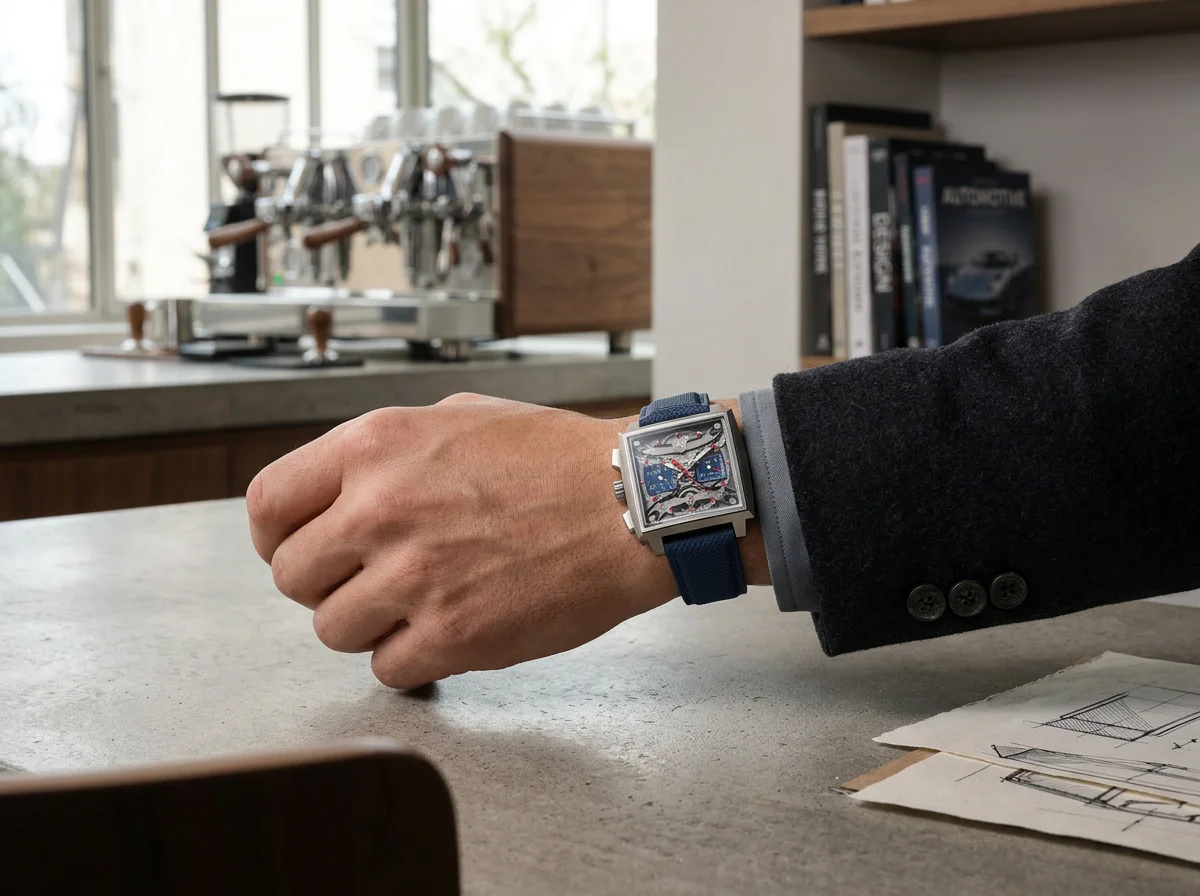 The Evergraph on wrist. The 40mm square case wears closer to a 38–39mm round. AI-generated editorial image.
The Bottom Line
The Monaco Evergraph is the most technically serious TAG Heuer has released in a generation. The compliant mechanism is real watchmaking progress, not marketing. At $25,000 it sits in a tier where the competition is primarily about heritage and name rather than engineering — and the Evergraph wins that argument on engineering alone.
If you are buying a watch in this price range because you care about movement architecture, this is the one to look at seriously. WatchTime's full technical review is worth reading alongside this post.
For pre-owned TAG Heuer chronographs in the meantime, the standard Monaco family is well-documented and well-supported — find current inventory at 5dwatches.com/shop/tag-heuer.
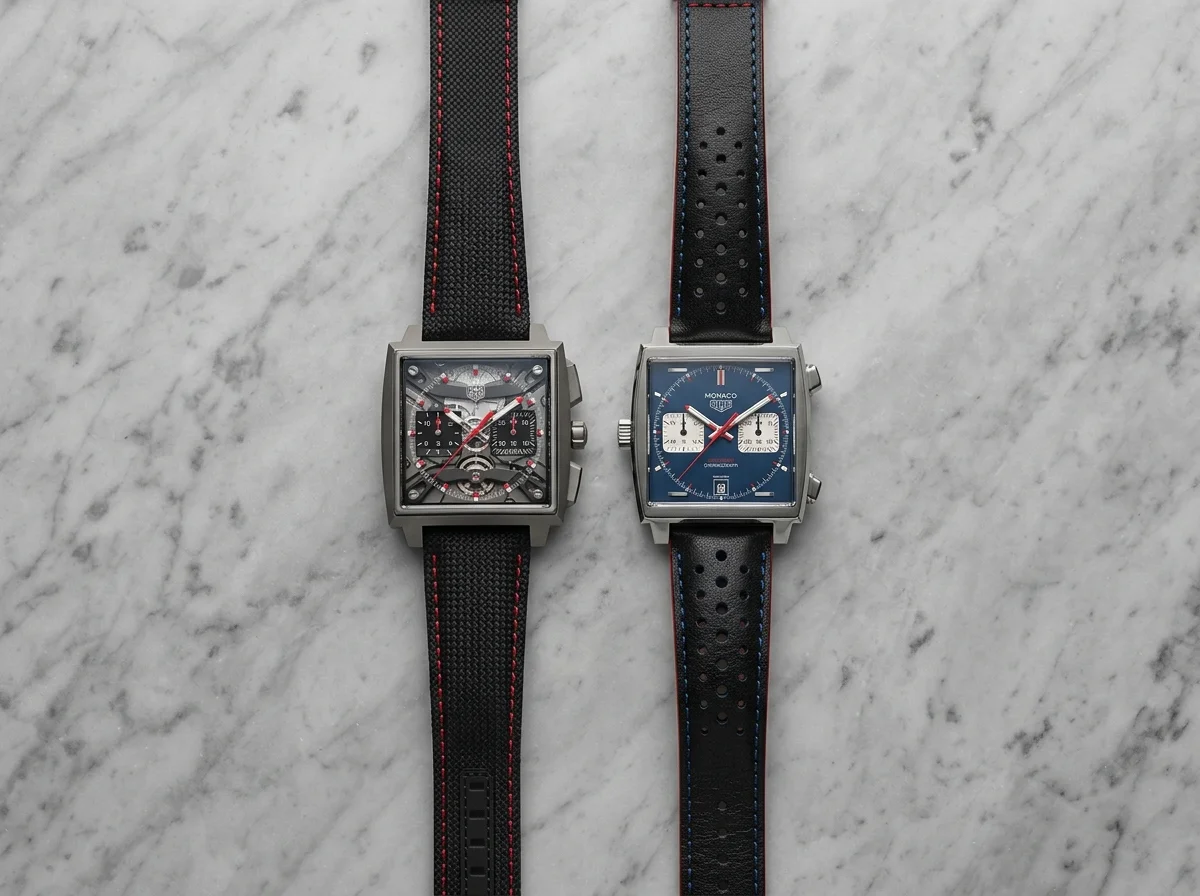 Evergraph versus standard Monaco. $25,000 versus $9,350. The price gap reflects a genuine engineering gap. AI-generated editorial image.