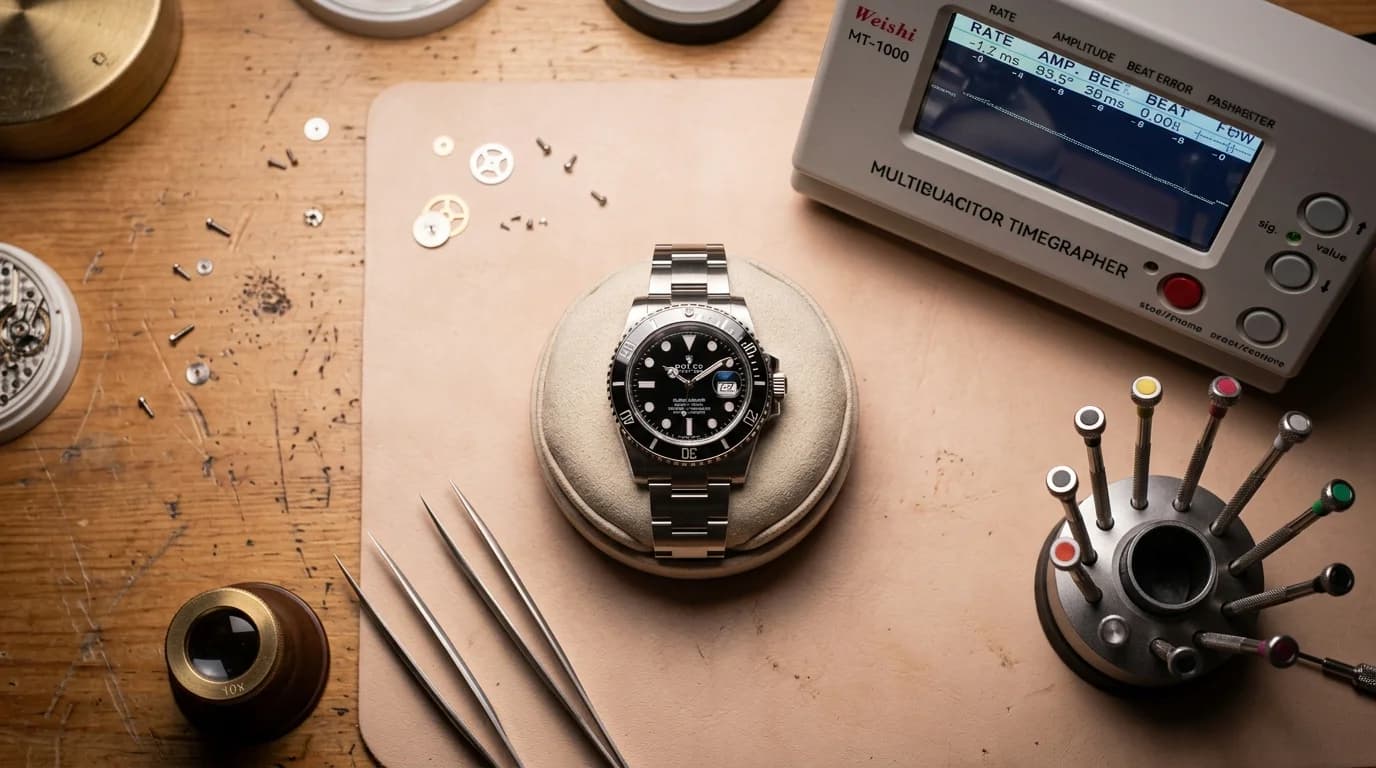
Buyers budget carefully for the watch itself, then forget the recurring bill that comes with owning one. Servicing is not optional maintenance you can skip forever. Skip it long enough and you risk real damage to the movement.
The Short Answer
A full mechanical watch service typically runs $800 to $1,600 for a modern steel Rolex at an official service center, and several hundred dollars up to about $1,200 for most Omega models, according to Bob's Watches and industry pricing data. Precious metal and complicated references cost more on both brands. Independent watchmakers typically charge 30 to 50% less than brand service centers, with the trade-off being the brand's own warranty and parts sourcing.
Why Servicing Costs Vary So Much
A watch service is not a flat fee. The price depends on the movement's complexity, whether parts need replacing, and whether you use the manufacturer's own service center or an independent watchmaker.
What a Full Service Actually Includes
A complete service means full disassembly, ultrasonic cleaning of every part, replacement of gaskets and worn components, relubrication, reassembly, and timing regulation on a machine before the watch ships back to you.
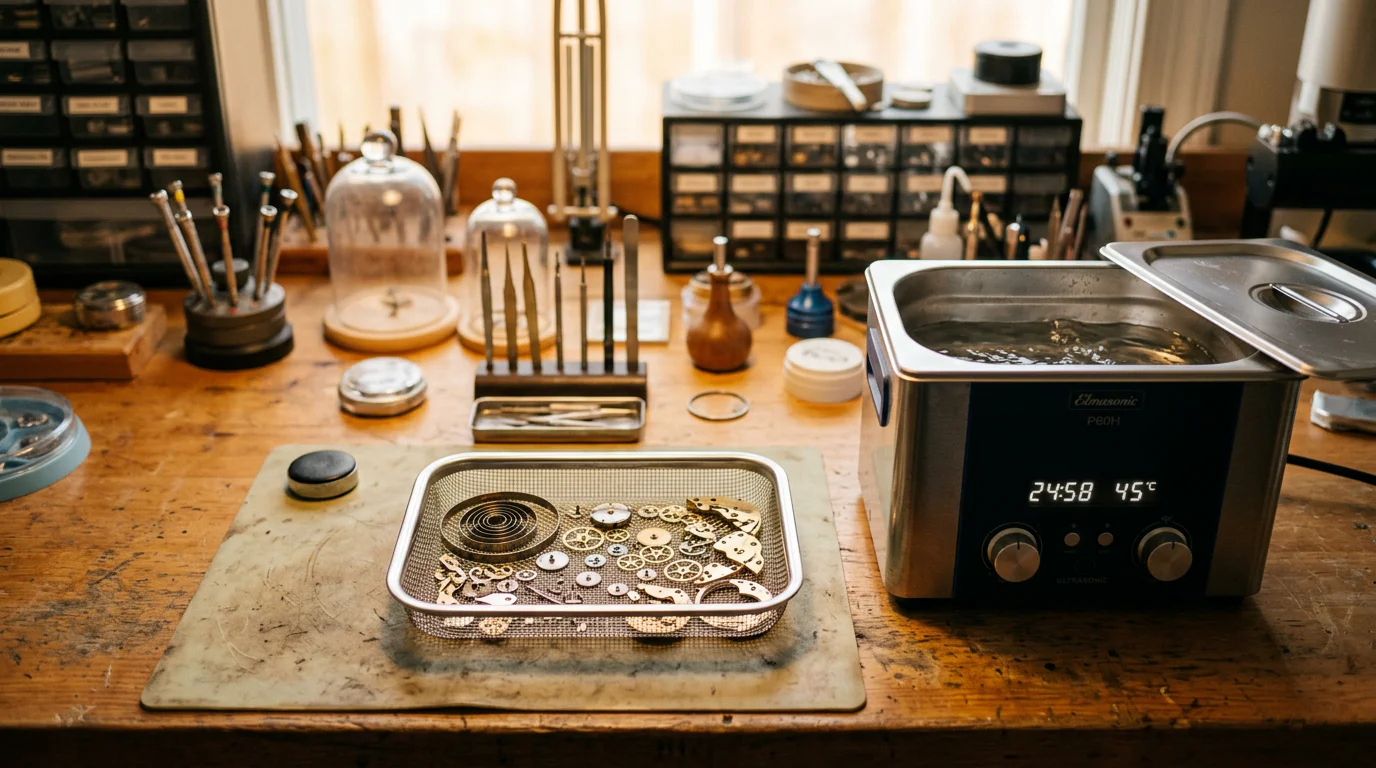 Every part comes off the movement, gets cleaned individually, and goes back on with fresh lubrication.
Rolex Service Costs
Rolex pricing scales with the movement type and case material, and jumps meaningfully once worn parts need replacing rather than just cleaning and lubrication.
| Model Type | Starting Cost | With Parts Replaced |
|---|---|---|
| Time-only (Oyster Perpetual, Datejust) | $800-$1,000 | $1,100-$1,600 |
| Steel sports (Submariner, Explorer) | $800-$1,100 | $1,300-$1,700 |
| Precious metal or complicated (Daytona, Sky-Dweller) | $1,300-$1,600 | $1,800-$2,800+ |
Figures per Bob's Watches. Crystal replacement typically adds $200 to $600, and crown or tube replacement adds $250 or more on top of the base service.
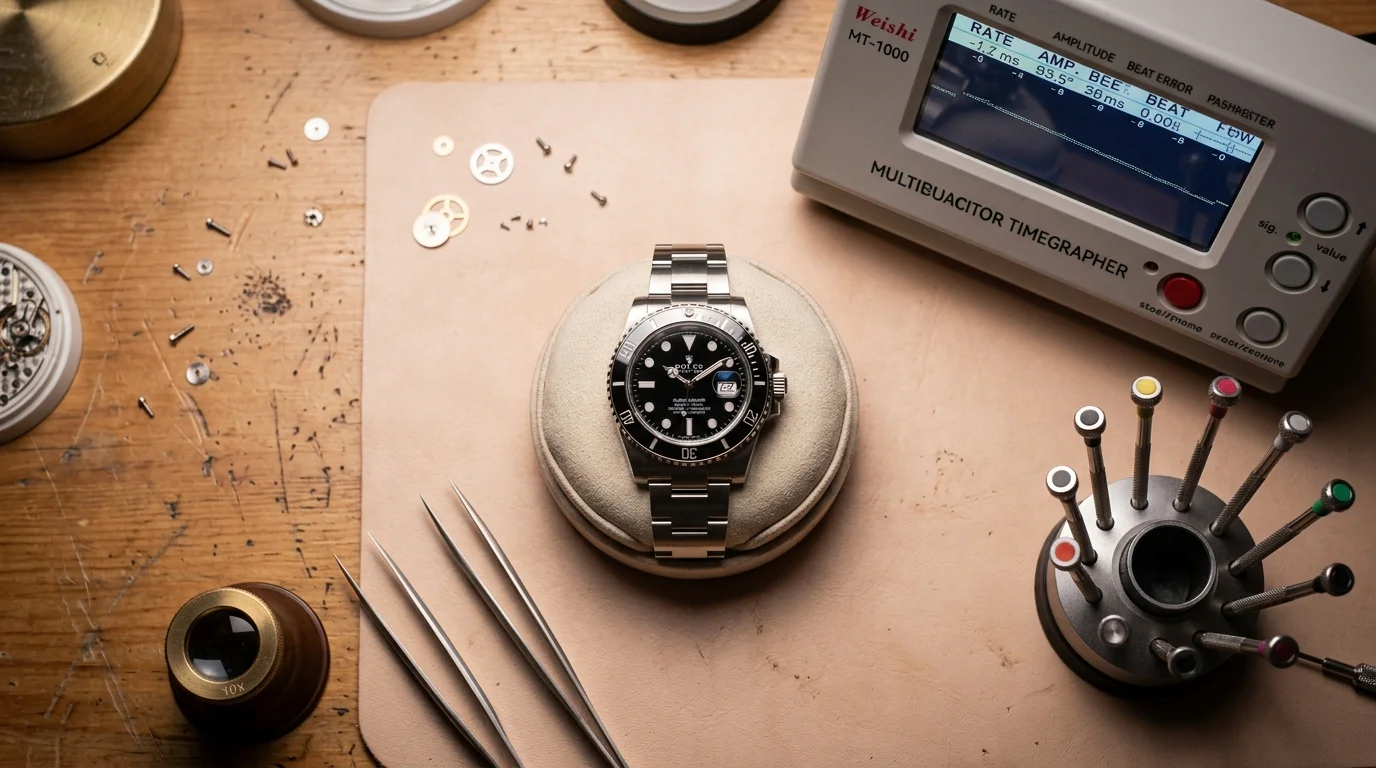 A Submariner on the bench. Steel sports models run $800 to $1,100 to start, more once parts need replacing.
How Often a Rolex Actually Needs Service
Rolex recommends roughly every 10 years for a modern watch under normal wear. A watch worn daily tends to need attention closer to every 5 to 7 years, and a vintage piece from before 1990 is safer serviced every 3 to 5 years.
Omega Service Costs
Omega's range runs lower than Rolex's on comparable models, and varies by whether the movement is a manual chronograph, an automatic co-axial, or quartz.
| Model Type | Official Service Center | Independent Watchmaker |
|---|---|---|
| Speedmaster Professional (manual) | $750-$850 | $500-$650 |
| Speedmaster automatic chronograph | $850-$1,200 | $700-$1,000 |
| Seamaster Diver 300M / Planet Ocean | $650-$800 | $450-$650 |
| Seamaster Aqua Terra | $600-$750 | $450-$600 |
| Constellation / De Ville | $600-$700 | $400-$550 |
| Quartz models | $350-$450 | $150-$300 |
Model-level figures per Watch Scanning's Omega service cost breakdown. Bob's Watches confirms the broader range as "several hundred to over a thousand dollars" depending on complexity.
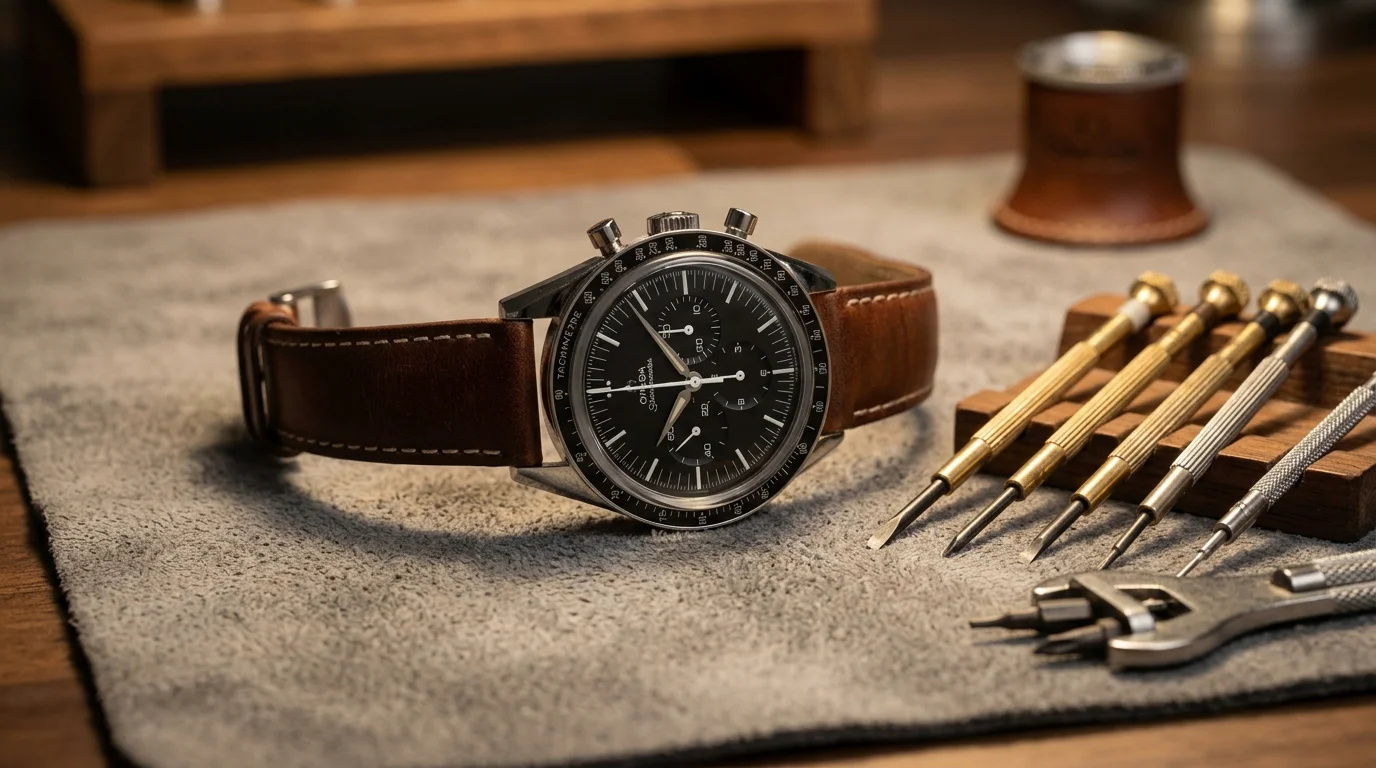 A Speedmaster on the bench. Manual chronographs run cheaper to service than automatic co-axial versions.
How Often an Omega Needs Service
Omega recommends servicing its modern co-axial movements every 5 to 8 years. Older, non-co-axial calibers should come in closer to every 4 to 5 years. Omega itself notes a co-axial movement may need only 2 to 3 services over 20 years of ownership, against 4 to 5 services for a traditional Swiss lever escapement over the same span.
Official Service Center vs Independent Watchmaker
Both brands' own service centers charge more than most independent watchmakers, and the gap is not small.
What You Get From the Manufacturer
An official service comes with genuine parts, a service warranty (typically 24 months on both Rolex and Omega), and a paper trail that matters for resale on higher-end references.
What You Give Up With an Independent
A qualified independent watchmaker typically charges 30 to 50% less, but you lose the brand's own warranty and, on some references, the ability to prove factory-only parts were used, which can matter to a future buyer.
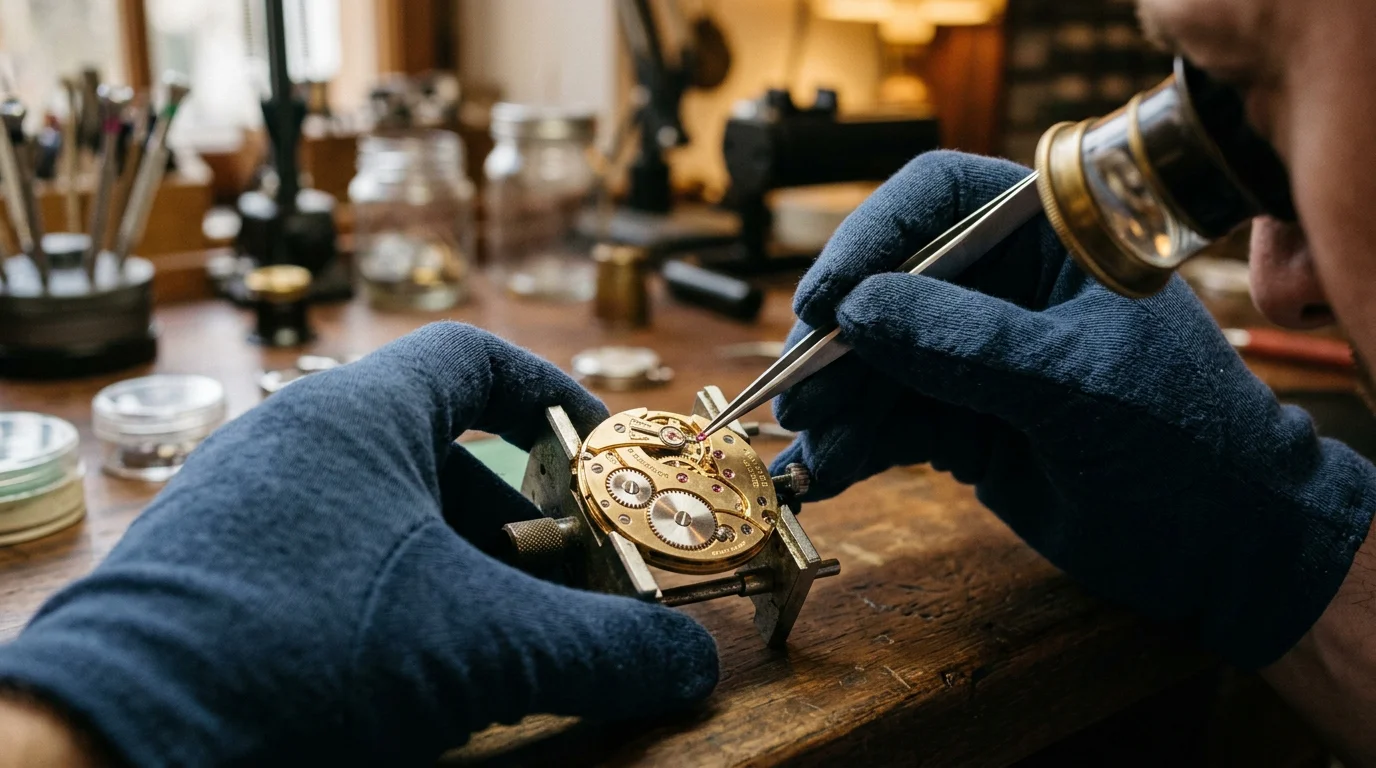 Independent watchmakers do the same disassembly and cleaning work, usually for meaningfully less than the brand's own service center.
The Timing Machine: How a Watchmaker Verifies the Work
Before a serviced watch ships back to you, it goes on a timing machine (a timegrapher) that measures the movement's rate and amplitude against a microphone reading the balance wheel's beat.
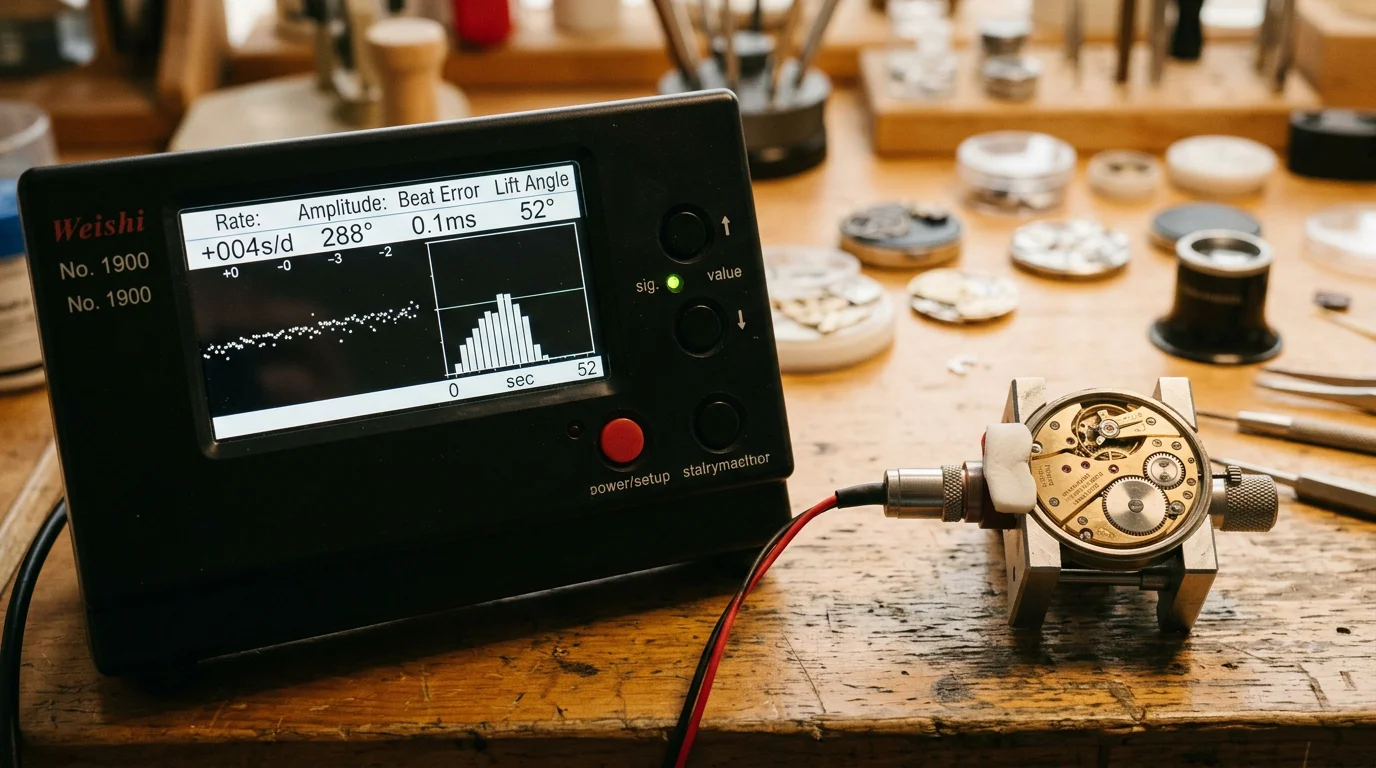 A timing machine reads the movement's beat through a microphone and graphs the rate against a reference line.
Why This Step Matters to You
This is the step that confirms the service actually fixed the accuracy problem you paid for. Ask any watchmaker, brand or independent, for the before-and-after timing graph. A shop that will not show you one is a shop worth avoiding.
How to Budget for This as a Buyer
Build the service cost into your total cost of ownership before you buy, not after the watch starts running fast or slow.
A Simple Rule of Thumb
Set aside roughly 10% of the watch's purchase price every 5 to 10 years for service, more if you are buying a complicated or precious metal reference. It will not be exact, but it keeps you from being surprised. Fit matters just as much as budget here too. Our lug-to-lug explainer covers the other spec buyers commonly overlook before purchase, the one that decides whether a watch actually sits right on your wrist.
FAQ
How much does it cost to service a Rolex?
A modern steel Rolex typically runs $800 to $1,600 for a full service at an official Rolex Service Center, with precious metal or complicated references running $1,300 to $2,800 or more once worn parts are replaced.
How much does it cost to service an Omega?
Omega service costs range roughly $350 for a quartz model up to $1,200 for an automatic chronograph like the Speedmaster at an official service center, with independent watchmakers typically charging 30 to 50% less.
How often should a mechanical watch be serviced?
Most manufacturers recommend service every 5 to 10 years for a modern watch under normal wear, with daily-worn watches on the shorter end and vintage pre-1990 pieces needing attention every 3 to 5 years.
Is it cheaper to use an independent watchmaker instead of the brand?
Yes. Independent watchmakers typically charge 30 to 50% less than official brand service centers, though you give up the brand's own service warranty and, on some references, verified factory-parts documentation.
What does a full watch service actually include?
A complete service means full disassembly, ultrasonic cleaning of every component, replacement of gaskets and worn parts, relubrication, reassembly, and timing regulation verified on a timing machine before the watch is returned.