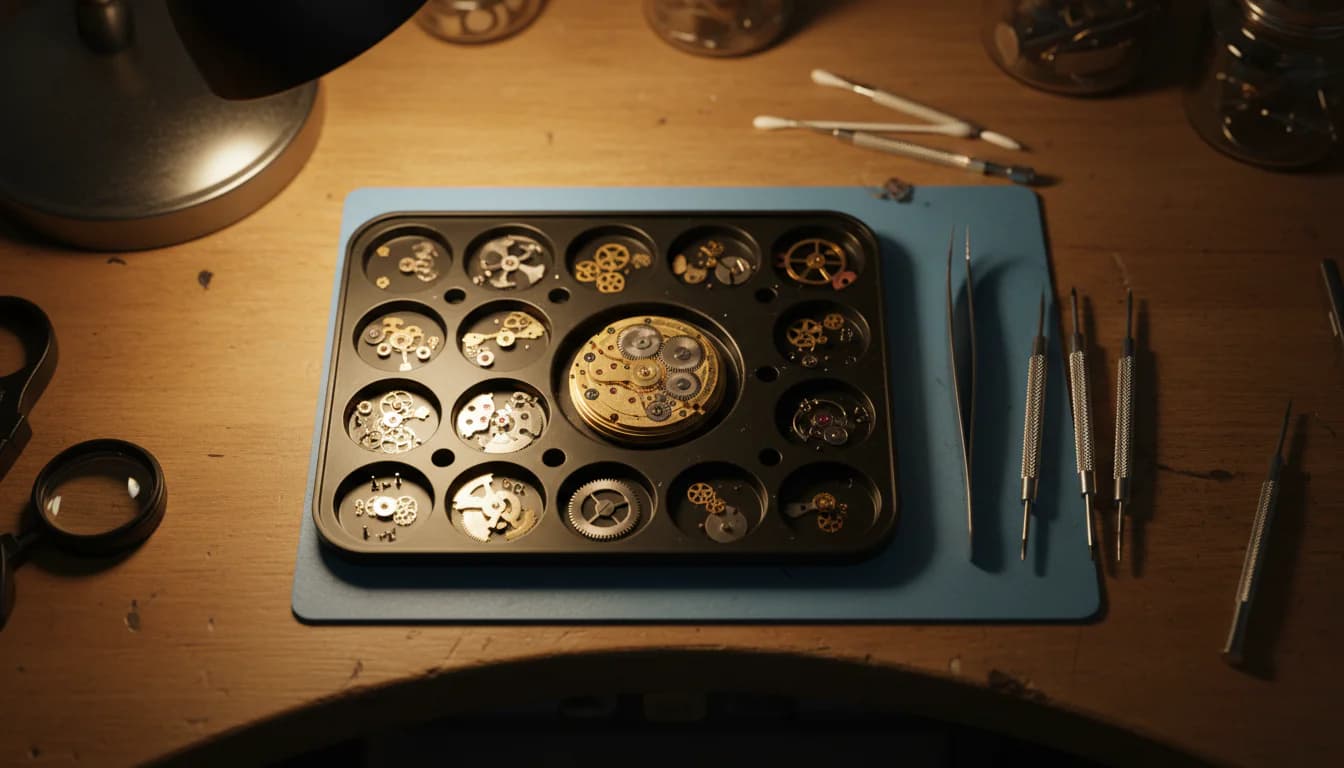
"Full service" gets thrown around loosely, sometimes meaning a quick clean and gasket swap, sometimes meaning the real thing: a complete overhaul that touches every part of the movement. Knowing the difference matters, because the price gap between them is real and so is what your watch actually gets.
This article was researched and drafted with AI assistance and reviewed by the 5D Watches team before publishing. Pricing, specs, and historical details are checked against primary sources.
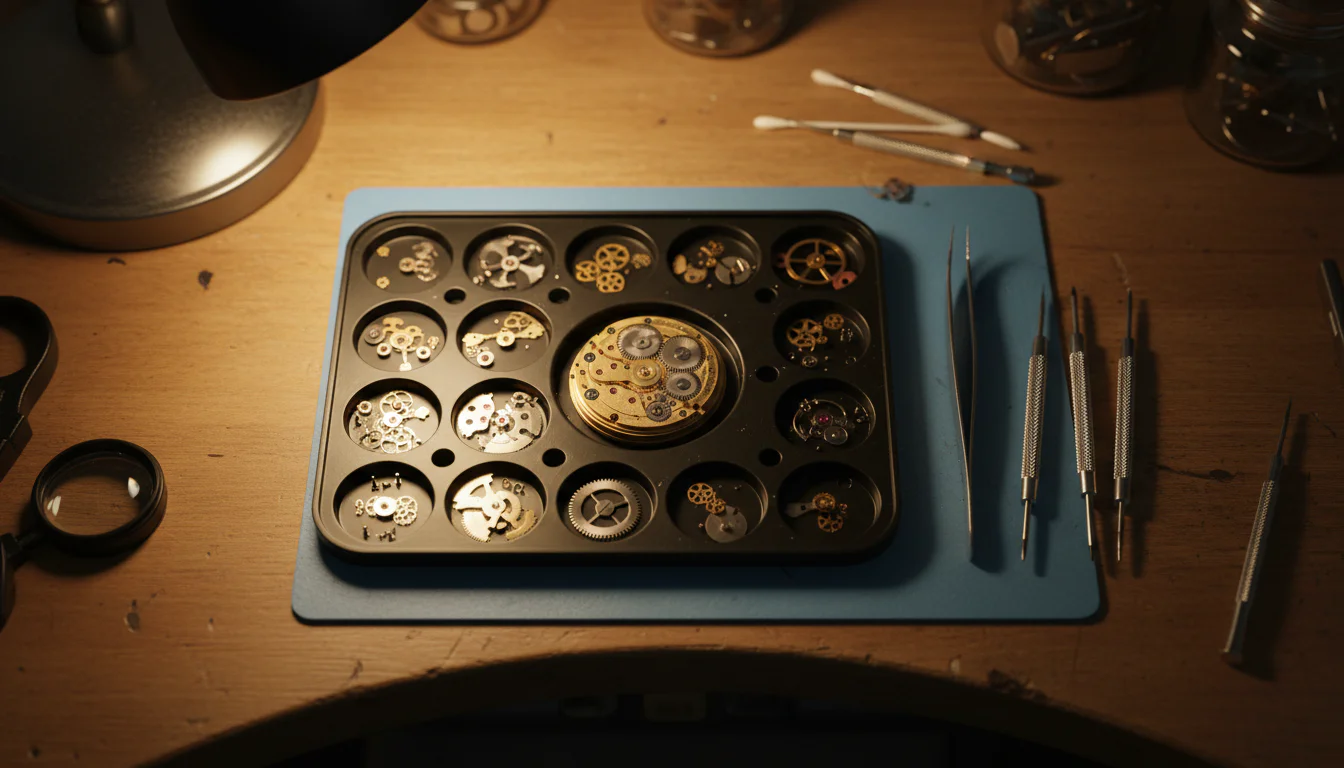 Every screw, gear, and jewel comes out. A full service is not a surface clean, it is a complete rebuild.
The short answer: A genuine full service means the movement is completely removed from the case and disassembled down to its individual components. Every part gets cleaned in an ultrasonic bath, inspected for wear, and reassembled with fresh lubrication. The watchmaker then regulates the movement on a timing machine to bring it back to factory-spec accuracy, replaces the crown and caseback gaskets, and pressure tests the case for water resistance. A full mechanical overhaul typically takes 4 to 12 weeks and is recommended roughly every 5 to 7 years.
Step one: complete disassembly
The watchmaker opens the caseback, removes the movement from the case entirely, and takes it apart piece by piece. Every gear, spring, jewel, and screw comes out.
Why this step cannot be skipped
Old lubricant does not stay where it was applied. Over years, it migrates, dries out, and turns gummy in places it should not be, which is exactly why a surface clean cannot substitute for full disassembly. The only way to properly clean and re-lubricate a movement is to take it apart entirely.
Step two: ultrasonic cleaning
Once disassembled, individual components go into an ultrasonic cleaning machine, small baskets or jars of cleaning solution agitated by high-frequency sound waves that dislodge old oil, dust, and contaminants from every surface, including places a cloth or brush could never reach.
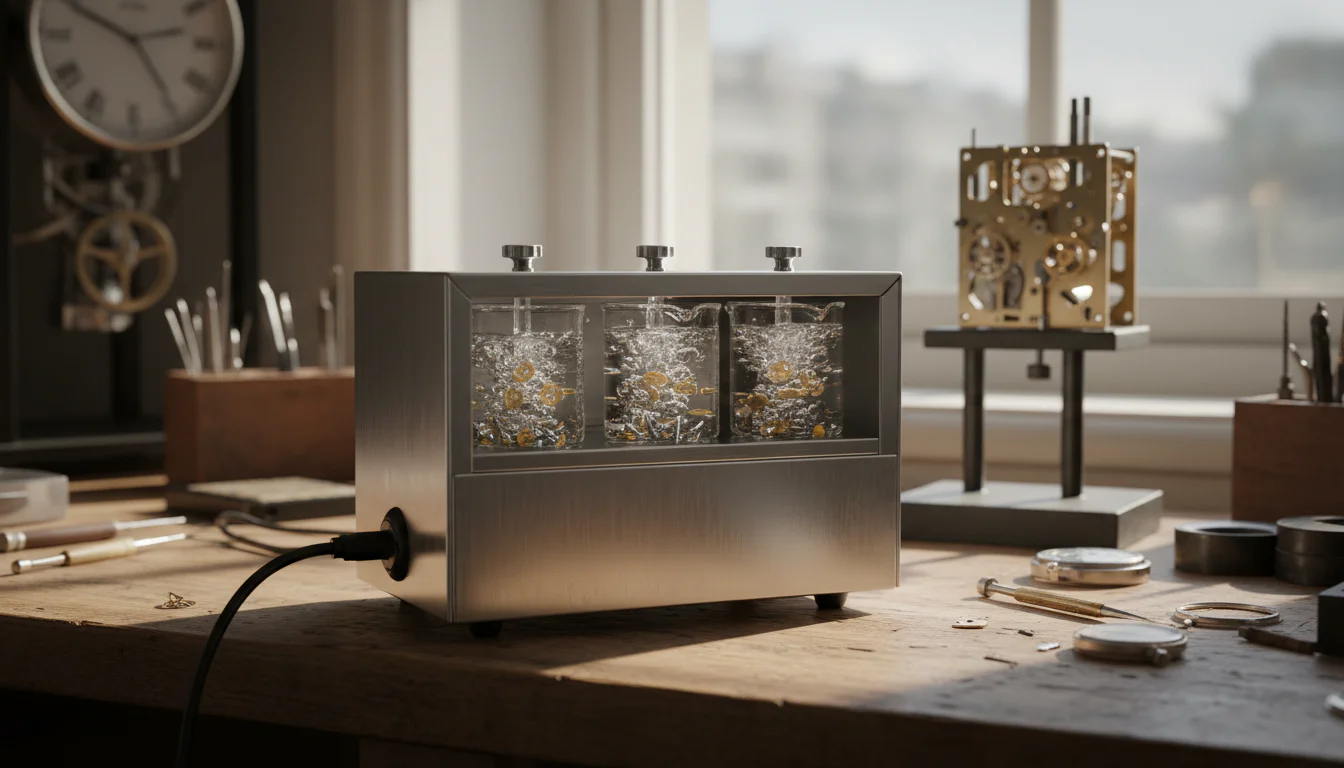 Ultrasonic cleaning reaches into gear teeth and jewel settings that hand-cleaning simply cannot access.
What this catches that a quick clean misses
Residual oil left on a gear tooth or pivot does not just sit there harmlessly. It attracts dust, which turns abrasive over time and accelerates wear on parts that are supposed to last decades. Ultrasonic cleaning is the step that actually resets the movement to a like-new baseline before anything gets reassembled.
Step three: inspection and parts replacement
With every component clean and separated, the watchmaker inspects each one under magnification for wear, scoring, or damage. Gears, pivots, and other parts showing measurable wear get replaced rather than reused.
This is also where a watchmaker catches problems you would never see from the outside: a slightly bent pivot, a worn jewel, a mainspring that has lost tension. None of that shows up as a symptom until the watch stops running or starts losing serious time.
Step four: reassembly and lubrication
The movement goes back together in the reverse order it came apart, and this time every pivot, gear train contact point, and escapement surface gets the correct type and amount of lubricant for that specific location. Different parts of a movement require different oil viscosities, and using the wrong one in the wrong place is its own failure mode.
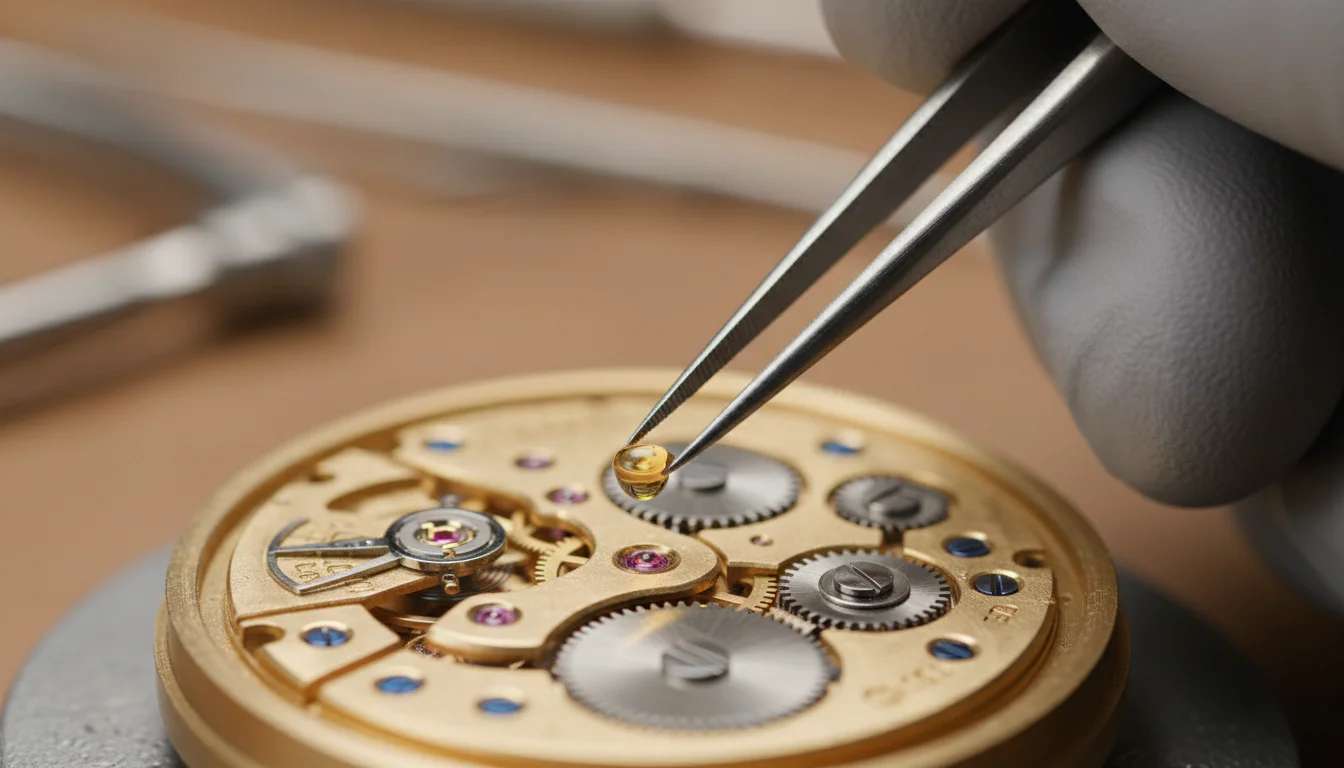 A single drop, precisely placed. Too much oil is as much a problem as too little.
Why lubrication is the whole point of servicing
Mechanical watch lubricant breaks down over years, not because it evaporates but because it oxidizes and thickens. A movement running on degraded lubricant wears its own parts down faster, which is the entire reason a 5 to 7 year service interval exists in the first place.
Step five: timing regulation
Once reassembled, the movement goes onto an electronic timing machine, a device that reads the audible ticks of the escapement through a microphone and displays rate, beat error, and amplitude on a screen in real time.
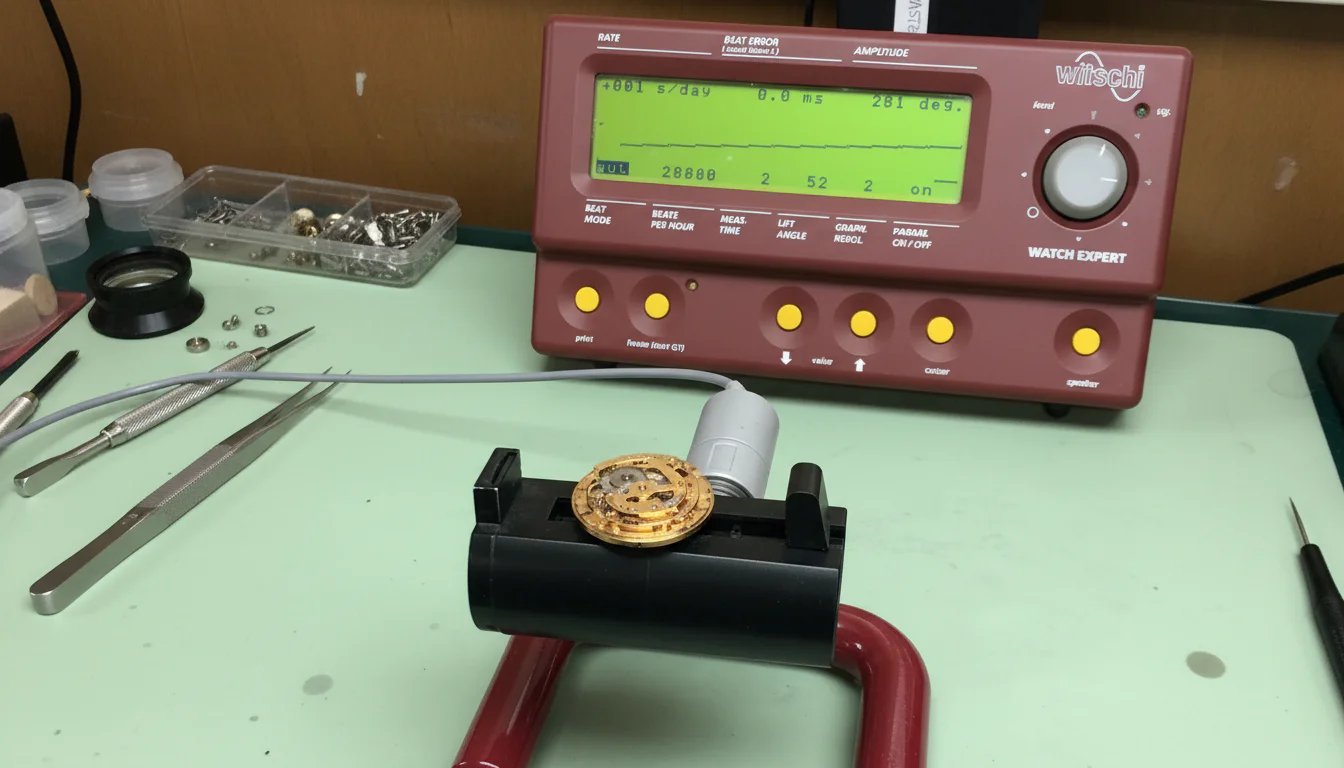 The timing machine reads the movement's actual rate in seconds per day, letting the watchmaker regulate it to spec before it ever goes back in the case.
The watchmaker then adjusts the hairspring's effective length in tiny increments using an integrated lever or screw, watching the rate trace shift on screen with each adjustment, until the movement holds accuracy within the manufacturer's specified tolerance.
Step six: gaskets and pressure testing
Crown and caseback gaskets are old rubber by the time a watch reaches its service interval, and old rubber does not seal reliably. Both get replaced as a matter of course during a full service, not just when a customer specifically asks about water resistance.
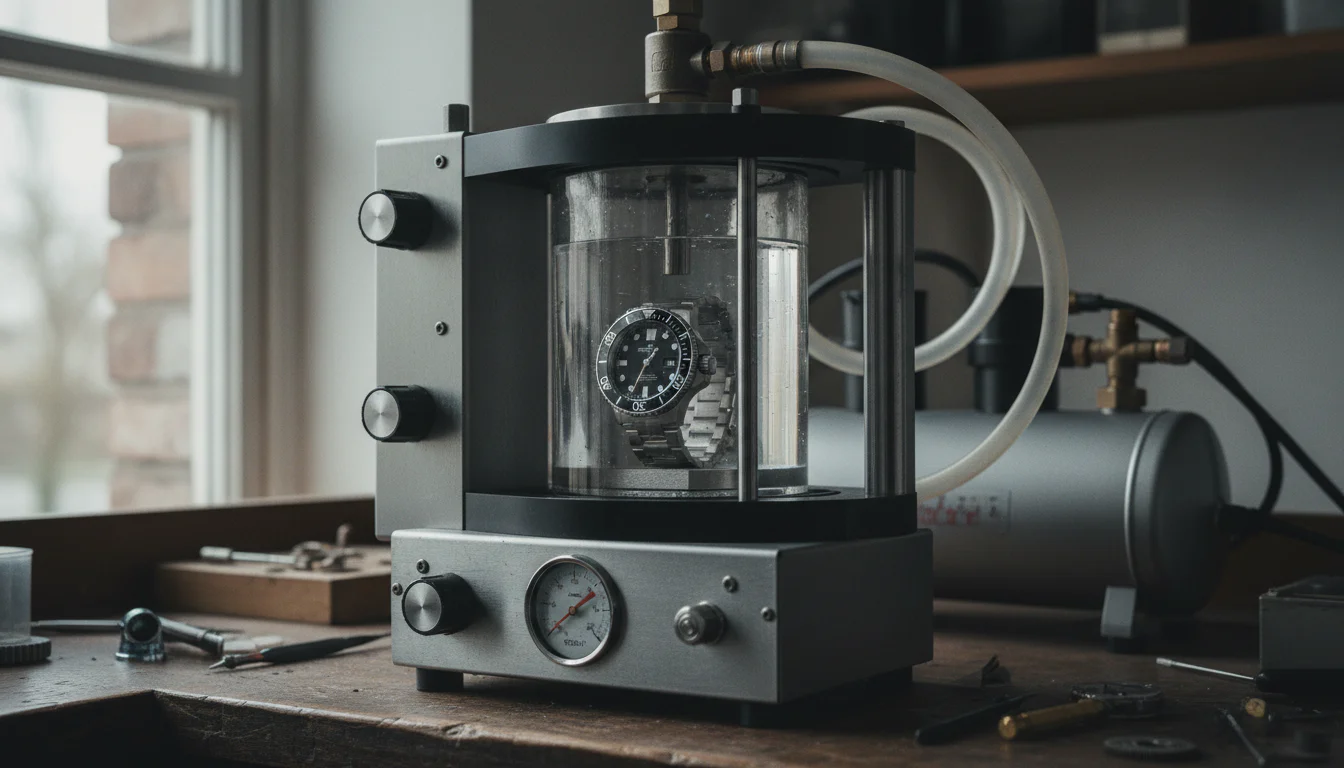 A pressure test confirms the case actually holds the water resistance rating printed on the dial, not just that it looks sealed.
The case then goes through a pressure test, particularly important for dive watches, to confirm the water resistance rating is actually being met and not just assumed from a visual inspection.
Full service vs the lesser options
Not every trip to a watchmaker needs the full protocol above, and knowing the difference saves you from overpaying or underservicing.
| Service tier | What it covers | Best for |
|---|---|---|
| Quick service | Battery swap, basic gasket check | Quartz watches, minor issues |
| Routine maintenance | Surface cleaning, seal inspection, pressure test | Watches running well, no accuracy complaints |
| Full mechanical overhaul | Complete disassembly through reassembly, all steps above | Watches at or past their 5 to 7 year interval, or showing accuracy or performance issues |
A watch can run and look fine on the wrist while suffering real internal wear, which is exactly why waiting for a visible problem before scheduling a full service usually costs more in the long run than servicing on schedule.
FAQ
How long does a full watch service take?
A complete mechanical overhaul typically takes 4 to 12 weeks depending on parts availability and movement complexity, though independent watchmakers handling routine work can sometimes turn it around faster.
How often does a mechanical watch actually need a full service?
Most manufacturers and independent watchmakers recommend a full service every 5 to 7 years, since lubricant degradation is a time-based process regardless of how much or little the watch has been worn.
Does a full service include polishing the case?
Case and bracelet polishing is typically a separate, optional request rather than a standard part of a movement service, since not every owner wants their case refinished. Ask your watchmaker to specify what is and is not included.
Is a full service the same at every price point?
No. Full service pricing varies significantly by brand and movement complexity, from roughly $450 for a straightforward Tudor overhaul to well over $2,000 for a complicated Patek Philippe movement. See our full breakdown of watch service costs by brand for specifics.
What happens if you skip servicing entirely?
Degraded lubricant causes accelerated wear on gears and pivots, which can eventually lead to the movement stopping or requiring far more extensive and expensive repair than a routine service would have cost.
The bottom line
A full service is a genuine rebuild, not a wipe and a battery. Every part comes out, gets cleaned, gets inspected, and goes back in with fresh lubrication before the movement is regulated back to spec and the case is pressure tested. If a quote sounds too cheap for what should be a 4 to 12 week process involving full disassembly, ask exactly what tier of service you are actually paying for.
For what all of this actually costs by brand, see our watch service cost guide.