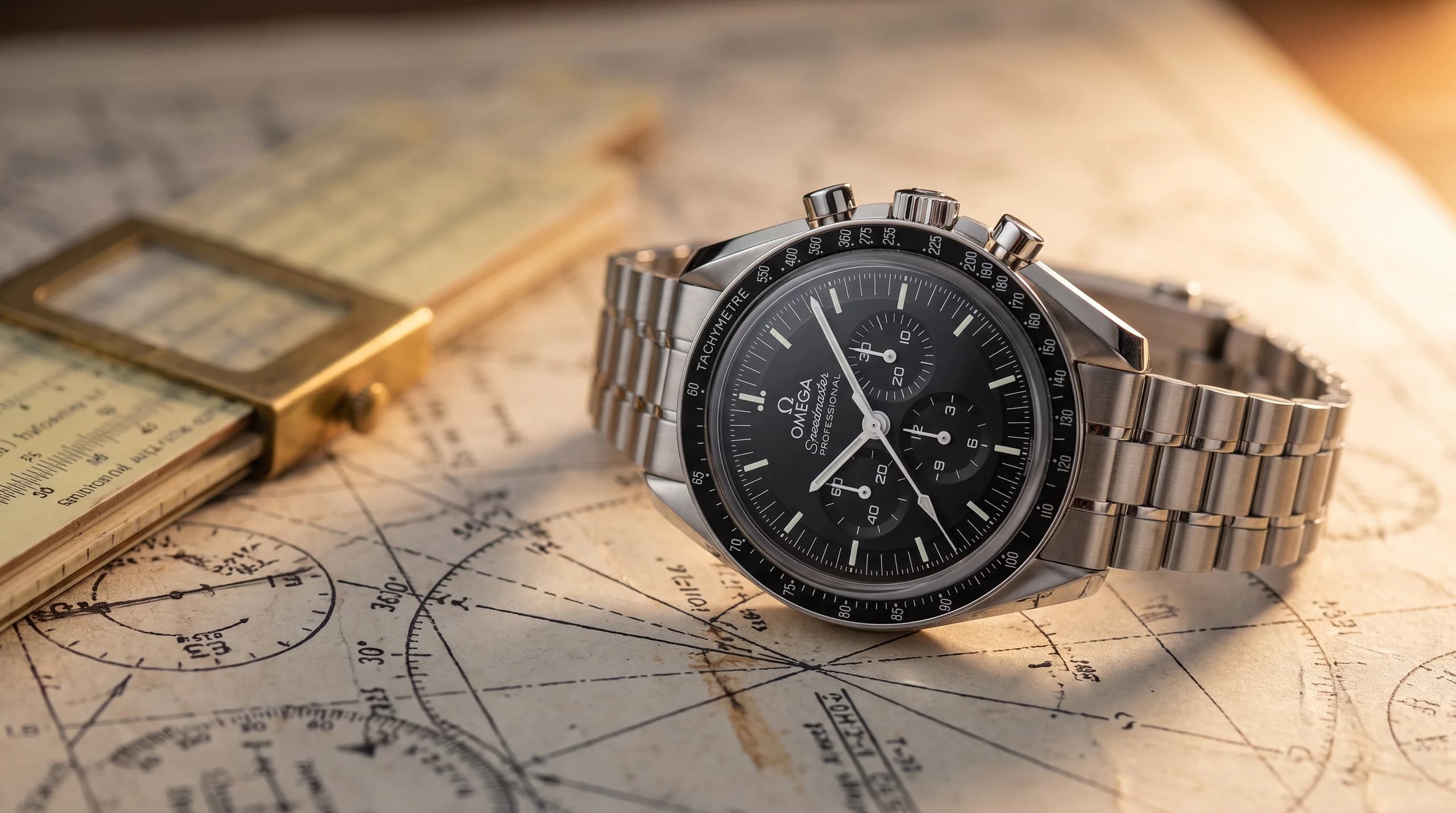
A chronograph is a watch with a built-in stopwatch. That is the whole idea in one line. Press a button to start timing, press again to stop, and a third press resets it to zero. Everything else, the extra dials, the outer scale, the two pushers on the side of the case, is just how that stopwatch is built and read. This guide explains what a chronograph is, how it works, and why it gets confused with a chronometer.
The images in this article are AI-generated for illustration. They are built from real reference photos of the actual watches discussed and are not photographs of specific inventory.
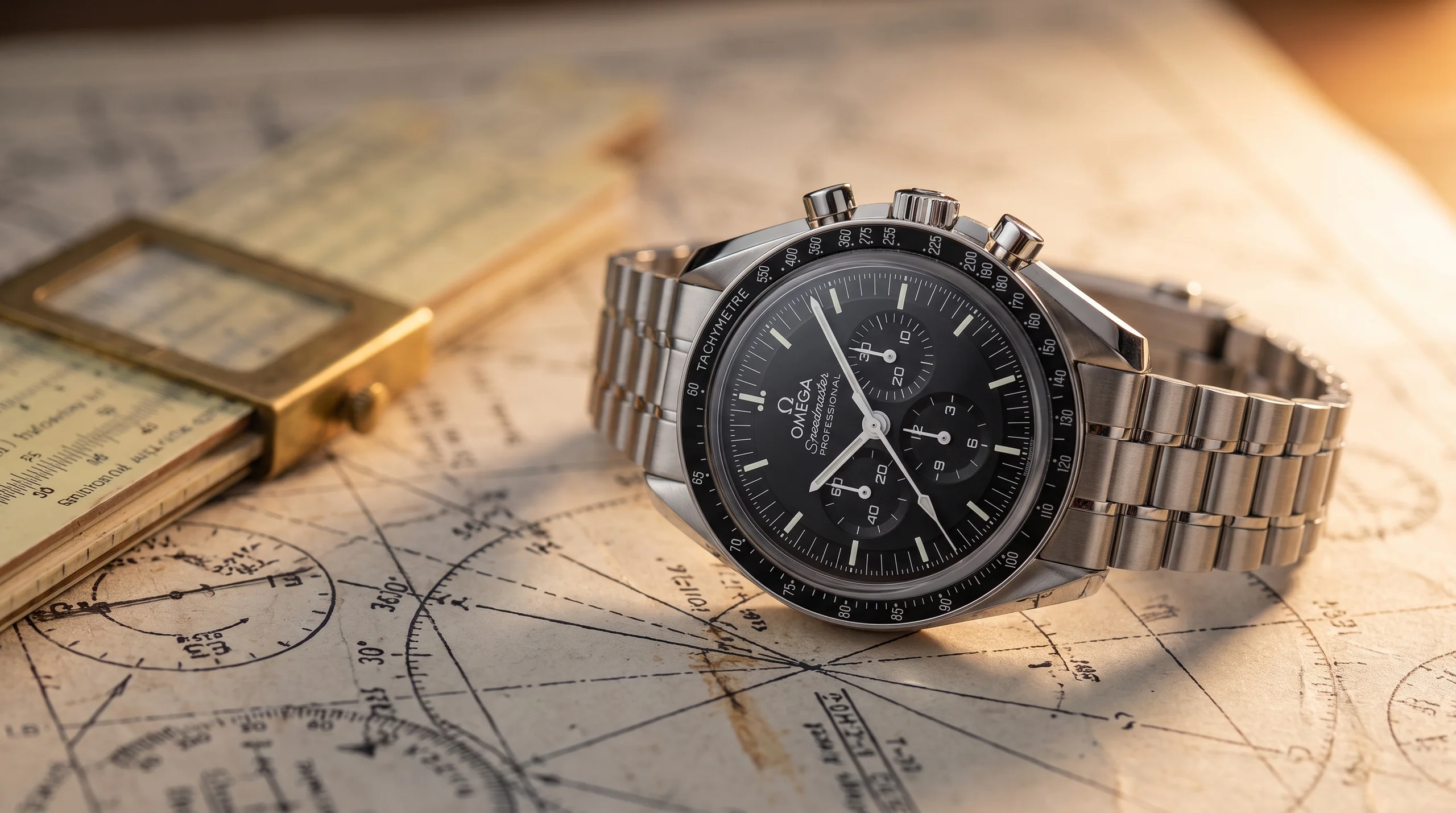 The Omega Speedmaster, the chronograph that went to the Moon and the easiest one to learn on.
The short answer
A chronograph is a stopwatch integrated into a watch. The two buttons on the side, called pushers, control it: the top one starts and stops the timing, the bottom one resets. The small dials on the face, called subdials or registers, count the elapsed minutes and hours, while a large central hand sweeps the seconds. A chronograph is about function. It is not a chronometer, which is a separate accuracy rating and a common source of confusion.
What a chronograph actually is
The word chronograph comes from the Greek for "time writer," from an early version that marked the dial with ink. Today it just means a watch that can time an event independently of the main timekeeping. Your hours and minutes keep running normally while the chronograph times a phone call, a parking meter, or a lap around a track.
That independence is the key. A regular watch tells you what time it is. A chronograph also tells you how long something took, without stopping the clock.
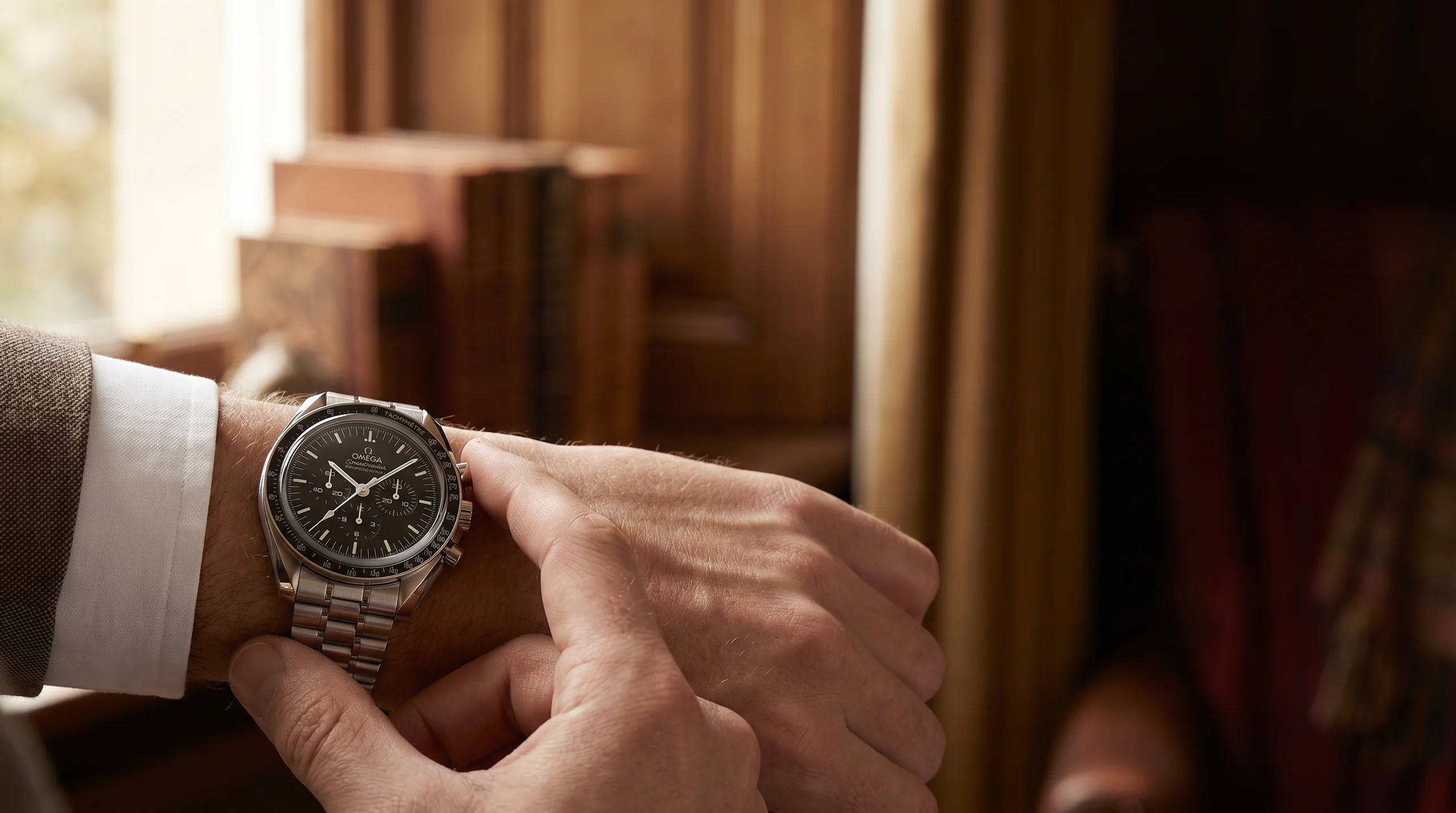 Top pusher to start and stop, bottom pusher to reset. That is the entire user manual.
How a chronograph works
Operation is simple. Press the top pusher and the central seconds hand starts sweeping. Press it again to stop and read the elapsed time. Press the bottom pusher and everything snaps back to zero.
The subdials do the counting. On most chronographs one subdial tracks elapsed minutes and another tracks elapsed hours, so you are not limited to 60 seconds. A third subdial usually shows the running seconds of the actual time, which is why it keeps ticking even when the chronograph is stopped. Learn which dial is which on your specific watch, because layouts vary.
Column wheel or cam, and why it matters
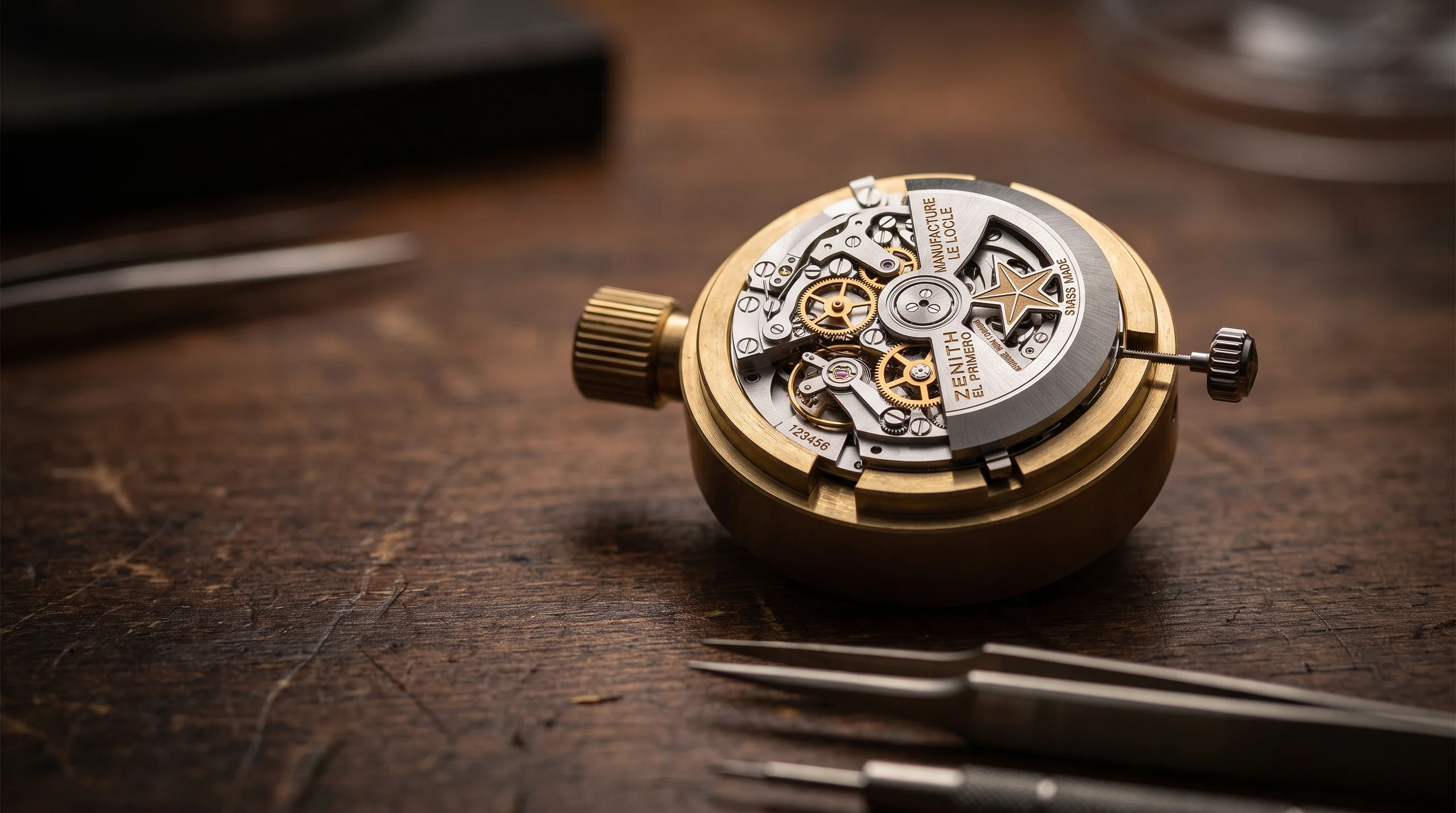 The Zenith El Primero movement. The small toothed column wheel is the traditional way to command a chronograph.
Inside, two engineering choices separate a nice chronograph from a basic one. The first is how the functions are commanded. A column wheel is the traditional, more expensive method, a small toothed wheel that gives a smooth, precise pusher feel. A cam or coulisse system does the same job more cheaply, with a slightly firmer press.
The second is how the chronograph engages the running movement. A lateral or horizontal clutch is traditional and can cause a tiny stutter of the seconds hand at start. A vertical clutch, used in the Rolex Daytona's caliber 4130 and many modern movements, engages cleanly with no jump. Neither is wrong, but the column wheel and vertical clutch combination is the mark of a serious chronograph.
For a version of this same chronograph mechanism doubled and specialized for timing two events at once, see our explainer on the rattrapante, or split-seconds chronograph.
Chronograph is not chronometer
This is the mix-up that trips up almost every newcomer. A chronograph is a function, a stopwatch. A chronometer is a certification of accuracy, awarded to a movement that passes an independent testing standard like COSC. A watch can be one, the other, both, or neither. For the full breakdown of the accuracy side, read our guide to what a chronometer is.
What the tachymeter does
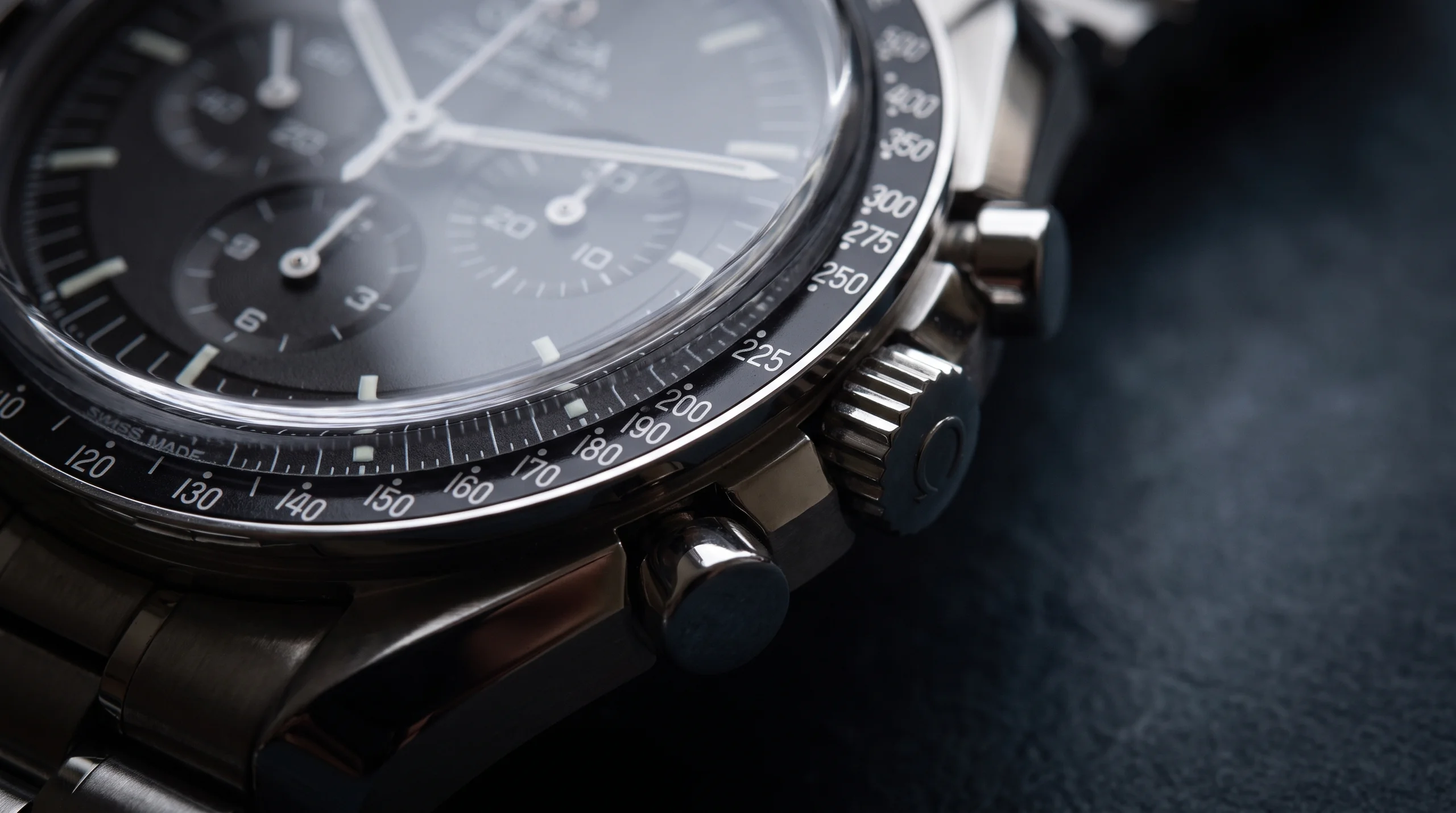 The tachymeter is the outer scale. It turns an elapsed time into a speed.
The numbers around the outer edge of many chronographs make up a tachymeter, and they measure average speed. Start the chronograph as an object passes a marker, stop it after one mile or one kilometer, and the seconds hand points at the average speed on the scale. Time a car over a measured mile and the bezel reads the miles per hour directly. It is a driver's tool from the pre-digital age, and mostly decorative now, but it is where the sporty look comes from. For the full mechanics, the math behind the scale, and its limitations, see our dedicated guide to how a tachymeter actually works.
The famous chronographs worth knowing
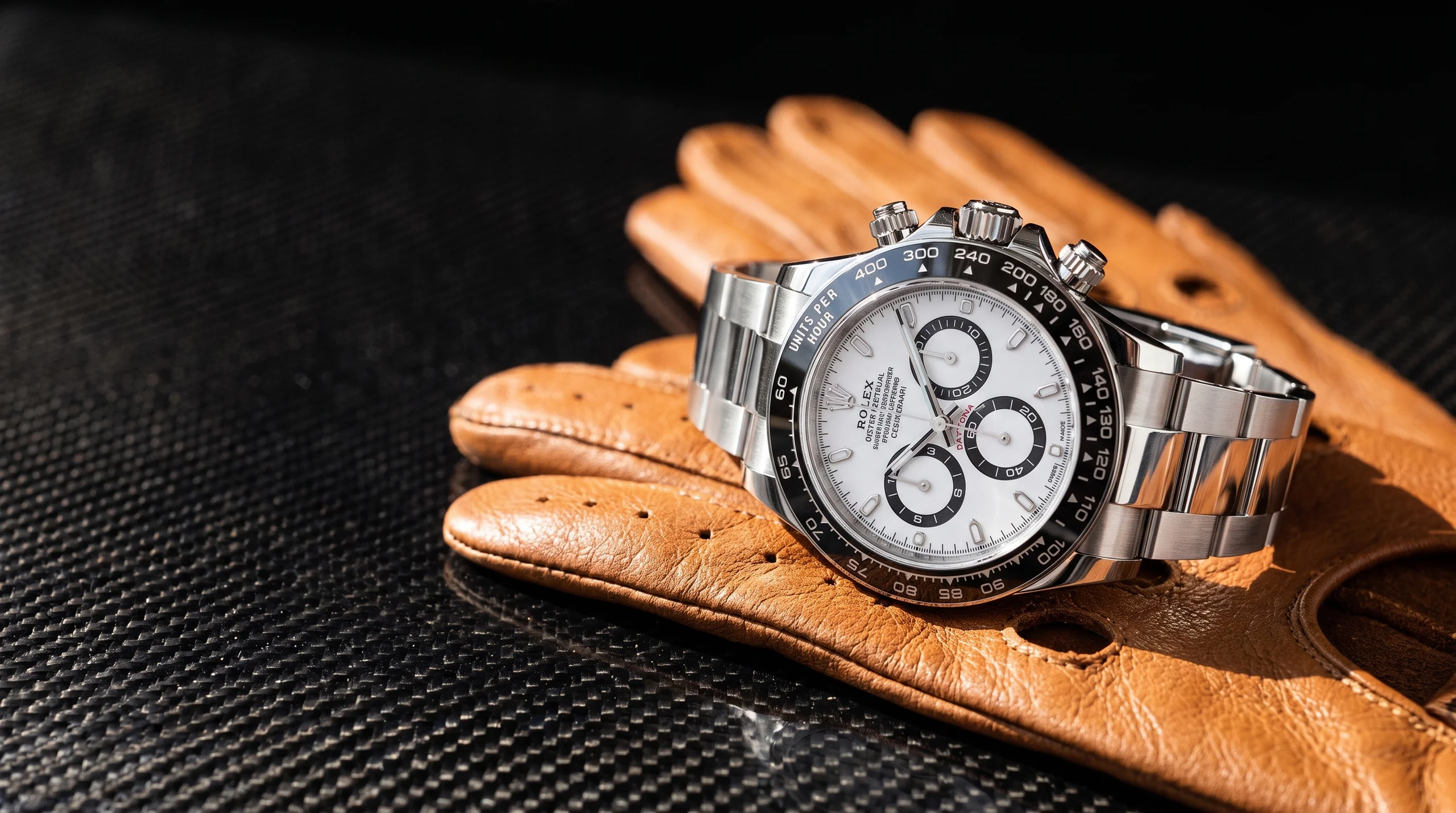 The Rolex Daytona, the chronograph most people picture first.
Three chronographs define the category. The Omega Speedmaster is the hand-wound classic that went to the Moon. The Rolex Daytona is the automatic racing icon and the hardest to buy at retail. The Zenith El Primero, launched in 1969, was one of the first automatic chronographs and ran at a fast 36,000 beats per hour, and it even powered the Daytona for years. For a head-to-head on the two most-asked-about models, see our Speedmaster vs Daytona breakdown, and for the movement that started the automatic era, our read on the Zenith El Primero.
Do you need one
A chronograph is more watch to own: more parts, a higher service cost, and a busier dial. If you will actually use the stopwatch, or you just love the look, it is worth it. If you want the cleanest possible time-only watch, a chronograph is the wrong tool. Either answer is fine, as long as you know which one you are buying. For a different complication that is pure charm rather than function, see our guide to the moonphase.
FAQ
What is a chronograph?
A chronograph is a watch with a built-in stopwatch. It can time an event independently of the main time display, using pushers to start, stop, and reset a central seconds hand, with subdials that count elapsed minutes and hours.
What is the difference between a chronograph and a chronometer?
A chronograph is a function, a stopwatch built into a watch. A chronometer is a certification of accuracy given to a movement that passes an independent standard such as COSC. They sound alike but describe completely different things, and a watch can be one, both, or neither.
How do you use a chronograph?
Press the top pusher to start the timing and press it again to stop. Read the elapsed time from the central seconds hand and the minute and hour subdials. Press the bottom pusher to reset everything to zero.
What does the tachymeter on a chronograph do?
The tachymeter is the scale around the dial or bezel that converts an elapsed time into an average speed. Start timing as an object passes a marker and stop after a measured mile or kilometer, and the seconds hand points to the speed. It is mostly decorative today.
What was the first automatic chronograph?
The first automatic chronographs arrived in 1969 in a three-way race, including the Zenith El Primero, the Seiko 6139, and the Chronomatic Caliber 11 developed jointly by Heuer, Breitling, and others. The El Primero is the most celebrated of the group for its high 36,000 beats per hour frequency.
Browse authenticated pre-owned chronographs from Omega, Rolex, and Zenith at 5dwatches.com, where every piece is inspected and authenticated before it ships.