The Short Answer
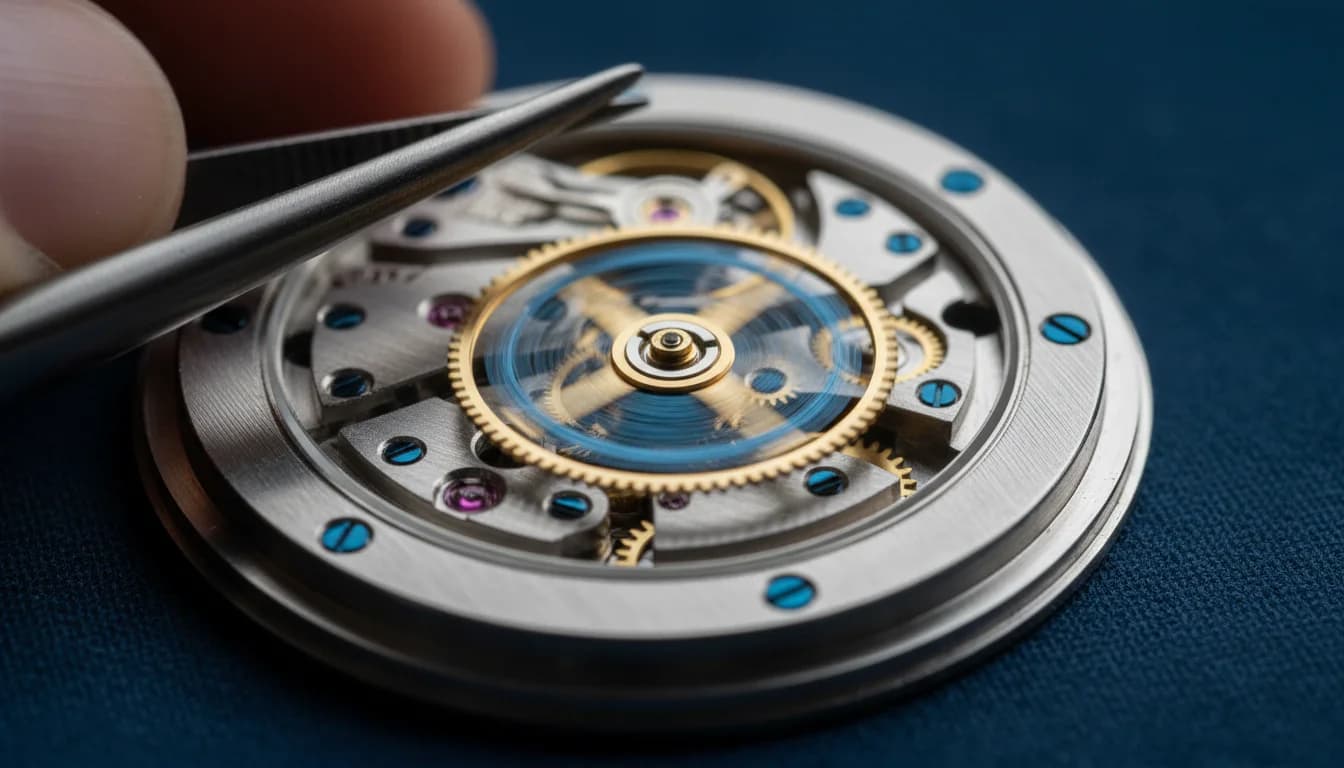
A hairspring, also called a balance spring, is the tiny coiled spring that works with the balance wheel to regulate a mechanical watch's timekeeping. It is the part that actually decides how fast or slow a watch runs, not the escapement, not the mainspring, and not the balance wheel on its own.
The balance wheel and hairspring swing back and forth together, and that swing rate, typically 21,600 to 28,800 vibrations per hour on a modern watch, sets the pace for every gear in the movement. Get the hairspring wrong and the whole watch runs wrong, no matter how well everything else is finished.
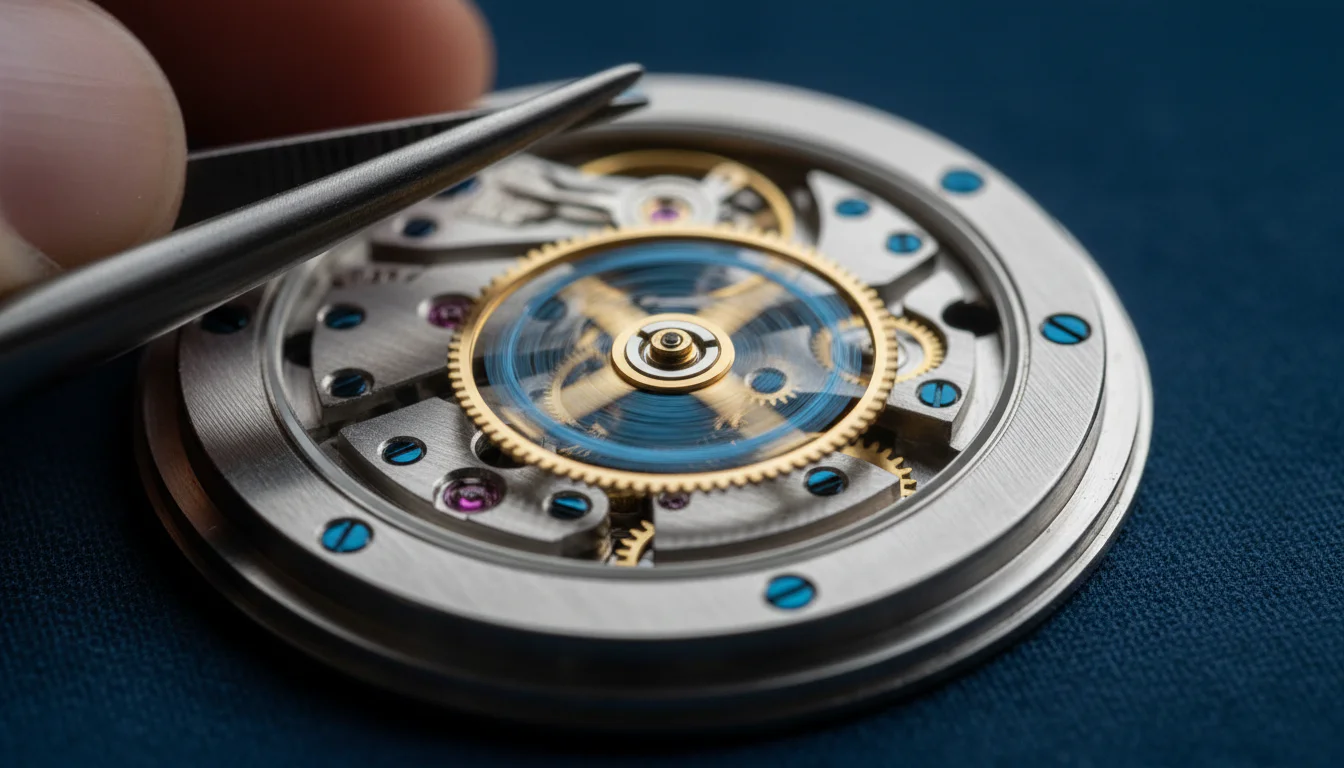 The hairspring is the fine coiled wire visible above the balance wheel, thinner than a human hair on most calibers, which gives the part its name.
The watch photos in this article were generated with AI image tools, conditioned on real reference photography so the movement layouts and case shapes are accurate to the real references.
Why This Tiny Spring Runs the Whole Watch
Every mechanical watch needs something to divide time into equal steps. The mainspring stores energy. The escapement releases that energy in small bursts. But neither one decides how long each burst lasts. That job belongs entirely to the balance wheel and hairspring, working together as what watchmakers call the regulating organ.
The hairspring coils and uncoils as the balance wheel rotates, acting like a tiny return spring that always pulls the wheel back toward center. That back-and-forth motion, called oscillation, happens at a fixed rate determined by the spring's elasticity, its length, and the balance wheel's weight distribution. Change any of those three and the watch speeds up or slows down.
How a Watchmaker Actually Adjusts It
Regulating a watch means fine-tuning the hairspring's effective length, since a shorter active length speeds up the oscillation and a longer one slows it down. On many movements this happens through a regulator lever that lightly pinches the spring; on higher-end calibers, weighted screws on the balance wheel rim do the same job with more precision.
The 350-Year-Old Argument Over Who Invented It
The hairspring's invention is one of horology's oldest disputes. Around 1657, both English scientist Robert Hooke and Dutch physicist Christiaan Huygens worked on applying a coiled spring to regulate a balance wheel. Most historians credit Huygens with building the first actual working watch using the idea, with his instrument maker Isaac Thuret constructing it.
The result was not a small improvement. Pocket watches before the hairspring lost or gained several hours a day. After it, accuracy jumped to roughly 10 minutes a day, an enormous leap for 17th century mechanics.
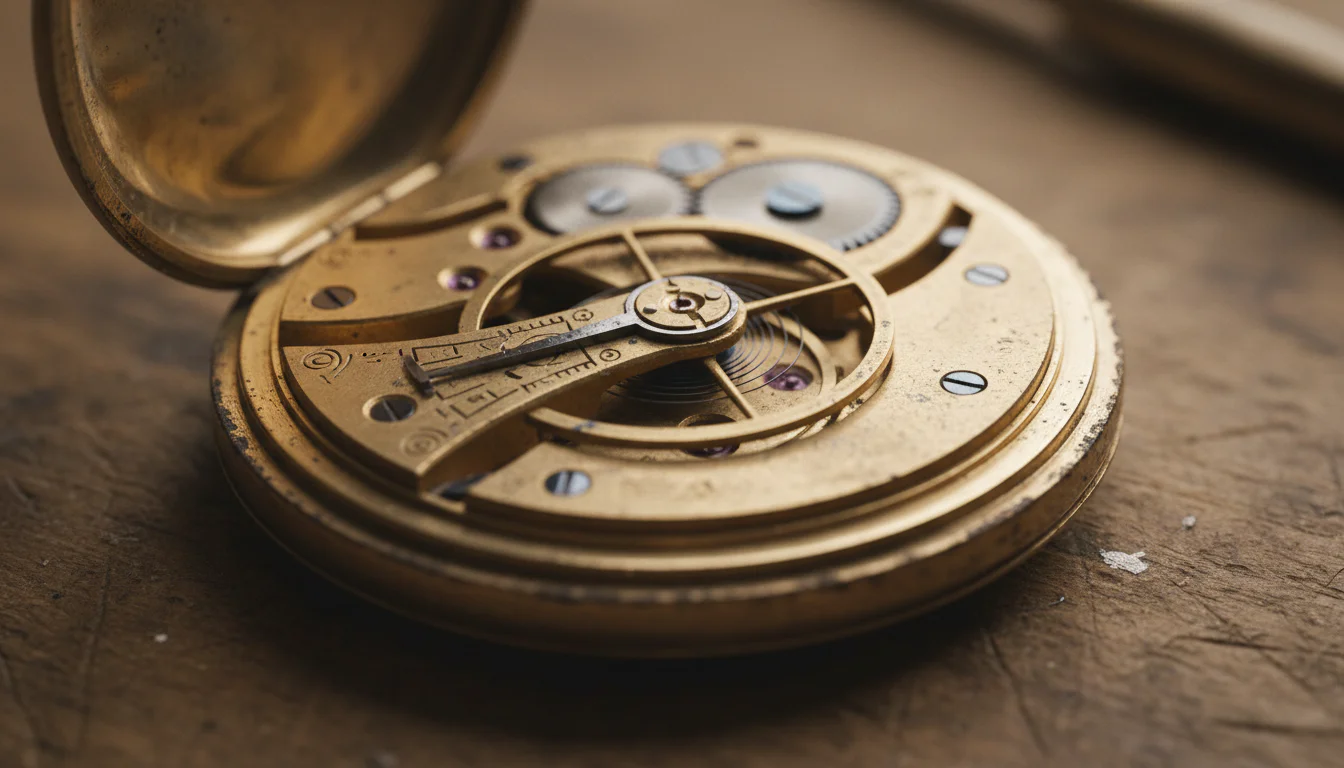 Early hairsprings were flat coils of hardened steel, a material that solved the oscillation problem but introduced a new one: performance that changed with the mainspring's remaining power.
The Isochronism Problem
A good hairspring is supposed to be isochronous, meaning the balance wheel takes the same amount of time to complete a swing whether that swing is wide or narrow. In practice, a flat coiled spring does not behave that way. As the mainspring unwinds and delivers less force, the balance's swing narrows, and a flat hairspring's rate drifts along with it.
Breguet's Fix, Still Used Today
Abraham-Louis Breguet solved the isochronism problem in the early 1800s with what is now called the Breguet overcoil: bending the outermost coil of the hairspring up and inward, in a different plane from the rest of the spring, so it breathes symmetrically around the balance's center of gravity.
Two versions exist: the gradual overcoil, bent in a smooth curve, and the more difficult Z-bend, prized by collectors for its cleaner geometry. Many modern movements use a simpler sharp-angle version called a dogleg, which is easier to manufacture but does the same job.
Modern Alloys Took Over From Steel
Plain steel hairsprings rust, weaken over time, and change stiffness with temperature. In 1900, Swiss physicist Charles Édouard Guillaume invented Elinvar, a nickel-steel alloy whose elasticity barely shifts with temperature, a discovery that won him the Nobel Prize in Physics in 1920. Nivarox, developed later from the same family of alloys, became the industry-standard hairspring material for most of the 20th century and is still used across the majority of Swiss watches made today.
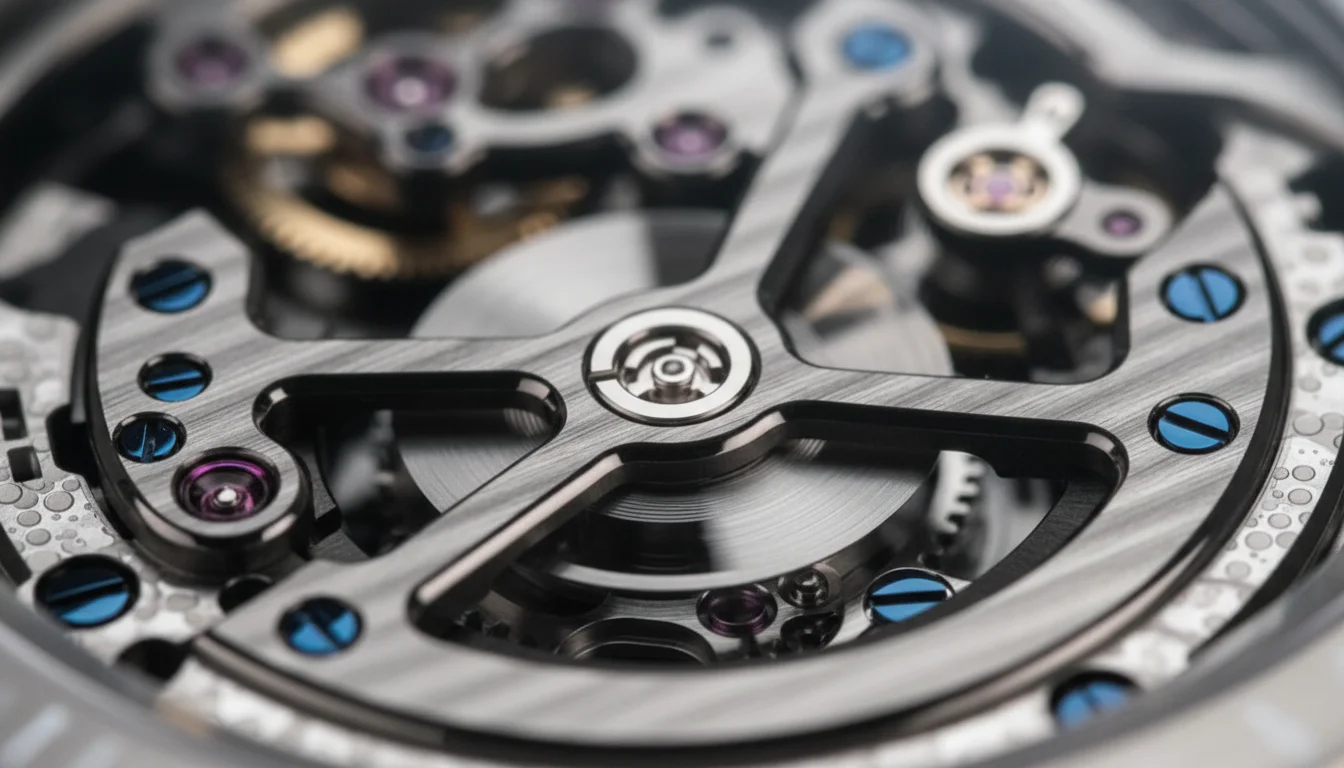 A finely finished modern balance wheel and bridge, the kind of hand-decorated regulating organ that still runs on a Nivarox-family hairspring in the large majority of Swiss watches made today.
The Silicon Shift, and What It Actually Fixes
Since the early 2000s, brands including Patek Philippe, Rolex, Omega, and Ulysse Nardin have introduced silicon hairsprings, etched rather than coiled, under names like Spiromax, Syloxi, and Si14. Silicon solves the one weakness Nivarox never fully escaped: magnetism.
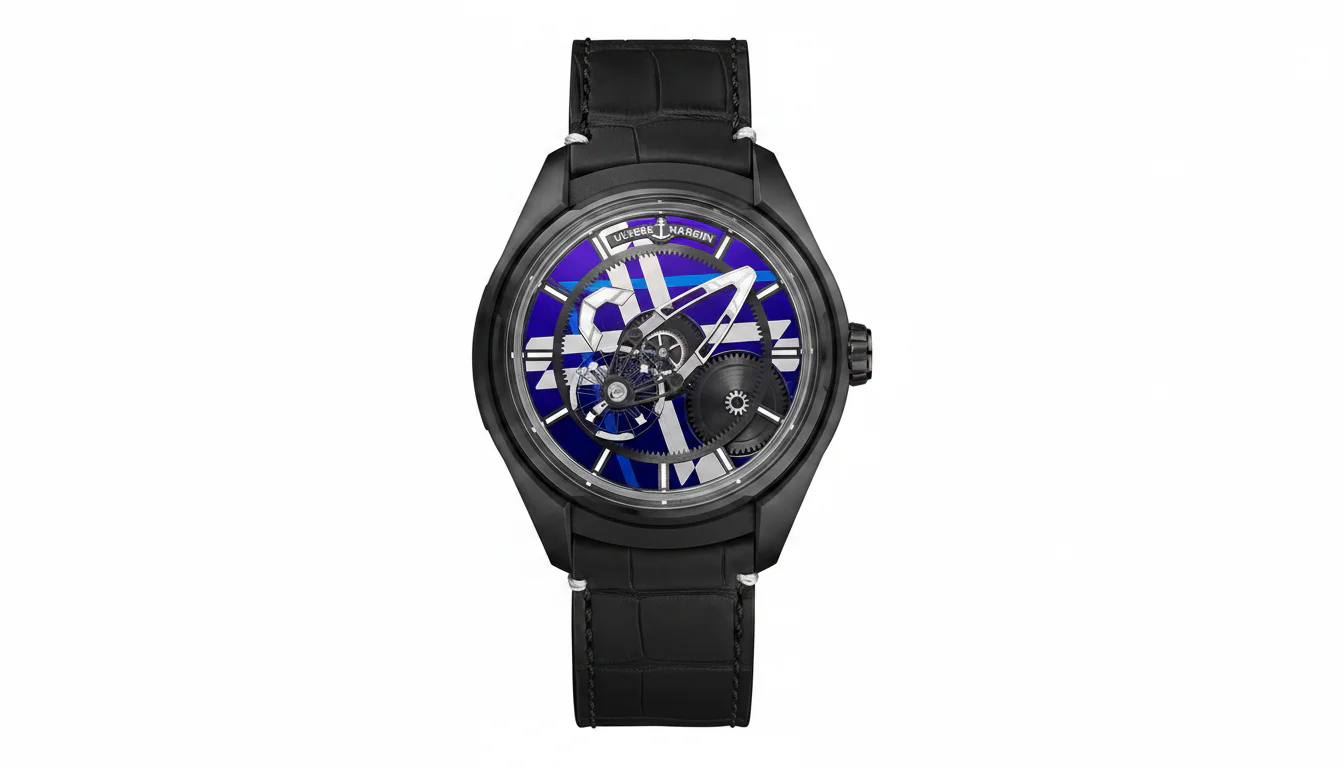 The Ulysse Nardin Freak became the first production watch to use a silicon escapement in 2001, opening the door to the silicon hairsprings now used across the industry.
A metal hairspring exposed to a strong enough magnetic field, a phone case magnet, a laptop speaker, a designer handbag clasp, can have its coils stick together and gain time dramatically, sometimes minutes a day, with no visible damage. Silicon is completely non-magnetic, needs no lubrication, and resists temperature swings better than Nivarox.
The Honest Trade-Off
Silicon is also more brittle than metal. A metal hairspring can survive an impact by bending and, depending on severity, being straightened back into shape by a watchmaker. A silicon hairspring under the same shock is more likely to shatter outright, which usually means replacing the entire balance assembly rather than a repair. Neither material is strictly better. Silicon trades impact resilience for magnetic immunity, and a buyer choosing between a modern silicon-equipped watch and an older Nivarox one is really choosing which failure mode they would rather risk.
What This Means When You Are Buying Pre-Owned
A watch that has gained significant time with no obvious mechanical fault is one of the most common signs of magnetization, and it is also one of the cheapest fixes a watchmaker can perform: demagnetizing takes minutes and costs a fraction of a full service. It is worth asking about before assuming a watch needs deeper work.
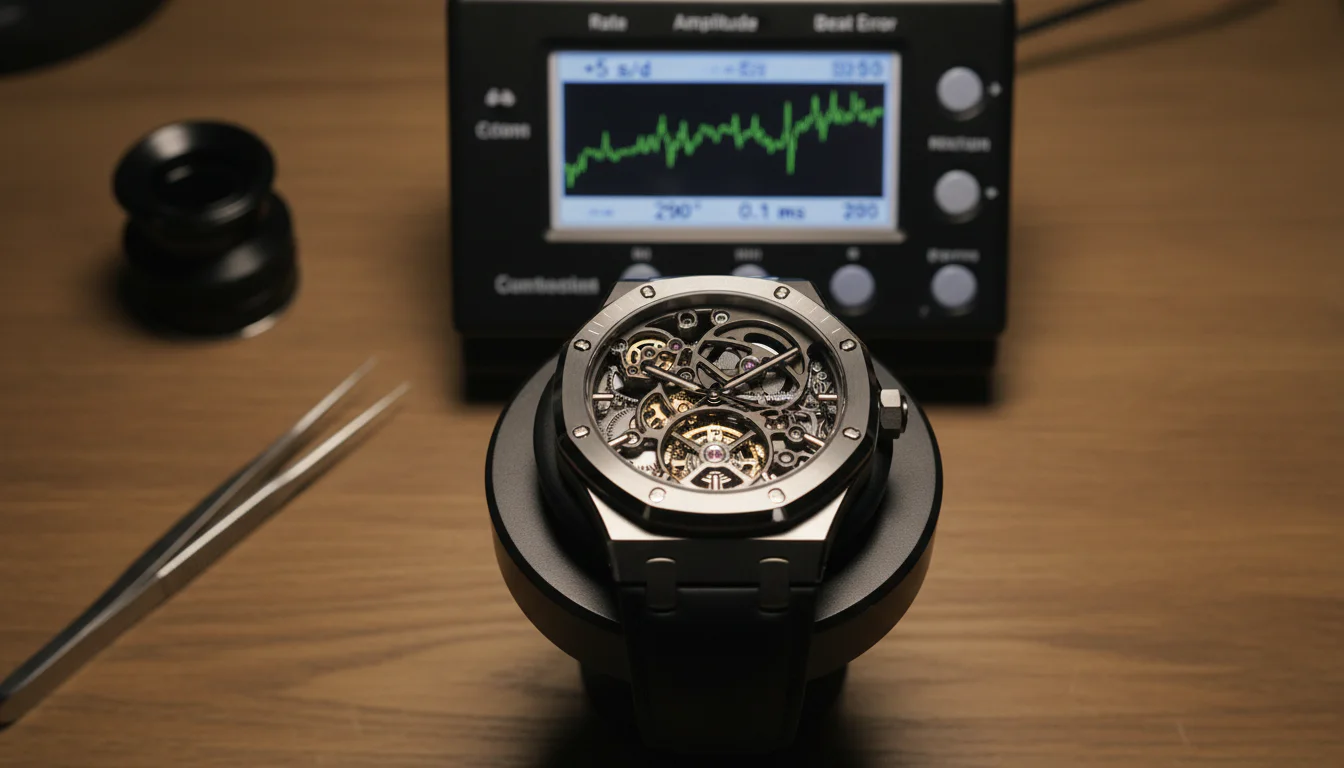 A timing machine reads the watch's actual rate in seconds per day, the first thing a watchmaker checks before deciding whether a hairspring problem is a quick fix or a real repair.
What Actually Requires a Specialist
A visibly bent, kinked, or coil-stuck hairspring, on the other hand, is a real repair, not a quick fix. On vintage pieces using now-obsolete calibers, sourcing a replacement hairspring can take a specialist watchmaker considerably longer than servicing a modern in-house movement with parts still in production.
FAQ
What is a hairspring in a watch?
A hairspring, or balance spring, is the fine coiled spring that works with the balance wheel to regulate a mechanical watch's rate. It is the part that actually determines how fast or slow the watch runs.
Who invented the hairspring?
Robert Hooke and Christiaan Huygens both worked on the concept around 1657, with most historians crediting Huygens and his instrument maker Isaac Thuret with building the first working watch to use it.
What is a Breguet overcoil?
A Breguet overcoil bends the outermost coil of a hairspring into a different plane, letting the spring expand and contract symmetrically so the watch keeps a more consistent rate regardless of the mainspring's remaining power.
Are silicon hairsprings better than traditional metal ones?
Silicon hairsprings are immune to magnetism and need no lubrication, which traditional Nivarox alloy springs cannot claim. But silicon is more brittle and can shatter under an impact that a metal hairspring would simply bend and survive.
Can a magnetized watch be fixed?
Yes, usually easily. Demagnetizing a watch with a metal hairspring takes a watchmaker only minutes and costs far less than a full service. A visibly damaged or broken hairspring is a more involved repair.
Related Reading
- What Is an Escapement? The Beating Heart of a Watch, Explained
- What Is a Chronometer? COSC Certification and the New 2026 Standard, Explained
- The Watch Accuracy Race: How Accurate Does a Watch Actually Need to Be?
- Twenty-Five Years of the Ulysse Nardin Freak: No Crown, No Hands, and the Silicon That Changed Everything