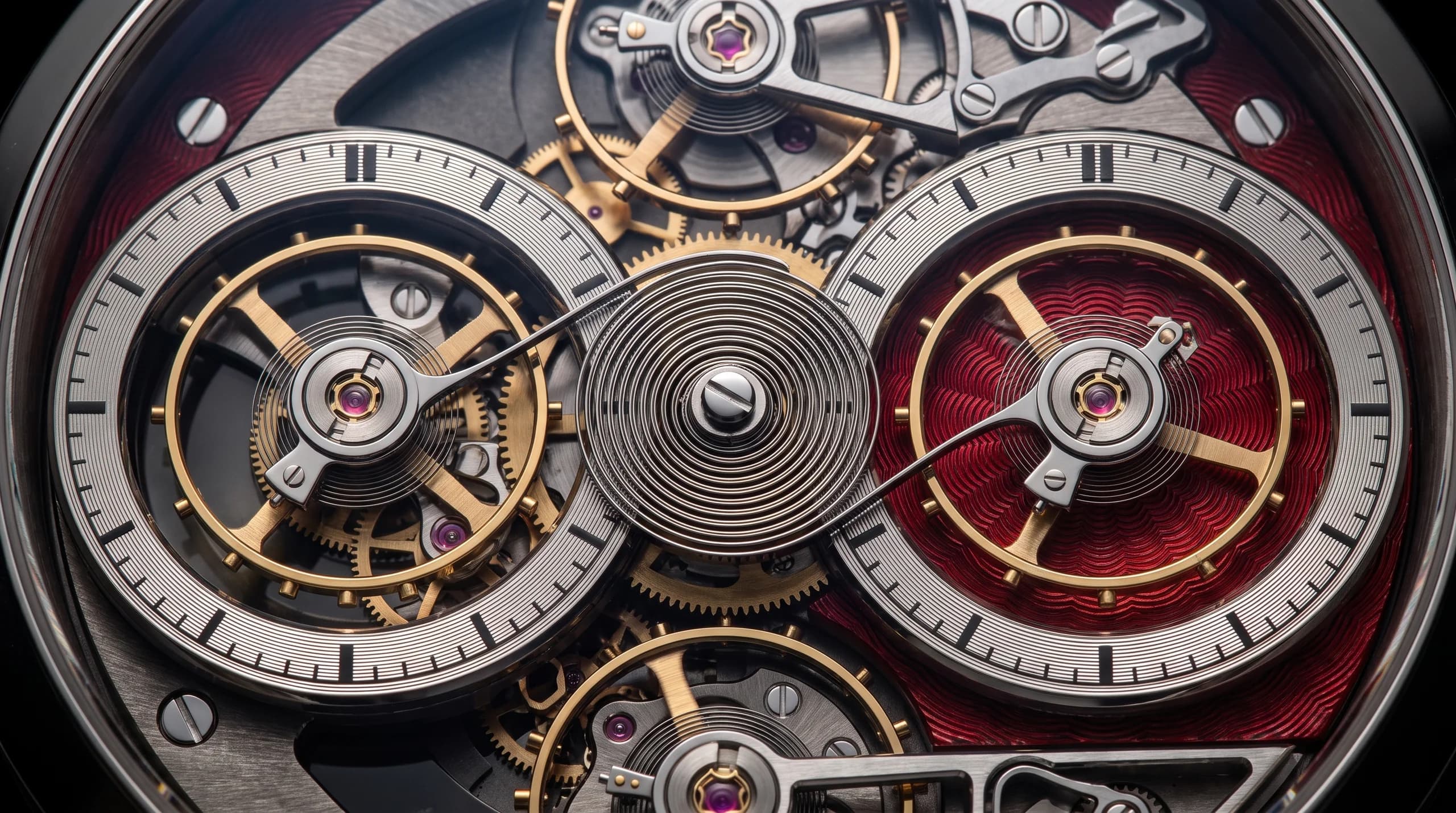
The Short Answer
A resonance watch runs two completely separate movements side by side in one case, each with its own balance wheel and escapement, placed close enough together that they synchronize with each other through a physical effect called mechanical resonance. F.P. Journe built the first production example of this in 1999, but the underlying physics dates back to 18th-century pendulum clockmaking, not to Journe himself.
The point of the whole exercise is accuracy. Two oscillators that lock into sync tend to average out small timing errors between them, in theory producing a more stable rate than either one running alone.
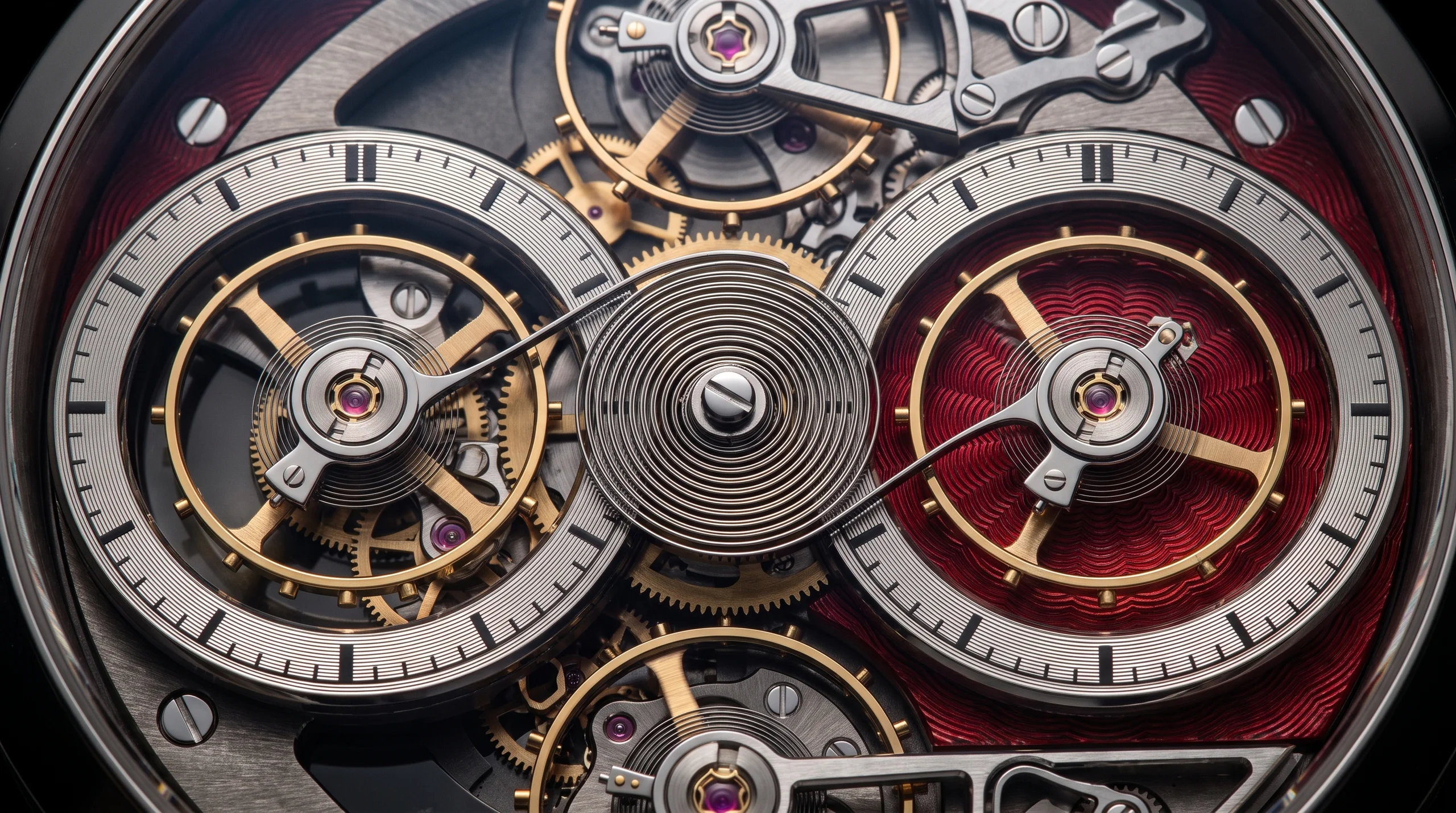 Not every resonance watch hides the coupling. Armin Strom's Mirrored Force Resonance puts a visible clutch spring linking its two balance wheels right on the dial.
The watch and movement photos in this article were generated with AI image tools, conditioned on real reference photography so the mechanical layout is accurate to the real thing.
Where the Idea Actually Comes From
Resonance as a horological concept predates the wristwatch by more than a century. Clockmaker Antide Janvier built resonance clocks in the late 1700s, and Abraham-Louis Breguet experimented with the same principle not long after, both working with pendulum clocks rather than portable watches.
That transmission happens through the air and through whatever solid structure connects the two oscillators, not through any electronic or magnetic link. It is a purely mechanical coupling.
Why It Took Until 1999 to Reach a Wristwatch
Fitting two full, independent movements into a case small enough to wear on a wrist, and getting their balance wheels close enough together for resonance to actually occur, is a genuinely hard engineering problem. Francois-Paul Journe solved it for his Chronometre a Resonance, released in 1999, becoming the first to bring the effect into a production wristwatch.
How Two Balance Wheels Actually Sync Up
Every mechanical balance wheel has a natural oscillation rate, set by its weight and the strength of its hairspring. Two balance wheels built to nearly identical specifications will oscillate at very close to the same rate on their own.
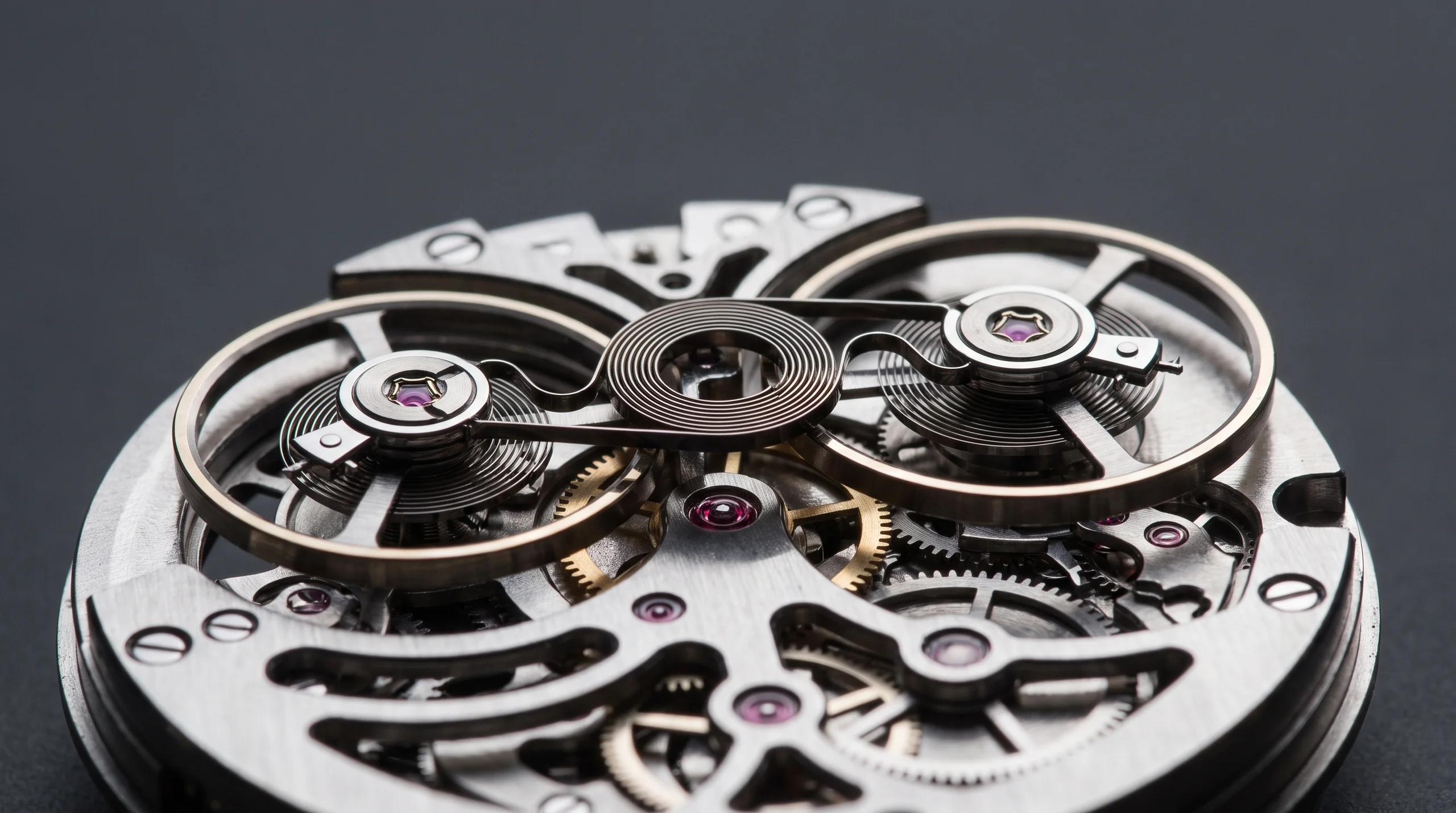 Armin Strom's patented clutch spring is a rare case of the coupling mechanism itself being visible and photographable, rather than happening invisibly through the movement plate.
Most resonance movements, including F.P. Journe's, rely purely on vibration transmitted through the shared movement plate, with no physical link between the two balance wheels at all. Armin Strom's design is the exception: a small coiled spring physically connects the two balance wheels, forcing the coupling rather than leaving it to structural vibration alone.
What Phase Locking Actually Buys You
Once two balance wheels lock into the same rate, a disturbance that speeds up or slows down one of them, a knock, a temperature shift, a change in position on the wrist, tends to get partially corrected as the pair pulls back toward sync. In principle this averages out small errors that would otherwise show up as one balance wheel's own timekeeping drift.
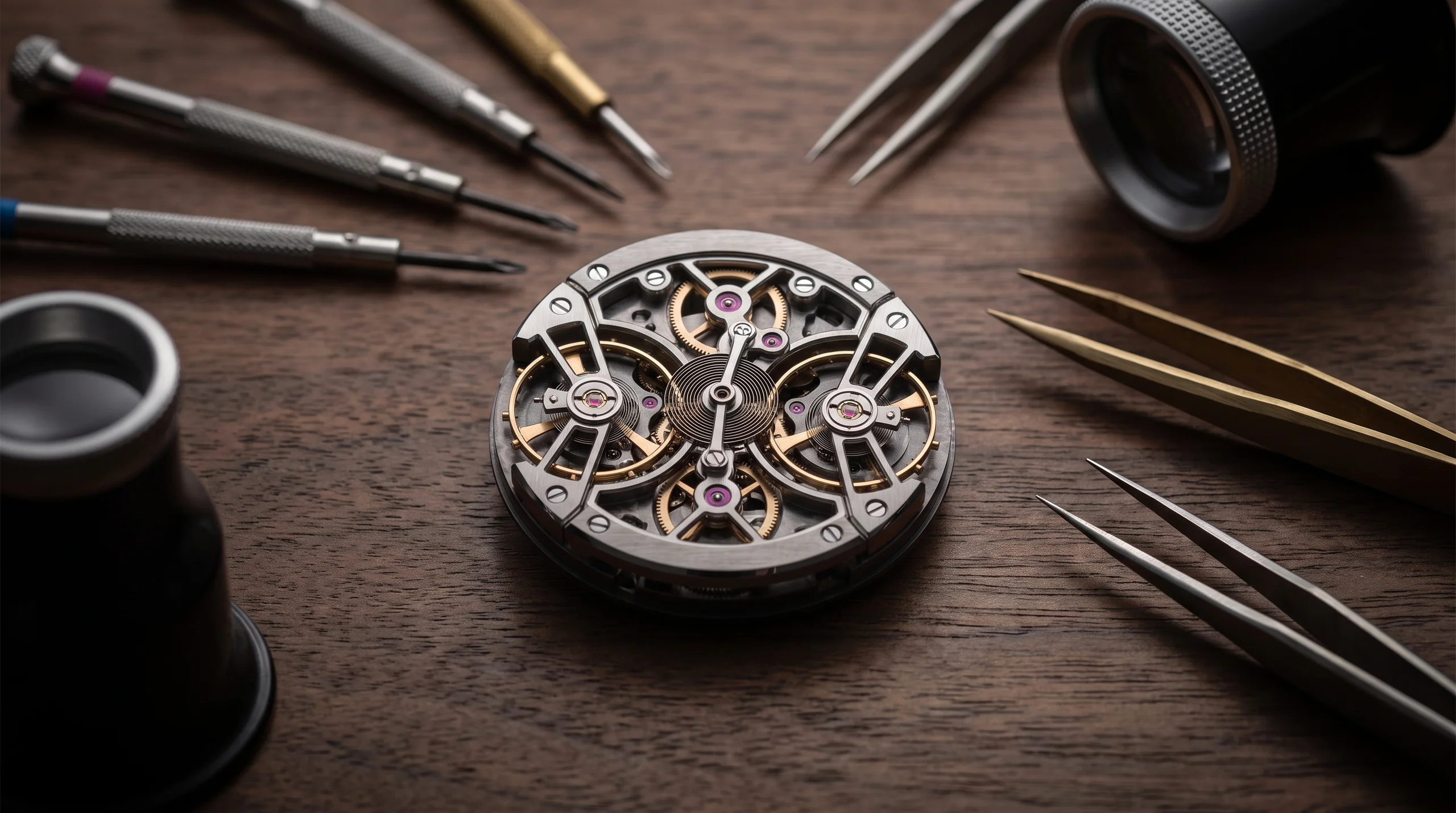 Regulating a resonance movement means tuning two separate escapements close enough in rate that synchronization can occur at all, a more demanding bench job than regulating a single balance wheel.
Resonance Is Not the Same as a Tourbillon
Both mechanisms exist to fight small timekeeping errors, but they attack different problems. A tourbillon rotates a single escapement continuously to average out position-based errors from gravity. A resonance movement uses two separate escapements influencing each other to average out a wider range of disturbances, at the cost of needing an entire second movement rather than one added rotating cage.
Does It Actually Improve Accuracy in Practice
Independent testing of resonance watches has shown modest, real improvements in rate stability compared to a single balance wheel of similar quality, though the effect is smaller and harder to isolate than manufacturers sometimes imply in marketing copy. It is a genuine physical phenomenon, not a myth, but it is not a dramatic one either.
 Verifying that a resonance effect is actually happening, rather than just two balance wheels running independently at a similar rate, requires the same kind of timing equipment used to regulate any high-end movement.
Who Else Builds Resonance Watches
F.P. Journe remains the name most associated with wristwatch resonance, and its design relies purely on structural vibration with no direct link between the balance wheels. Armin Strom takes the opposite approach with a patented Resonance Clutch Spring that mechanically links the two balance wheels directly, a more overt and more directly coupled version of the same underlying idea.
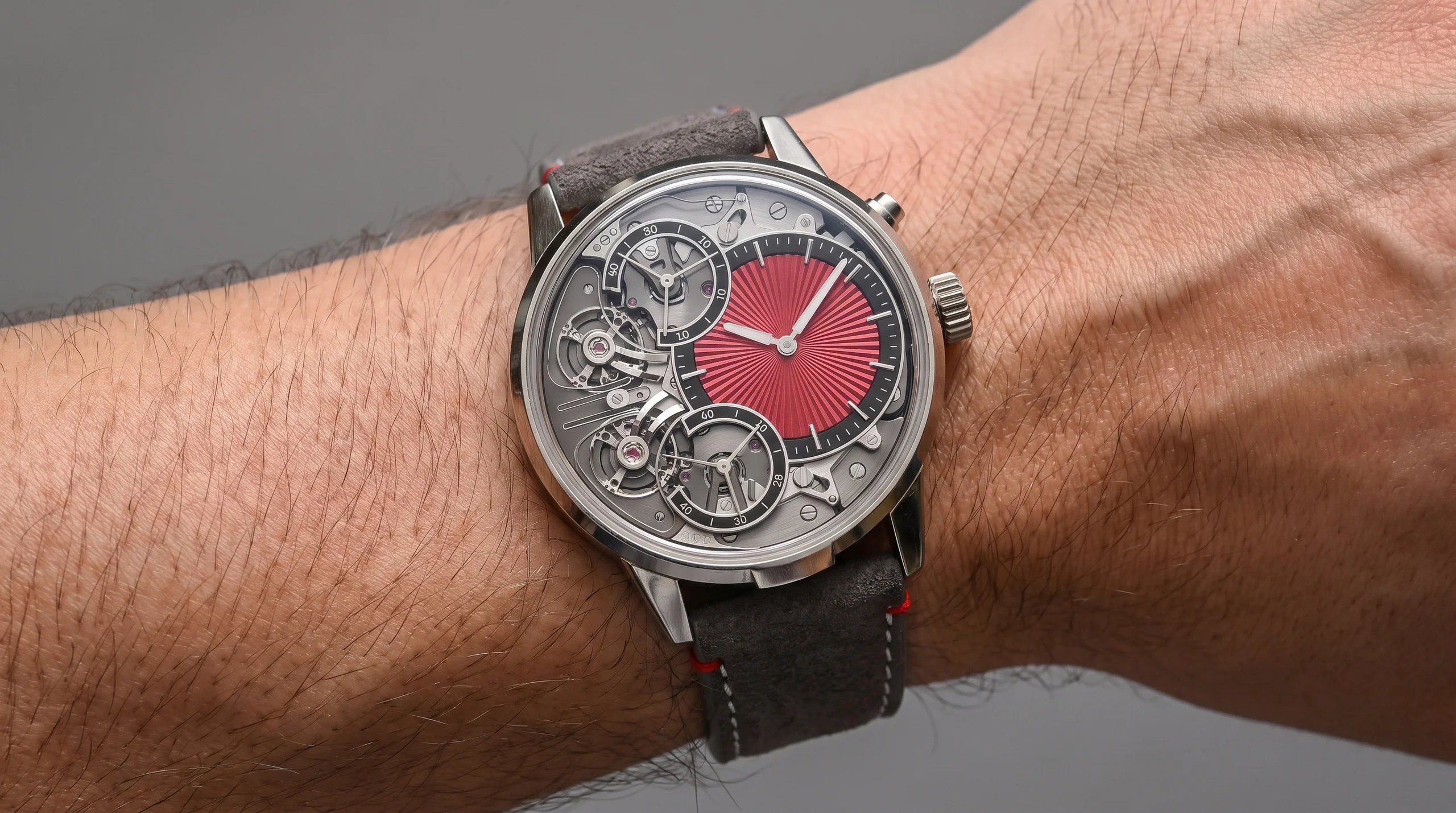 Armin Strom's skeletonized construction puts the whole resonance mechanism, both balance wheels and the clutch spring between them, on open display rather than hiding it behind a solid dial.
The Honest Trade-Off
A resonance watch costs more to build than an equivalent single-movement watch, in some cases dramatically more, because it requires two complete escapements, two mainsprings, and precise tuning to get both oscillators close enough in rate for resonance to occur at all. The accuracy benefit is real but modest. Most buyers are paying for the mechanical achievement itself, not for a wristwatch that will meaningfully out-time a well-regulated single-balance chronometer.
FAQ
What is a resonance watch?
A resonance watch contains two separate, independent movements in one case, each with its own balance wheel and escapement, positioned close enough together that they synchronize with each other through mechanical vibration.
Does a resonance watch actually keep better time?
Testing shows a modest, genuine improvement in rate stability from the resonance effect, though it is smaller than marketing language sometimes suggests. It is a real phenomenon, not a dramatic one.
Who invented the resonance wristwatch?
Francois-Paul Journe brought resonance into a production wristwatch for the first time with the F.P. Journe Chronometre a Resonance in 1999. The underlying physical principle dates back to 18th-century pendulum clockmakers like Antide Janvier.
What is the difference between a resonance watch and a tourbillon?
A tourbillon rotates a single escapement to average out position-based errors from gravity. A resonance watch uses two separate escapements that influence each other through vibration, addressing a broader range of small timing disturbances.
Does Armin Strom build resonance watches the same way as F.P. Journe?
No. Armin Strom uses a patented clutch spring to mechanically link its two balance wheels directly, while F.P. Journe's design relies on vibration transmitted through the shared movement structure without a direct physical link between the two oscillators.