Most Watches and Wonders coverage stops at the press release.
The harder question is what the pre-owned market actually did in the 30 days after the show.
The 2026 fair closed roughly four weeks ago. Rolex's biggest catalog shake-up since the five-digit Submariner retirement landed across three discontinuations and one full ground-up redesign. The secondary market has had a month to react, and the price movement reveals more about where Rolex is headed than any of the official press releases did.
This is the working dealer's read on three specific moves the market made in the 30 days after April 14, 2026, what each one signals, and where the smart pre-owned buy positions are now that the dust has started to settle.
All images in this post are AI-generated and may not perfectly represent the actual watch references discussed. They are intended for illustration only.
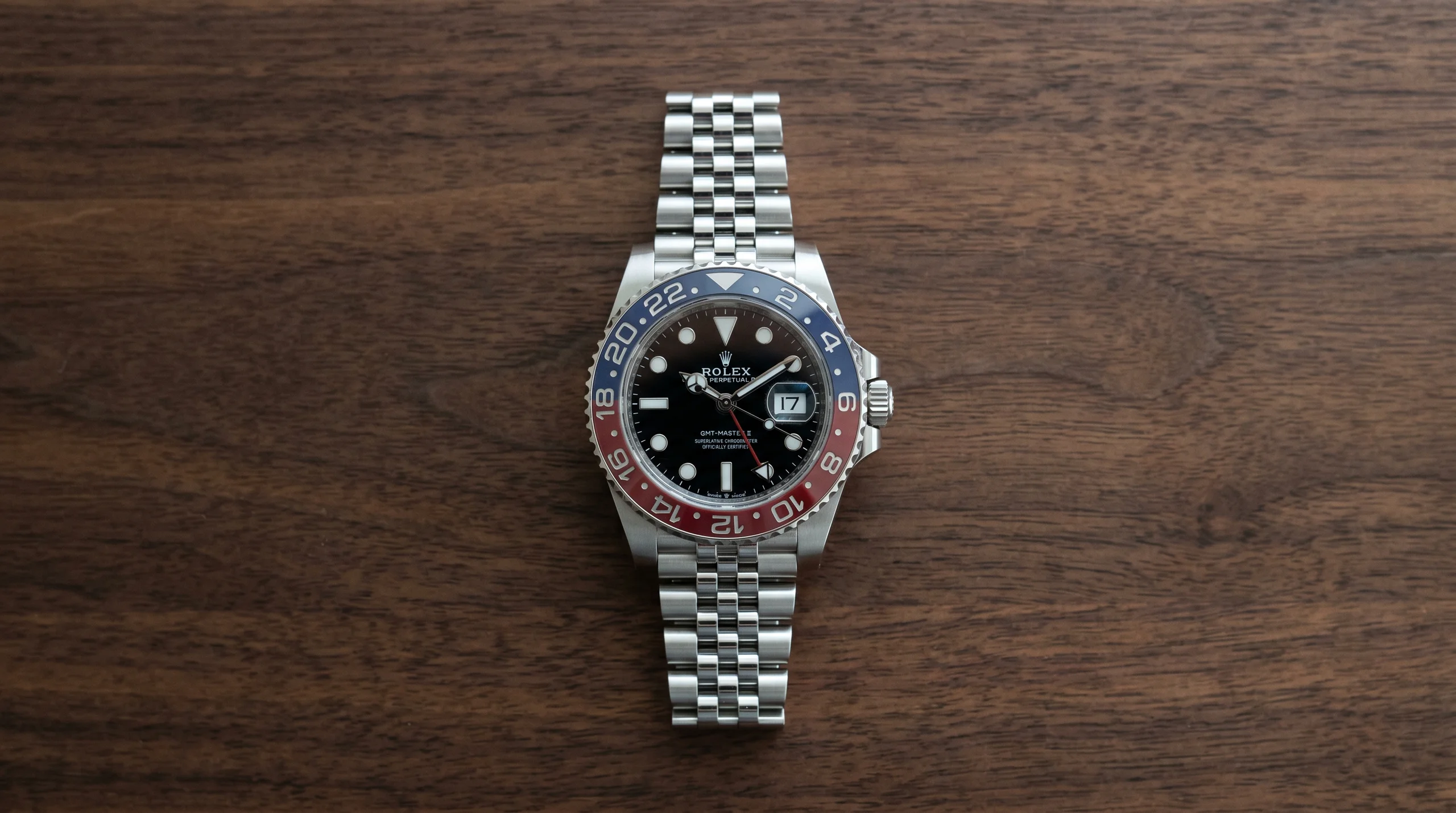
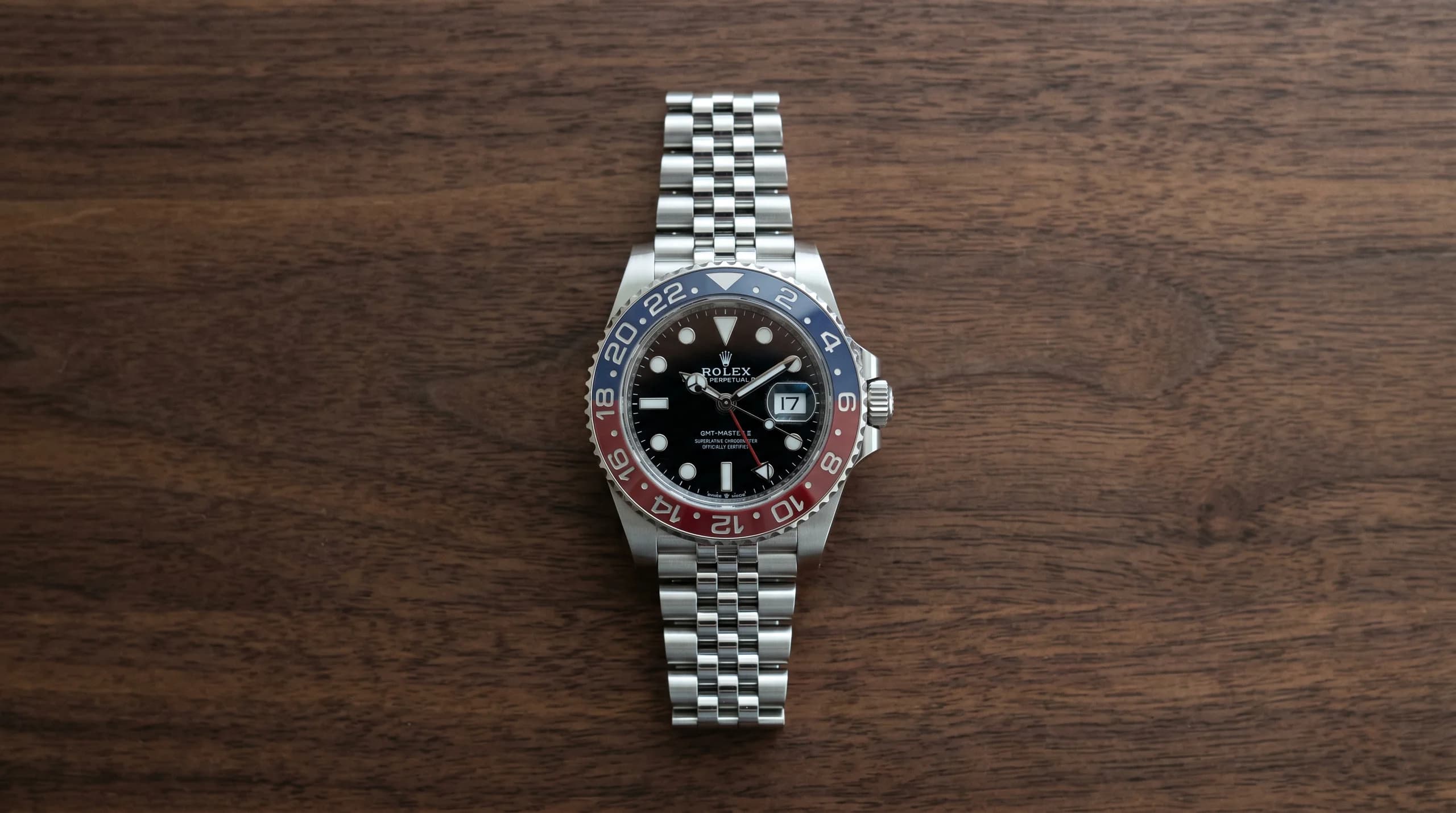
The discontinued Rolex GMT-Master II Pepsi reference 126710BLRO. The red and blue Cerachrom bezel that defined the modern travel watch is now a closed chapter in the Rolex catalog, and the secondary market repriced the reference inside 48 hours of the W&W 2026 confirmation.
The short answer
In the 30 days following Watches and Wonders 2026, three Rolex sport references made significant secondary market moves. The Pepsi GMT-Master II 126710BLRO spiked from a pre-show median of roughly $25,000 to current asking prices of $30,000-$40,000 on the back of confirmed discontinuation with no Coke replacement, with 2026-dated unworn examples leading the surge. The Cookie Monster Submariner 126619LB climbed roughly 8 percent to an average of $42,000, the first time the white gold reference has traded above its long-term band of $33,000-$45,000 since launch. The original Yacht-Master II 116680 showed the opposite effect: instead of rising on its 2024 discontinuation, it has continued to soften under the gravitational pull of the new 126680 redesign at $20,300 retail. This is the "redesign compression" anomaly, and it is the most overlooked market signal of the post-W&W cycle. The counter-positioning move for buyers right now is not to chase the just-discontinued references at peak-emotion pricing. It is to look at the current production references that Rolex did not touch at W&W, which are quietly absorbing the demand displaced from the discontinued pieces.
Movement One: The Pepsi GMT Confirmed Its Trajectory
Rolex pulled the GMT-Master II Pepsi reference 126710BLRO from the catalog on April 14, 2026, alongside the white gold 126719BLRO sibling reference. No Coke replacement was announced. For the first time in the Cerachrom ceramic era, the steel GMT-Master II lineup contains no red bezel at all.
The market moved within hours.
Robb Report's post-show coverage quotes WatchGuys CEO Robertino Altieri describing how steel Pepsi prices "surged past $30,000, with unworn examples pushing above $40,000" within days of the catalog removal. The pre-show median was roughly $25,000 against a retail price of $11,800, which had already represented a 100 percent premium for most of the reference's 2018-2026 production run.
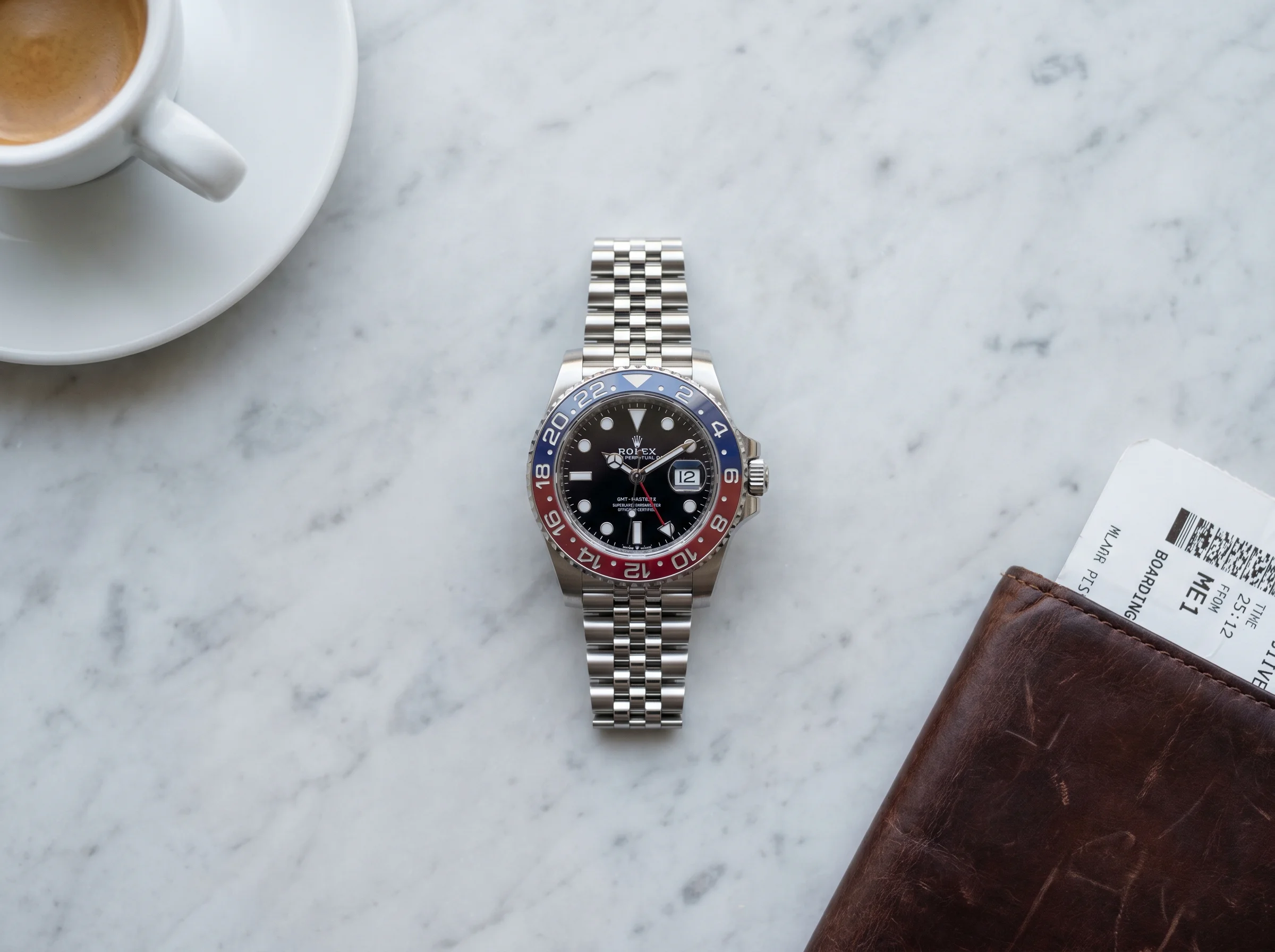
The Pepsi GMT in its natural context. Eight years of production, multi-year authorized dealer waitlists, and a sustained 100 percent secondary market premium against retail. The April 14 confirmation removed the remaining uncertainty discount.
The interesting data is the 12-month lead-in. WatchCharts shows the 126710BLRO was already up 19.2 percent over the trailing year before the official discontinuation, outpacing the Rolex Market Index by more than 12 percentage points. The market had partially priced in the exit. The confirmation removed the remaining uncertainty discount.
The closest historical parallel is the 2020 retirement of the Submariner Hulk 116610LV, which roughly doubled in secondary market value within two years of discontinuation. If that pattern holds for the Pepsi from a higher starting floor, prices in the $35,000 to $40,000 range by year-end 2026 are the consensus view across the dealer community. Bob's Watches and WatchGuys both publicly anchored their projections in that zone.
What changes the math for the Pepsi specifically:
No replacement signaling. When Rolex retires a reference and announces a successor in the same lineage, the displaced demand pulls forward into the new piece. The 2024 Air-King ref. 126900 replacement for the 116900 is the textbook recent example. With the Pepsi, there is no Coke, no red-bezel successor in any material. The displaced demand has nowhere structural to go inside the GMT-Master II family except into the Batman, Batgirl, Bruce Wayne, and Sprite references.
For the full lineage and reference-by-reference background on the Pepsi exit, see our original April 20 Pepsi discontinuation analysis. For buyers who were already on the authorized dealer waitlist when the news hit, the three real options now are covered in our Pepsi waitlist dealer advice post.
Movement Two: The Cookie Monster Surprise
The Cookie Monster Submariner Date reference 126619LB was the quieter discontinuation. Same April 14 catalog removal date, no press release, much less coverage in the post-show cycle.
The price move surprised most dealers.
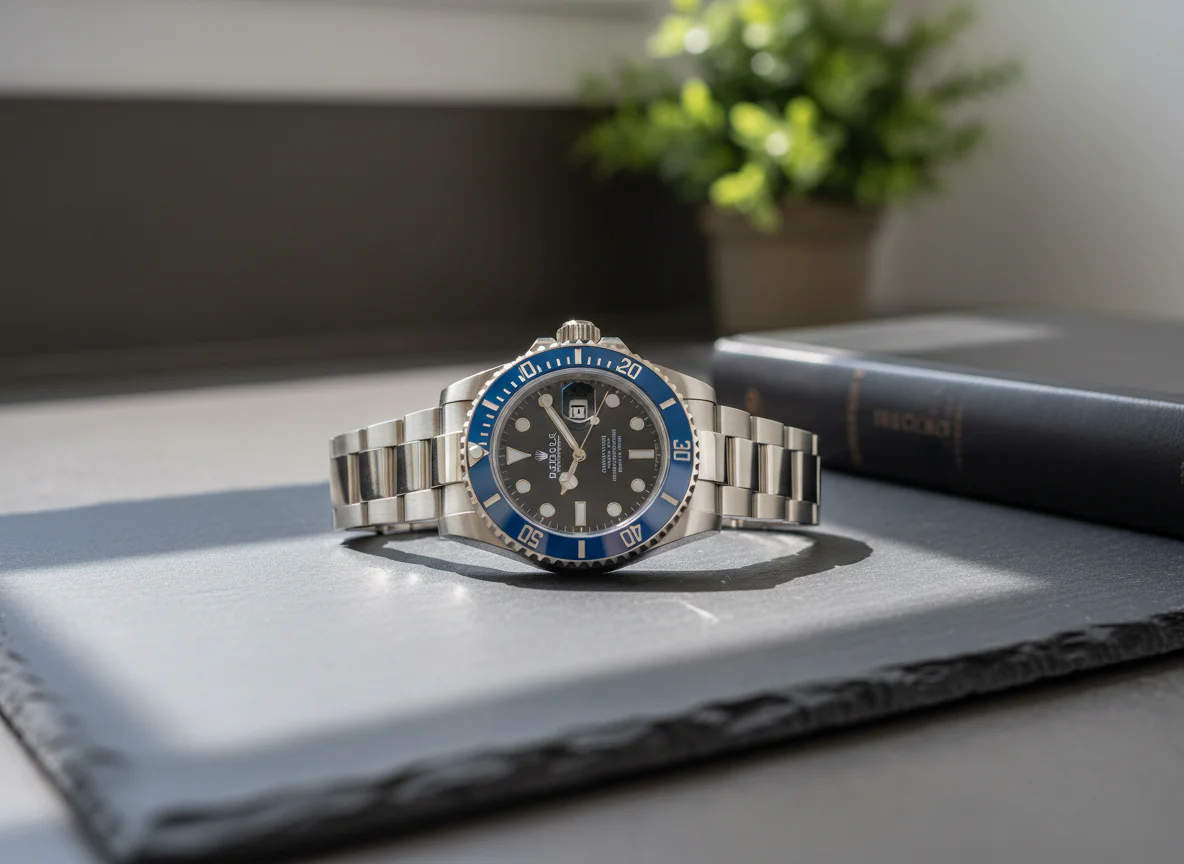
The Cookie Monster Submariner 126619LB. The only modern Submariner with a full white gold case and bracelet paired with a non-matching, boldly colored bezel. Six years of production now constitutes the entire global inventory.
Bob's Watches market data shows the 126619LB has climbed 8.25 percent since the announcement, with the watch now averaging $41,995 across the tracked dealer network. WatchGuys puts the current pre-owned and unworn range at $33,000-$45,000, with unworn 2026-dated examples pushing closer to $50,000.
The reason this matters: the Cookie Monster spent most of its 2020-2026 production run trading at or below its $52,100 retail. WatchCharts data on the 126619LB shows the reference was down 24.8 percent over the five years through April 2026, the worst performance in the entire Submariner Date collection. The post-show 8.25 percent climb is the first time the reference has shown sustained upward movement since launch.
Two factors drove the reversal:
Scarcity becomes the price story. White gold Submariners have always been produced in small numbers compared to the steel Submariner reference 126610LN. Six years of 126619LB production constitutes the total available global inventory now. With no successor announced, the supply curve became fixed.
The visual identity premium. The Cookie Monster is the only modern Submariner with a full white gold case and bracelet paired with a non-matching, boldly colored bezel. The 116619LB Smurf (its all-blue 40mm predecessor) followed a similar post-discontinuation arc after its 2020 retirement, eventually trading $35,000-$55,000 on Chrono24 by 2025.
The strategic read on the Cookie Monster post-W&W: this is the rare case of a reference where the discontinuation announcement appears to be repricing the watch's long-term valuation upward, not just creating a short-term spike. Buyers expecting a Pepsi-style 50-100 percent climb are unlikely to see it. Buyers expecting the reference to find a new permanent floor 10-20 percent above its long-term band are more aligned with where the market actually settled.
For the complete list of references Rolex retired at the show beyond just the Pepsi and Cookie Monster, see our Every Rolex Discontinued at Watches and Wonders 2026 breakdown.
Movement Three: The Redesign Compression Anomaly
The original Yacht-Master II reference 116680 is the most overlooked story of the post-W&W cycle.
Rolex discontinued the entire original Yacht-Master II collection in 2024, two years before the 2026 redesign arrived. WatchCharts data through April 2026 shows the 116680 has continued to soften since that 2024 discontinuation, down 6.7 percent over the trailing 12 months and underperforming the broader Rolex Market Index by more than 10 percentage points.
This is the opposite of the normal discontinuation pattern. Pepsi up. Cookie Monster up. Yacht-Master II 116680 down.
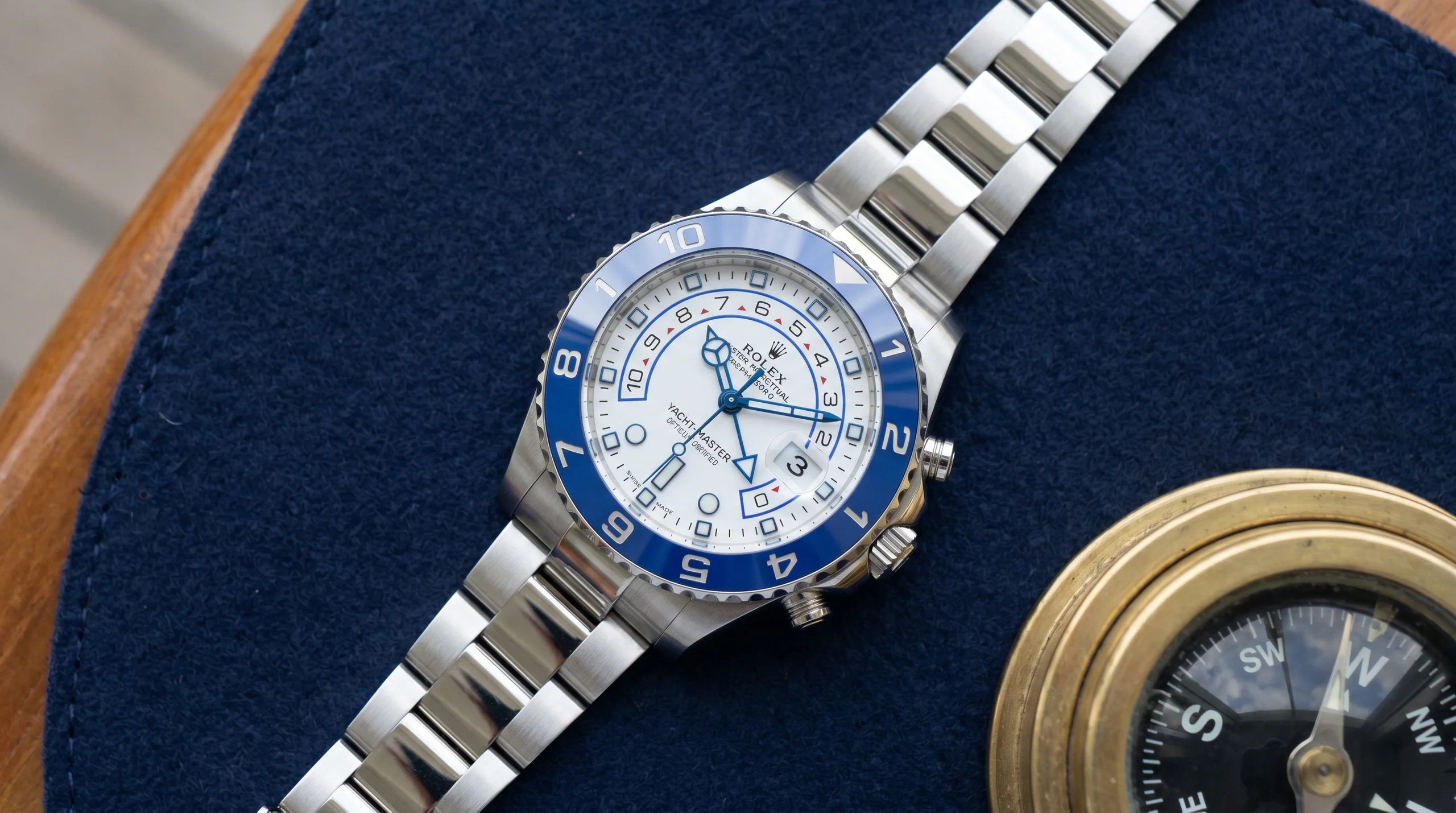
The new Yacht-Master II 126680. The redesign moved the regatta countdown off the dial and onto the flange edge, cleaned up the bezel, and added the counterclockwise caliber 4162. The same price band as the original 116680 created the "redesign compression" pattern on the predecessor.
The reason is what dealers are starting to call "redesign compression." When Rolex retires a reference and then releases a substantially redesigned successor at a lower or similar retail price, the new model becomes a gravitational center that pulls demand away from the discontinued original instead of validating it.
The new Yacht-Master II 126680 launched at W&W 2026 at $20,300 in steel, roughly the same price band the original held before its 2024 discontinuation. The redesign is significant: a counterclockwise countdown via the new caliber 4162, a slimmed-down case profile, the elimination of the Ring Command bezel in favor of a clean blue Cerachrom timing bezel, and the relocation of the countdown display from the dial to the flange. For collectors who wanted the regatta function in a Rolex, the choice is now clearly the new reference rather than the original.
Pre-owned 116680 pricing has not collapsed. The reference still trades in roughly the $14,000-$18,000 range depending on condition and full-set status. But the trajectory is downward, not upward, despite the discontinuation status that would normally signal scarcity-driven appreciation.
For the working dealer's complete read on what the new Yacht-Master II 126680 actually represents and why it might be the most underpriced Rolex sport watch in the 2026 catalog, see our Yacht-Master II 126680 redesign analysis.
The Yacht-Master II is the test case for what happens when Rolex executes a successful redesign at the same price band. The same compression pattern is the risk for any other reference Rolex might retire and resurrect in coming years.
What This Pattern Signals: The 30-60 Day Lag Effect
The post-W&W secondary market typically operates in two phases.
Phase one (days 0-30): Emotion-driven repricing. Confirmed discontinuations generate immediate upward pricing on the affected references as collectors and dealers scramble to position inventory. Asking prices spike. Median sell times compress (the Pepsi went from typical 30-45 day sell windows to 16 days post-discontinuation). The supply side pulls inventory off the market to wait for higher prices.
Phase two (days 30-90): The market discovers the actual new floor. The frantic activity of the first 30 days produces asking prices that often exceed sustainable transaction levels. Through May and June, the actual sale prices typically settle 10-20 percent below the peak ask prices from late April. The references that hold their gains through this phase are the ones with genuine structural scarcity.
We are now entering phase two for the W&W 2026 discontinuations. Pepsi asking prices have stabilized in the $30,000-$40,000 range, with a small gap between asking and actual sale levels suggesting the market is finding its real new floor in the low-to-mid $30,000s for clean steel examples. Cookie Monster asking prices appear to be holding above $42,000, which suggests the structural scarcity argument is genuine for that reference rather than emotion-driven. The original Yacht-Master II remains the outlier, continuing to soften.
The lag effect also explains why post-W&W coverage that ends at the show itself misses the most important data. The market reaction does not show its real character until 30-60 days out.
Counter-Positioning: The Smart Pre-Owned Buys Right Now
The instinct when the catalog shrinks is to chase the discontinued references. The math usually does not work.
The smarter play is to look at the current production references that Rolex did not touch at W&W, which are quietly absorbing the demand displaced from the discontinued pieces without the post-discontinuation price spike.
The Submariner 126610LN at $13,000-$16,000 Pre-Owned

The standard Submariner Date 126610LN. Same caliber 3235 movement as the Cookie Monster, same 41mm case architecture, same Cerachrom bezel construction. Trades $13,000-$16,000 pre-owned without the post-discontinuation premium.
The standard black-on-black Submariner Date 126610LN remained in production at W&W 2026 with no significant changes to the reference. It is the most produced steel Submariner in the catalog, the most liquid Rolex sport reference on the pre-owned market, and the reference that most directly absorbs displaced demand from the Cookie Monster Submariner exit. Pre-owned trades in roughly the $13,000-$16,000 range with full set. Same caliber 3235 movement as the Cookie Monster, same 41mm case architecture, same Cerachrom bezel construction.
For the complete reference-level walkthrough on the 126610LN and what a working dealer actually inspects before pricing one, see our Submariner 126610LN buying guide.
The Batman GMT 126710BLNR at $14,000-$17,000 Pre-Owned
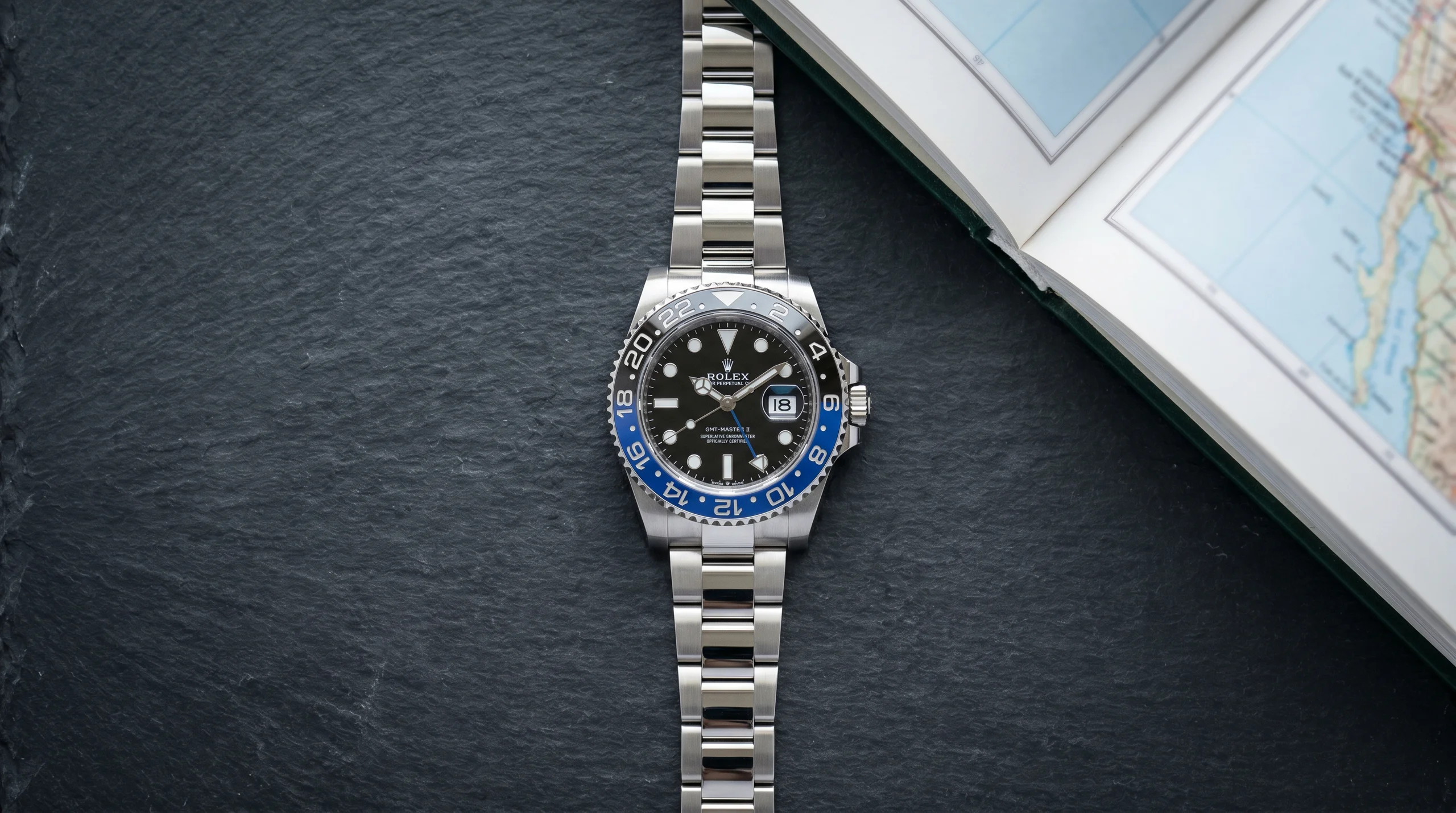
The Batman GMT 126710BLNR. Same case, same caliber 3285, same Cerachrom bezel construction as the Pepsi. Blue-and-black versus red-and-blue is the only meaningful visual difference, and the pricing math just shifted in the Batman's favor.
The Batman absorbs the most displaced demand from the Pepsi exit. Same case, same caliber 3285, same Jubilee bracelet option, same Cerachrom bezel construction. Blue-and-black versus red-and-blue is the only meaningful visual difference. Pre-owned market liquidity is the deepest in the GMT-Master II family. Trades $14,000-$17,000 with full set depending on year and bracelet.
The Bruce Wayne (grey-and-black 126710GRNR) and Sprite (green-and-black left-crown 126720VTNR) cover the remaining demand displaced from the Pepsi, each with its own visual identity and pricing band. The Batman remains the most liquid and most broadly recognized of the three.
For a complete head-to-head working dealer comparison of the Batman, Bruce Wayne, and Sprite as direct Pepsi alternatives, see our steel GMT-Master II comparison post.
The New Yacht-Master II 126680 at $20,300 Retail
The Yacht-Master II 126680 launching at $20,300 in steel is the most overlooked piece of the 2026 catalog. Lower retail than the Submariner Date in steel. Identical retail to the Sea-Dweller. New caliber 4162 with counterclockwise countdown. Significant mechanical complexity. Available without the multi-year waitlist that defines almost every other current Rolex sport reference.
The market has not yet repriced the new YM II upward to where its mechanical content suggests it should sit. That gap is the buying opportunity for buyers who can either land an authorized dealer allocation or pick up an early 2026 pre-owned example before the broader market catches up.
The First-Buyer Comparison: Submariner Versus GMT-Master II
For buyers entering the Rolex sport category for the first time and weighing the discontinuation context, the underlying decision is whether the sub-$15,000 segment is better served by a Submariner or a GMT-Master II. The Pepsi exit collapses the choice toward the Submariner for most buyers, but the case for the Batman GMT remains strong if travel function matters. Our Submariner versus GMT-Master II first-buyer comparison walks through the full decision tree.
The Honest Take
The post-W&W price spike on the Pepsi is real but heavily front-loaded into the first 30 days. Buyers who jumped on it in mid-to-late April paid asking prices that are unlikely to be sustained as the market discovers its phase-two floor through May and June. The Cookie Monster move is smaller in percentage terms but more structurally durable, because the scarcity argument is genuine rather than emotion-driven. The Yacht-Master II 116680 redesign compression is the warning sign about how successful Rolex redesigns can undercut their own discontinued predecessors instead of validating them.
The broader macro context still matters. The 15 percent permanent U.S. tariff on Swiss watches and gold sitting above $4,500 per ounce are pushing new retail prices upward on every gold reference Rolex sells, which raises the relative value of in-production steel references and indirectly supports the discontinued pre-owned market. For the full read on how the tariff and gold pricing environment is reshaping the 2026 pre-owned market, see our 15 percent tariff and gold market analysis.
For most buyers, the smart play right now is to ignore the discontinued references at peak-emotion pricing and position in the current production sport references that benefit from displaced demand without the post-discontinuation premium. The Submariner 126610LN, Batman GMT 126710BLNR, and the new Yacht-Master II 126680 all sit in that category. Each one offers a path into the Rolex sport segment without paying the post-W&W discontinuation tax that the Pepsi and Cookie Monster now carry.
The market is still moving. The phase-two transaction data through June and July will tell the real story of where these references settle.
Browse authenticated pre-owned Rolex sport watches at 5dwatches.com.