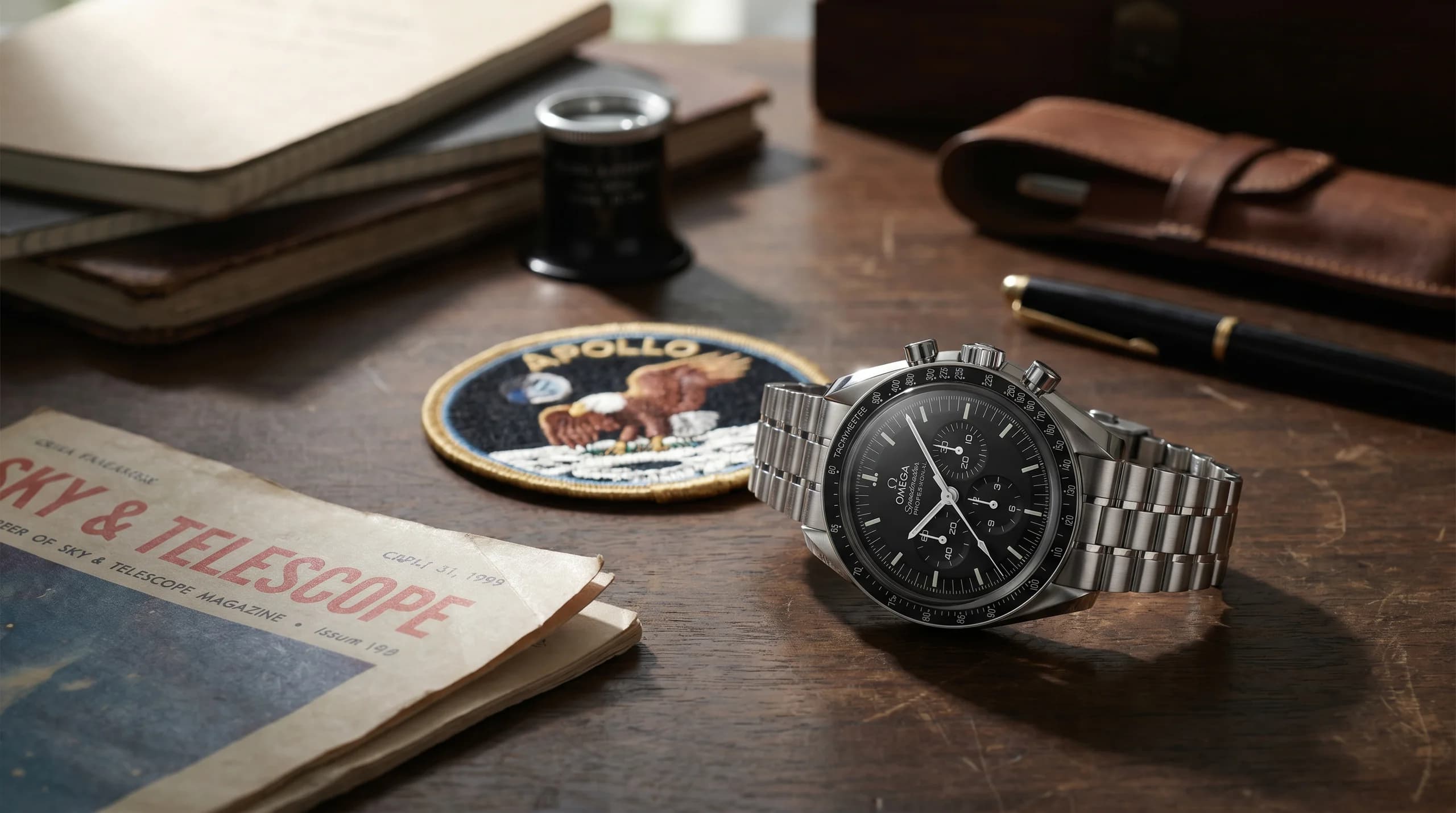
The Omega Speedmaster Professional Moonwatch is the single most historically significant chronograph in production. NASA-qualified for manned space missions in 1965. On the wrist of every American astronaut on every Apollo lunar mission, including the lunar surface during the Apollo 11 EVA on July 21, 1969. The reference that has been continuously produced in essentially the same case shape since 1968, across four caliber generations. The dial layout, the tachymeter bezel, the asymmetric case with crown guards — these have not changed in 58 years.
What has changed is the catalog around it. The current-generation Calibre 3861 Master Chronometer replaced the Calibre 1861 in January 2021. The Reverse Panda variants launched in January 2026 added ceramic bezels and lacquered sapphire-sandwich construction. The Silver Snoopy Award 50th Anniversary, the Calibre 321 Ed White reissue, the Speedy Tuesday partnerships, the Apollo program commemoratives — the limited editions now form a parallel collector market alongside the standard production references.
This guide decodes the entire Moonwatch Professional family. The Hesalite, the Sapphire, the Reverse Panda, the white dial, the Moonshine Gold, the Calibre 321, the limited editions, plus the previous-generation 311.30.42.30 family and the vintage 145.022 / 145.012 / 105.012 territory. Retail and pre-owned pricing as of May 2026. For the chronograph-decision context against the Rolex Daytona, see our Omega Speedmaster Professional versus Rolex Daytona comparison.
All images in this post are AI-generated and may not perfectly represent the actual watch references discussed. They are intended for illustration only.
The Short Answer
The current-generation Speedmaster Professional Moonwatch with Calibre 3861 starts at $7,300 retail for the Hesalite-on-bracelet reference 310.30.42.50.01.001. The Sapphire Sandwich variant (310.30.42.50.01.002) sits at roughly $9,100 retail. The 2026 Reverse Panda releases pushed the ceiling up: the steel version (310.30.42.50.01.004) at $10,400 and the Moonshine Gold version (310.60.42.50.01.002) at $49,300.
Pre-owned trades roughly 20 to 35% below current retail on most references. The standard 310.30.42.50.01.001 Hesalite sits at $4,400 to $5,200 pre-owned. The Sapphire version at $5,800 to $6,400. The previous-generation Calibre 1861 references (311.30.42.30.01.005 Hesalite, 311.30.42.30.01.006 Sapphire) trade at $3,500 to $5,500, offering the deepest value play in the modern Moonwatch lineup.
For the typical buyer: the current Hesalite (310.30.42.50.01.001) is the default first Speedmaster. The previous-gen 311.30.42.30.01.005 is the value entry. The Reverse Panda is the most distinctive 2026 release. The vintage 145.022 is the collector's gateway. The Silver Snoopy 50th and Calibre 321 Ed White are the limited editions that hold value above retail.
The Modern Moonwatch Family: Quick Reference
| Reference | Configuration | Retail (May 2026) | Pre-Owned Range |
|---|---|---|---|
| 310.30.42.50.01.001 | Hesalite / steel bracelet | $7,300 | $4,400-$5,200 |
| 310.30.42.50.01.002 | Sapphire sandwich / bracelet | $9,100 | $5,800-$6,400 |
| 310.32.42.50.01.001 | Hesalite / NATO strap | $6,800 | $3,900-$4,600 |
| 310.32.42.50.01.002 | Sapphire / NATO strap | $8,500 | $5,200-$5,800 |
| 310.30.42.50.04.001 | White dial / steel bracelet (2024) | $9,400 | $7,800-$8,900 |
| 310.30.42.50.01.004 | Reverse Panda steel (Jan 2026) | $10,400 | $9,800-$10,400 |
| 310.60.42.50.01.002 | Reverse Panda Moonshine Gold | $49,300 | $44,000-$48,000 |
All current-generation Moonwatches run the Calibre 3861, the METAS Master Chronometer manual-wind chronograph movement that replaced the Calibre 1861 in January 2021.
The Current Hesalite Moonwatch: 310.30.42.50.01.001
The 310.30.42.50.01.001 with Hesalite (acrylic) crystal is the default current Speedmaster Professional. It is what NASA tested in 1965, what astronauts wore on the moon, and what Omega has continued to produce in essentially unchanged form for nearly 60 years.
| Spec | Detail |
|---|---|
| Case | 42mm brushed/polished steel, 13.6mm thick, 50m water resistance |
| Crystal | Domed Hesalite (acrylic) with painted Omega logo at center |
| Bezel | Fixed black anodized aluminum tachymeter with white scale, "dot over 90" (DON) |
| Dial | Matte black double-stepped, three sub-dials at 3/6/9 |
| Movement | Calibre 3861, manual-wind, 50-hour PR, METAS Master Chronometer |
| Retail (May 2026) | $7,300 (US) |
| Pre-Owned | $4,400 - $5,200 |
The Hesalite is the historically authentic configuration. NASA selected acrylic over sapphire and mineral glass specifically because Hesalite, if it shattered, would crack into large pieces rather than fine shards that could float in zero gravity and damage spacecraft equipment. Modern owners typically don't operate in zero gravity, but the Hesalite remains the configuration with continuous lineage to the original lunar-surface watches.
The Calibre 3861 update in 2021 added METAS Master Chronometer certification (-2/+4 sec/day, 15,000 gauss magnetic resistance), Si14 silicon balance spring, co-axial escapement, and refined column-wheel chronograph architecture. The case dropped from 14.3mm thick (Cal 1861 generation) to 13.6mm. The bezel font got slightly lighter. The Omega logo remained painted on the dial (not applied) on this Hesalite reference, preserving the historical aesthetic.
The closed solid caseback carries the "THE FIRST WATCH WORN ON THE MOON" engraving along with the Seahorse logo. The Sapphire variant (next section) has an exhibition caseback instead.
For buyers building a Speedmaster pillar alongside a Rolex Daytona ambition (see our Daytona buying guide), the Hesalite is the historically faithful answer. The price differential is real: the Speedmaster pre-owned at $4,400-$5,200 against the steel Daytona at $27,000+ pre-owned. Our Speedmaster Professional versus Rolex Daytona comparison covers the decision in detail.
The Sapphire Sandwich: 310.30.42.50.01.002
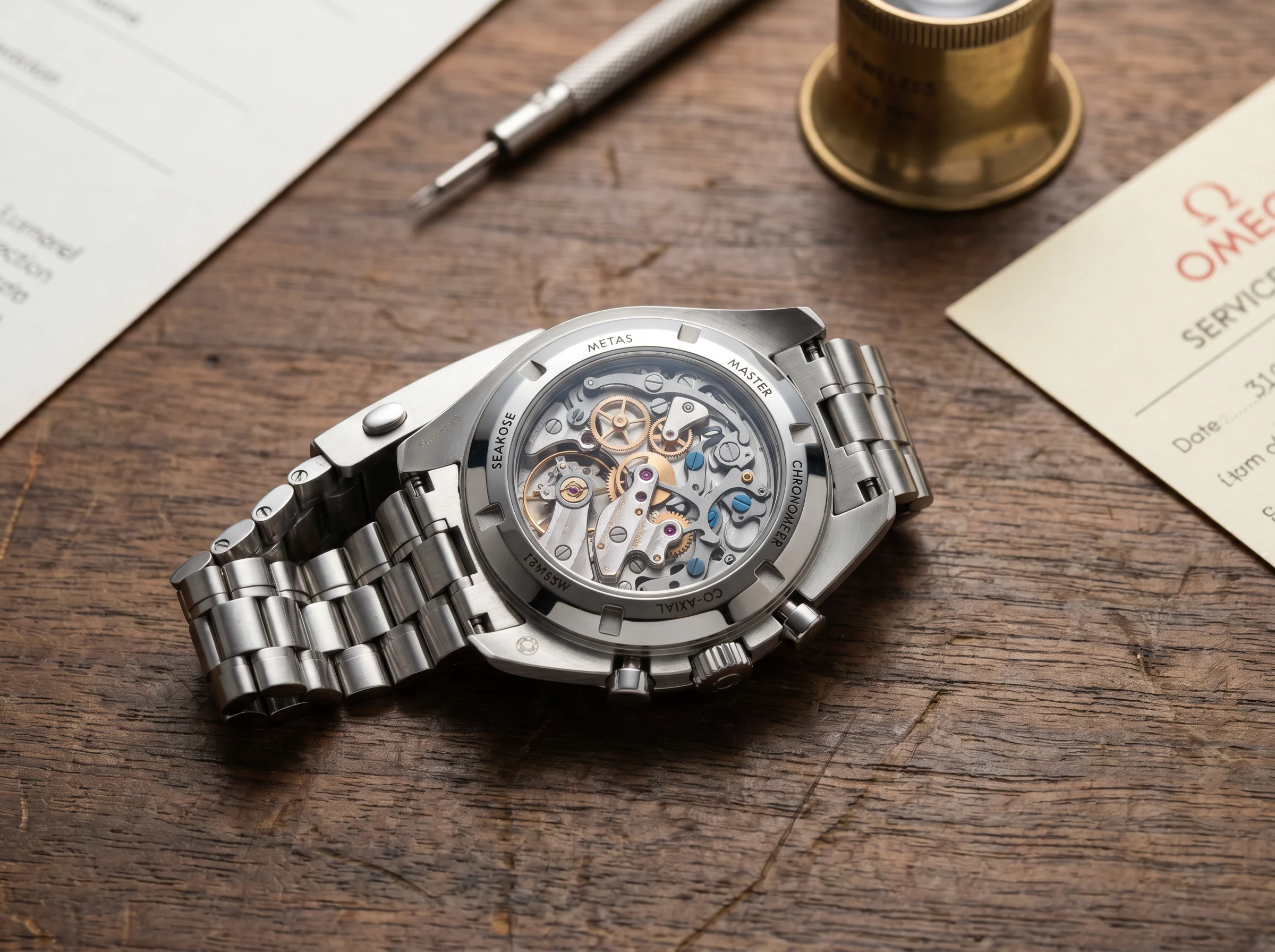 The Sapphire Sandwich (310.30.42.50.01.002) gets an exhibition caseback showing the Calibre 3861 manual-wind chronograph movement: gold-toned bridges, Sedna gold escapement, METAS Master Chronometer certification. The Hesalite version retains the closed caseback with the "first watch worn on the moon" engraving.
The Sapphire Sandwich substitutes flat sapphire crystals on both front and back. The front sapphire is anti-reflective coated. The rear sapphire is an exhibition window showing the Calibre 3861 movement.
Material differences from the Hesalite version:
- Sapphire crystal (top and back) vs. Hesalite (top only, closed solid back)
- Applied Omega logo on the dial vs. painted logo
- Slightly thinner case (13.2mm vs. 13.6mm)
- Heavier wrist presence due to sapphire vs. acrylic crystal density
WatchCharts data through May 2026 puts the Sapphire variant at approximately a 10-20% premium over the Hesalite on the pre-owned market. The 310.30.42.50.01.002 is also identified as the most popular Speedmaster reference by transaction volume in the WatchCharts data.
The exhibition caseback is the selling proposition. The Calibre 3861 is visually striking: Sedna gold-toned balance wheel and escapement bridge, blue-toned column wheel chronograph mechanism, Geneva striped bridges, METAS Master Chronometer engraving around the sapphire window perimeter. For buyers who care about seeing the mechanism through the caseback, the Sapphire variant is the clear choice.
For buyers prioritizing the historical aesthetic (Hesalite, closed caseback, painted logo), the 310.30.42.50.01.001 is the closer match to the lunar reference.
The 2026 Reverse Panda: 310.30.42.50.01.004 and 310.60.42.50.01.002
 The 2026 Reverse Panda 310.30.42.50.01.004 added a black ceramic bezel with enamel-filled tachymeter and a glossy lacquered black dial with white recessed sub-dials. The first reverse panda Speedmaster Professional outside the limited-edition Speedy Tuesday 2017. Retail $10,400 US.
Released January 13, 2026, the Reverse Panda configuration is the most significant Moonwatch dial-and-bezel update in years. The 310.30.42.50.01.004 (steel) at $10,400 retail and the 310.60.42.50.01.002 (Moonshine Gold) at $49,300 retail share the same dial and bezel construction but in different case materials.
Material and construction changes from the standard Sapphire Sandwich:
| Feature | Standard 002 | Reverse Panda 004 |
|---|---|---|
| Dial | Matte black, painted scale | GLOSSY black lacquer, recessed white sub-dials |
| Bezel | Aluminum insert, white printed scale | BLACK CERAMIC, white ENAMEL-filled scale |
| Sub-dials | Flat | Recessed (two-layer dial construction) |
| Hands/markers | Rhodium-plated, luminous | Rhodium-plated, glossy lacquered (slight contrast) |
The reverse-panda configuration (white sub-dials on black main dial) had appeared exactly once before on a standard-production Moonwatch Professional: the 2017 Speedy Tuesday limited edition (311.32.42.30.01.001, 2,012 pieces). The 2026 release is the first standard-production reverse panda in the Moonwatch line.
Market response: the steel Reverse Panda has held close to retail in early secondary trading. The Moonshine Gold version (a 18k proprietary Omega yellow gold alloy with paler tone than 18k yellow gold) has traded slightly below retail given the substantial $49,300 entry. For both, the ceramic bezel and lacquered dial construction differentiate the references enough from the standard Moonwatch that buyers who want a distinctive modern Speedmaster have a clear answer.
The Moonshine Gold Reverse Panda was teased at the 2025 Met Gala (worn by Colman Domingo) before the formal launch. The metal weight on the gold version is significant — buyers should expect a wrist presence noticeably heavier than the steel.
The White Dial: 310.30.42.50.04.001 (March 2024)
The white-dial Moonwatch launched in March 2024 as the first standard-production white-dial Speedmaster Professional. Black sub-dials on a white main dial (true panda configuration, opposite of the Reverse Panda). Sapphire sandwich construction, Calibre 3861, $9,400 US retail.
Pre-owned market trades at $7,800 to $8,900 — the smallest discount to retail of any standard Moonwatch variant. Demand has consistently outpaced supply since launch. The white dial reads as a Rolex Daytona homage (Daytona 116500LN white dial is the closest mainstream comparison), but the bicompax-style three-sub-dial layout differentiates it.
For buyers who want a distinctive Speedmaster without the Reverse Panda's lacquered-dial gloss, the white dial is the cleaner answer.
The Previous Generation: Calibre 1861 (Pre-January 2021)
The Calibre 1861 references ran from 1996 to January 2021. They are the immediate predecessor to the current Calibre 3861 generation and remain the deepest value play in the modern Moonwatch lineup.
| Reference | Configuration | Pre-Owned Range |
|---|---|---|
| 311.30.42.30.01.005 | Hesalite / steel bracelet | $3,500 - $4,500 |
| 311.30.42.30.01.006 | Sapphire sandwich / bracelet | $4,000 - $5,500 |
| 311.32.42.30.01.005 | Hesalite / strap | $3,200 - $4,000 |
| 311.32.42.30.01.006 | Sapphire / strap | $3,800 - $4,800 |
The Calibre 1861 was the lineal descendant of the Calibre 321 → 861 → 1861 family that powered every Moonwatch from 1968 to 2021. It was rhodium-plated, manual-wind, and column-wheel based. Not METAS Master Chronometer certified (the 1861 predates the certification), but mechanically robust with long service intervals.
Differences from the Cal 3861 generation:
- 50-hour power reserve (vs. 50 hours on 3861, same)
- No Master Chronometer certification (3861 has METAS, -2/+4 sec/day, 15,000 gauss)
- 14.3mm case thickness (vs. 13.6mm Hesalite / 13.2mm Sapphire on 3861)
- Painted Omega logo on Hesalite (same as 3861)
- Heavier bezel font on 1861 (vs. lighter font on 3861)
For buyers willing to give up the METAS certification in exchange for ~30% lower pre-owned pricing, the Calibre 1861 generation is the smart entry. Mechanical robustness is similar. Service intervals are similar. The aesthetic differences (case thickness, bezel font) are subtle.
Vintage Territory: 145.022, 145.012, 105.012
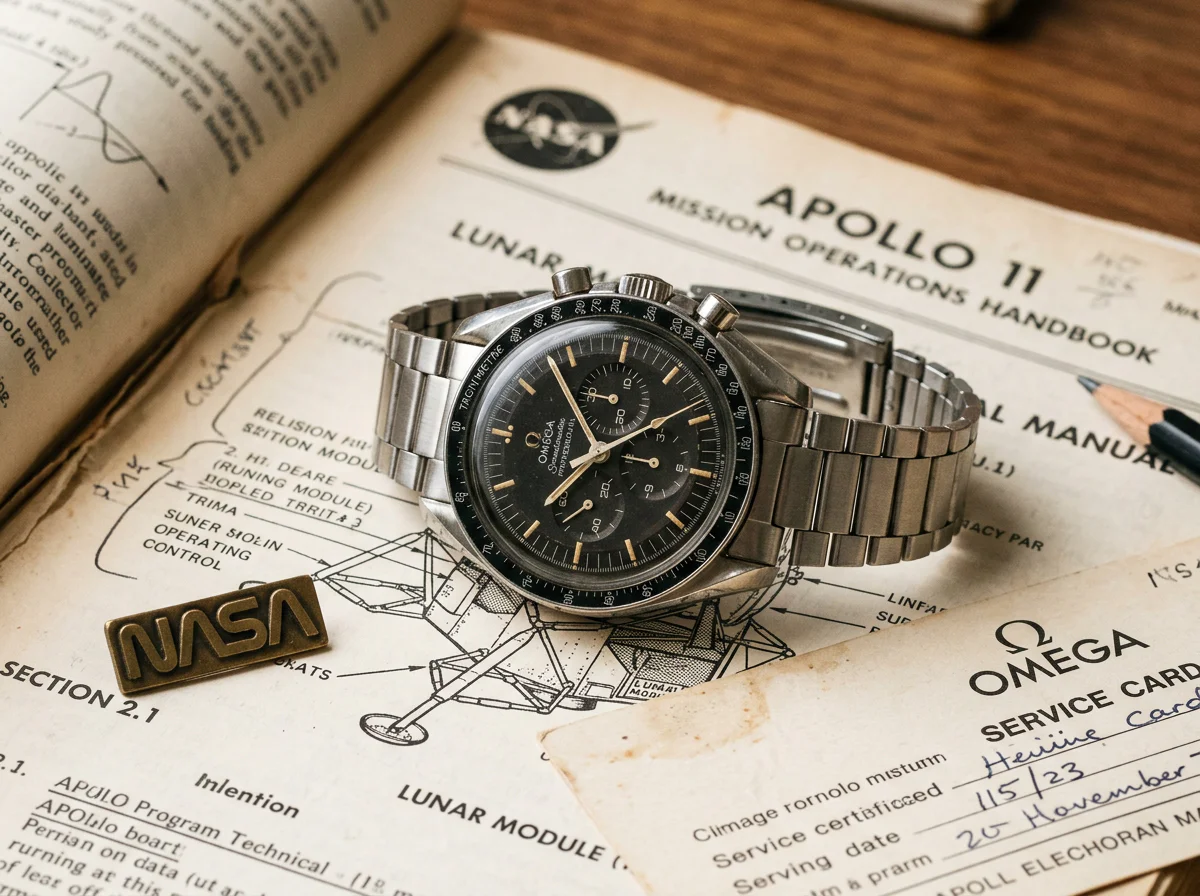 The 145.022 ran from 1968 to 1988 with the Calibre 861 movement. Tritium dials from this era develop a distinctive creamy patina that ceramic and modern lume cannot reproduce.
The vintage Moonwatch Professional references are the collector's gateway into the line. Production from 1968 to 1988 covered the immediate post-Apollo era through the 1980s. The aged tritium dials and aluminum bezels develop a patina that modern lume and ceramic cannot reproduce.
| Reference | Years | Movement | Pre-Owned Range |
|---|---|---|---|
| 105.012 | 1962-1963 | Calibre 321 | $30,000 - $80,000+ |
| 145.012 | 1967-1968 | Calibre 321 | $20,000 - $45,000 |
| 145.022 | 1968-1988 | Calibre 861 | $8,000 - $18,000 |
| 3590.50 | 1988-1996 | Calibre 1861 | $4,500 - $7,500 |
The 105.012 is the "first Moonwatch" — the reference Buzz Aldrin wore on the lunar surface during the Apollo 11 EVA. Production years 1962-1963. Calibre 321 movement (the column-wheel chronograph that defined the early Speedmaster). Clean examples with full sets trade $30,000 to $80,000 depending on dial era and serial range. The most documented Apollo-era examples have approached six-figure auction results.
The 145.012 ran from 1967 to 1968 as the last Calibre 321 reference before Omega transitioned to the simplified Calibre 861. It is the most affordable Cal 321 Moonwatch by a meaningful margin, trading $20,000 to $45,000.
The 145.022 (1968-1988) is the workhorse vintage Moonwatch. 20 years of continuous production across multiple dial generations (the "Pre-Moon" early 145.022, the standard production runs of the 1970s and 1980s, the various dial-text variations). Calibre 861 movement. Pre-owned $8,000 to $18,000 depending on serial range, dial originality, and condition.
The 3590.50 (1988-1996) bridges the gap between the 145.022 and the modern 311.30.42.30 references. Calibre 1861. Pre-owned $4,500 to $7,500 — the most accessible vintage Moonwatch.
Authentication on vintage Speedmasters is critical. Service-era dial swaps, replacement bezels, and aftermarket bracelets are common. The Omega Vintage Heritage program (operated by Omega) can authenticate specific references through factory archives for a fee. For broader authentication framework, see our Frankenwatch authentication primer, which covers the same principles applied across vintage Rolex but applies cleanly to vintage Omega as well.
Limited Editions: Silver Snoopy, Calibre 321, Apollo Anniversaries
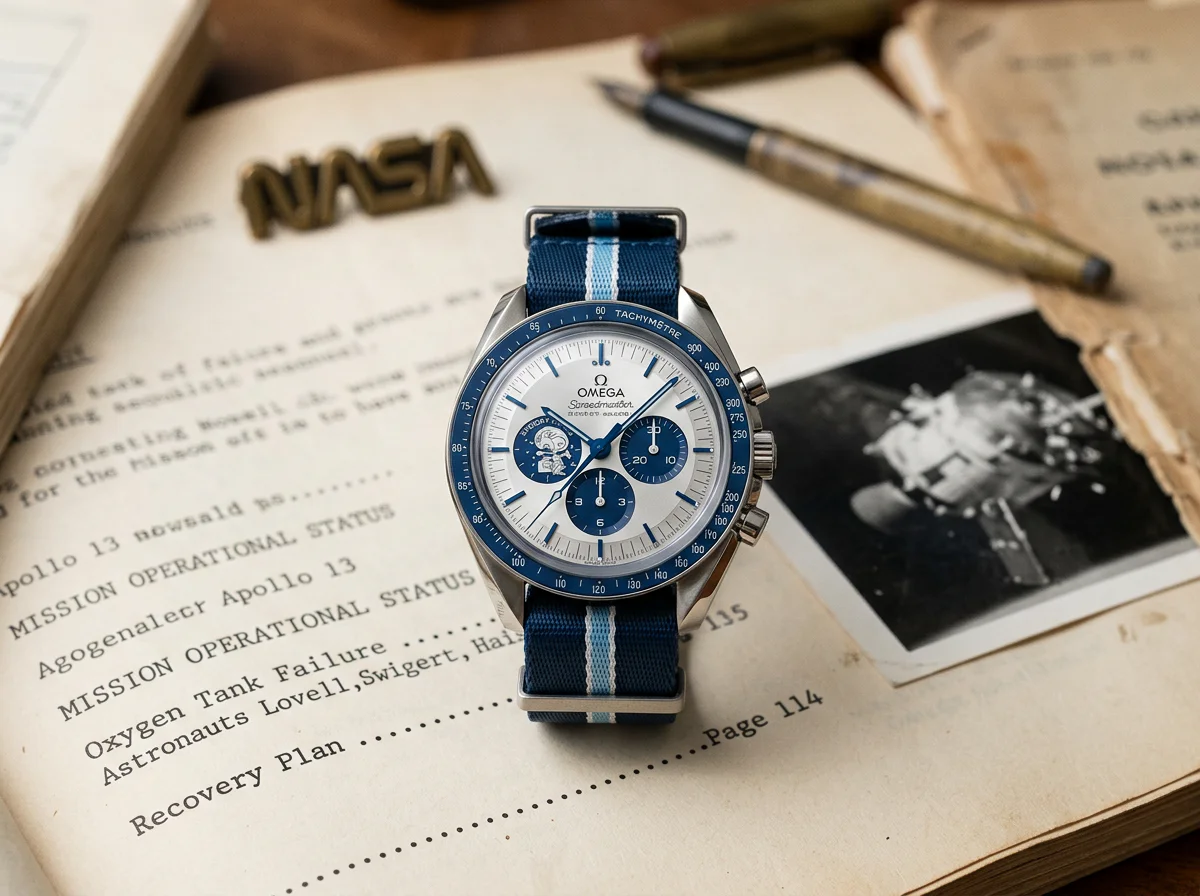 The Silver Snoopy Award 50th Anniversary 310.32.42.50.02.001 was the 2020 release commemorating Omega's role in the Apollo 13 safe-return mission. The reference has consistently traded above retail since launch.
The Speedmaster limited-edition catalog is the parallel collector market alongside the standard production. Three references that consistently trade above retail:
Silver Snoopy Award 50th Anniversary (310.32.42.50.02.001): Released 2020 commemorating Omega's role in the Apollo 13 mission safe return. Silver dial, blue ceramic bezel, blue NATO strap, animated caseback showing a small Snoopy spacecraft animation tied to the chronograph movement. Retail at launch was $9,600. Pre-owned market trades at $25,000 to $32,000 — a 2.6x to 3.3x retail multiplier.
Calibre 321 Ed White Reissue (311.30.40.30.01.001): Released 2020 as the first standard-production Speedmaster with the original Calibre 321 movement (the historic column-wheel chronograph). 39.7mm case, "Ed White" dial configuration referencing astronaut Ed White's reference. Retail at launch was $14,100. Pre-owned trades $14,000 to $18,000. The reference is in current production but allocation-limited.
Speedy Tuesday 1 (311.32.42.30.01.001): Released 2017 in partnership with Fratello, 2,012 pieces. The first reverse-panda Moonwatch Professional. Limited to forum members initially. Retail at launch was $6,500. Pre-owned now trades $18,000 to $25,000.
Speedy Tuesday 2 "Ultraman" (311.12.42.30.01.001): Released 2018, 2,012 pieces. Orange dial accents referencing the 1971 Japanese TV series. Pre-owned $14,000 to $18,000.
Apollo 11 50th Anniversary references: The 310.20.42.50.01.001 (Moonshine Gold) and 310.32.42.50.01.001 (steel) released for the 2019 anniversary. Both trade at premiums to original retail.
For collectors building a Speedmaster portfolio, the limited editions form the appreciation layer above the standard production. The Snoopy 50th has been the strongest performer over the past 5 years; the Calibre 321 Ed White is the strongest contemporary release; the Speedy Tuesday partnership pieces remain the cult-favorite small-production references.
The Calibre 3861 in Context
The Calibre 3861 was the most significant Speedmaster Professional movement update in 30 years when it launched in January 2021. The technical specifications:
| Spec | Calibre 3861 |
|---|---|
| Type | Manual-wind chronograph |
| Diameter | 27mm |
| Frequency | 21,600 vph (3 Hz) |
| Power reserve | 50 hours |
| Jewels | 26 |
| Chronograph | Column wheel, vertical clutch |
| Balance spring | Si14 silicon paramagnetic |
| Escapement | Co-axial (Omega proprietary) |
| Certification | METAS Master Chronometer (-2/+4 sec/day, 15,000 gauss) |
| Caseback | Closed (Hesalite) or sapphire exhibition (Sapphire variants) |
The Master Chronometer certification is the key differentiator from the predecessor Calibre 1861. METAS certifies movements after the COSC chronometer process to a tighter daily accuracy spec (-2/+4 sec/day vs. COSC's -4/+6 sec/day) plus magnetic resistance testing to 15,000 gauss (typical mechanical watches are spec'd to 60-100 gauss). The Si14 silicon balance spring is paramagnetic; the co-axial escapement reduces friction at the impulse point versus traditional Swiss lever escapements.
Service intervals run 5 to 8 years on a properly worn 3861, similar to the broader Omega Master Chronometer family. The chronograph mechanism (column wheel, vertical clutch) is the architecturally elegant approach; the column wheel coordinates the chronograph functions through a stepped vertical pillar rather than the cam-based systems used in cheaper movements. The vertical clutch engages the chronograph without the seconds hand jumping when started.
The 3861 also added improved shock resistance over the 1861 and improved the rate-stability across temperature variation. For daily-wear buyers, the practical differences from the 1861 are minor (50-hour reserves on both, both column-wheel architecturally). For collectors who care about technical specification, the METAS certification is the defining upgrade.
What Should You Actually Buy?
If this is your first Speedmaster: The 310.30.42.50.01.001 Hesalite on bracelet. $4,400-$5,200 pre-owned. Historically faithful, METAS certified, the default answer.
If you want value: The 311.30.42.30.01.005 Hesalite (previous generation Calibre 1861). $3,500-$4,500 pre-owned. ~30% discount to the current 3861 with similar mechanical robustness.
If you want the exhibition caseback: The 310.30.42.50.01.002 Sapphire Sandwich. $5,800-$6,400 pre-owned. Shows the Calibre 3861 movement.
If you want distinctive: The 2026 Reverse Panda (310.30.42.50.01.004 steel or 310.60.42.50.01.002 Moonshine Gold). The first standard-production reverse-panda Moonwatch since the 2017 Speedy Tuesday limited.
If you want a white dial: The 310.30.42.50.04.001 (2024 release). The white-dial Speedmaster that reads as the Daytona-alternative for buyers wanting the bicompax-style chronograph in light dial configuration.
If you want vintage: The 145.022 with Calibre 861. $8,000-$18,000 depending on serial range and dial originality. The workhorse vintage Moonwatch and the cleanest historical lineage.
If you want a collector piece: The Silver Snoopy Award 50th, the Calibre 321 Ed White, or one of the Speedy Tuesday partnership pieces. All three have consistently traded above retail since launch.
If you want a Daytona alternative: The Speedmaster Professional Hesalite. Our head-to-head comparison covers the decision; the short version is the Speedmaster delivers the chronograph at one-fifth the Daytona price with arguably the stronger historical pedigree.
The Working Dealer's Bottom Line
The Speedmaster Professional Moonwatch is the chronograph that anchors the entire Omega catalog. It is the reference that hasn't changed in essential character for 58 years and won't change in the next 10. The Calibre 3861 update in 2021 added METAS certification without disrupting the visual continuity. The 2026 Reverse Panda releases extended the configuration catalog without compromising the historical aesthetic. The vintage and limited-edition catalog forms a parallel collector market that consistently outperforms the broader watch market index.
For collectors building an Omega pillar alongside Rolex (see our Rolex versus Omega comparison for the broader brand-level decision), the Moonwatch is the anchor reference. The Seamaster Diver 300M, Aqua Terra, Constellation Observatory, and Speedmaster Reduced form the broader Omega ecosystem. The recently released Seamaster 007 First Light Chronograph is the most recent flagship release worth tracking alongside the Moonwatch family.
Pre-owned Speedmaster Professional buying remains the cleanest entry point into a historically significant chronograph at the $4,000-$7,000 budget. The market has been steady through every correction cycle since 2000. The Calibre 3861 generation will be the dominant pre-owned reference family for the next decade. The Calibre 1861 generation is the deep value entry. The vintage 145.022 is the collector's gateway.
Browse authenticated pre-owned Omega Speedmaster Professional inventory at 5dwatches.com/shop/omega.