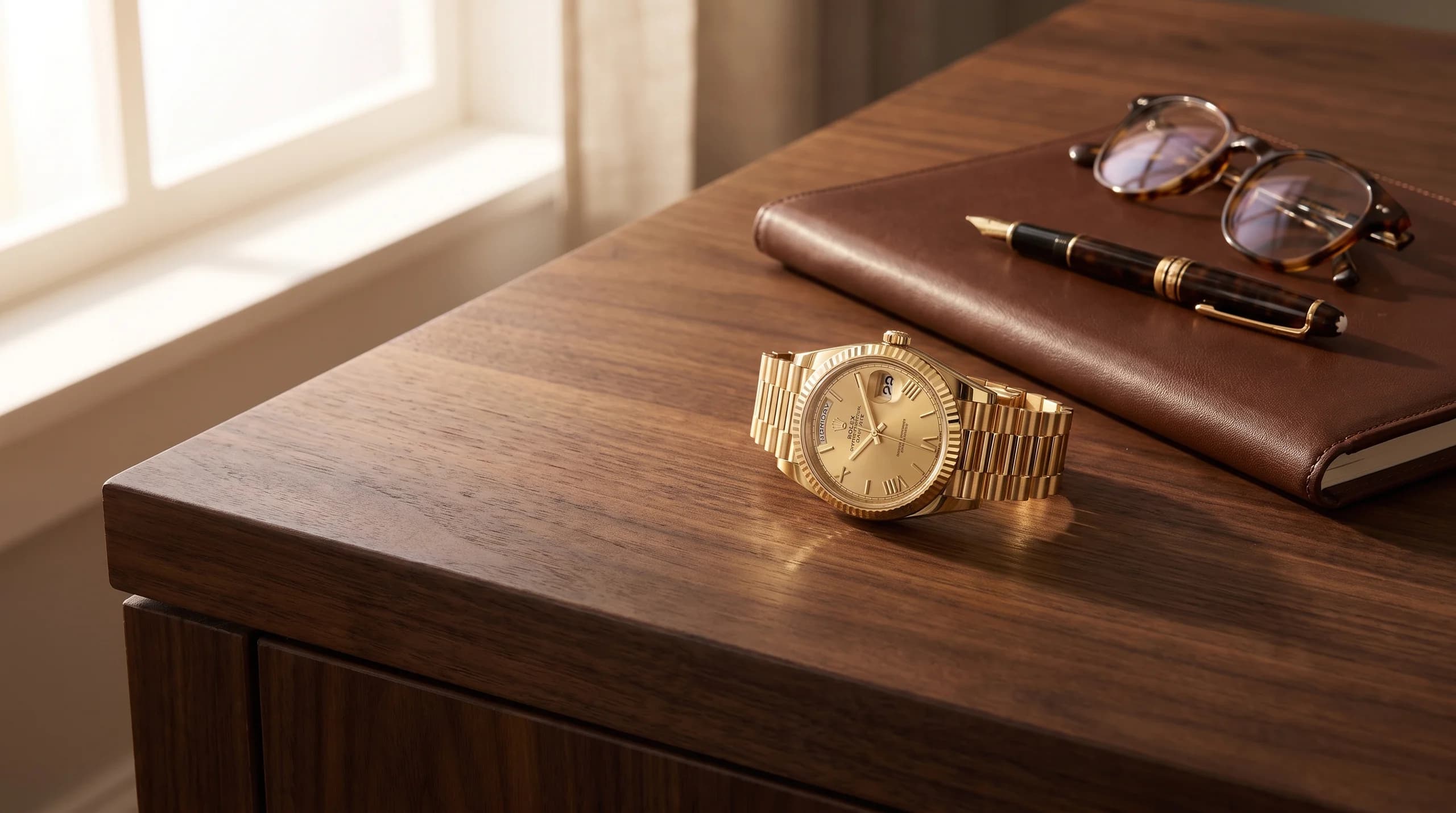
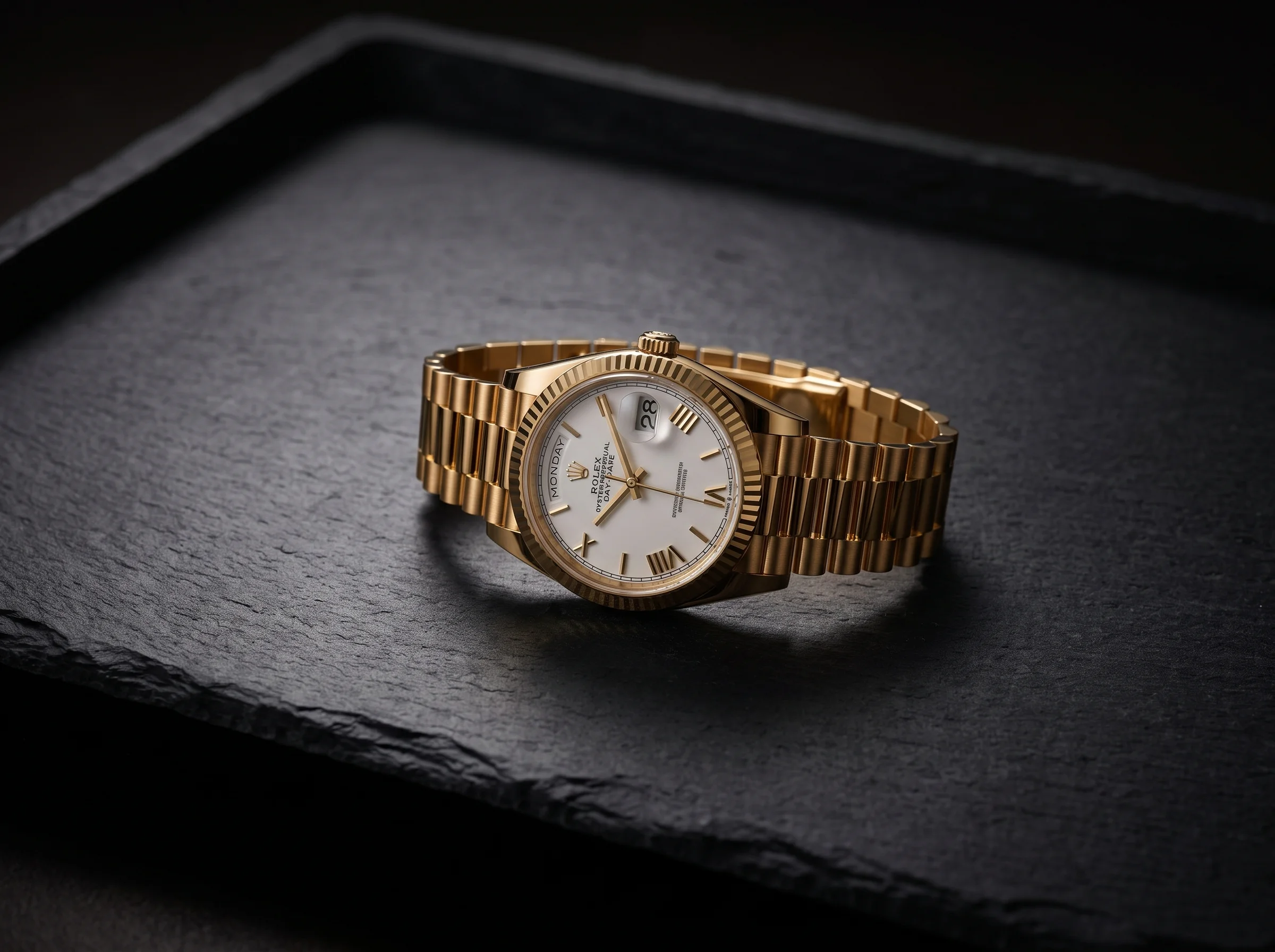
Ask a room full of people to picture a Rolex, and many of them will see the same thing: a heavy gold watch with the day of the week written across the top. That watch is the Day-Date, and almost everyone calls it the President. Far fewer can tell you why, and the explanation you hear most often is wrong.
The short answer
The Rolex Day-Date is called the President for two reasons, and the most repeated origin story does not hold up. The nickname traces to Lyndon B. Johnson, the first sitting US president to wear one in office, and to the three-link President bracelet Rolex designed specifically for the model. It does not come from Dwight Eisenhower, whose famous gold Rolex was a Datejust.
There is a point underneath the trivia that matters if you are buying. The Day-Date is the only Rolex made exclusively in gold and platinum, which gives it a price floor that steel sport models do not have, and the pre-owned market opens the door from about $8,000 at the vintage end.
The images in this article are AI-generated editorial illustrations. They represent the references discussed and are not photographs of specific watches for sale.
Where the President name actually comes from
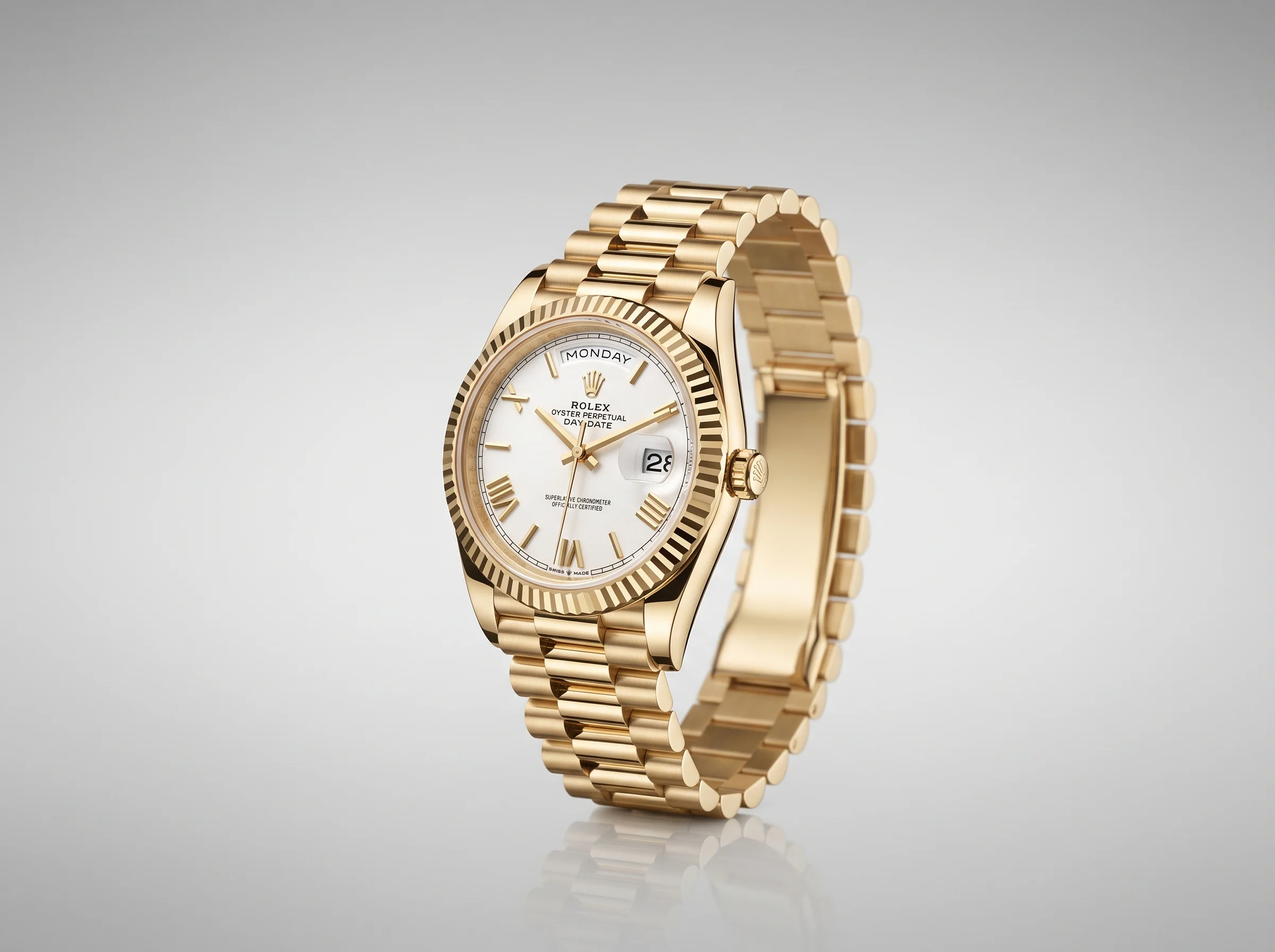
Rolex introduced the Day-Date in 1956 as its flagship, and from the start it wore a new three-link bracelet with semi-circular links. That bracelet, built only for this model, is the piece most directly tied to the name. Historians at Monochrome note that the bracelet itself became known as the President, and the name later spread to the whole watch.
The political link came a few years later. Lyndon B. Johnson wore a yellow gold Day-Date in office, and Bob's Watches ties the Rolex President nickname directly to him. Rolex leaned into it, running a 1966 advertisement that called the watch the President's Watch and placed it on the wrists of Presidents everywhere.
Johnson was the first US president to wear a Rolex of any kind while in office, and he had a habit of gifting Day-Dates to friends.
The Eisenhower myth, corrected
Here is the part most buying guides get wrong. The claim that Eisenhower inspired the nickname, or that Rolex handed him a Day-Date, falls apart on the dates. Eisenhower received a gold Rolex to mark the brand's 150,000th chronometer in 1951, and he wore it on the cover of LIFE magazine in July 1952.
That watch was an 18k yellow gold Datejust ref. 6305, and the Day-Date did not reach the market until 1956. Bob's Watches lays it out plainly: the timeline makes it impossible for Eisenhower's Rolex to have been a Day-Date. If a seller tells you the Eisenhower connection is why the watch got its name, they have the reference wrong.
The presidents who did wear one
Johnson is the clearest Day-Date wearer, and he handed them out freely. After him the picture is looser than the legend suggests. Gerald Ford bought a Day-Date only after leaving office, and Ronald Reagan mostly wore a Datejust rather than the Day-Date.
John F. Kennedy is the odd case. He was gifted a yellow gold Day-Date by Marilyn Monroe in 1962, engraved on the caseback, and by most accounts he passed it off and never wore it in public.
The watch has largely left the modern White House. As Chrono24 and others have noted, Joe Biden wears a Rolex, though a sportier Datejust 41 with a blue dial rather than a gold Day-Date.
What makes a Day-Date a Day-Date
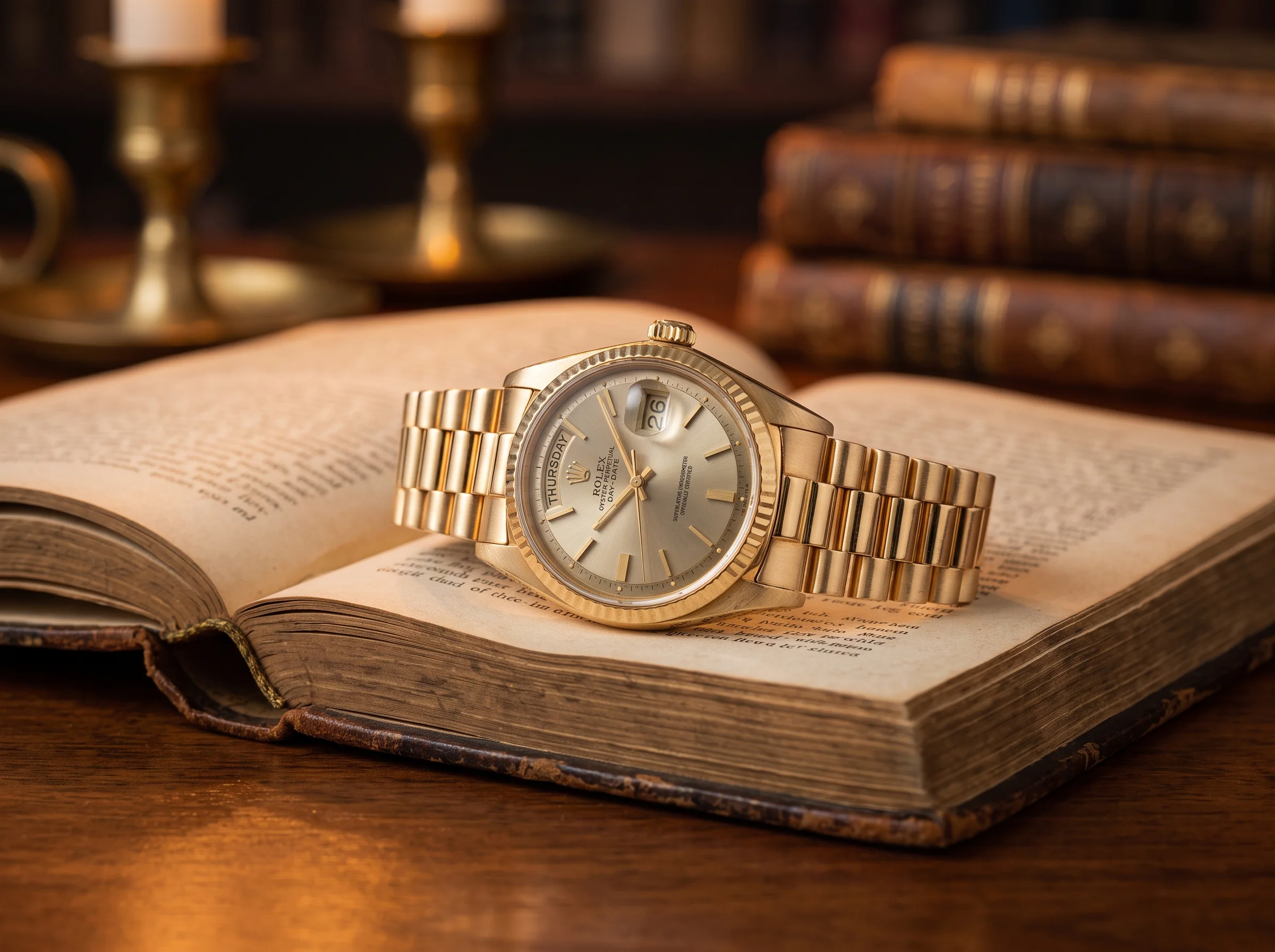
The Day-Date earned its place in history as the first wristwatch to show the date and the day of the week spelled out in full, through a curved window at 12 o'clock. That day display is now offered in 26 languages. The rest of the design has stayed remarkably consistent: an Oyster case, a fluted or smooth bezel, and a Cyclops lens over the date.
Sizing is the main thing that has moved. The Day-Date has been 36mm since 1956, Rolex produced a larger 41mm Day-Date II from 2008 to 2015, and the current Day-Date 40 arrived in 2015. Movements advanced in step, from the early caliber 1555 to today's caliber 3255, which uses the efficient Chronergy escapement and holds a 70-hour power reserve.
Only gold and platinum, and why that matters
Every Day-Date ever made has been cased in 18k gold or 950 platinum. Rolex has never built one in steel, and that is a deliberate identity choice rather than a cost decision. It also means every example carries real precious-metal weight.
Bob's Watches estimates that a fully linked vintage ref. 18238 holds roughly 114 grams of 18k gold. That metal sets a floor beneath the watch's value, which is a large part of why Day-Dates ride out market slumps better than steel sport references. For the wider picture on metal pricing right now, our read on the gold and platinum gap covers where the two sit today.
What a Day-Date costs pre-owned in 2026
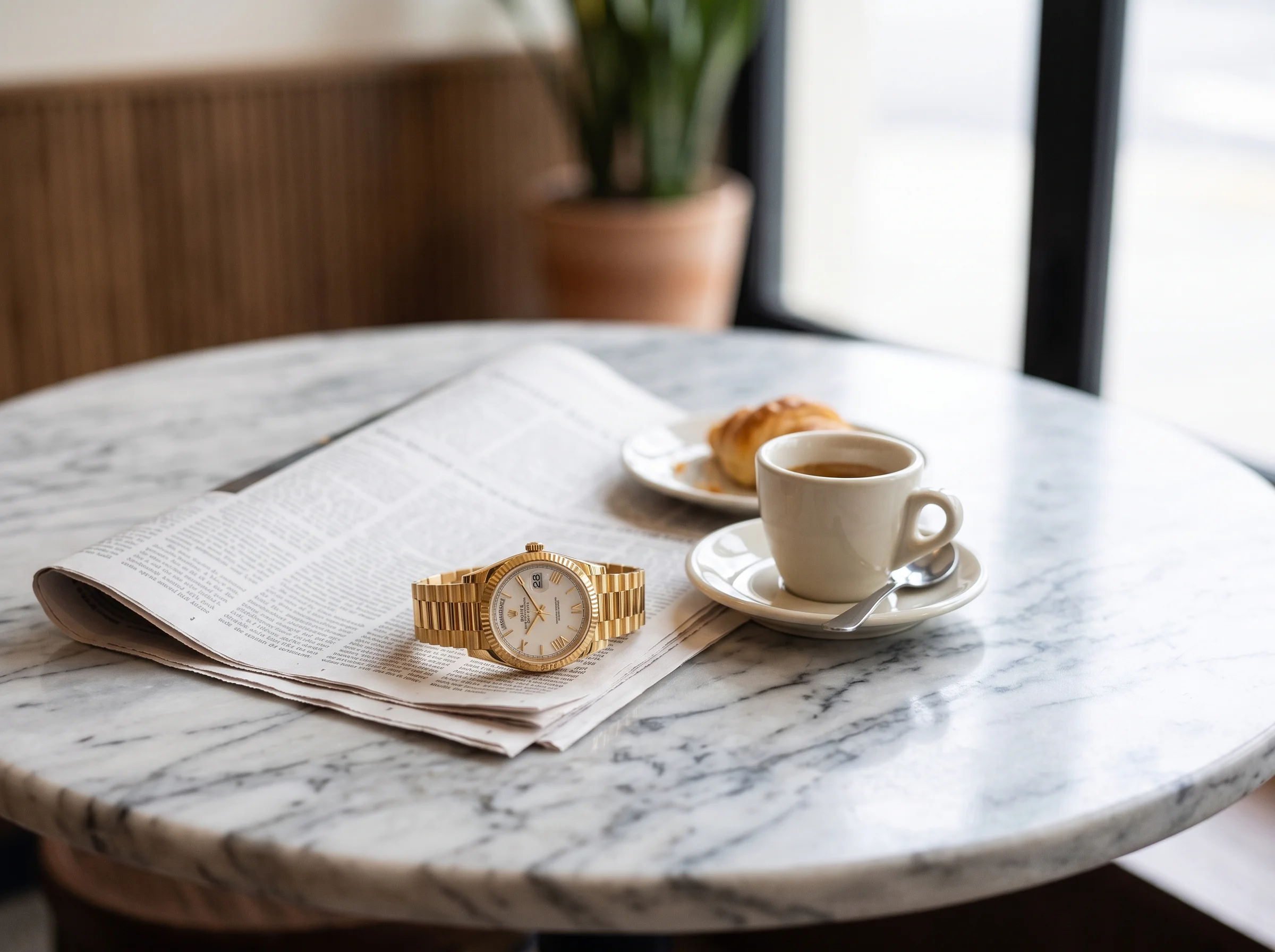
Prices swing widely by era, metal, and dial. The vintage four-digit references are the entry point, and the modern 40mm models sit at the top of the everyday range. Here is a working snapshot, drawn from current dealer and market data.
| Reference | Era and size | Pre-owned range | Source |
|---|---|---|---|
| 1803 | Vintage 36mm | $8,000 to $12,000 | Bob's Watches |
| 18038 | Neo-vintage 36mm | $12,000 to $18,000 | WatchGuys |
| 128238 | Modern Day-Date 36 | $28,000 to $35,000 | WatchGuys |
| 228238 | Day-Date 40, yellow gold | market value $50,250 | WatchCharts |
A couple of notes on those numbers. Vintage 1803 examples can dip toward $7,500 without a bracelet, since the gold bracelet is a large share of the value. At the modern end, WatchCharts lists the yellow gold 228238 at a market value of $50,250 as of June 2026, essentially level with its $50,400 retail.
The market read
The Day-Date behaves differently from Rolex's steel sport watches, and that gap is the real reason to pay attention. When the market corrected in 2022, the Day-Date average fell about 20 percent, while many steel references dropped 40 percent or more, according to Bob's Watches transaction data. It then stabilized and climbed back above $30,000 on average by late 2025.
The recent trend has run upward. WatchCharts shows the 228238 up 15.8 percent over the past year, ahead of the broader Rolex index. Across the whole collection, WatchCharts puts the average Day-Date near $38,000, spanning roughly $9,000 to $114,000 by metal, dial, and rarity. Rolex also added a Day-Date 40 in a new Jubilee gold alloy (ref. 228235JG) with a green aventurine dial at Watches and Wonders 2026, as covered by Chrono24.
How to buy one the smart way
The vintage route is the honest value play. A yellow gold 1803 at $8,000 to $12,000 buys real Day-Date history, the pie-pan dial, and a warm acrylic crystal, for less than the premium some steel sport Rolexes now carry over retail. If you want modern proportions and the latest movement, the Day-Date 40 is the target, though you pay for it.
Three details move the price more than anything else:
- Box and papers. A complete set adds a clear premium and makes resale easier.
- Dial. Rare and colorful dials command a lot. The green Roman money dial on the 228238 sits at the top of the non-diamond range, and vintage lacquer Stella dials can multiply a watch's value.
- Bracelet condition. Older gold President bracelets stretch over the decades. The modern Day-Date 40 bracelet added ceramic inserts to fight that, so check any vintage example for stretch.
If the gold Day-Date is out of reach
The Day-Date's core idea shows up elsewhere in the catalog, sometimes for far less. If you like the day-and-date layout without the solid-gold price, our read on the relaunched Tudor Royal covers a true day-date at 40mm for a fraction of the cost. For the two-tone middle ground, the Rolesor guide explains the smart-money way into gold. And if you are weighing new against used more broadly, Rolex Certified Pre-Owned, explained breaks down what the official seal does and does not buy.
The bottom line
The President nickname is really a story about one bracelet and one president, Lyndon Johnson, dressed up over the years by Rolex advertising and a lot of secondhand retelling. The Eisenhower version makes for a good line, but it puts the wrong watch on the wrong wrist.
What holds up is the watch itself: the only Rolex made purely in gold and platinum, with a metal floor under its value and a market that moves in gentle steps rather than violent swings. For how the Day-Date stacks up against the rest of the current lineup, our 5 Best Rolex Watches to Buy in 2026 names it the pick for a statement watch. Browse authenticated pre-owned Rolex at 5dwatches.com to see where the Day-Date and its alternatives sit today.