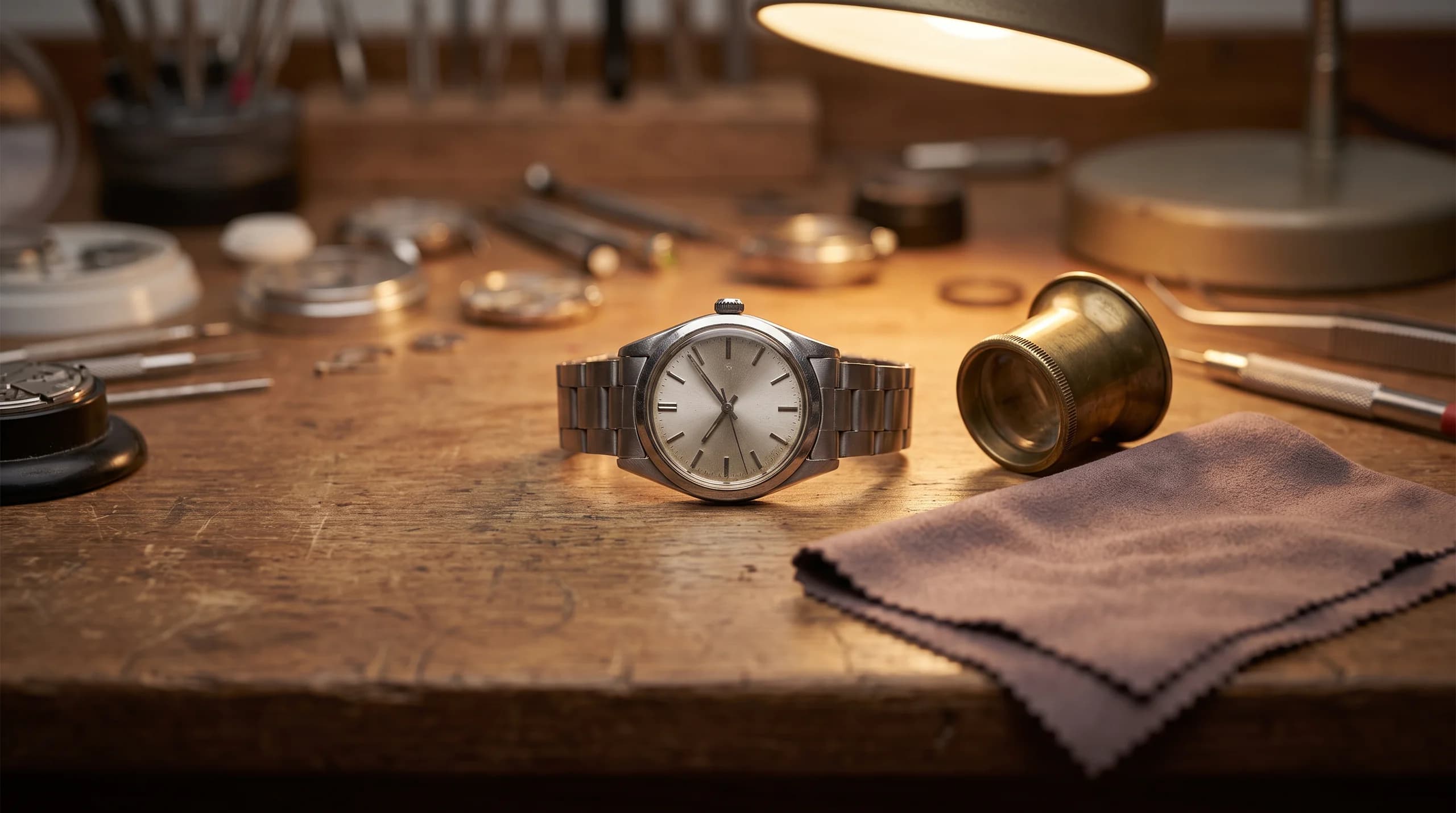
Polishing feels like a favor. You send off a tired vintage watch, it comes back gleaming, and it looks a decade younger on the wrist. The problem is that on a vintage or collectible watch, the gleam is usually the sound of value leaving the building. A buffing wheel does not add anything. It removes metal, and it removes the exact thing serious buyers are paying for.
That is the short version of a debate collectors have run for years. The longer version has real nuance, because the right answer depends entirely on what the watch is and what you want from it. Here is how a working dealer thinks about it.
The images in this article are AI-generated illustrations created for editorial purposes. They are not photographs of a specific watch offered for sale.
The short answer: for a vintage or collectible watch, do not polish it. Polishing removes irreplaceable factory metal, rounds the sharp edges collectors prize, and can wipe out a meaningful chunk of value. For a modern watch you actually wear, a careful professional polish is fine. And a proper service is not a polish, though many service centers treat it as one unless you tell them otherwise.
What polishing actually removes
Polishing is not cleaning. It grinds away a thin layer of the case to erase scratches, and that metal does not come back. In the process it softens the case architecture, the sharp lug edges, the crisp bevels, and the defined line between brushed and polished surfaces that the factory built in. Vintage dealer Eric Wind puts it plainly to Gear Patrol: buffing removes metal and changes the architecture of the case, and there is essentially no way to undo it.
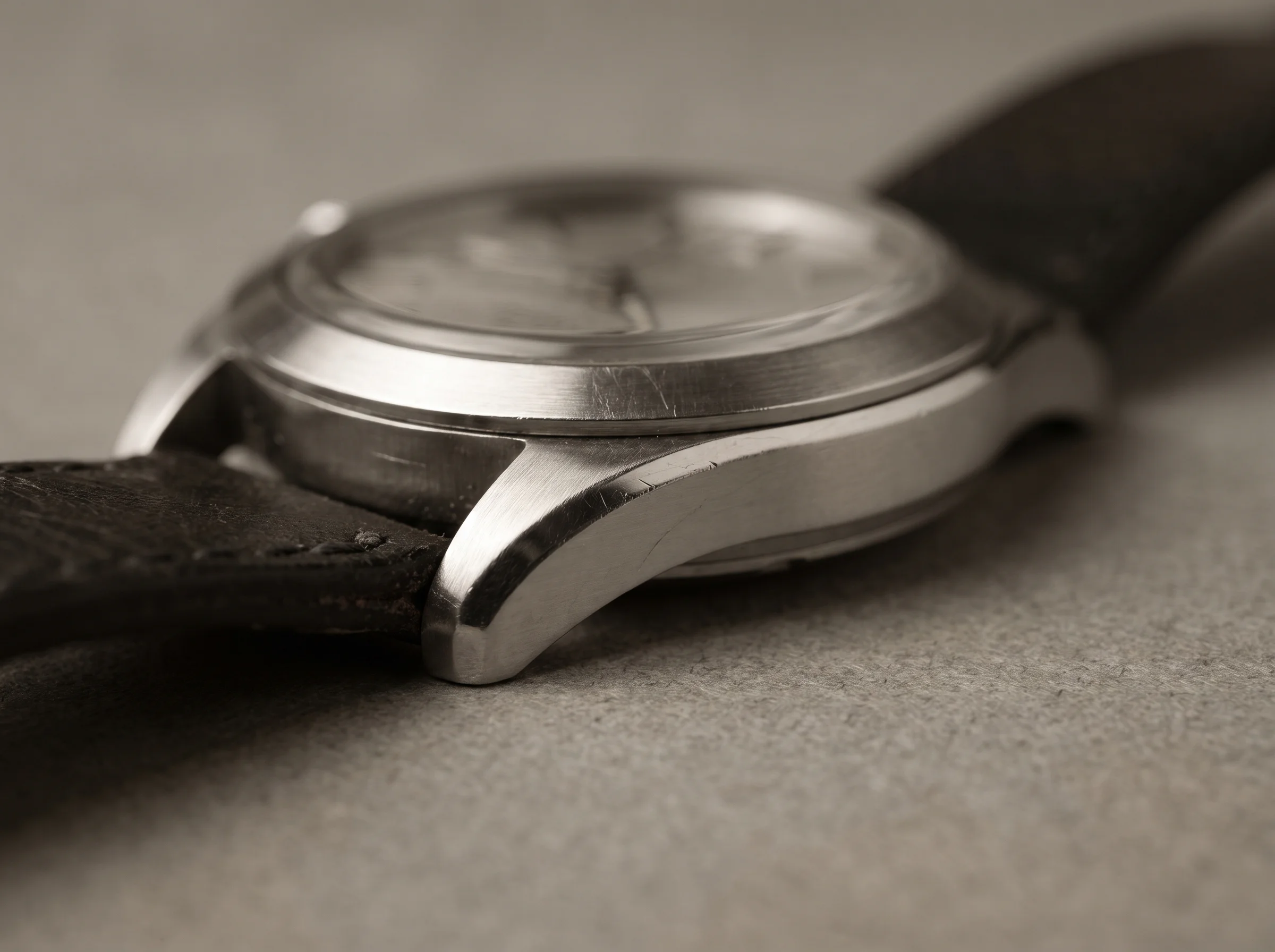 Sharp lug edges and crisp chamfers, the factory geometry a buffing wheel rounds away for good.
Collectors have a phrase for what survives: crisp lugs. Bob's Watches describes the contrast well, noting that unpolished or lightly polished cases keep thick, beveled lugs with sharp edges, while over-polished ones end up thinner and rounder with almost no edge definition. The lug holes tell the same story: sharp on an original case, enlarged and rounded once a polisher has been at them. A bad polish is not a mistake you paint over; it is permanent.
The five-refinish rule
There is a rough industry rule of thumb that a steel case can be meaningfully refinished around five times before the lines and edges are gone for good. It is a guideline, not a law. A light pass by a skilled hand can be repeated more often, and one aggressive session by a careless technician can do more damage than five careful ones. Gold and platinum make it worse, because they are softer than steel and give up more material every time, so lugs thin and engravings fade faster.
Why collectors pay for "unpolished"
Originality is the currency of vintage collecting, and an untouched case is the clearest proof of it. The most quoted example is Paul Newman's own Rolex Daytona, an unpolished, honestly worn watch that sold for $17.75 million at Phillips in 2017. The watch was far from pristine. Its originality is what the money chased.
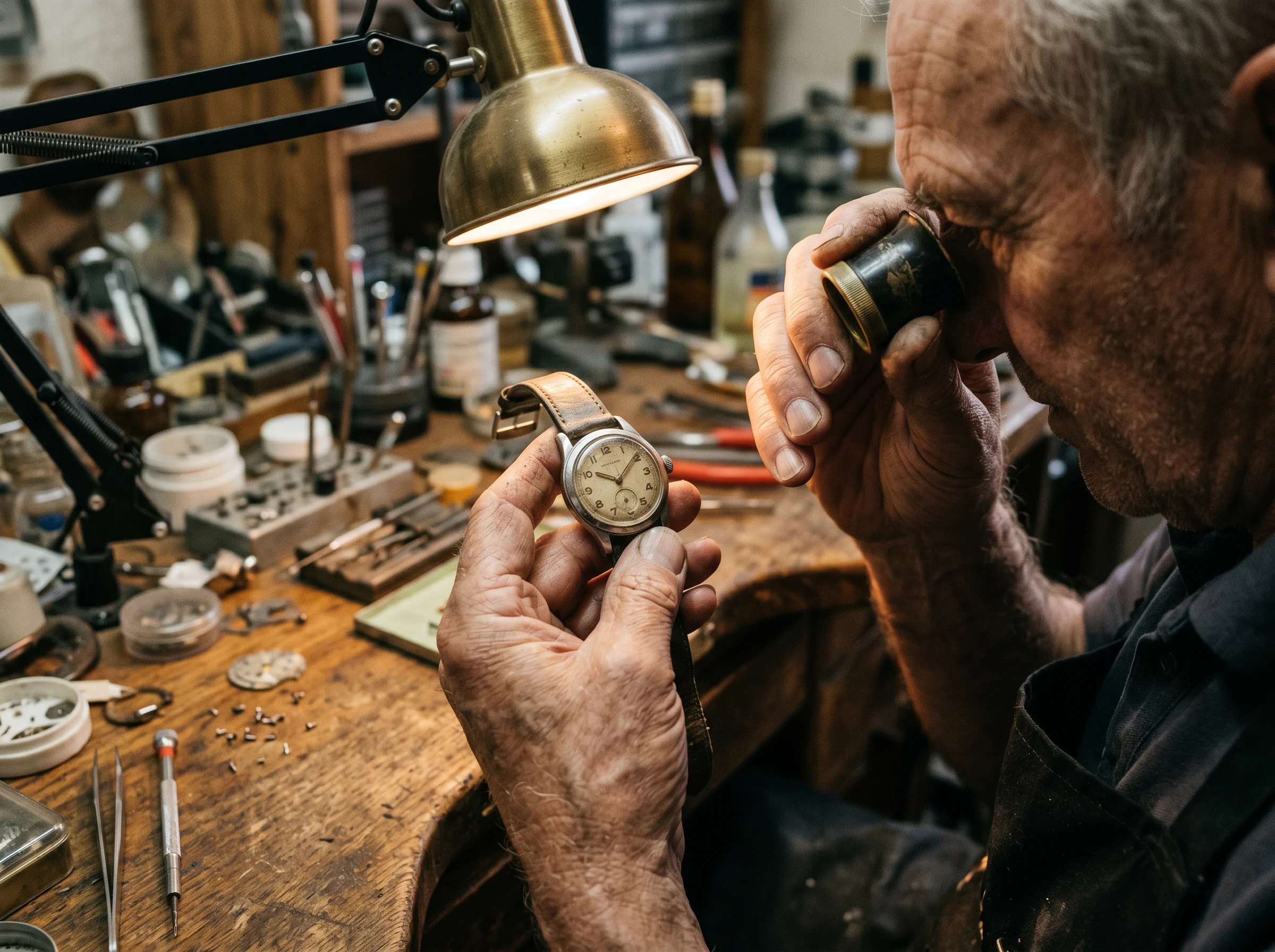
 Honest wear tells a buyer the watch is original. A mirror shine on a forty-year-old case tells them the opposite.
The same logic runs all the way down the price ladder. On the integrated-bracelet designs like the Royal Oak and Nautilus, sharp octagonal bevels and flat polished facets are the whole point, and a heavy polish blurs them and drops the value. If you are selling, the instinct to freshen it up first usually backfires. Bob's Watches, which buys pre-owned watches for a living, openly advises sellers against polishing beforehand, because it often lowers the price and costs you the service fee on top.
The catch: "unpolished" is often a lie
Here is the honest complication. Truly untouched vintage watches are rare, because most old watches were serviced at some point and quietly polished as part of that service. A large share of fifty and sixty year old sports watches have been through it at least once. So when a listing says unpolished, treat it as a claim to verify: ask for sharp macro photos of the lugs, the chamfers, and the lug holes, and judge the edges yourself.
| Case feature | Factory or unpolished | Over-polished |
|---|---|---|
| Lug edges | Sharp and defined | Rounded and soft |
| Bevels and chamfers | Crisp, even | Faint or gone |
| Lug holes | Sharp-edged | Enlarged, rounded |
| Engravings | Deep and crisp | Shallow, blurry |
| Overall finish | Brushed and polished contrast | Uniform mirror shine |
A service is not a polish
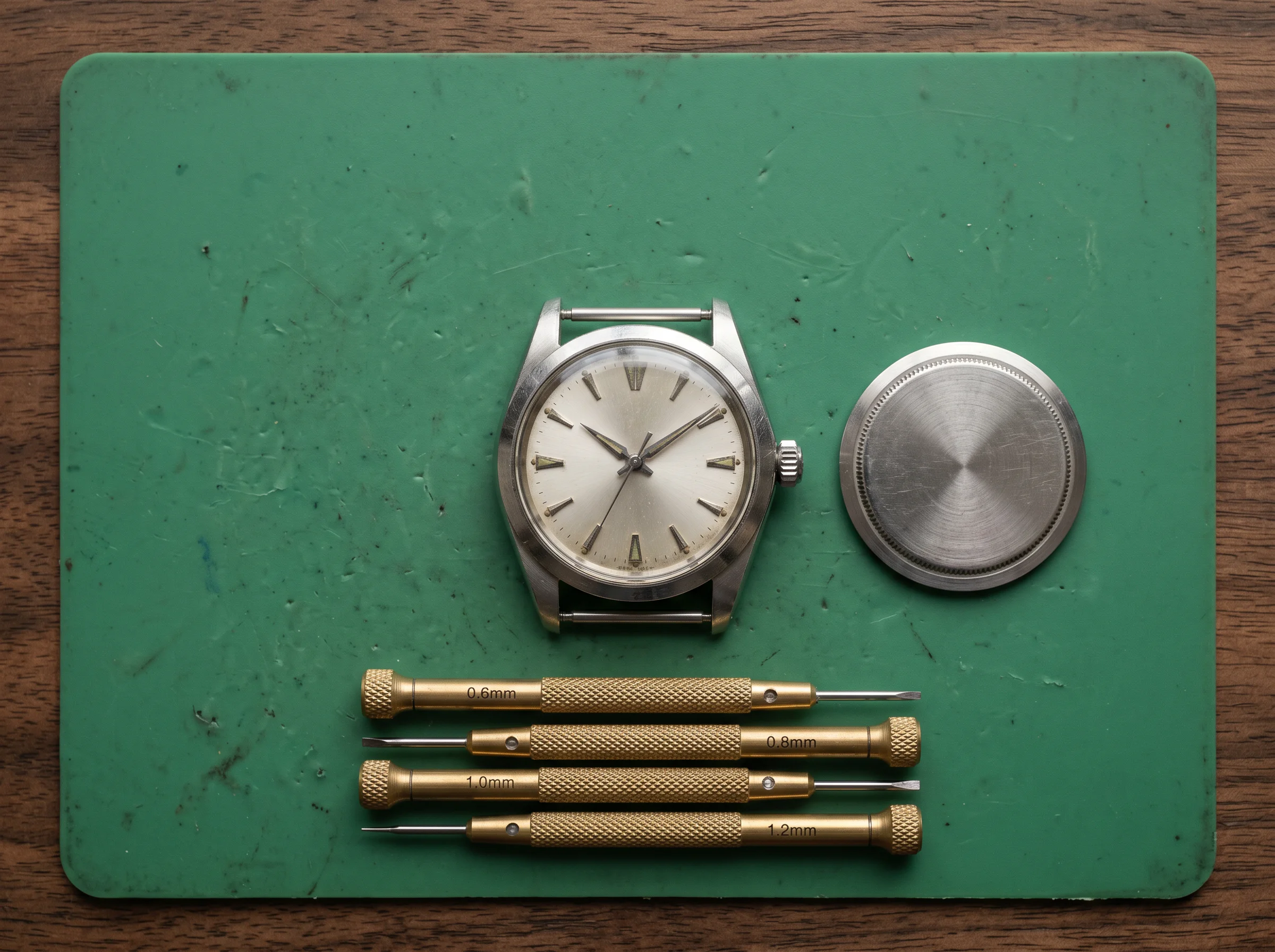
This is where people lose money by accident. A service cleans and oils the movement, replaces worn gaskets, and restores water resistance. None of that requires touching the outside of the case. Polishing is a separate, cosmetic step, and it is optional.
 A service keeps the watch running. Whether the case gets touched is a separate decision, and it is yours to make.
The trap is that many manufacturer service centers polish by default, folding it into the standard workflow unless you specifically opt out. If you care about the case, say so in writing when you hand the watch over: service only, no polishing. An independent watchmaker who understands vintage is often more willing to honor that request than a big service center, whose priorities are timekeeping and water resistance with cosmetics as an afterthought. It is the same reason service history should shape what you pay for any pre-owned piece.
When polishing is actually fine
None of this is an argument for never polishing anything. If you own a modern watch that you wear hard and you are bothered by the swirls and dings, a careful professional polish is completely reasonable, and it will look great. The value math that governs a vintage collectible simply does not apply to a current-production reference you bought to enjoy.
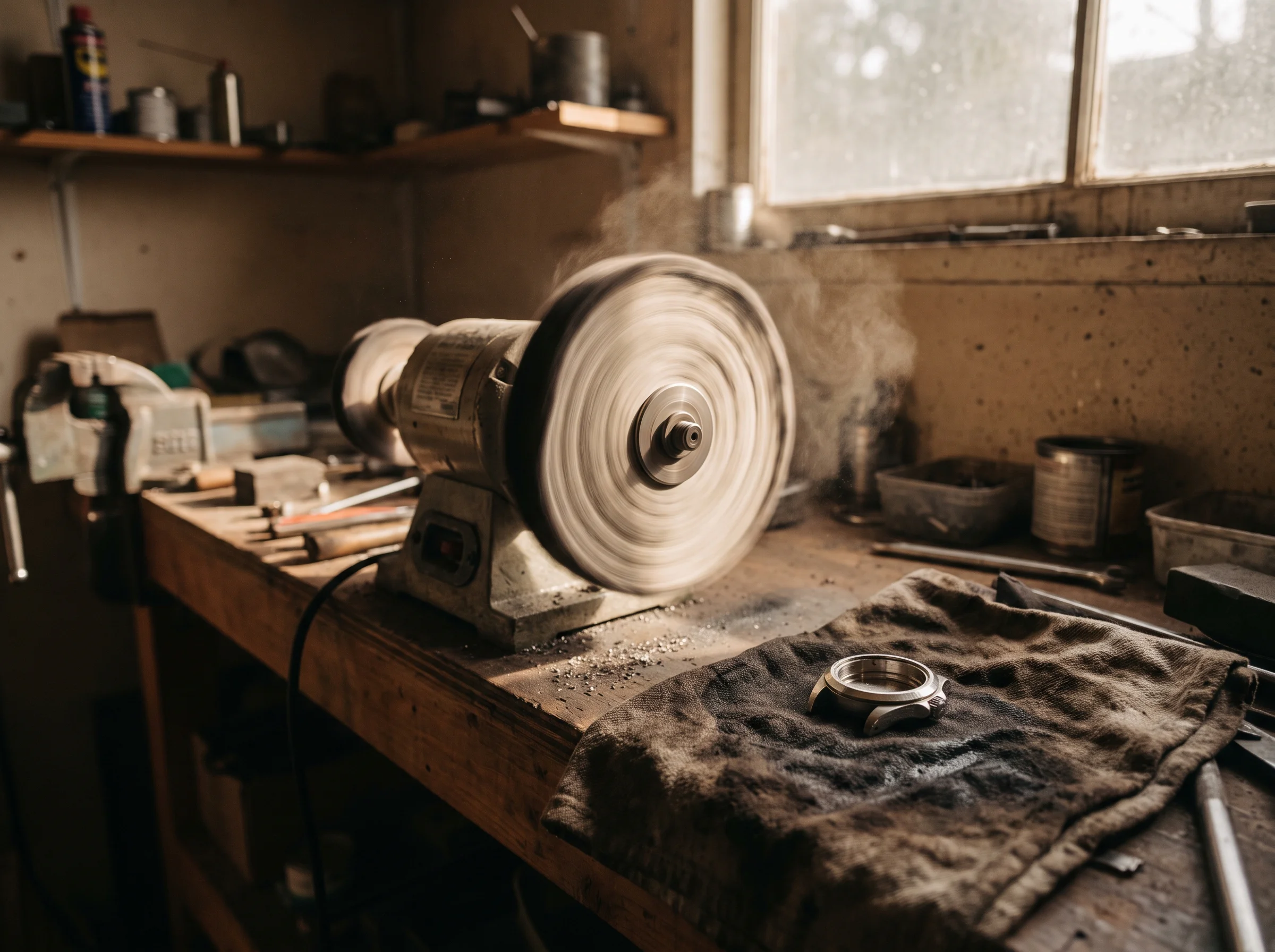 A buffing wheel in skilled hands is a tool, not a threat. The question is always the watch it is pointed at.
There is also a credible counter-view worth knowing. Some restorers argue that skilled refinishing, done with a lapping machine rather than a crude buffing wheel, can preserve case geometry and even rescue a case a previous jeweler already ruined. That work exists and it is real, but it is specialist, expensive, and the exception. For deep damage on a watch you intend to keep, ask your watchmaker whether laser welding is an option, because adding metal back and reshaping the lugs beats grinding the case down further.
The rule that survives all of it is simple. Match the decision to the watch. If it is modern and yours to wear, polish it if you like. If it is vintage, collectible, or something you may sell, the honest, original example is the one worth protecting, the same way original box and papers and unaltered, non-franken parts protect value everywhere else in this market.
Browse authenticated pre-owned Omega at 5dwatches.com.