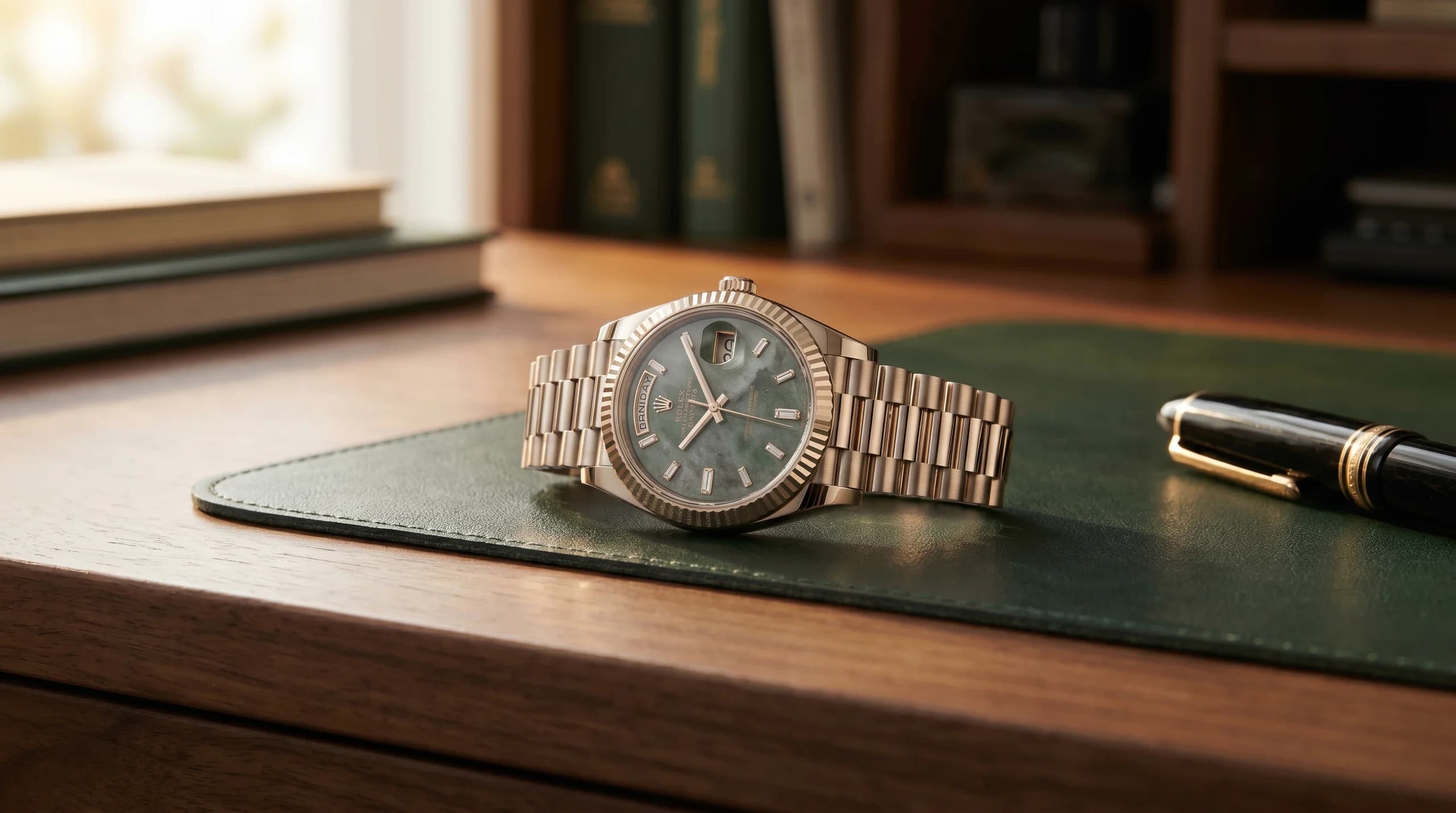
Rolex introduced its first new precious metal alloy in 21 years at Watches and Wonders 2026.
Most of the coverage missed it.
The headline release of the show was the Rolesium Daytona reference 126502: sapphire caseback, grand feu enamel dial, "Exceptional Watches" tier, the watch that broke seven decades of Rolex design convention in a single launch. The Jubilee Gold Day-Date sat in the same tier and got a fraction of the attention.
That mismatch is the story. A new gold alloy from Rolex's in-house foundry is not a once-a-year occurrence. The last time it happened was 2005, when Everose entered the catalog. The 21-year gap between Everose and Jubilee Gold sets the pace of Rolex's metallurgical innovation cycle. Whatever happens with Jubilee Gold over the next decade is the alloy story through 2040 and beyond.
This is a working dealer's read on what Jubilee Gold actually is, which two references debut it, why the rollout pattern matters, where the alloy is likely to spread next over 24 to 36 months, and what pre-owned buyers should actually do while the new alloy is allocation-only at retail.
All images in this post are AI-generated and may not perfectly represent the actual watch references discussed. They are intended for illustration only.
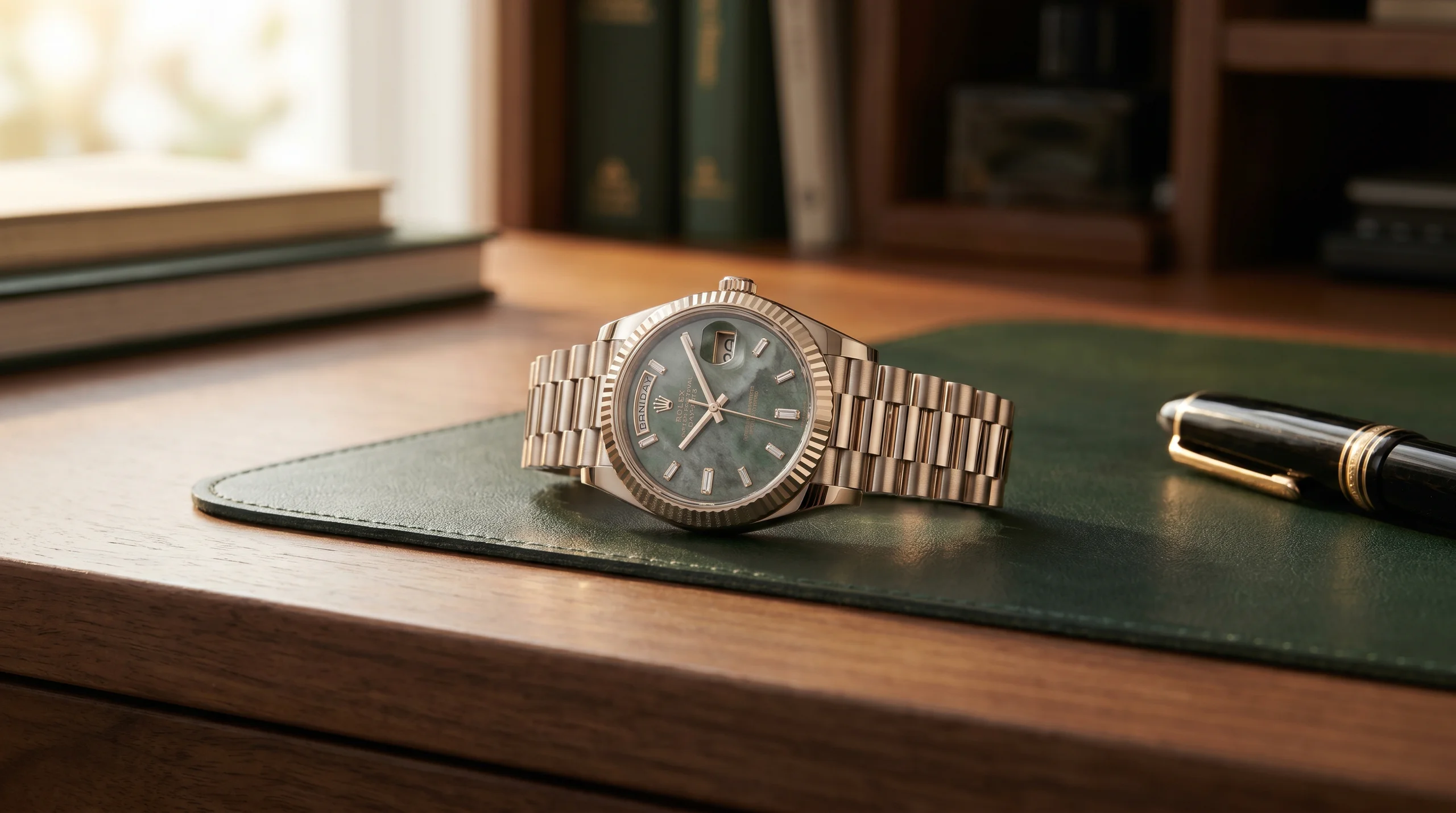
The Rolex Day-Date 40 reference 228235JG-0003 in Jubilee Gold with the green aventurine stone dial. The alloy reads softer than yellow gold and paler than Everose, with a hint of warm gray when light hits the polished surfaces.
The short answer
Jubilee Gold is Rolex's new proprietary 18k gold alloy, developed and produced in-house at the brand's foundry in Plan-Les-Ouates, Geneva. It is Rolex's first new precious metal alloy since Everose debuted in 2005. The color sits between yellow gold and rose gold with a softer, paler tone that Rolex describes as combining "tender yellow, warm gray, and soft pink." The alloy debuted at Watches and Wonders 2026 on two Day-Date 40 references: 228235JG-0003 with a green aventurine stone dial and 10 baguette-cut diamond markers at $62,700 USD, and 228235JG-0002 with a gold leaf motif dial and applied Roman numerals. Both are off-catalog pieces in Rolex's "Exceptional Watches" tier alongside the Rolesium Daytona, available only through select authorized dealers to existing loyal clients. The full Oyster case, fluted bezel, and President bracelet (with ceramic inserts on the solid links) are crafted from Jubilee Gold. The movement is the caliber 3255 with a 70-hour power reserve and Rolex's strengthened 2026 Superlative Chronometer certification. For most buyers, the alloy is functionally inaccessible. The pre-owned Everose Day-Date 40 at $30,000-$38,000 is the sensible alternative.
What Jubilee Gold Actually Is
Jubilee Gold is an 18k gold alloy, meaning 75 percent pure gold by mass with 25 percent other metals making up the remaining quarter. The specific composition is proprietary, and Rolex has not disclosed the breakdown of the alloying metals.
The visible result is a tone that sits between traditional yellow gold and Everose. Monochrome's hands-on coverage describes it as "less brash than yellow gold, warmer than white gold, but not quite as warm or coppery as rose gold." aBlogtoWatch's review reads it as "pale gold" with a hue that mimics the tone of older gold alloys as they fade over decades of wear. Rolex's own marketing positions Jubilee Gold as a unification of the brand's three other gold tones (yellow, white, Everose) in a single material.
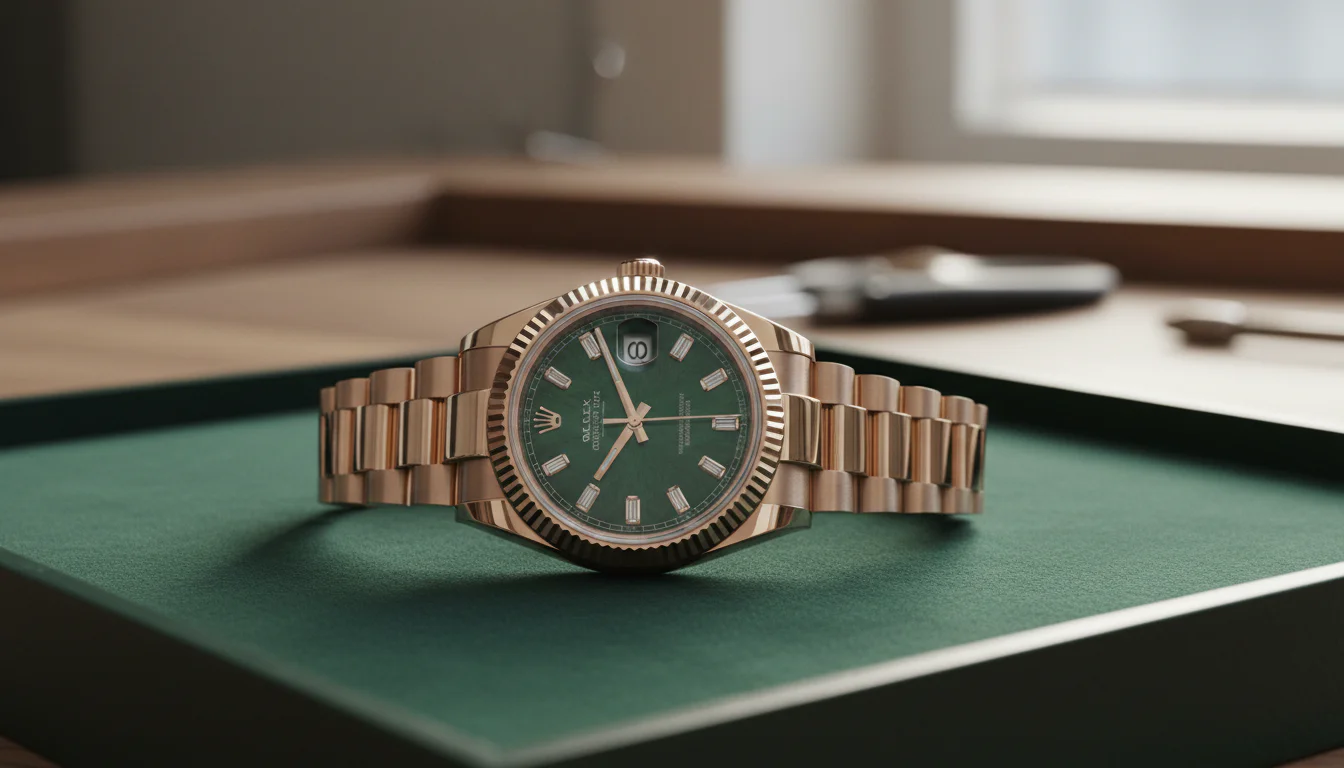
The President bracelet in Jubilee Gold. Three-piece solid link architecture with polished center links and satin-brushed outer links. Ceramic inserts hidden between links reduce wear over decades of daily use. The concealed Crownclasp keeps the bracelet line uninterrupted.
The technical execution matters as much as the color. Rolex produces Jubilee Gold entirely at the brand's metallurgical operation in Plan-Les-Ouates, Geneva, where Oystersteel, Everose, and the existing yellow and white gold alloys are also produced. Every component of the Day-Date 228235JG is Jubilee Gold: the case middle, the fluted bezel, the President bracelet's three-piece solid links (with the standard ceramic inserts to reduce friction wear between links), the applied Rolex coronet on the dial, the diamond settings, and the hand frames around the weekday and date displays.
The 21-Year Context
This is the first new precious-metal alloy from Rolex since Everose (the brand's proprietary rose gold formulation) was introduced in 2005. Before Everose, the alloy lineup was yellow gold, white gold, and platinum. Including Oystersteel, Rolesor (steel + gold combinations), and RLX titanium (introduced in 2023 on the Yacht-Master 42 Titanium), Jubilee Gold expands Rolex's material catalog to nine distinct material families.
The 21-year gap is not random. Rolex's foundry-side innovation cadence runs on multi-decade cycles because the design constraints of a new alloy are not just metallurgical. The alloy has to behave consistently across the brand's production scale, polish acceptably with existing finishing equipment, age predictably over decades on customers' wrists, and integrate with the brand's color and design language across hundreds of references. That kind of validation does not happen in two years.
The Two Day-Date References That Debut the Alloy
Most new Rolex materials debut on a single hero reference. Jubilee Gold debuted on two. Both are Day-Date 40 variants in the "Exceptional Watches" tier, both reference codes carry the "JG" suffix that denotes Jubilee Gold.
Reference 228235JG-0003: Green Aventurine and Diamonds
The widely-photographed launch piece. The 40mm case, fluted bezel, and President bracelet are Jubilee Gold. The dial is natural green aventurine stone with subtle gray inclusions. The hour markers are 10 baguette-cut diamonds. The hands, weekday arc frame at 12, and date frame at 3 are Jubilee Gold. The applied Rolex coronet is Jubilee Gold. The diamond settings are Jubilee Gold.
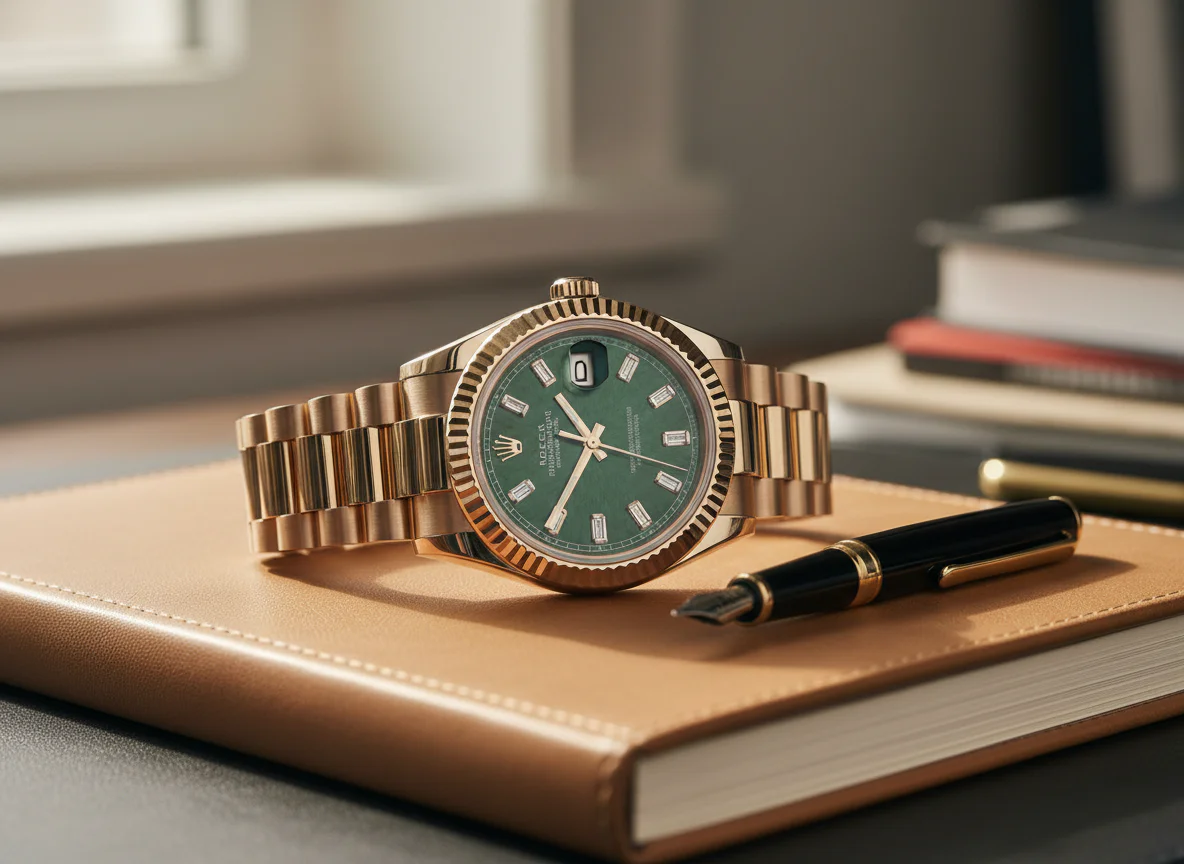
Three-quarter view of the 228235JG-0003 showing the case profile, fluted Jubilee Gold bezel, and President bracelet architecture. The 40mm Oyster case measures 12mm thick and carries 100 meters of water resistance via the Twinlock screw-down crown.
Watch Collecting Lifestyle's live coverage puts the retail at $62,700 USD. The Day-Date 70th anniversary (the model launched in 1956) and the Oyster centenary (the case launched in 1926) converge on this single reference.
Reference 228235JG-0002: Gold Leaf Motif Dial
The second launch reference is less photographed but arguably the more wearable execution. Same 40mm Jubilee Gold case, same fluted bezel, same President bracelet. The dial is a gold leaf motif with applied Roman numeral hour markers, which reads dressier and more classical than the diamond-and-aventurine variant. Rolex has not published US retail for this reference; it sits in the same off-catalog allocation pool.
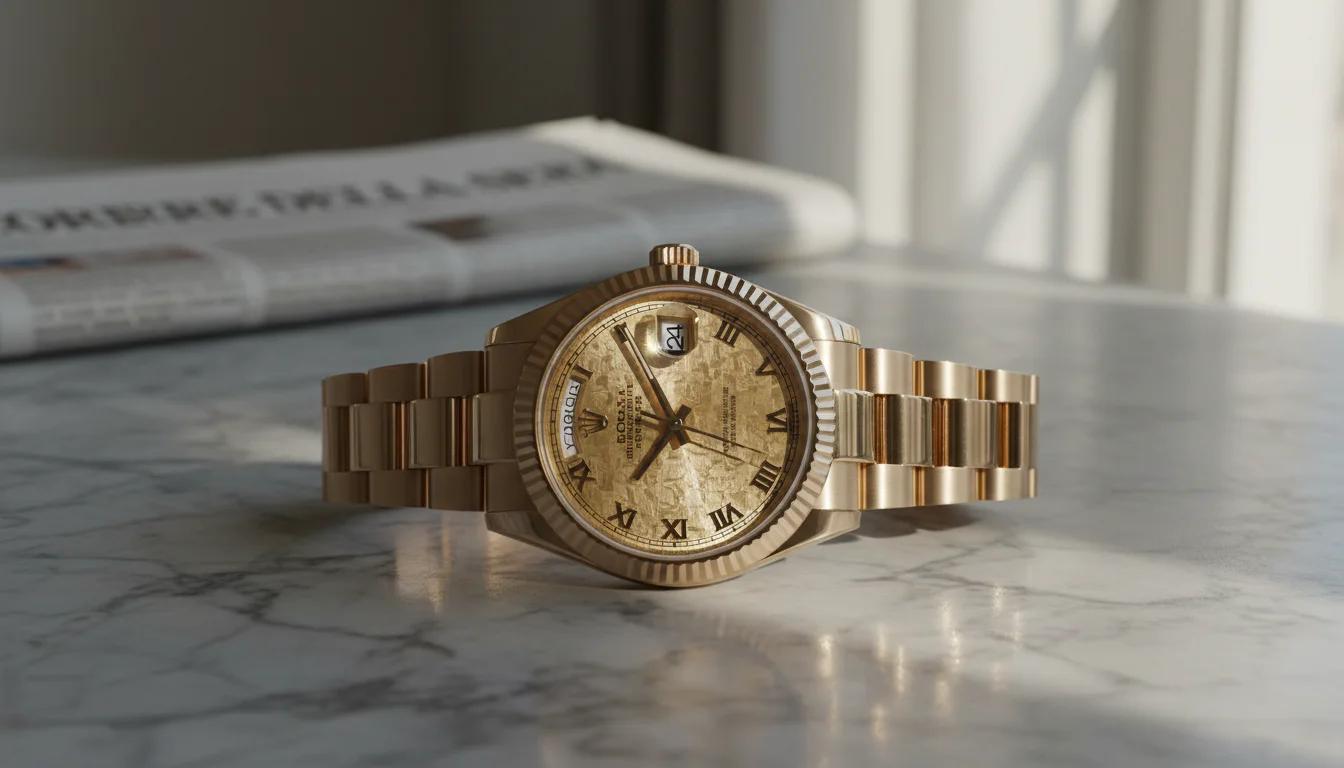
The 228235JG-0002 gold leaf motif variant. The textured dial pattern catches light with a dimensional shimmer that reads dressier and more classical than the diamond-and-aventurine 0003 reference. Two debut references signal broader catalog intent for the alloy.
Oracle of Time's W&W 2026 roundup flags this dual-reference debut as a deliberate move. Most new Rolex materials launch on a single signaling piece. Two simultaneous references signals broader catalog intent.
Why This Matters: The Three Firsts
First New Rolex Alloy in 21 Years
The Everose-to-Jubilee gap is the longest interval between new precious-metal alloy introductions in modern Rolex history. The signal: when Rolex introduces a new alloy, it represents a multi-decade commitment to that material. Buyers who acquire a Jubilee Gold piece in 2026 own the first generation of an alloy that will define a Rolex material story through 2040 and beyond.
First Alloy to Debut on Two References Simultaneously
Everose debuted on the Day-Date in 2005 as a single reference initially. Jubilee Gold debuted on two Day-Date 40 variants at the same show. The pattern signals Rolex's intent to develop Jubilee Gold as a category rather than a single signaling piece. The dual-reference launch is the foundation for an expanded Jubilee Gold rollout in subsequent years.
Off-Catalog "Exceptional Watches" Tier Placement
The 2026 "Exceptional Watches" tier contains exactly two pieces: the Rolesium Daytona 126502 and the Jubilee Gold Day-Date 228235JG. Both are off-catalog (not listed in standard Rolex.com production catalogs), both are allocation-only to select clients, both represent the brand's highest-flex hand-finished output for the centennial year. The tier didn't exist as a formal Rolex marketing category before 2026. Watch this tier in coming years as Rolex's signal for what the brand considers genuinely exceptional rather than standard catalog material.
Strategic Implications: What to Watch For Next
The Datejust 41 Is the Most Likely Next Reference
Rolex's pattern with new materials follows a predictable rollout sequence: debut on the most prestigious model (Day-Date), then expand to the highest-volume models (Datejust), then to professional sport references where appropriate (GMT-Master II, Submariner, Yacht-Master, Daytona).
Everose followed this pattern. Debuted on the Day-Date 40 in 2005. Expanded to the Datejust 36 and Daytona within the next 24 months. By 2010, Everose was a full material category across the catalog.
The Jubilee Gold rollout should follow the same trajectory. The most plausible next reference is the Datejust 41 in Jubilee Gold, likely in 2027 or 2028 W&W. Watch for full Jubilee Gold variants on the Datejust 36 to follow within 12 months of the Datejust 41 introduction.
Whether Jubilee Gold expands to Rolex's professional sport references is the harder question. Yellow gold and Everose appear on the GMT-Master II, Submariner, and Yacht-Master. The Jubilee Gold tone reads dressier and softer than those alternatives, which may keep it within dressy collections (Day-Date, Datejust) rather than spreading to sport configurations.
The 21-Year Cadence Signals Slow Material Innovation
Everose was introduced in 2005. Jubilee Gold landed in 2026. The 21-year cycle is the closest thing to a metallurgical cadence Rolex has published. Don't expect another new Rolex precious-metal alloy before 2040. Jubilee Gold is the brand's alloy story for the next 15-plus years.
That timeline matters for collectors. A first-year Jubilee Gold piece in 2026 represents the genesis of a material that will define Rolex's high-end metallurgy through the foreseeable future. The investment thesis (if a buyer is thinking that way) is the same as buying first-year Everose in 2005: early generation, longest possible appreciation window.
The "Exceptional Watches" Tier Is Becoming Rolex's Halo Category
Le Mans Daytona (2023). Rolesium Daytona (2026). Jubilee Gold Day-Date (2026). Three references in three years, all off-catalog, all hand-finished, all allocation-only.
Rolex has historically released halo pieces sporadically. The "Exceptional Watches" tier formalizes the category. Watch this tier as the brand's signaling channel for genuinely scarce, premium-finished pieces over the next decade.
The strategic effect on retail: tier-above pricing pulls buyers who can't land allocations into the next-best-option references. The Rolesium Daytona pulls into the standard 126500LN Panda. The Jubilee Gold Day-Date pulls into the existing yellow gold, Everose, and platinum Day-Date 40 references. The "Exceptional Watches" tier doesn't replace catalog production. It pressurizes it.
For broader strategic context on Rolex's 2026 catalog moves, see our Rolesium Daytona breakdown and the full Day-Date President guide.
What Pre-Owned Buyers Should Actually Do
The Jubilee Gold Day-Date is functionally inaccessible for most buyers. Off-catalog status means it is not available through standard authorized dealer channels. Allocation goes to existing loyal clients with established Rolex relationships, and even those clients are competing for very limited annual production. Grey market premiums on these pieces will likely run 50 to 100 percent above retail for the first two to three years.
The pre-owned alternatives are where the actual buy decisions sit.
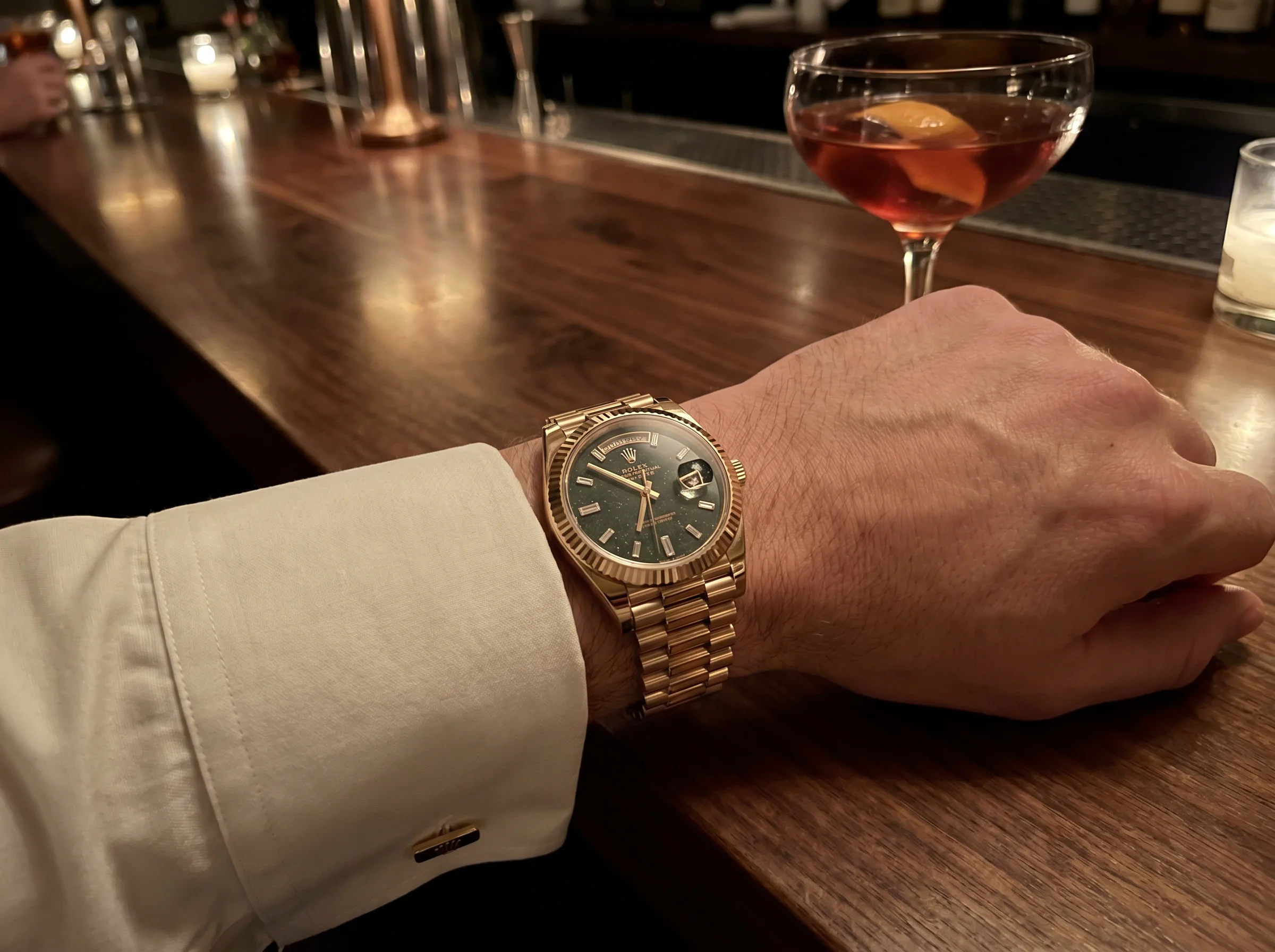
The Day-Date 40 on the wrist in evening light. The Jubilee Gold tone reads softer than yellow gold against a white shirt cuff and sits within the dressy register that pre-owned Everose and yellow gold Day-Date 40 references already occupy at half the retail.
The Everose Day-Date 40 at $30,000-$38,000 Pre-Owned
The Everose Day-Date 40 reference 228235 (the standard non-JG variant) trades in the $30,000-$38,000 range pre-owned with full set. Same 40mm Oyster case, same President bracelet, same fluted bezel, same caliber 3255 movement, same 100m water resistance. Different alloy, but the ownership experience is functionally identical. For most buyers attracted to the dressy presence of a precious-metal Day-Date 40, the Everose pre-owned route delivers 90 percent of the experience at 50 percent of the new Jubilee Gold retail.
The Everose version also has 21 years of secondary-market price discovery behind it, which means buyers know what they are paying for and what the watch is likely to be worth in five years. Jubilee Gold doesn't have that history yet.
The Yellow Gold Day-Date 40 228238 at $28,000-$35,000 Pre-Owned
For buyers who prefer the warmer, more traditional gold tone, the standard yellow gold Day-Date 40 reference 228238 trades $28,000-$35,000 pre-owned. Same case, same bracelet, same movement, same Day-Date dignity. The yellow gold has the longest pricing history of any Day-Date material, the cleanest pre-owned market liquidity, and the broadest collector recognition.
For deeper guidance on choosing between Day-Date references, see our complete Day-Date 'President' buying guide.
The Yellow Gold Datejust 36 at $26,000-$32,000 Pre-Owned
The more pointed counter-positioning: for most buyers attracted to gold Rolex dignity at a dressy size, the Yellow Gold Datejust 36 delivers 80 percent of the same wearable experience at roughly half the Day-Date 40 retail.
The Datejust does not carry the President bracelet or the day-of-week display, which are the two most distinctive Day-Date features. For buyers who care about those specifically, the Day-Date premium is justified. For buyers who want a 36mm or 40mm precious-metal dress Rolex, the Datejust represents the most sensible entry point into the gold side of the catalog.
The Pre-Owned 228235 With Olive Green Dial as the Sleeper
The pre-owned Everose Day-Date 40 reference 228235 with the olive green sunburst dial (the standard non-JG, non-aventurine variant) is the underpriced piece of this conversation. Same case, same movement, same anniversary year context, deep green dial that reads close to the new Jubilee Gold aventurine reference. Trades $32,000-$36,000 pre-owned. The closest pre-owned analogue to the Jubilee Gold debut piece without the allocation game.
The Honest Take
The Jubilee Gold introduction is the kind of move that gets less attention than it deserves because it sits in a non-photogenic adjacent space. The Rolesium Daytona has the immediate visual story: sapphire caseback, grand feu enamel dial, breaking decades of design convention. The Jubilee Gold Day-Date has the longer-arc strategic story: a new alloy that will spread across the catalog over 15-plus years and define Rolex's high-end metallurgical positioning through 2040.
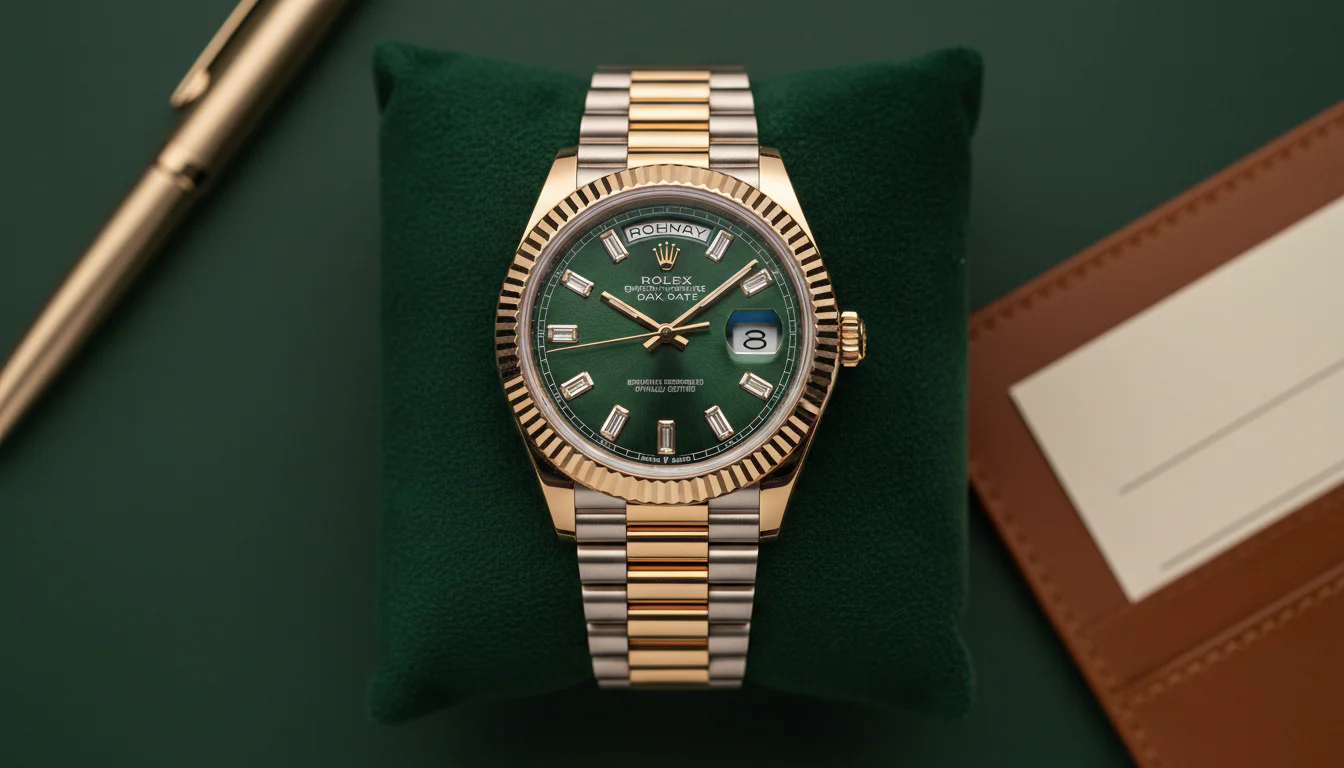
The Jubilee Gold Day-Date 40 in repose. First-year pieces in this alloy represent the opening position in a material that will define Rolex's flagship metallurgy through the next 15-plus years.
For watch collectors thinking at the catalog level, this is the more consequential 2026 release. The Rolesium Daytona is one watch. Jubilee Gold is a material that will appear on dozens of references over the coming decade.
For buyers thinking at the wrist level, the answer is different. The Jubilee Gold pieces are allocation-only, premium-priced, and will be effectively unobtainable for most of the addressable buying audience for the next two to three years. The smart move is to position in adjacent references that benefit from the upmarket pull without paying the allocation premium. Pre-owned Everose Day-Date 40 at $30,000-$38,000 is the cleanest version of that play.
The 21-year cadence between Everose and Jubilee Gold also caps speculation. If Rolex's next new alloy isn't due until roughly 2047, the Jubilee Gold story is going to compound slowly. First-year pieces today are an early position in a material that will define Rolex's flagship metallurgy for the next two decades. That is the actual investment thesis, separate from the immediate aesthetic question of whether the Jubilee Gold tone resonates with any given buyer's preferences.
For Rolex's broader 2026 catalog moves and how Jubilee Gold connects to the rest of the centenary year strategy, see our Rolesium Daytona analysis and the full Day-Date 'President' guide. For the macro market context that frames why off-catalog allocation games matter more in 2026 than in prior years, see the tariff and gold pricing analysis.
The Jubilee Gold Day-Date is the watch most readers won't be buying. It's also the release that quietly tells you the most about where Rolex is heading.
Browse authenticated pre-owned Rolex Day-Date watches at 5dwatches.com.