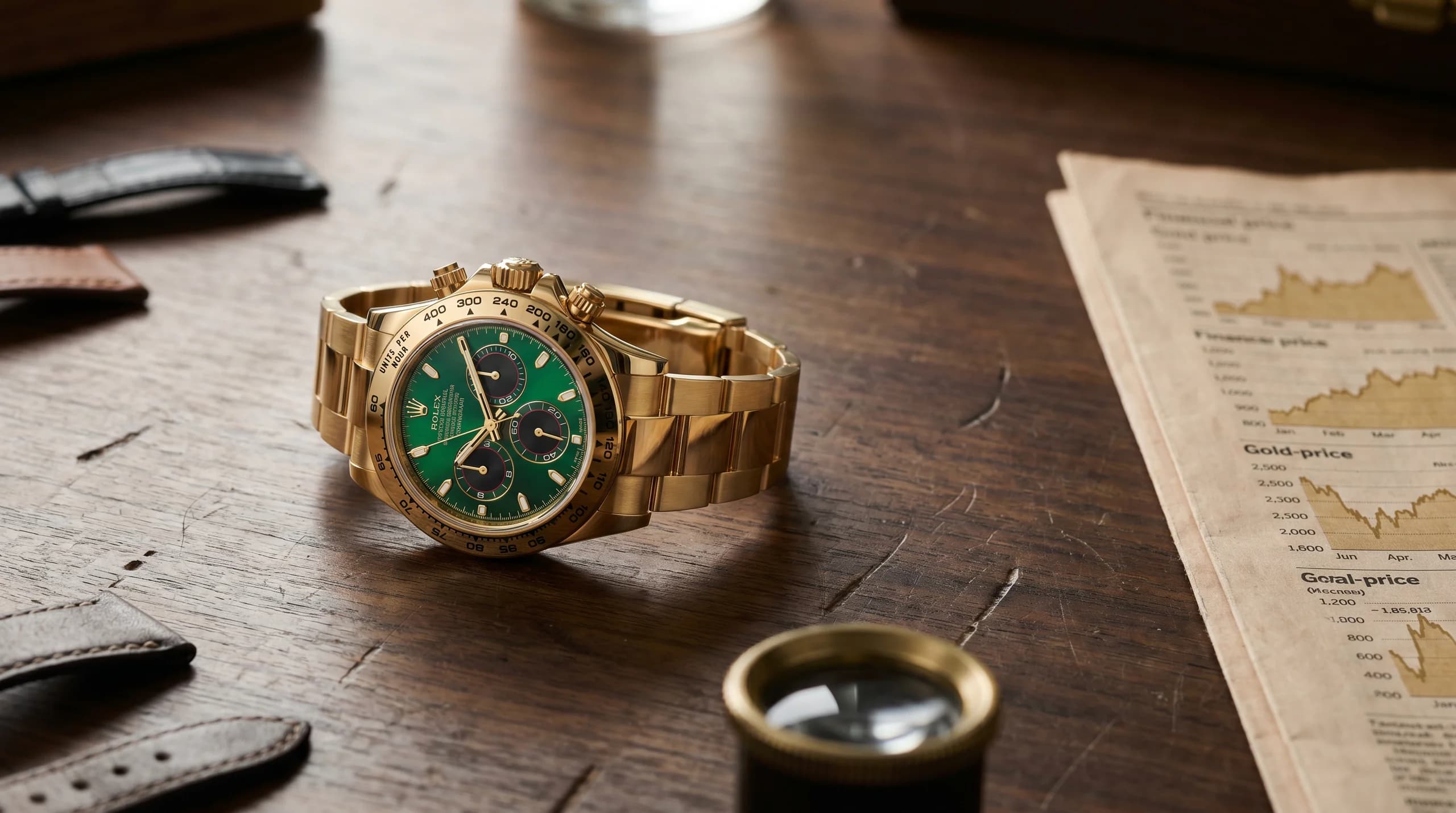
Gold hit an all-time high of $5,589 per ounce on January 28, 2026. As of Monday's open, May 25, 2026, spot trades at $4,562. That is an 18.4% correction in roughly four months, after a 64% run in 2025 (the biggest single-year gain for gold since 1979). The pullback hit its low of $4,694 on May 12, then partially recovered. Through it all, the structural drivers (central bank buying, fiscal pressure, geopolitical risk) have not reversed.
The watch market angle is not about whether gold finishes the year at $4,500 or $6,000. The angle is about timing. When Rolex set its January 1, 2026 retail prices, the company was pricing in a gold curve that pointed up and to the right. That curve flattened. Whether the company defers, skips, or holds its telegraphed mid-year increase is now a live question that affects pre-owned gold watch buyers in ways most retail-watching coverage is missing.
All images in this post are AI-generated and may not perfectly represent the actual watch references discussed. They are intended for illustration only.
The Short Answer
The gold spot correction has not yet fully translated into pre-owned gold watch pricing. Pre-owned markets lag spot by roughly 60 to 90 days. Spot started correcting in early February. We are now in the window where pre-owned gold pricing should be reflecting the lower spot environment, but the market is still partially priced for the January peak.
That gap is the buying window. Yellow gold Daytonas, Day-Date Presidents, and the broader pre-owned gold Rolex inventory are trading at meaningful discounts to current retail. Whether that window closes (gold rallies back, Rolex executes its mid-year increase) or widens (gold trades sideways below $5,000, Rolex defers the mid-year move) depends on the next 60 to 90 days.
For buyers who have been waiting for gold-watch pricing rationality, the window is open now. It is unlikely to stay open at this width indefinitely.
The Numbers: ATH to Today
The trajectory in chronological context:
| Date | Gold Spot | Move |
|---|---|---|
| Dec 31, 2024 | ~$2,640 | — |
| Dec 31, 2025 | ~$4,331 | +64% YoY |
| Jan 20, 2026 | $4,736 | New ATH |
| Jan 28, 2026 | $5,589 | Peak ATH |
| Feb 6, 2026 | $4,863 | -13% from peak |
| May 12, 2026 | $4,694 | -16% from peak |
| May 25, 2026 | $4,562 | -18.4% from peak |
The January spike was driven heavily by gamma trading in the options market: aggressive call-option buying forced market makers to chase spot to maintain hedges, producing parabolic late-January gains. The Chicago Mercantile Exchange responded with a series of margin-requirement hikes starting January 13, shifting from fixed-USD margins to notional-percentage margins. The CME action was the proximate cause of the February correction.
The structural backdrop has not reversed. Central banks net-purchased 244 tonnes in Q1, up 3% year-over-year. The PBoC extended its consecutive monthly gold-buying streak to 17 months through April. US inflation hit 3.8% in April, the highest since May 2023. The case for gold as a structural hedge remains intact. What changed is the speculative overshoot got worked off.
Institutional 2026 forecasts span a wide range. HSBC's average for the year sits at $4,587, with a 2026 range of $3,950 to $5,050 and a year-end target of $4,450. JPMorgan carries a Q4 target of $6,300. Wells Fargo year-end range is $6,100 to $6,300. BNP Paribas projects a 2026 peak of $6,250. Westpac sees a structural floor of $4,500 to $5,000 through 2030. The dispersion across major forecasters is the largest in any commodity right now.
What Rolex Priced In at January 1
Rolex executed its annual price adjustment effective January 1, 2026. Steel references absorbed 2 to 6%. Two-tone Rolesor saw 4.5 to 6%. Full-gold references absorbed 5 to 10% depending on model. Platinum sat in the middle at 3.5 to 4.5%.
The gold-side increases were the headline:
| Reference | January 2026 Move |
|---|---|
| Yellow gold Daytona 116508 | +14% (largest single move in catalog) |
| White gold Daytona 126509 | Now retails above $56,400 |
| Yellow gold Day-Date 40 228238 | +6.4% to ~$40,250 |
| Yellow gold Day-Date 40 (Jubilee Gold) | $44,000 → $48,000 (+9%) |
| Sky-Dweller gold references | +8-9% |
| Two-tone Rolesor (Submariner, GMT Rootbeer) | +4-6% |
 The yellow gold Day-Date 40 228238 absorbed a 6.4% MSRP increase in January, with the broader Day-Date 40 yellow gold range moving from $44,000 to $48,000 at retail. The pre-owned market trades comfortably below that current retail figure.
The January Rolex memo cited "rising raw material costs, tariff pressures on Swiss imports, and weakening of the U.S. dollar against the Swiss franc." That memo was written in late November and early December 2025, when gold was running parabolic into the January ATH. The 14% Yellow Gold Daytona move was Rolex telegraphing confidence that gold would sustain at or above $5,000 through mid-year. Industry analysts at the time read the increase pattern as pre-positioning for a second adjustment by July if gold held those levels.
We covered the full mechanics in The 15% Tariff and Gold at $4,500: A Working Dealer's Read on the 2026 Pre-Owned Market earlier in May. That piece treated the high gold environment as the operating reality. This piece updates the read with three additional weeks of data and a 5% lower spot price.
The Pre-Owned Gold Watch Lag
Pre-owned gold watch prices do not move in lockstep with gold spot. The lag is generally 60 to 90 days between a spot move and the corresponding pre-owned shift. Three reasons drive the lag:
1. Inventory turn time. A pre-owned dealer who acquired inventory at higher metal pricing (Q4 2025, Q1 2026) is not going to mark inventory down inside 30 days. The pricing on inventory acquired at peak gold rolls forward through normal turn cycles.
2. The reference-watch premium absorbs metal-price moves. For high-demand references (Daytona, Day-Date, Patek Calatrava in gold), the premium over melt value is structural. Gold weight in a 116508 Daytona is roughly 90 to 100 grams; even a $1,000-per-ounce spot move shifts intrinsic gold value by roughly $3,000 on a watch that trades north of $40,000. The watch-as-watch premium dwarfs the metal weight.
3. Authorized dealer pricing creates a ceiling, not a floor. When retail goes up but spot comes down, the pre-owned market has a chance to catch up downward. Pre-owned moves first when retail moves up. The downward catch-up is slower because dealers are loath to cut margins on existing inventory.
The implication: the gold spot correction that began in February should be working its way through pre-owned gold watch pricing right now. May to July 2026 is when the lag becomes pricing.
What's Already Below Retail
Pre-owned gold Rolex Daytonas have been trading at or below current retail for several months. Same for many Day-Dates. The 15% U.S. tariff on Swiss watches that took effect in 2025 (and remains in place) is a meaningful share of why: imported new gold Rolex pieces carry tariff-inflated MSRPs that pre-owned units (already in the country) bypass.
| Reference | Current MSRP | Pre-Owned Range | Discount to Retail |
|---|---|---|---|
| Yellow gold Daytona 116508 (green dial) | ~$50,000-52,000 | $42,000-48,000 | 10-16% |
| White gold Daytona 126509 | $56,400+ | $48,000-54,000 | 5-15% |
| Yellow gold Day-Date 40 228238 | ~$48,000 | $38,000-44,000 | 8-21% |
| Platinum Day-Date 228206 | ~$72,000 | $55,000-65,000 | 10-25% |
| Yellow gold Sky-Dweller 326938 | ~$54,000 | $44,000-50,000 | 7-19% |
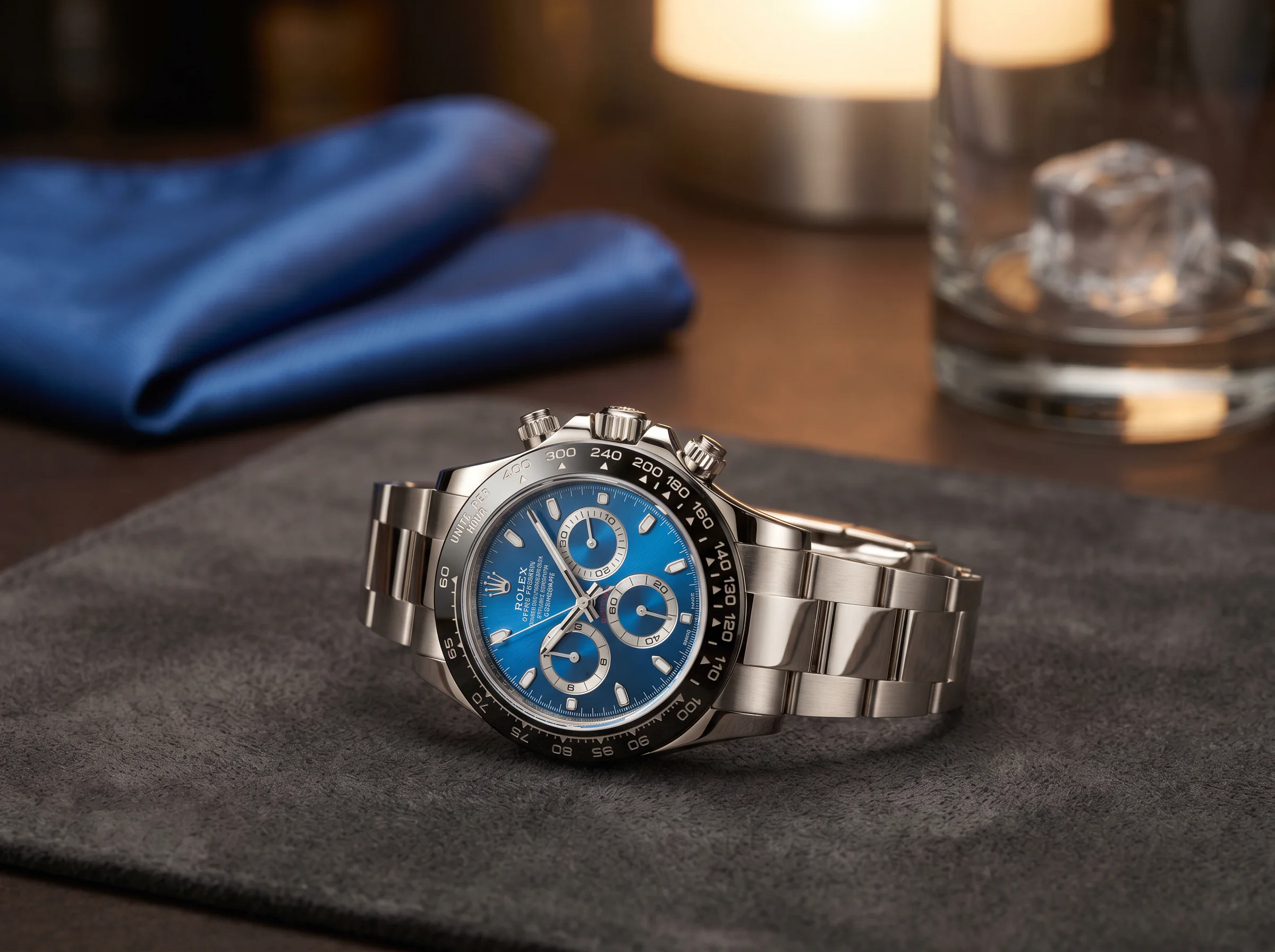 The white gold Daytona 126509 carries a current retail above $56,400. The pre-owned market trades it at $48,000-$54,000 depending on year and condition. The arbitrage window is real and largely a tariff-and-MSRP story rather than a watch-market story.
We covered the broader Daytona pricing structure in detail in our Rolex Daytona Buying Guide. The takeaway for gold buyers specifically: the gold sport-Rolex pre-owned market has been the most attractive segment to buy at or below retail for at least six months, and the gold correction is widening that gap rather than closing it.
The Mid-Year Question
Rolex traditionally executes its retail price adjustment on January 1. Mid-year adjustments are uncommon but not unprecedented (the company executed a mid-year tariff-driven move in 2025). The January 2026 memo and the subsequent late-Q1 industry chatter both pointed to a likely mid-year adjustment if gold sustained above $5,000 per ounce through spring.
Gold did not sustain above $5,000.
Spot has now traded below $5,000 since early February (with the brief exception of mid-March rebounds). The May average sits in the $4,500 to $4,700 range. The case for a Rolex mid-year increase based on metal costs has weakened considerably. The case based on tariff or currency pressure remains alive (USD/CHF has not materially recovered), but the metal-cost driver was the loudest piece of the January increase narrative.
The market has begun to price out the mid-year increase probability. That changes the urgency calculation for pre-owned gold buyers:
- If Rolex executes a mid-year increase anyway: the pre-owned discount to retail widens further (good for pre-owned buyers).
- If Rolex defers: pre-owned pricing has time to absorb the gold correction without retail moving up to support it (also good for pre-owned buyers, but with less urgency).
- If gold rallies back above $5,000 and Rolex executes mid-year: the window closes hard and fast.
The asymmetry favors acting now. The downside of waiting is a 60-day window of gold rally followed by a Rolex move that prices back to the January peak assumption. The downside of buying now is missing a further 5 to 8% pre-owned correction. The downside risks are not symmetric. Acting in the current window protects against the worse outcome (a fast retail catch-up if gold rallies).
This is market observation, not investment advice. Watches are watches. The metal weight is real but not the primary driver of long-term watch value. Buy the watch, not the metal.
What This Means by Category
Pre-owned Yellow Gold Daytona (116508, 116509 LN, 126508): The clearest current opportunity. Current pre-owned ranges sit $5,000 to $9,000 below current retail. The yellow gold Daytona has historically been the most liquid gold Rolex sport reference. Inventory turn is fast. The Watches and Wonders 2026 Rolesium 126502 release added another data point that pulled buyer attention from the gold Daytona toward the steel-and-platinum variant; that distraction widens the pre-owned gold opportunity.
Pre-owned Day-Date Presidents (228238 yellow gold, 228206 platinum, 228239 white gold): Trading at the deepest discount to current retail in the lineup. The Day-Date is the heaviest of the gold Rolex references by precious metal weight (~165 grams) and consequently the most exposed to gold spot. The new Jubilee Gold alloy referenced in our Jubilee Gold Day-Date strategic read creates additional dispersion in the Day-Date pricing structure that favors patient pre-owned buyers.
Two-tone Rolesor: Sub-Bluesy, GMT Root Beer, Datejust two-tones. These absorbed 4 to 6% MSRP increases in January, less than full gold but more than steel. Pre-owned two-tone Rolesor has been a stable value play for years; the gold correction modestly improves the math without dramatically changing the secondary market dynamics.
Platinum (Daytona 116506, Day-Date 228206): Platinum spot prices moved similarly to gold in 2025 to 2026, though with a steeper January correction. Pre-owned platinum Rolex carries one of the largest absolute MSRP-to-pre-owned gaps in the entire catalog, often $15,000 to $25,000 below retail on the Day-Date.
Non-Rolex gold (Patek Calatrava, AP gold Royal Oak, Cartier Tank gold, VC Patrimony): Each brand executes pricing differently. Patek Philippe gold dress watches generally trade closer to retail on the secondary market. AP gold Royal Oak references absorbed major MSRP increases in late 2025 and Q1 2026 and have started showing pre-owned softening. The broader observation applies: the gold spot correction is feeding into the pre-owned market for any reference where metal weight is a meaningful share of MSRP.
The Working Dealer's Read
The story most market coverage missed in late 2025 was how aggressively new-watch retail had priced gold's continued ascent. The January 2026 Rolex memo, the AP gold Royal Oak repricing, and the wider Swiss industry's gold-tier MSRP increases all assumed gold would sustain at or above the late-2025 trajectory. Spot disagreed.
The disconnect between current retail (priced for $5,000+ gold) and current spot (trading near $4,500) is now wide enough that pre-owned gold watches are running the largest sustained discounts to retail since the 2021-2022 market peak unwound. For Rolex specifically, gold Daytonas and Day-Date Presidents are trading 10 to 21% below current retail across most configurations.
Rolex has the option to defer the telegraphed mid-year increase if gold trades sideways below $5,000 through June. The market has begun to price out that increase. Pre-owned buyers benefit either way, but the asymmetric scenario (gold rallies, mid-year increase executes) creates the only reason to act with urgency.
We covered the broader post-Watches and Wonders market shift in 30 Days After Watches and Wonders 2026: What the Rolex Pre-Owned Market Actually Did. The gold correction overlays that picture: the Pepsi surge, the Cookie Monster surprise, and the gold-metal repricing are all working through the secondary market simultaneously. Buyers reading any single signal in isolation are missing the composite picture.
The composite is this. The window for buying pre-owned gold luxury watches at meaningful discounts to current retail is open. The gold correction has not yet fully passed through. The mid-year Rolex increase is increasingly unlikely. The 15% U.S. tariff is permanent. The structural case for gold-as-asset remains intact even after the 18% correction from January.
This is not financial or investment advice. Watch buyers should buy watches they want to wear. But for buyers who have been waiting for a friendlier gold-watch buying environment, May to July 2026 is shaping up as the friendliest 90 days in over a year.
Browse authenticated pre-owned gold Rolex inventory at 5dwatches.com/shop/rolex.